

Best Quiet Tower Fans for Bedroom Use in 2026
A bedroom fan needs to do more than move air. If the motor is distracting, the airflow feels harsh, the display stays bright, or speed changes wake you up, even a powerful tower fan can become uncomfortable at night. The best quiet tower fan for bedroom use should balance low noise with useful airflow, smooth oscillation, convenient controls, and a footprint that works beside a bed.
This guide focuses on those bedroom-first criteria rather than treating maximum airflow or an advertised decibel number as the only measure of performance. Because the supplied product data covers one specific tower fan rather than a complete independently tested five-model lineup, the comparison below distinguishes verified product specifications from general buying criteria instead of inventing test results for competing models.
Best Quiet Tower Fans for Bedrooms: Quick Comparison
| Option | Noise / Comfort | Airflow | Oscillation | Heating | Timer | Best For |
| 42-Inch Bladeless Tower Fan | 36–45 dB claimed operating range | Multiple speeds + natural wind mode | Left and right | Yes | 2–8 hours | Year-round bedroom comfort |
| Traditional tower fan | Varies by model | Typically cooling-focused | Varies by model | Usually no | Varies | Cooling-focused use |
| Pedestal fan | Varies by model and speed | Often strong airflow | Varies | No | Varies | Higher-volume airflow |
| Separate fan + heater | Depends on both appliances | Depends on fan | Depends on fan | Yes | Depends on appliances | Homes wanting separate devices |
Our Top Pick by Bedroom Use Case
Best for year-round bedroom comfort: the 42-inch bladeless tower fan is designed to combine cooling, heating, air circulation, and purification in one tower. Its supplied specifications list a 36–45 dB noise range, remote control, left-and-right oscillation, multiple fan speeds, natural wind mode, and a 2–8 hour timer.
Best for light sleepers: prioritize the lowest usable speed and actual nighttime sound rather than maximum airflow. A manufacturer's dB rating is useful context, but it should not automatically be treated as an independent bedroom noise measurement.
Best for hot sleepers: choose a fan that can maintain meaningful airflow without requiring maximum speed all night.
Best for smaller bedrooms: look for a narrow vertical design, broad oscillation, and airflow appropriate to the room rather than simply buying the most powerful fan available.
Best for larger bedrooms: prioritize airflow distribution and oscillation coverage so air reaches more of the room without requiring unnecessarily high fan speeds.
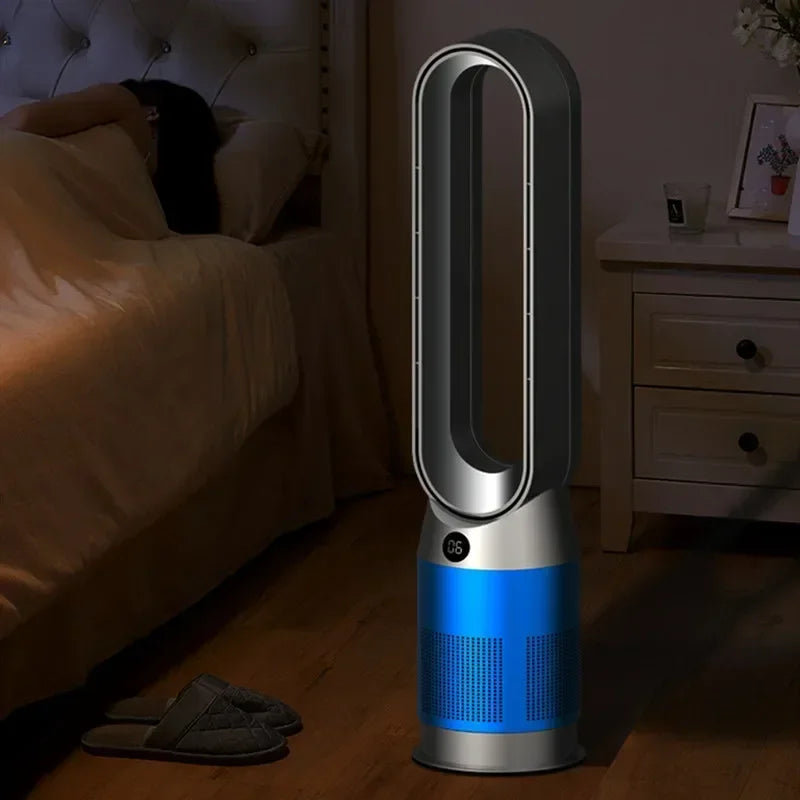
How We Evaluate Quiet Tower Fans for Bedroom Use
A meaningful bedroom comparison should separate measurable specifications from subjective comfort. The supplied product information verifies several useful characteristics for the 42-inch model, but it does not provide independent laboratory testing against competing fans. Therefore, claims about other models should be verified before treating them as direct performance comparisons.
Noise and Decibel Testing
Noise should ideally be measured at a consistent distance, in the same room, with the same fan speed and similar background conditions. A manufacturer may measure noise at a particular speed or distance that differs from another brand's method. That makes two published dB numbers less directly comparable than they appear.
The supplied specifications for the featured bladeless tower fan state a 36–45 dB noise range. This is useful as a manufacturer-provided reference point, but it should not be presented as an independently measured result. Bedroom acoustics, wall reflections, furniture placement, and individual sensitivity can all affect how noticeable a fan sounds.
Airflow and Fan-Speed Testing
A quiet bedroom fan does not need to produce maximum airflow at all times. For sleeping, the more useful question is whether the lowest comfortable setting provides enough circulation without creating an irritating rush of air.
The featured model has multiple speed settings and a natural wind mode. Its left-and-right oscillation is also designed to distribute airflow rather than continuously directing it at one sleeping position.
Bedroom Usability Checks
Nighttime usability includes more than motor noise. A useful bedroom tower fan should be easy to control from bed, should offer a practical timer, should distribute air effectively, and should fit without creating unnecessary floor clutter.
The featured model includes remote control operation, left-and-right oscillation, adjustable fan speeds, and a 2–8 hour timer. Its 42-inch vertical format is intended to provide airflow while occupying a relatively compact footprint compared with using separate cooling and heating appliances.
What Is a Quiet Enough Noise Level for Sleeping?
There is no single decibel level that guarantees comfortable sleep for every person. A bedroom's background noise, room acoustics, sleep sensitivity, and whether someone prefers white noise all influence the result.
How Many Decibels Is Quiet Enough for a Bedroom?
Lower fan noise is generally preferable for light sleepers, but the number alone does not tell the complete story. A steady, unobtrusive sound may be easier for some people to sleep through than an intermittent clicking, rattling, or changing motor tone.
The featured bladeless tower fan lists 36–45 dB of noise. Treat this as a product specification rather than an independently verified nighttime measurement.
Why a Manufacturer's dB Rating May Not Tell the Whole Story
Decibel readings depend on measurement conditions. Distance from the fan, fan speed, room environment, microphone position, and testing method can all change the result. This is why a bedroom-focused evaluation should also consider what the fan sounds like at its lowest useful setting and whether oscillation introduces additional mechanical noise.
Quiet Operation vs. White Noise
Some sleepers actively prefer a consistent low-level fan sound because it can mask intermittent household or outdoor noises. Others want the least audible airflow possible. The right choice therefore depends on whether you are looking for near-silent operation or predictable background sound.
What Makes a Tower Fan Good for Sleeping?
Low-Speed Airflow Without Excessive Motor Noise
For overnight use, maximum cooling performance is not always the priority. A fan should provide a comfortable low-speed setting that keeps air moving without forcing you to tolerate unnecessary motor or airflow noise.
Sleep Mode and Gradual Speed Changes
A genuine sleep-oriented experience should minimize interruptions during the night. Look for predictable speed behavior, convenient controls, and a timer that can shut the fan off without requiring you to get out of bed.
Do not assume that every product's “sleep mode” works the same way. Some simply reduce fan speed, while others may alter speed or display behavior. Verify the actual implementation before buying.
Oscillation Coverage for Even Bedroom Airflow
Oscillation can improve comfort by distributing airflow around the room instead of continuously blowing toward one person. The featured tower fan provides left-and-right oscillation, which can be useful when the fan is positioned near a bed or against a wall.
Timer, Remote Control, and Display Brightness
Bedroom controls should be convenient after the lights are off. A remote lets you change settings from bed, while a timer can limit operation after you fall asleep. Display brightness is another consideration that should not be overlooked when shopping specifically for nighttime use.
The featured model includes remote operation and a 2–8 hour timer. The supplied product information does not specify display brightness or a dedicated display-dimming function, so those features should not be assumed.
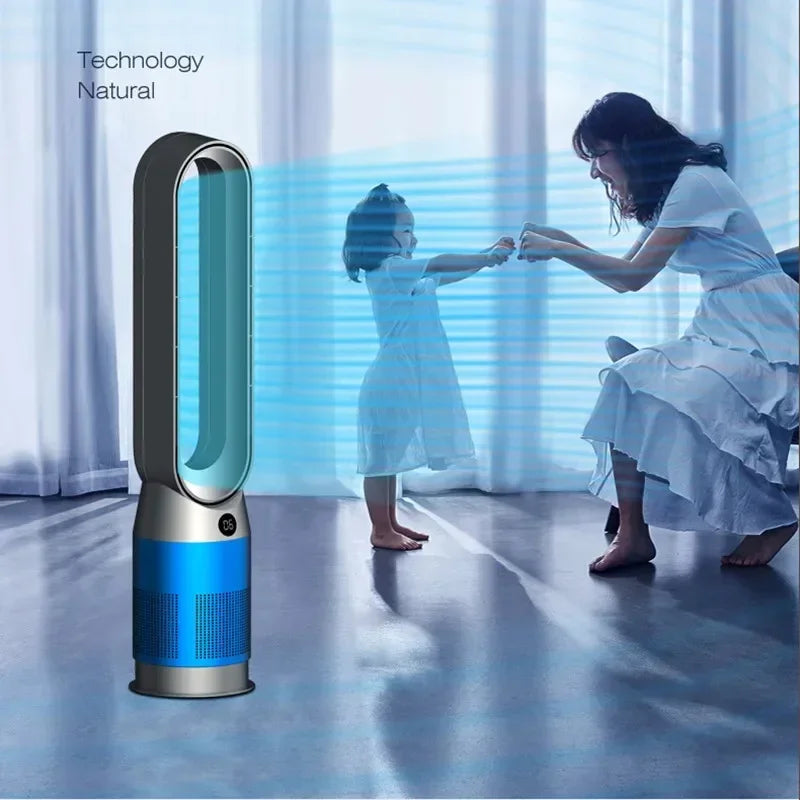
Quiet Tower Fan Review: 42-Inch Bladeless Tower Fan
Best for Year-Round Bedroom Comfort
The 42-inch bladeless tower fan is positioned as an all-season home comfort appliance rather than a cooling-only fan. It combines cool-air and warm-air modes with air circulation and purification functionality, making it relevant for bedrooms that feel hot in summer and cold during cooler periods.
The supplied specifications list a 36–45 dB noise range, multiple fan speeds, natural wind mode, left-and-right oscillation, remote control, and a 2–8 hour timer. The application range is listed as 15–25 m², which makes room size an important consideration when deciding whether its airflow is appropriate for your bedroom.
Pros:
- Combines cooling and heating in one tower.
- 36–45 dB manufacturer-provided noise range.
- Bladeless enclosed design without exposed rotating blades.
- Left-and-right oscillation for broader airflow distribution.
- Remote control for convenient nighttime adjustments.
- 2–8 hour timer.
- Natural wind mode and purification functionality.
- Designed for rooms measuring approximately 15–25 m².
Cons:
- 110V availability may vary, according to the supplied product information.
- The supplied data does not provide independent noise-testing results.
- Display brightness is not specified.
- Actual bedroom comfort depends on room acoustics, placement, and personal noise sensitivity.
- At 40W and 220V/50Hz, buyers should verify electrical compatibility before ordering.
See the 42-inch bladeless tower fan if you want one appliance for cooling, heating, circulation, and everyday bedroom comfort.
Quiet Tower Fan Buying Guide: Which One Is Right for You?
Best Choice for Light Sleepers
Focus first on the lowest comfortable fan speed, consistent motor behavior, and the absence of rattling or mechanical clicking. A published dB rating is helpful, but it should be evaluated alongside actual nighttime usability.
Best Choice for Hot Sleepers
Hot sleepers need enough airflow to remain comfortable without automatically running a fan at its loudest setting. Look for adjustable speeds, effective oscillation, and a low setting that still moves useful amounts of air.
Best Choice for Small Bedrooms
A vertical tower design can be attractive when floor space is limited. Consider the fan's physical dimensions, oscillation range, and the manufacturer's intended room area. The featured model is specified for approximately 15–25 m².
Best Choice for Larger Bedrooms
For a larger bedroom, airflow distribution matters as much as the fan's peak output. Oscillation can help spread air through more of the room, potentially reducing the need to point the fan directly at the bed.
Explore lifestyle devices for broader home-comfort needs if you are comparing this type of appliance with other everyday home devices.
Are Oscillating Tower Fans Quiet Enough for Bedrooms?
Yes, an oscillating tower fan can be appropriate for bedroom use, but the mechanism itself should be evaluated for unwanted clicking, rattling, or movement noise. Oscillation can improve airflow distribution while allowing a lower speed to provide useful circulation across the room.
Oscillation Benefits for Bedroom Air Circulation
Instead of directing airflow continuously toward one sleeping position, oscillation moves the airflow across a wider area. This can make nighttime airflow feel less concentrated and can support more even room circulation.
What to Listen for When Testing Oscillation
When evaluating a fan in person, listen during both stationary and oscillating operation. Pay attention to changes in motor tone, clicking at the end of the oscillation range, vibration, or rattling from the housing. These sounds can become more noticeable when the rest of the bedroom is quiet.
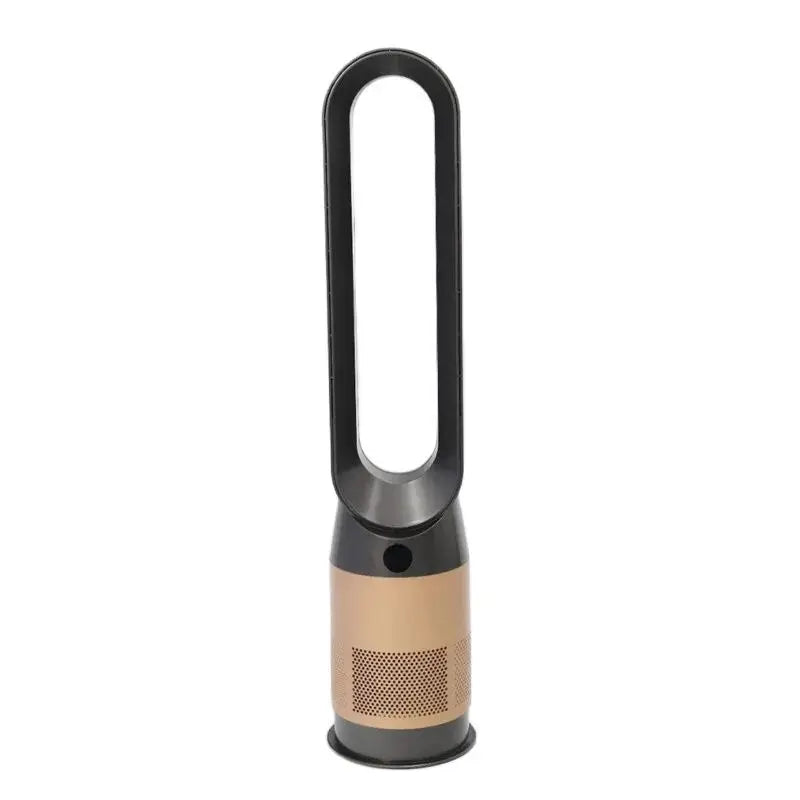
Tower Fan vs. Pedestal Fan for Sleeping: Which Is Quieter?
Noise and Motor Sound
Neither tower fans nor pedestal fans are automatically quieter in every situation. Noise varies according to motor design, fan speed, construction, airflow resistance, and individual model. A fair comparison should use the same measurement conditions rather than assuming that one form factor always produces less noise.
Airflow, Footprint, and Oscillation
Tower fans emphasize a vertical, space-saving form factor and can be useful where floor space is limited. Pedestal fans can offer a different airflow profile and often prioritize strong room circulation. The better bedroom choice depends on placement, room size, airflow preference, and sensitivity to noise.
Which Type Is Better for Your Bedroom?
Choose a tower fan when a vertical footprint, integrated controls, and broad oscillation fit your bedroom better. Consider a pedestal fan when strong directional airflow and a different placement arrangement are more important. In either case, compare the actual low-speed noise and usable airflow rather than relying on product category alone.
How to Make a Tower Fan Quieter at Night
Use the Lowest Comfortable Fan Speed
Running a fan at maximum speed creates more airflow and can also increase audible motor and air movement. Start with the lowest setting that keeps the room comfortable and increase it only when necessary.
Place the Fan on a Stable Surface
Vibration can create unnecessary rattling even when the motor itself is relatively quiet. Make sure the tower is standing securely on a stable, level surface and is not touching furniture or another object.
Keep the Intake and Air Outlet Clear
Do not block the fan's airflow paths with bedding, curtains, furniture, or other objects. Restricted airflow can affect performance and may make operation less comfortable.
Use Sleep Mode and the Timer
If your model provides sleep-oriented controls, use them to reduce unnecessary overnight operation. A timer can also prevent the fan from continuing to run after the period when cooling or circulation is needed.
Quiet Bedroom Tower Fan Buying Checklist
- Check the manufacturer's stated noise range and measurement conditions when available.
- Prioritize low-speed noise rather than maximum-speed noise alone.
- Look for smooth, useful airflow at the lowest comfortable setting.
- Check whether oscillation distributes air without clicking or rattling.
- Confirm that the timer covers your preferred nighttime schedule.
- Choose a remote control if you want to adjust the fan from bed.
- Check display brightness if you are sensitive to light while sleeping.
- Match the fan's intended room size to your bedroom.
- Consider whether heating is useful enough to replace a separate seasonal appliance.
- Verify voltage and frequency compatibility before ordering.
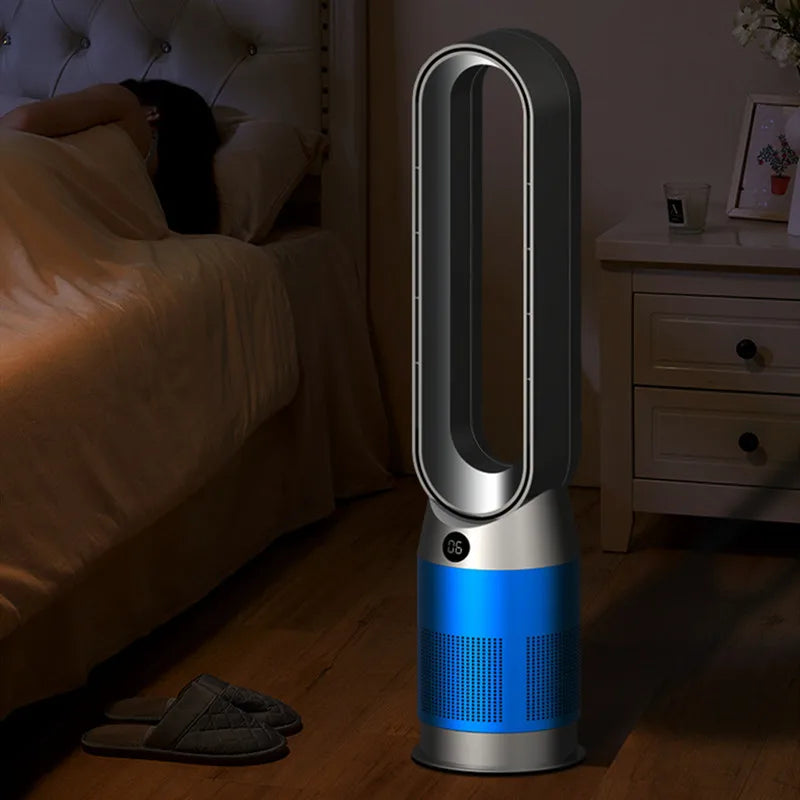
Comparison Matrix: What Matters Most for Bedroom Use?
| Bedroom Requirement | What to Prioritize | Why It Matters |
| Light sleeper | Low-speed noise and stable motor sound | Reduces the chance that fan operation becomes a sleep distraction. |
| Hot sleeper | Useful airflow at moderate speeds | Balances cooling performance with nighttime noise. |
| Small bedroom | Vertical footprint and oscillation | Helps conserve floor space while distributing airflow. |
| Larger bedroom | Airflow reach and oscillation coverage | Supports broader circulation without relying exclusively on maximum speed. |
| Year-round use | Cooling plus heating | Can reduce the need for separate seasonal appliances. |
| Bedside control | Remote and timer | Allows adjustments without getting out of bed. |
Final Verdict: Choosing the Best Quiet Tower Fan for a Bedroom
The best quiet tower fan for bedroom use is not necessarily the model with the lowest advertised dB number. The better choice balances nighttime noise, usable low-speed airflow, smooth oscillation, convenient controls, timer functionality, footprint, and the needs of the specific room.
For shoppers seeking a single appliance that combines cooling and heating with bedroom-friendly controls, the 42-inch bladeless tower fan offers a strong all-season feature set. Its supplied specifications include a 36–45 dB noise range, multiple speeds, natural wind mode, left-and-right oscillation, remote control, purification functionality, and a 2–8 hour timer for rooms of approximately 15–25 m².
However, the available product information does not establish independent comparative testing against five competing models. Buyers who are especially sensitive to nighttime noise should therefore treat the stated dB figure as a manufacturer specification and pay close attention to real-world room acoustics, placement, oscillation sounds, and the lowest usable speed.
Compare the 42-inch bladeless tower fan for bedroom use when you want cooling, heating, airflow circulation, and a space-saving tower design in one appliance.
Browse Body Care and Health Devices for additional home-focused device options.
Pillar Article: Best Bladeless Tower Fan Heaters of 2026: Tested & Compared













