

Best Remote Controlled Tower Fans for 2026: Convenient Picks Compared
A remote controlled tower fan should make everyday comfort easier, not add another layer of frustration. A poorly positioned control panel, limited airflow, excessive nighttime noise, or an inconvenient timer can undermine an otherwise capable fan. The right model should let you adjust airflow from across the room while also matching your room size, noise tolerance, oscillation needs, and seasonal comfort goals.
This guide takes a practical approach to choosing a remote controlled tower fan. Instead of treating the number of speeds or features as the deciding factor, we focus on remote usability, airflow distribution, oscillation, nighttime comfort, timer behavior, room suitability, maintenance, and the trade-offs that matter after purchase.
Best Remote Controlled Tower Fans at a Glance
For shoppers comparing tower fans, the most useful starting point is not simply which model has the most features. It is whether the fan's controls, airflow, noise profile, oscillation, and operating range fit the room where you intend to use it.
| Option | Remote Control | Oscillation | Noise Information | Timer | Room Suitability | Best For |
| KentDO 42-Inch Bladeless Tower Fan | Remote controlled | Left and right | 36–45 dB stated | 2–8 hours | 15–25 m² | Year-round cooling and heating |
| Traditional Tower Fan | Model dependent | Usually available | Model dependent | Model dependent | Small to medium rooms | Simple cooling |
| Pedestal Fan | Model dependent | Often available | Model dependent | Model dependent | Medium to large rooms | Higher-volume air movement |
| Separate Fan + Heater | Depends on appliances | Depends on fan | Depends on appliances | Depends on appliances | Varies | Dedicated seasonal appliances |
Our Top Picks by Use Case
- Best all-season option: KentDO 42-Inch Bladeless Tower Fan, because its stated configuration combines cooling, heating, air circulation, purification functionality, remote control, and oscillation in one tower.
- Best for a bedroom: A tower fan with verified low-speed noise performance, a useful timer, and remote access from the bed. The KentDO model states a 36–45 dB operating range, although actual bedroom suitability depends on speed and individual noise sensitivity.
- Best for a 15–25 m² room: A model explicitly matched to that room range rather than one selected solely by its speed count.
- Best for year-round use: A cooling and heating tower can reduce the need to switch between separate appliances.
- Best for simple remote operation: Look for direct access to speed, oscillation, mode, and timer functions rather than a remote overloaded with rarely used controls.
Explore the KentDO 42-Inch Bladeless Tower Fan if you want a single tower designed for cooling, heating, circulation, and everyday remote-controlled operation.
How We Evaluated Remote Controlled Tower Fans
A useful tower fan comparison needs to distinguish between specifications supplied by a manufacturer and performance that has been independently measured. The product specifications in this guide are based on the supplied product information. Where independent testing is not available, performance is described cautiously rather than presented as a laboratory-tested result.
Remote Control Usability
A remote control is valuable because you can change fan settings without getting up. That becomes particularly useful in a bedroom, living room, or home office where the fan may be positioned several feet away.
When comparing a remote controlled tower fan, consider whether the remote provides straightforward access to the settings you actually use: power, speed, mode, oscillation, and timer. Also consider whether the remote requires line of sight, how easily buttons can be identified, whether the display can be seen from the intended position, and whether the remote has a practical storage location.
The supplied KentDO specifications confirm remote operation, but do not specify the remote's exact operating range, infrared technology, battery type, or storage mechanism. Those details should therefore be verified before purchase if they are important to you.
Airflow and Room Coverage
Room coverage is more meaningful than simply counting fan speeds. A fan can offer numerous speed levels while still being poorly matched to a particular room layout.
The KentDO tower is specified for rooms measuring approximately 15–25 m². Its left-and-right oscillation is intended to distribute airflow across a wider area rather than keeping the airflow fixed in one direction.
Noise and Nighttime Comfort
Noise is especially important when a fan will run while you sleep or work. A manufacturer-reported decibel figure should not automatically be interpreted as a guarantee that every person will find the fan silent.
The supplied KentDO specification lists 36–45 dB. That provides a useful reference point, but the actual perceived sound can vary according to fan speed, room acoustics, placement, airflow turbulence, and the listener's sensitivity to continuous or tonal sounds.
Controls, Timer, and Energy-Conscious Operation
A timer can prevent unnecessary operation after you fall asleep or leave a room. The KentDO model specifies a 2–8 hour timer range, giving it a useful role for nighttime cooling or scheduled comfort.
Its stated electrical rating is 40W at 220V and 50Hz. Actual energy consumption depends on operating mode and runtime, so a rated power figure should not be treated as a prediction of monthly electricity costs.
Maintenance, Portability, and Build Practicality
Tower fans can save floor space compared with wider pedestal-style designs, but their tall form factor also means placement matters. Check the available floor area, clearance around the air intake and outlet, and the fan's overall dimensions before ordering.
The KentDO model is listed as stainless steel and measures approximately 42 inches in height, with the supplied specification describing the size as 1050–1199 mm. Cleaning requirements should always be checked against the manufacturer's instructions, particularly when a fan includes purification functionality.
Best Remote Controlled Tower Fans: Detailed Picks
Best Overall: KentDO 42-Inch Bladeless Tower Fan
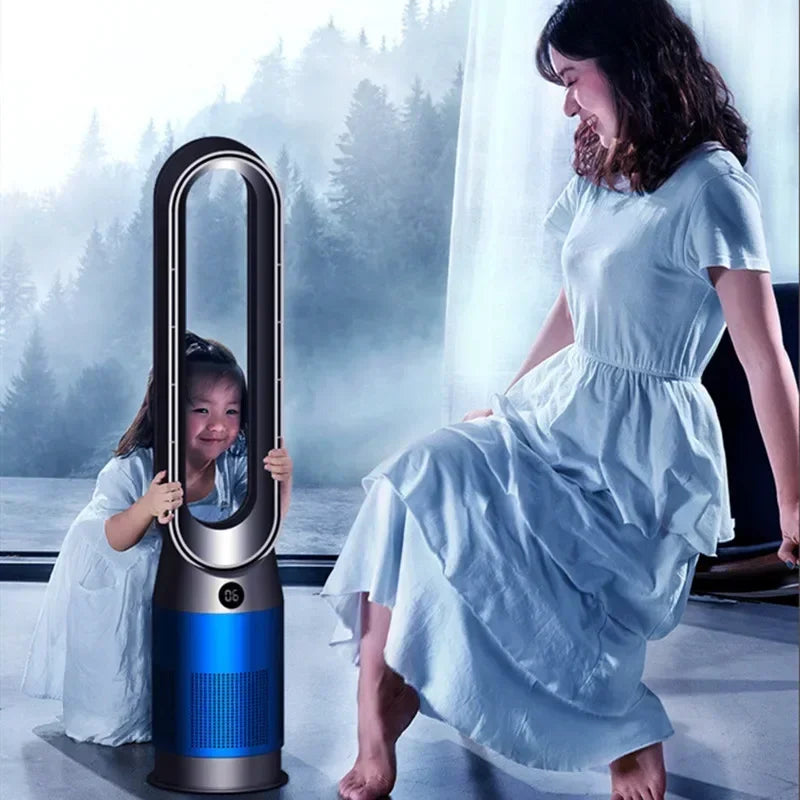
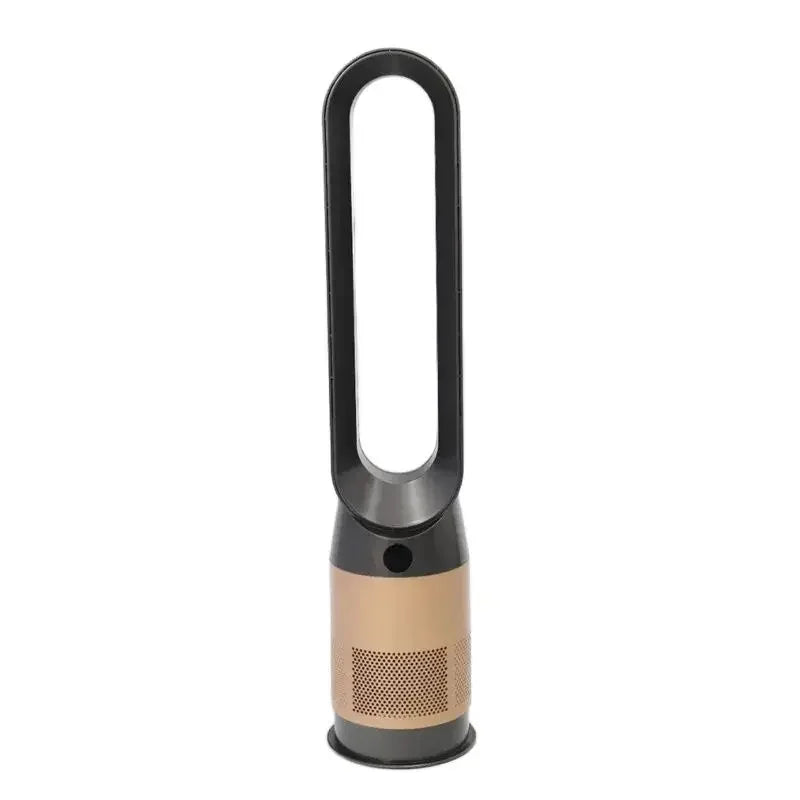
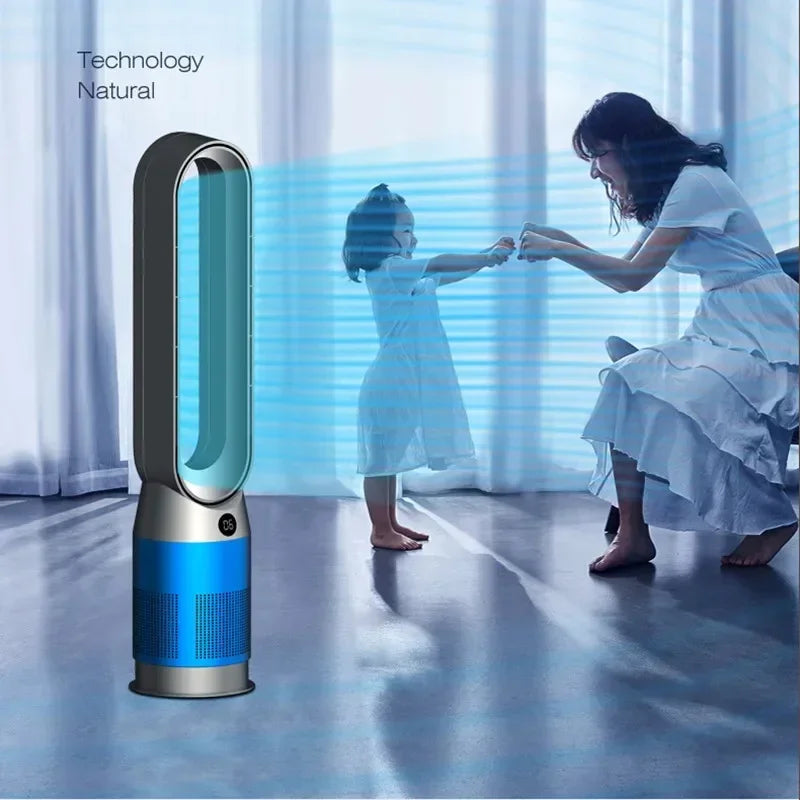
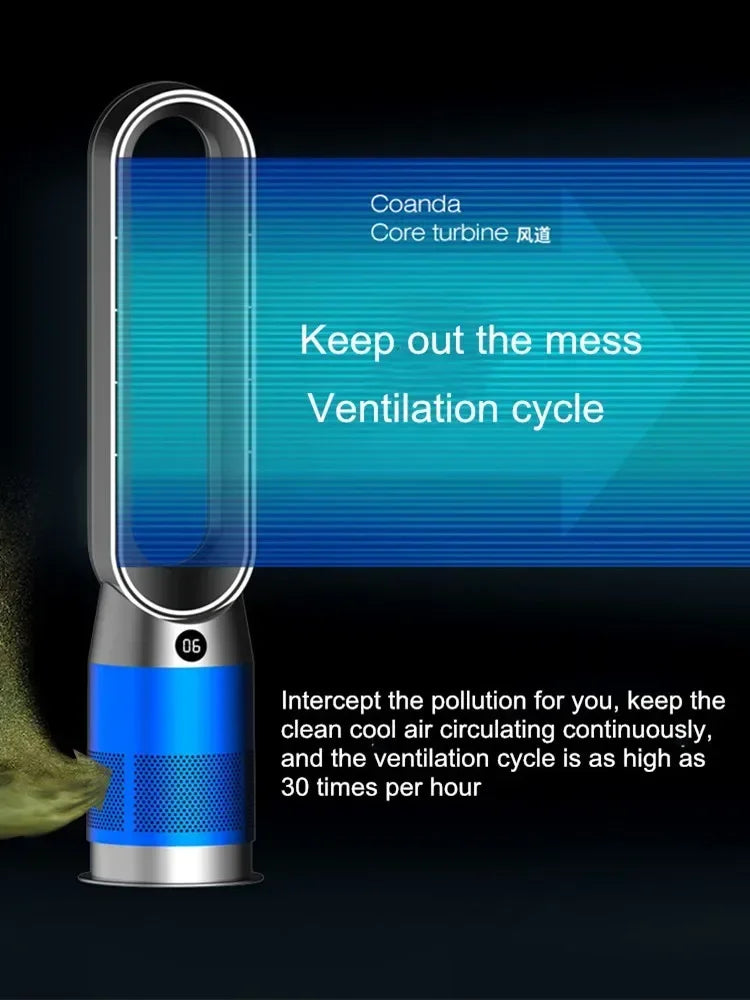
For shoppers who want more than seasonal cooling, the KentDO 42-inch bladeless tower fan stands out because its product configuration combines several functions in one appliance. It provides cool-air and hot-air modes, remote operation, left-and-right oscillation, multiple fan speeds, natural wind mode, and purification functionality.
The all-in-one design is particularly relevant when a room becomes stuffy during summer but uncomfortable during colder periods. Instead of keeping a cooling fan and separate heating appliance available throughout the year, one tower can serve different comfort needs.
Its stated 15–25 m² application range also gives shoppers a more concrete starting point for room matching than a generic claim of being suitable for "large rooms."
- Pros: Cooling and heating in one appliance; remote control; left-and-right oscillation; 2–8 hour timer; stated 36–45 dB noise range; enclosed bladeless design; natural wind mode; purification functionality.
- Cons: 220V/50Hz specification may not suit every electrical system; exact remote range is not specified; no independent noise testing is provided in the supplied information; a 42-inch tower may be larger than necessary for very small spaces.
See the full KentDO 42-inch tower fan specifications before purchasing, especially if you need a particular voltage configuration.
Best for Bedrooms
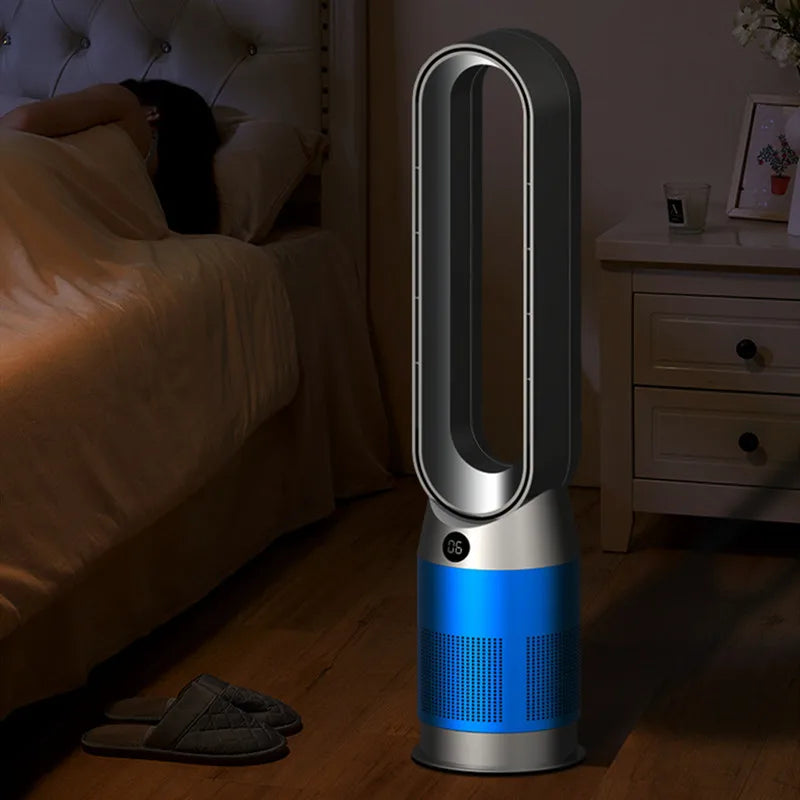
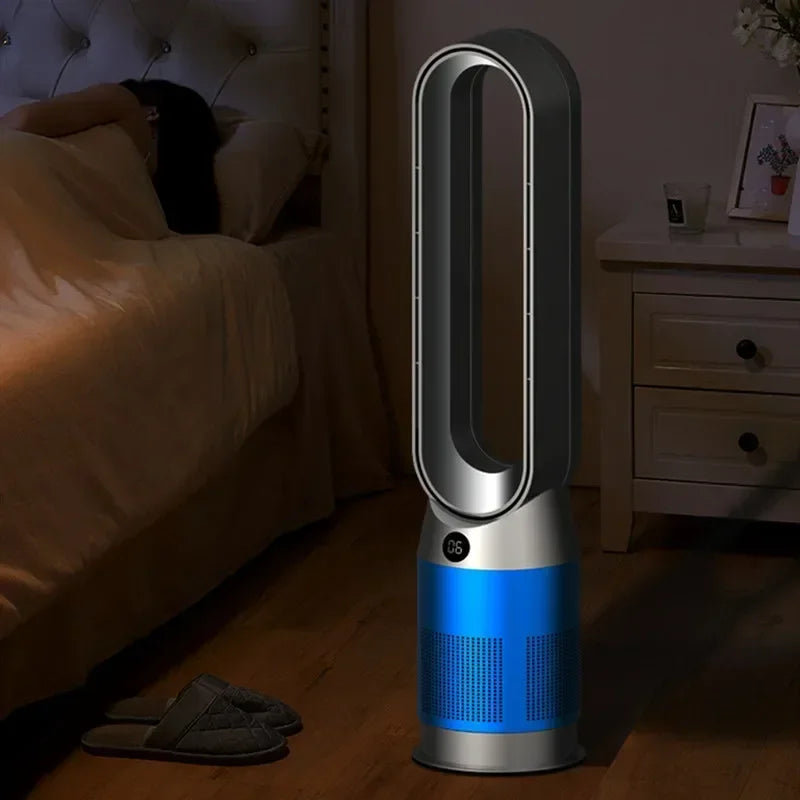
The best tower fan for a bedroom is not necessarily the strongest fan. Low-speed comfort, timer functionality, remote accessibility, oscillation, and nighttime display behavior can matter more than maximum airflow.
The KentDO model's stated 36–45 dB range makes it relevant for buyers specifically investigating quieter tower fan options. However, because the supplied information does not provide independent acoustic testing or separate decibel figures for every speed, it is more accurate to describe it as a fan with a stated low-noise range rather than promise that it will be silent.
The remote can also be useful when the fan is positioned across the bedroom. The 2–8 hour timer provides a way to limit overnight operation without requiring you to get out of bed.
Best for Medium Living Rooms
Living rooms often benefit from oscillation because airflow needs to reach more than one seating position. A fixed fan can feel strong when aimed directly at one person but less useful elsewhere in the room.
The KentDO tower uses left-and-right oscillation and is specified for approximately 15–25 m². That makes it worth considering for medium-sized spaces within that range. For rooms significantly larger than the stated application area, however, shoppers should not assume that a taller tower automatically provides sufficient whole-room cooling.
Best for Home Offices
In a home office, the objective is often controlled personal comfort rather than maximum airflow. Excessively strong airflow can become distracting, while a fan that is too loud can interfere with calls or concentration.
A remote controlled tower fan can be convenient when you need to adjust airflow without reaching under a desk or walking across the room. Multiple speeds, natural wind mode, oscillation, and timer functionality can also make it easier to tailor operation throughout the workday.
Best for All-Season Comfort
A cooling-only fan makes sense if your primary concern is summer heat. But if one room alternates between feeling too hot and too cold throughout the year, a cooling and heating tower can reduce appliance clutter.
The KentDO model is explicitly designed for both cooling and heating. That makes its strongest differentiator less about being another tower fan and more about combining multiple home-comfort functions in a single vertical appliance.
Remote Control Features That Actually Matter
Remote Range and Responsiveness
The most useful remote is one that works reliably from the location where you normally sit or sleep. Range specifications are helpful, but walls, furniture, positioning, and control technology can affect real-world performance.
Before buying, check whether the manufacturer specifies a remote range and whether the remote requires direct line of sight. If the specification is unavailable, avoid assuming that every remote controlled tower fan will work equally well from across a large room.
Infrared vs. Other Remote or Wireless Controls
Many traditional appliance remotes use infrared communication, which generally requires a suitable path between the remote and the receiver. Other control systems may use different wireless technologies. The important question for most shoppers is not which technology sounds more advanced, but whether the control system reliably performs the functions you need.
Remote Storage and Battery Convenience
A small remote is easy to misplace. A practical design should make it easy to keep the controller close to the appliance. If remote storage is not built into the product, establish a consistent place for it.
Display Visibility and Nighttime Controls
A display should be readable when you need it without becoming an unwanted light source in a dark bedroom. If sleep mode, display dimming, or display shutoff is important to you, verify that the specific model provides it. The supplied KentDO information does not confirm a dedicated display-dimming function, so it should not be assumed.
How Much Airflow and Oscillation Do You Need?
Choosing a Fan for Small Rooms
Small bedrooms and offices usually do not require the same airflow capacity as large open living areas. A compact footprint, controlled low-speed operation, and suitable oscillation may be more valuable than maximum fan output.
Choosing a Fan for Medium and Larger Rooms
As room size increases, airflow distribution becomes increasingly important. A fan positioned in one corner may need a broad sweep to move air toward multiple occupants or across a wider section of the room.
For the KentDO tower, the stated 15–25 m² application range should be treated as the primary room-sizing reference. If your space is considerably larger, consider whether multiple airflow sources or a dedicated HVAC system would be more appropriate.
Oscillation Angle and Airflow Distribution
Oscillation changes the experience of a tower fan because it distributes airflow rather than concentrating it in one fixed direction. Left-and-right oscillation can be particularly useful in living rooms, bedrooms, and shared spaces where occupants are not sitting directly in front of the fan.
Why More Speed Settings Do Not Always Mean Better Cooling
Speed count is easy to advertise but harder to translate into comfort. What matters is whether the available levels give you useful control over airflow intensity and noise.
For a bedroom, several genuinely usable low-to-medium settings can be more valuable than a large number of incremental speeds that are rarely used. For a living room, stronger airflow and wider distribution may take priority.
Are Remote Controlled Tower Fans Quiet Enough for Bedrooms?
What to Look for at Low Speed
Bedroom noise involves more than a single decibel number. Airflow sound, motor characteristics, vibration, floor contact, and room acoustics can all influence how noticeable a fan feels at night.
When comparing a quiet bladeless tower fan, prioritize verified low-speed information where available. Also consider whether the fan can deliver enough airflow at a lower setting to keep you comfortable without requiring its highest speed.
Sleep Mode, Display Dimming, and Timer Behavior
Nighttime convenience is where remote control can provide a particularly meaningful benefit. You can reduce the speed, change the mode, activate the timer, or stop the fan without leaving bed.
However, not every tower fan has a dedicated sleep mode or dimmable display. Treat those features as model-specific requirements rather than universal tower-fan characteristics.
How to Interpret Decibel Claims
Decibel measurements should be compared cautiously because measurement distance, room conditions, fan speed, and test methodology can change the reported result. A manufacturer's stated figure is useful for initial comparison but is not necessarily equivalent to an independently measured laboratory result.
The supplied KentDO figure of 36–45 dB is therefore best treated as a manufacturer-provided specification.
Timer, Energy Use, and Everyday Operating Costs
Timer Increments to Look For
Timers are useful when you want cooling or heating for a defined period rather than continuous operation. A shorter timer can work well for falling asleep, while longer settings may suit an evening in the living room.
The KentDO tower specifies a 2–8 hour timer range, which provides flexibility for both short and extended sessions.
Energy-Conscious Fan Operation
The simplest way to reduce unnecessary energy use is to match fan operation to actual comfort needs. Use the lowest effective speed, make use of the timer, and avoid running a fan in an empty room unless there is a specific reason to do so.
The KentDO tower is rated at 40W. Electricity consumption depends on how long the appliance operates and which mode it uses, so a 40W rating should not be interpreted as a fixed hourly or monthly energy cost.
Automatic Shutoff and Memory Behavior
Before relying on a timer every night, verify how the specific fan behaves after timed operation or a power interruption. These behaviors can differ substantially between models and are not specified in the supplied KentDO product information.
Which Remote Controlled Tower Fan Is Best for Your Room?
Best Choice for a Bedroom
Prioritize low-speed noise, timer functionality, remote accessibility, and controllable airflow. The KentDO tower is a relevant option for bedrooms within its stated 15–25 m² application range, particularly if you also want heating during colder periods.
Best Choice for a Living Room
Look for stronger airflow, meaningful oscillation, and controls that can be operated from a sofa. The KentDO tower's left-and-right oscillation and remote operation fit this use case, provided the room falls within the stated application range.
Best Choice for a Home Office
For office use, choose a fan that can maintain comfortable airflow without becoming a distraction. Remote control, natural wind mode, multiple speeds, and a timer can all be useful during long work sessions.
Best Choice for Small Spaces
A vertical tower design can be useful where floor space is limited. However, do not select a 42-inch model simply because the room is small. Compare the fan's physical footprint with the available space and confirm that its stated application range fits your room.
Remote Controlled Tower Fan Features: What to Prioritize
Must-Have Features
- Responsive remote control
- Useful low-to-high speed adjustment
- Oscillation appropriate for the room layout
- Timer functionality
- Easy-to-use onboard controls
- Room-size suitability
- Clearly stated electrical specifications
Nice-to-Have Features
- Natural wind mode
- Sleep-focused controls
- Display dimming
- Remote storage
- Air purification functionality
- Combined heating and cooling
Features That May Not Matter for Every Buyer
Do not pay extra simply for a long list of modes. If you primarily need a bedroom fan for several hours at night, remote access, low-speed comfort, oscillation, and a useful timer may matter far more than advanced connectivity or numerous specialized modes.
Likewise, purification functionality should not automatically be treated as a replacement for a dedicated air purifier. If air-quality improvement is your primary goal, investigate the filtration technology, filter specifications, replacement requirements, and independently verified performance of the particular appliance.
Pros and Cons of Remote Controlled Tower Fans
Advantages
- Convenient control: Adjust settings without walking to the appliance.
- Space-conscious design: Tall tower construction can use less floor width than some conventional fan designs.
- Oscillating airflow: Helps distribute air across a wider area.
- Timer convenience: Useful for sleep, work, and scheduled operation.
- Bedroom-friendly potential: Lower-speed operation and remote access can make nighttime use more convenient.
- All-season functionality: Cooling and heating models can reduce dependence on separate appliances.
Limitations
- Remote dependence: A misplaced or depleted remote battery can reduce convenience.
- Line-of-sight limitations: Some remote technologies may require suitable positioning.
- Model-specific noise: "Quiet" is not a universal characteristic across all speeds or brands.
- Room-size limits: A tower fan should not be assumed to replace whole-home HVAC or adequately cool spaces beyond its stated application.
- Maintenance: Dust accumulation and filter requirements vary by design.
- Electrical compatibility: The KentDO product is specified at 220V and 50Hz, so buyers requiring 110V should confirm availability before ordering.
How to Clean and Maintain a Remote Controlled Tower Fan
Cleaning the Exterior and Air Intake
Dust can accumulate around air intakes and external surfaces over time. Follow the manufacturer's cleaning instructions, disconnect the appliance from power before cleaning, and avoid introducing moisture into electrical components.
Grille and Filter Maintenance
Purification and filtration systems vary considerably. Do not assume that every tower fan contains a replaceable filter simply because it includes purification functionality. Check the exact filter type, cleaning method, replacement interval, and availability of replacement parts before purchase.
Keeping the Remote Control Working Reliably
Store the remote somewhere consistent, protect it from moisture, and replace batteries when responsiveness begins to decline. If the system uses infrared communication, keep the receiver area unobstructed when operating the fan.
Remote Controlled Tower Fan Buying Checklist
Before You Buy, Check These 10 Things
- Room size: Does the manufacturer's stated coverage match your room?
- Airflow: Does the fan provide the type of airflow you actually need?
- Oscillation: Is the sweep suitable for the room layout?
- Remote range: Can you operate it from your normal seating or sleeping position?
- Remote responsiveness: Are the controls straightforward and easy to use?
- Low-speed noise: Is there credible information about nighttime operation?
- Timer: Does the available timer range match your routine?
- Display behavior: Can you confirm whether the display is suitable for nighttime use?
- Dimensions: Will the tower fit comfortably in the intended location?
- Cleaning and warranty: Are maintenance requirements, replacement parts, and warranty terms clear?
If your priorities include cooling and heating in the same appliance, the KentDO 42-inch bladeless tower fan is worth evaluating against this checklist. Its stated specifications include 15–25 m² room application, remote control, left-and-right oscillation, a 2–8 hour timer, 40W power, and 36–45 dB reported noise.
Frequently Asked Questions About Remote Controlled Tower Fans
What is the benefit of a remote controlled tower fan?
The primary benefit is convenience. You can adjust speed, mode, oscillation, or timer settings without physically walking to the fan. This is particularly useful when the appliance is across a bedroom, living room, or office.
How far away can a tower fan remote work?
Practical range varies by model, remote technology, positioning, and obstructions. If exact range matters, check the manufacturer's specification rather than assuming all tower fan remotes have the same operating distance.
Are tower fans with remote controls good for bedrooms?
They can be. Look for comfortable low-speed airflow, low measured or stated noise, a useful timer, appropriate oscillation, and nighttime-friendly controls. A remote can also let you change settings from bed.
Do tower fans use a lot of electricity?
Consumption depends on rated power, operating mode, speed, and runtime. A fan's wattage alone does not determine its monthly cost. Using appropriate speeds and timers can help avoid unnecessary runtime.
Is oscillation important on a tower fan?
Oscillation is useful when you want airflow distributed across more than one location. It can be especially helpful in shared bedrooms, living rooms, and offices where people are positioned away from the fan's central airflow path.
What should I look for in a tower fan remote?
Prioritize responsive controls, a sensible button layout, adequate operating range, easy access to speed and timer settings, and convenient storage. If you plan to use the fan at night, consider whether the remote is easy to operate without turning on bright lights.
How do you clean a remote controlled tower fan?
Disconnect the fan from power and follow the manufacturer's cleaning instructions. Remove surface dust from accessible areas without allowing moisture to reach electrical components. Filter and grille requirements depend on the model, so verify them before cleaning or replacing anything.
What is better for a bedroom: a tower fan or a traditional fan?
A tower fan may be preferable when you want a slim footprint, vertical airflow distribution, oscillation, and remote operation. A traditional fan may be preferable when you prioritize a different airflow pattern or easier access to exposed fan components. Noise, room layout, and personal airflow preference should ultimately determine the choice.
Final Verdict: Choosing the Best Remote Controlled Tower Fan
The best remote controlled tower fan is not automatically the model with the most speeds or the longest feature list. The better choice is the one that fits your room, produces useful airflow at a comfortable noise level, distributes air effectively, and gives you convenient control over the settings you actually use.
For shoppers who want an all-season appliance rather than a cooling-only fan, the KentDO 42-inch bladeless tower fan offers a particularly broad feature combination: cool-air and warm-air modes, remote control, left-and-right oscillation, multiple speeds, natural wind mode, purification functionality, a 2–8 hour timer, and a stated application range of 15–25 m².
Its stated 36–45 dB noise range also makes it relevant to buyers researching quiet tower fans, although that figure should be treated as manufacturer-provided rather than independent acoustic testing. Likewise, shoppers who need 110V should confirm availability before ordering because the supplied specification lists 220V/50Hz.
If your priority is reducing appliance clutter while maintaining flexible cooling and heating throughout the year, review the KentDO 42-inch bladeless tower fan against the buying checklist above and make the decision based on room size, nighttime comfort, airflow distribution, remote convenience, and the functions you will actually use.
Related Indoor Comfort Resources
For additional home-comfort and device-related content, explore the Lifestyle collection and Body Care and Health Devices collection. These internal resources can help shoppers discover other practical devices designed for everyday comfort and home use.
Pillar Article: Best Bladeless Tower Fan Heaters of 2026: Tested & Compared













