

Best Tower Fan and Air Purifier Combos of 2026
A tower fan and air purifier combo can solve two everyday problems at once: uncomfortable airflow and stale indoor air. But a tall appliance with a “purification” setting is not automatically a high-performance air purifier. The best choices should be evaluated on two separate jobs: how effectively they move air for cooling or heating, and how meaningfully they filter airborne particles.
That distinction matters if your bedroom feels hot at night, your living room feels stuffy, or you want to reduce appliance clutter without giving up useful air cleaning. This guide compares the most important performance criteria—including airflow, filtration, noise, room coverage, controls, heating, maintenance, and energy use—so you can choose a combination unit based on what it actually does rather than how many features appear on the box.
Best Tower Fan and Air Purifier Combos at a Glance
The strongest combination units balance airflow and purification instead of treating one function as an afterthought. For shoppers, the comparison below is the most useful starting point.
Quick Comparison Matrix
- Best overall balance: Look for a true filtration system, documented room coverage, useful fan control, acceptable low-speed noise, and manageable replacement-filter costs.
- Best for bedrooms: Prioritize sleep-mode noise, gentle airflow, timer controls, and a published low-noise rating rather than maximum fan speed alone.
- Best for strong cooling: Prioritize multiple fan speeds, wide oscillation, directional airflow, and enough airflow reach for the room.
- Best for air cleaning: Choose a model that identifies its filter technology and provides CADR, airflow-through-filter, air-change, or similarly meaningful performance information.
- Best for small spaces: A compact combination unit can make sense when floor space is limited and moderate airflow and purification are sufficient.
- Best for year-round comfort: A fan-heater-purifier design can replace multiple appliances when heating is also a requirement.
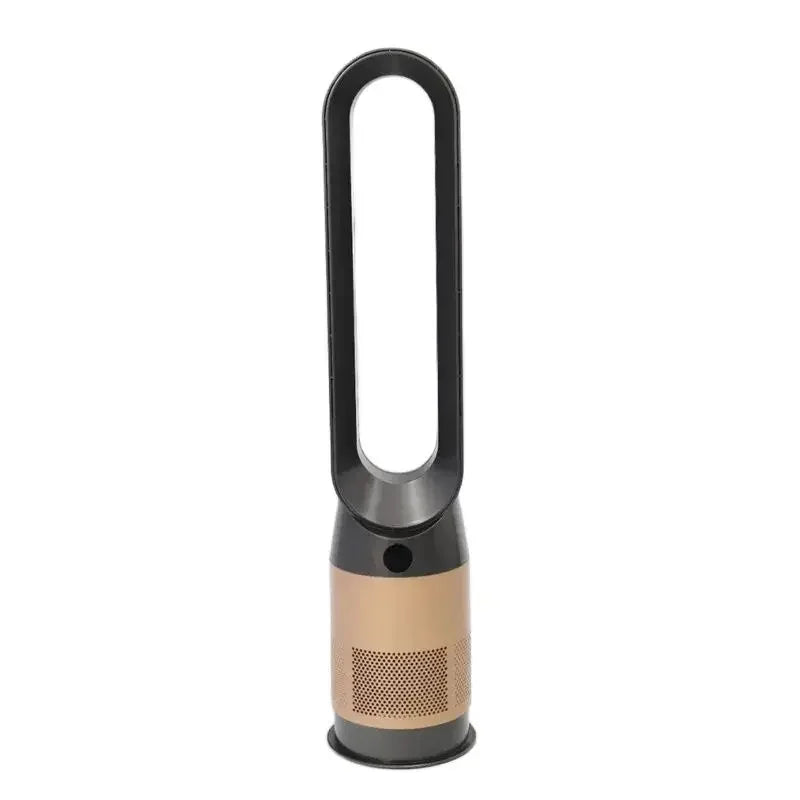
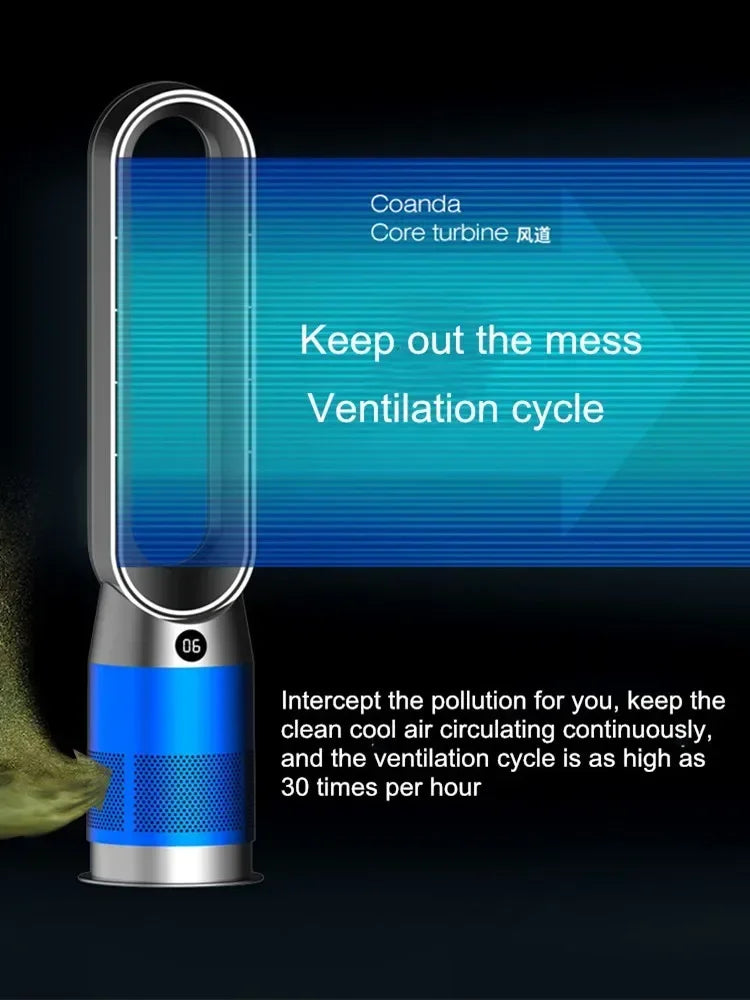
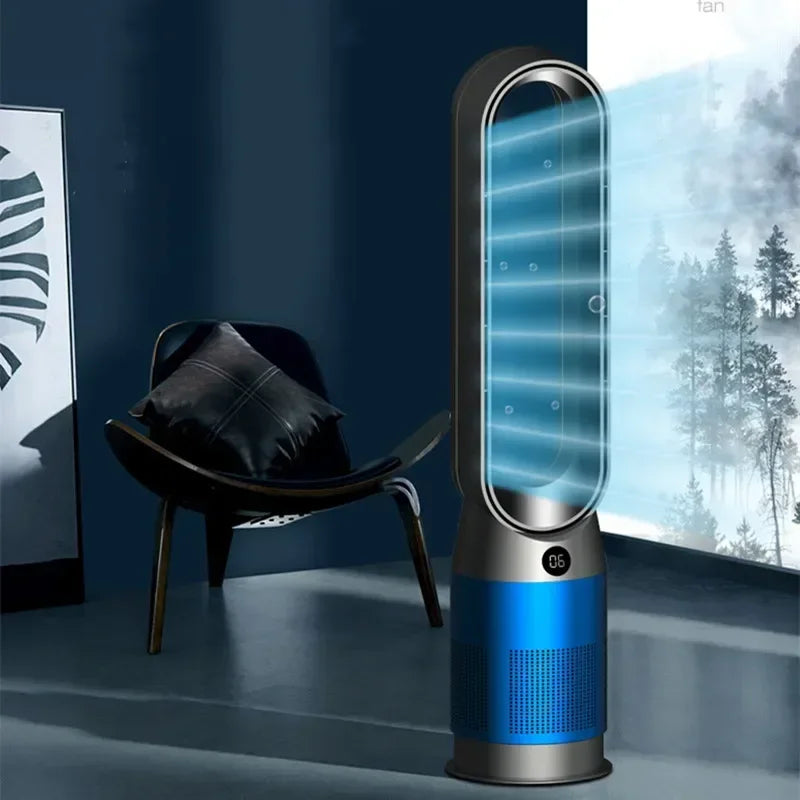
One important distinction: the KentDO Bladeless Tower Fan 42-Inch is designed around year-round room comfort, with cooling, heating, air circulation, natural wind mode, purification functionality, remote control, and left-right oscillation. Its stated application is approximately 15–25 m², making it particularly relevant for bedrooms, offices, and smaller living spaces.
Explore the product details here: https://kentdohealthybeauty.com/products/bladeless-tower-fan-42-inch
Best for All-Season Comfort
A multifunctional tower becomes especially valuable when one room changes from too hot to too cold throughout the year. The KentDO model combines cool-air and warm-air modes with adjustable fan speeds, oscillation, a 2–8 hour timer, and remote operation. Its stated noise range of 36–45 dB is also positioned for quieter everyday operation.
Best for Documented Air-Cleaning Performance
For purification-first shoppers, the deciding factor should be published filtration and performance data. Look for an identified HEPA or equivalent filter, CADR or comparable airflow-through-filter information, room coverage based on a defined methodology, and replacement-filter availability. A product that merely says “purifies air” without explaining its filtration system deserves closer scrutiny.
How We Evaluate Tower Fan and Air Purifier Combos
A combination appliance should not receive a high ranking simply because it has more modes. We evaluate these products using a dual-performance framework: fan performance and purification performance.
Fan Performance
For the fan side, the important questions are straightforward. How many speed settings are available? Does the appliance oscillate? Can airflow be directed effectively? Does it offer a natural-wind mode? Can it move enough air across the room to make cooling practical?
Oscillation matters because a fixed stream of air can leave parts of a room feeling stagnant. Wide left-and-right movement can distribute airflow more evenly, particularly when a tower is positioned near a wall or in a corner.
Purification Performance
Purification requires a different set of measurements. A filter needs to capture pollutants from air that actually passes through it. That means filter construction, airflow through the filter, CADR or an equivalent metric, and stated room coverage are more useful indicators than a generic “air purifier” label.
HEPA filtration is primarily associated with particle removal. Activated carbon serves a different role and can help with certain odors and gaseous pollutants, although effectiveness depends heavily on the amount and design of carbon used. Neither technology should be treated as a universal solution for every indoor pollutant.
Noise, Controls, and Energy Use
Noise should be considered at the settings you will actually use. Maximum-speed noise can be less relevant than low-speed or sleep-mode performance if the appliance will run beside your bed.
Remote controls, timers, displays, sensors, app connectivity, and automatic modes can also make a major difference in daily usability. Energy consumption matters more when a unit operates for many hours every day, especially when heating is involved.
Maintenance and Ownership Cost
The purchase price is only part of the equation. Check how often the filter needs replacement, whether replacement filters are readily available, how much they cost, and whether the intake and exterior require regular cleaning.
Best Tower Fan and Air Purifier Combos of 2026
1. Best Overall for Year-Round Home Comfort: KentDO Bladeless Tower Fan 42-Inch
The KentDO 42-inch bladeless tower fan is best viewed as an all-season comfort appliance rather than a purification-first machine. It combines cooling and heating with air circulation and purification functionality in a space-saving tower format.
For rooms between approximately 15 and 25 m², its combination of adjustable speeds, left-right oscillation, natural wind mode, remote control, and timer functionality gives it a practical everyday feature set. The enclosed bladeless design also avoids exposed rotating blades, while its stated 36–45 dB noise range supports its positioning as a quieter indoor option.
- Pros: Cooling and heating in one appliance; 42-inch space-saving tower; remote control; left-right oscillation; multiple speeds; natural wind mode; 2–8 hour timer; stated 36–45 dB noise range.
- Cons: Detailed filtration specifications such as filter type and CADR are not provided in the supplied product information; 220V/50Hz specification may not suit every US household without confirming voltage compatibility.
Ideal for: Shoppers who want one appliance for cooling, heating, circulation, and fresher-feeling indoor air in a 15–25 m² room.
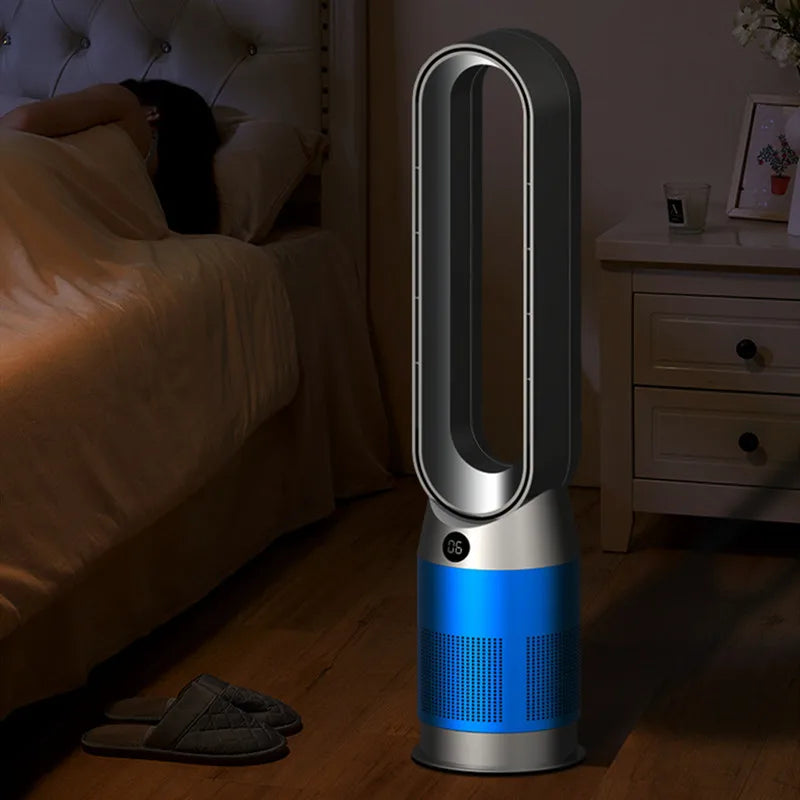
2. Best for Bedrooms and Quiet Operation: A Low-Noise Purification Tower
Bedroom shoppers should judge a combination unit differently from someone cooling a large living room. Low-speed noise, sleep mode, timer functionality, comfortable airflow, and night-time controls become more important than maximum airflow.
A good bedroom model should provide enough circulation to prevent the room from feeling stagnant without producing an intrusive stream of air. If the purifier runs continuously overnight, low-noise filtration is equally important.
- Pros: Comfortable overnight airflow; lower operating noise at practical settings; timer or sleep controls; potentially continuous filtration.
- Cons: Quiet operation may require sacrificing maximum airflow; published maximum airflow does not necessarily describe bedroom performance.
3. Best for Strong Cooling and Air Circulation: High-Airflow Tower Design
If your primary complaint is a hot, stuffy room, airflow should come first. Look for multiple speed levels, broad oscillation, directional control, and an airflow path that reaches the areas where people actually sit or sleep.
Remember that a fan does not lower the room's actual air temperature in the same way an air conditioner does. It improves perceived comfort by moving air across the skin and distributing air within the room. This is why tower fans can be useful for summer comfort even when they are not substitutes for air conditioning.
- Pros: Stronger perceived cooling; better circulation; useful for hot bedrooms and living rooms; broad airflow distribution.
- Cons: Strong airflow can increase noise; maximum fan performance does not prove strong purification.
4. Best for Air Purification Performance: Filter-First Tower Combos
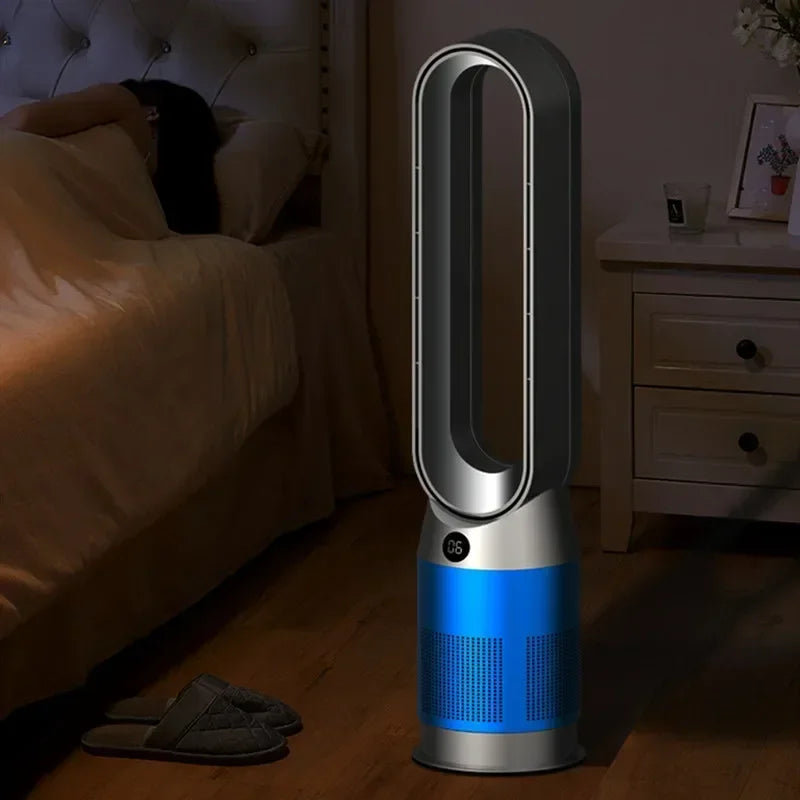
If clean-air performance is your primary goal, choose the product with the clearest evidence rather than the most attractive feature list. The ideal specification sheet identifies the filter, explains the filtration system, and provides measurable performance information.
CADR is particularly useful because it connects particle removal with the amount of cleaned air delivered. Air changes per hour can also help explain how frequently the air in a defined room volume is theoretically processed.
- Pros: Easier to compare purification performance; better transparency; stronger basis for matching a unit to room size.
- Cons: Better filtration can increase filter replacement costs; purifier-focused designs may not deliver the strongest cooling airflow.
5. Best Value Combination Unit: One Appliance Instead of Two
Combination appliances can deliver value without being the absolute best at every individual task. The main benefit is consolidation: one footprint, one control system, and one appliance to manage.
This can be particularly attractive in apartments, bedrooms, home offices, and other rooms where floor space is limited. A single tower can also reduce the visual clutter created by placing a separate fan and purifier next to each other.
- Pros: Saves space; fewer appliances; consolidated controls; potentially lower upfront cost than buying multiple devices.
- Cons: A dedicated purifier may clean air more effectively; a dedicated fan may deliver stronger airflow; both functions compete for the same physical design space.
Tower Fan vs. Air Purifier: What Does the Combination Unit Actually Do?
What a Tower Fan Does
A tower fan moves air. Oscillation spreads that airflow, while speed controls change the intensity. The resulting air movement can make people feel cooler and can help redistribute air within a room.
What an Air Purifier Does
An air purifier pulls room air through a filtration system and returns filtered air to the room. The effectiveness of that process depends on the filter, airflow rate, operating time, room volume, and pollutant concentration.
Why Combination Units Can Be Useful
The advantage is convenience. One appliance can circulate air while its filtration system processes a portion of that air. For people who dislike appliance clutter, this can be a compelling trade-off.
When Two Separate Appliances Are Better
Separate devices are usually more flexible. You can position the fan where airflow is most comfortable and place the purifier where filtration is most useful. You can also select a high-performance purifier without compromising fan design, or a powerful fan without needing to accommodate a filter.
Do Tower Fan Air Purifier Combos Really Clean the Air?
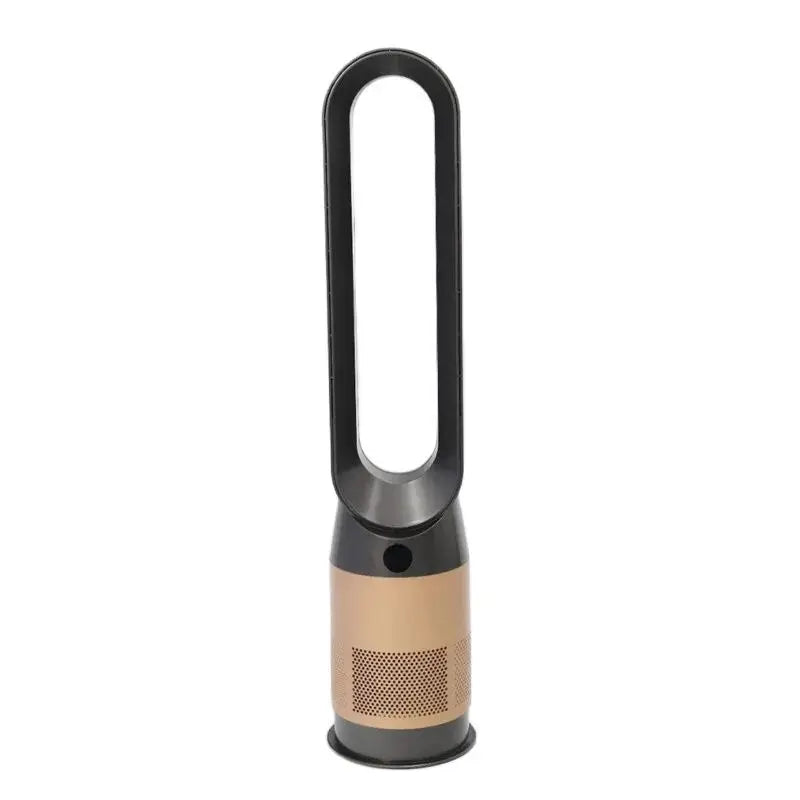
They can, but the answer depends on the filtration system and the amount of air processed through it. A fan's ability to circulate air does not automatically make it an effective purifier.
Look for a Real Filter and Published Performance Data
Before buying, identify the filter type and look for meaningful performance specifications. CADR, air changes per hour, filtration efficiency under defined testing conditions, and room coverage are much more useful than vague statements such as “removes impurities.”
What HEPA Filters Can and Cannot Remove
HEPA filters are designed for particle filtration. They can be relevant to airborne particulate matter, but a HEPA filter should not automatically be described as a solution for gases or every odor source. Those concerns require different filtration mechanisms or source control.
The Role of Activated Carbon
Activated carbon can adsorb certain gases and odor compounds. However, carbon performance depends on the quantity, surface area, airflow, and contaminant involved. A tiny carbon layer should not be treated as equivalent to a purifier designed specifically around substantial gas-phase filtration.
How to Choose the Right Tower Fan and Air Purifier
1. Match Airflow to Your Cooling Needs
For a hot bedroom or stuffy office, prioritize airflow reach, oscillation, fan speeds, and directional control. A tower that barely moves air may technically circulate the room but still leave you uncomfortable.
2. Match Purification to Room Size
Do not select a purifier solely because the manufacturer says it is suitable for a particular room. Compare CADR or equivalent performance and consider the air-change rate you actually need. A unit designed around modest airflow may be less appropriate for a larger space even if its advertised coverage sounds impressive.
3. Check the Filtration System
Identify whether the appliance uses HEPA or another particle filter, whether it includes activated carbon, and whether the filter is replaceable. If the filtration technology is not clearly described, treat the purification claim cautiously.
4. Compare Noise at Practical Settings
For sleeping, working, or studying, low-speed noise is often more important than maximum-speed noise. A fan that sounds quiet only at its weakest setting may not remain comfortable when you need stronger circulation.
5. Calculate Filter and Energy Costs
Estimate how often filters need replacement and how much replacement filters cost. For heating models, also consider electrical consumption because heating can use substantially more energy than fan-only operation.
6. Consider Controls and Extra Features
Remote controls, timers, sleep modes, oscillation, natural wind modes, air-quality sensors, displays, and heating can make a multifunction appliance significantly easier to use. The key is to prioritize features that solve a real problem rather than paying for modes you will never use.
For broader home-device shopping, the KentDO Lifestyle collection can also be useful when comparing space-saving household comfort products: https://kentdohealthybeauty.com/collections/lifestyle
Key Features That Matter Most
CADR and Air Changes per Hour
CADR helps communicate how much cleaned air a purifier delivers for specific particle categories. Air changes per hour describes how frequently a defined room volume can theoretically be processed. Together, these metrics provide more useful context than an unsupported room-size claim.
HEPA and Activated Carbon Filters
Think of these as complementary technologies rather than interchangeable labels. Particle filtration and gas or odor adsorption address different categories of contaminants.
Oscillation and Fan Speed
Oscillation affects distribution, while speed affects airflow intensity. For everyday comfort, having several usable settings can be more valuable than a single extremely powerful setting.
Noise Level
Noise affects whether you can comfortably operate the unit for long periods. Bedroom and office users should pay particular attention to low-speed and sleep-mode measurements.
Energy Consumption and Filter Replacement
Long-term value depends on operating costs as well as purchase price. Check wattage, expected usage, filter life, and replacement-filter availability before making a final decision.
Are Combination Units Better Than Buying a Separate Fan and Air Purifier?
Choose a Combination Unit If...
- You want to reduce floor and furniture clutter.
- You prefer one appliance and one control system.
- Your room needs moderate cooling and air filtration rather than maximum performance from either category.
- You want heating, cooling, circulation, and purification in one device.
- You have limited space in a bedroom, office, or apartment.
Choose Separate Appliances If...
- Strong cooling is your highest priority.
- Air purification is a major concern and you want the highest available CADR or filtration performance.
- You need flexible placement for airflow and filtration.
- You want independent operation of the fan and purifier.
Space, Cost, and Performance Trade-Offs
The central trade-off is convenience versus specialization. A combination unit can be easier to live with, while two dedicated appliances can provide greater control over each function.
For a 15–25 m² room where space efficiency and year-round comfort are priorities, a multifunction tower can make considerable sense. For a larger space or a situation where air cleaning is the primary objective, dedicated equipment may be the stronger choice.
Best Combo for Every Room and Use Case
Bedrooms
Prioritize low noise, gentle airflow, timers, and appropriate room coverage. A tower with heating can also be useful when a bedroom becomes uncomfortable during cooler seasons.
Living Rooms
Prioritize stronger airflow, broad oscillation, and convenient controls. Larger rooms generally require more careful attention to both airflow distribution and purifier capacity.
Home Offices
Low noise becomes especially important during calls and focused work. A compact tower with remote control, timer operation, and steady airflow can help maintain comfort without occupying much desk or floor space.
Small Apartments
Combination appliances are particularly compelling when every square foot matters. Instead of keeping separate appliances for summer cooling, winter heating, and air cleaning, one tower can consolidate several functions.
What to Know About Filter Replacement and Maintenance
How Often Should You Replace the Filter?
There is no universal replacement interval. Follow the manufacturer's guidance and consider actual operating hours, indoor dust levels, pets, smoke exposure, and other environmental conditions. A heavily used purifier may require more frequent attention than a lightly used one.
How to Keep the Fan and Filter System Clean
Keep exterior surfaces, air intakes, and outlets free from accumulated dust. Never wash or modify a filter unless the manufacturer specifically states that it is washable. Improper cleaning can damage filtration media and reduce performance.
Estimate the Long-Term Ownership Cost
A practical ownership calculation should include the purchase price, electricity, replacement filters, and expected maintenance. This is particularly important when comparing an inexpensive multifunction appliance against a premium purifier with more expensive replacement filters.
For additional home-care and device content, the KentDO Body Care and Health Devices collection provides another internal resource: https://kentdohealthybeauty.com/collections/body-care-and-health-devices-1
Final Verdict: Which Tower Fan and Air Purifier Combo Is Right for You?
The best tower fan and air purifier combo is not necessarily the one with the longest feature list. The stronger choice is the one that performs the jobs you actually need at a level you can verify.
If your priority is air purification, start with the filter and measurable purification performance. If your priority is cooling and circulation, start with airflow, oscillation, speed control, and room size. If your priority is year-round comfort, consider whether heating, cooling, circulation, and purification in one appliance are worth the trade-off against separate devices.
The KentDO 42-inch bladeless tower fan is particularly suited to shoppers who value an all-season, space-saving approach for approximately 15–25 m² rooms. Its strongest advantages are the combination of cool and warm air modes, enclosed bladeless design, remote control, left-right oscillation, natural wind mode, timer, and stated 36–45 dB operating range. However, shoppers who make air purification their primary buying criterion should verify the exact filter construction and available purification performance specifications before ordering.
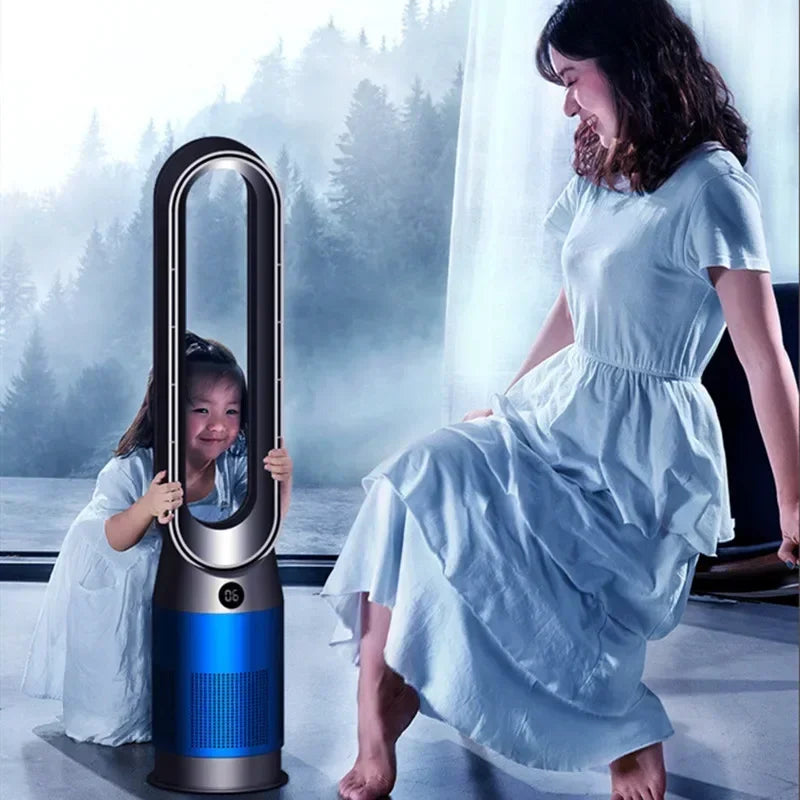
For a room that feels hot in summer, chilly in winter, and cluttered with separate appliances, a multifunction tower can be a practical middle ground. The right choice is ultimately the one that matches your room size, airflow expectations, noise tolerance, purification requirements, and long-term maintenance budget.
Pillar Article: Best Bladeless Tower Fan Heaters of 2026: Tested & Compared













