Does a battery-powered camping heater last all night?
In most cases, no . A battery-powered camping heater rarely provides continuous heat for 8 or more hours unless it's paired with a very large portable power station or used on a low intermittent setting.
- A 500Wh battery powering a 1500W heater lasts approximately 20 minutes under ideal conditions.
- The same battery running a 500W heater lasts roughly 1 hour before efficiency losses.
- A 2000Wh power station running a 250W heater may approach 7–8 hours, depending on temperature and inverter efficiency.
For true overnight camping in freezing weather, battery-powered heaters work best as supplemental heat alongside proper insulation, quality sleeping bags, and—where appropriate—a dedicated gas camping heater designed for outdoor use.
Camping Heater Battery Operated: How Long Will It Really Last?
⏱ 7 min read
A camping heater battery operated sounds like the perfect solution—silent, portable, and flame-free. But when the temperature drops at 3 a.m., real-world battery performance matters far more than advertised specifications. This guide explains how long battery-powered camping heaters actually last, how to calculate runtime yourself, and when a gas heater or hybrid setup makes more sense for overnight camping.
Which option keeps you warm without draining the battery before sunrise? Read on to find out.

camping heater battery operated for cold weather camping — See it in action
How Long Will a 1500 Watt Heater Run on Battery?
Quick runtime table by battery size
| Battery Capacity | Ideal Runtime | Typical Real-World Runtime |
|---|---|---|
| 300Wh | 12 minutes | 10–11 minutes |
| 500Wh | 20 minutes | 17–19 minutes |
| 1000Wh | 40 minutes | 34–37 minutes |
| 2000Wh | 80 minutes | 68–74 minutes |
Instant answer for common battery banks
If you're wondering how long will a 1500 watt heater run on battery , the answer is usually far less than an hour . High-wattage electric heaters consume energy extremely quickly. Even premium portable power stations lose around 10–15% through inverter conversion, making real runtime shorter than the simple calculation suggests.
1500W Heater Runtime Calculator Explained
Runtime formula
Runtime (hours) = Battery Capacity (Wh) ÷ Heater Wattage (W)
Watts vs watt-hours
Watts (W) measure how much power the heater uses at any moment, while watt-hours (Wh) measure how much energy the battery stores. Runtime depends on both numbers.
Voltage and amp-hours
If your battery capacity is listed in amp-hours (Ah), convert it first:
Battery Wh = Voltage × Amp-hours
Example:
- 12V × 100Ah = 1200Wh
- 24V × 100Ah = 2400Wh
- 48V × 100Ah = 4800Wh
Worked calculation examples
- 1000Wh ÷ 250W = approximately 4 hours before efficiency losses.
- 1200Wh ÷ 500W = about 2.4 hours.
- 2000Wh ÷ 1500W = roughly 1.3 hours under ideal conditions.
How battery-powered camping heaters work
Battery types and capacities
Portable camping heaters typically rely on one of these battery technologies:
- Li-ion: Lightweight, rechargeable, and common in portable power stations.
- LiFePO4: Longer service life, improved cold-weather durability, and deeper usable capacity.
- Lead-acid (AGM): Lower cost but significantly heavier with less usable energy.
Battery capacity is measured in watt-hours (Wh). Larger capacity generally means longer runtime.
Heater wattage vs runtime formula
The lower the heater's wattage, the longer the battery lasts. Small personal heaters operating around 150–300W are much more practical for battery use than household 1500W heaters.
Continuous power requirements
Many heaters also require an inverter capable of supplying continuous output. A 1500W heater typically requires an inverter rated above 1500W to account for startup loads and maintain stable operation.
Runtime Tables for Common Battery Sizes
12V 100Ah battery
A fully charged 12V 100Ah battery stores about 1200Wh before losses.
| Heater Power | Estimated Runtime |
|---|---|
| 150W | 6–7 hours |
| 250W | 4–4.5 hours |
| 500W | 2 hours |
12V 200Ah battery
Doubling battery capacity approximately doubles runtime under similar conditions.
24V and 48V systems
Larger battery banks found in RVs and off-grid systems provide significantly longer runtime but also cost considerably more and add weight.
Portable power stations
Modern lithium power stations are convenient for car camping, but even high-capacity models struggle to power a full-size 1500W heater overnight.
Real-World Runtime vs Theoretical Runtime
Inverter efficiency
Most portable power stations lose 10–15% of stored energy while converting DC battery power into household AC electricity.
Depth of discharge
Many battery systems avoid using 100% of stored capacity to protect battery lifespan, reducing usable runtime.
Cold weather losses
Low temperatures reduce battery performance, particularly with older lithium-ion and lead-acid batteries. Runtime often decreases noticeably below freezing.
Battery aging
As batteries age, total capacity gradually declines. A battery rated at 1000Wh when new may deliver substantially less after years of heavy use.
Why All-Night Heating Is So Hard on Batteries
Electric heat requires substantial energy. Even large lithium batteries struggle to supply continuous heating for an entire night, especially when outdoor temperatures remain below freezing.
Key factors that drain batteries faster
- Below-freezing temperatures
- Higher heat settings
- Poor tent insulation
- Older batteries
- Inverter efficiency losses
Can a battery heater run all night?
Only under limited conditions. Small personal heaters running on low settings with a high-capacity battery bank may approach overnight runtime. Full-size 1000W–1500W electric heaters generally cannot maintain heat all night using portable batteries alone.
Types of Portable Camping Heaters Compared
Battery operated electric heaters
Best for: Short warming sessions, morning comfort, emergency backup, and enclosed spaces where open flames are unsuitable.
Trade-off: Quiet and clean, but limited runtime.
Rechargeable hybrid heaters
Best for: Car campers using portable power stations, solar charging, or vehicle charging between nights.
Trade-off: More flexible but still constrained by battery capacity.
Gas-powered portable camping heaters
Best for: Extended cold-weather camping where sustained warmth matters.
Trade-off: Longer runtime but requires careful ventilation and safe operation.
What Battery Size Do You Need for 1, 2, 4, 8, or 12 Hours?
Battery bank sizing chart
| Desired Runtime | 250W Heater | 500W Heater |
|---|---|---|
| 1 hour | 250Wh+ | 500Wh+ |
| 2 hours | 500Wh+ | 1000Wh+ |
| 4 hours | 1000Wh+ | 2000Wh+ |
| 8 hours | 2000Wh+ | 4000Wh+ |
| 12 hours | 3000Wh+ | 6000Wh+ |
LiFePO4 vs AGM requirements
LiFePO4 batteries generally deliver more usable energy, tolerate deeper discharge, and maintain performance better over thousands of charge cycles, making them a stronger choice for frequent campers despite their higher initial cost.
Safety and Cold-Weather Performance
Indoor safety
Battery-powered heaters eliminate combustion gases, but they still require proper clearance from sleeping bags, clothing, and tent fabrics.
Cold weather battery performance
Store batteries inside insulated containers or sleeping bags overnight whenever manufacturer guidance allows, helping preserve capacity in freezing temperatures.
Ventilation considerations
Even with electric heaters, tents should maintain adequate ventilation to reduce condensation and improve overall comfort.
- Place heaters on stable, non-flammable surfaces.
- Use insulated sleeping systems to reduce heating demand.
- Carry backup power or an alternative heat source.
- Never exceed the inverter's continuous power rating.
Gas vs Battery: Which Is Better for Overnight Camping?
Runtime comparison
Gas heaters typically provide substantially longer continuous heat than battery-powered electric heaters.
Safety comparison
Battery heaters eliminate combustion, while gas heaters require careful ventilation and adherence to manufacturer safety recommendations.
Cost comparison
Battery systems involve higher upfront equipment costs, whereas gas heaters usually have lower purchase prices but require ongoing fuel purchases.
For many campers, the most practical solution is combining a battery heater for short-term comfort with a gas heater designed for extended outdoor use.
Many campers pair a battery heater with a gas option like the portable camping gas heater to balance safety, convenience, and all-night warmth.
For more outdoor lifestyle essentials, explore our Lifestyle collection.
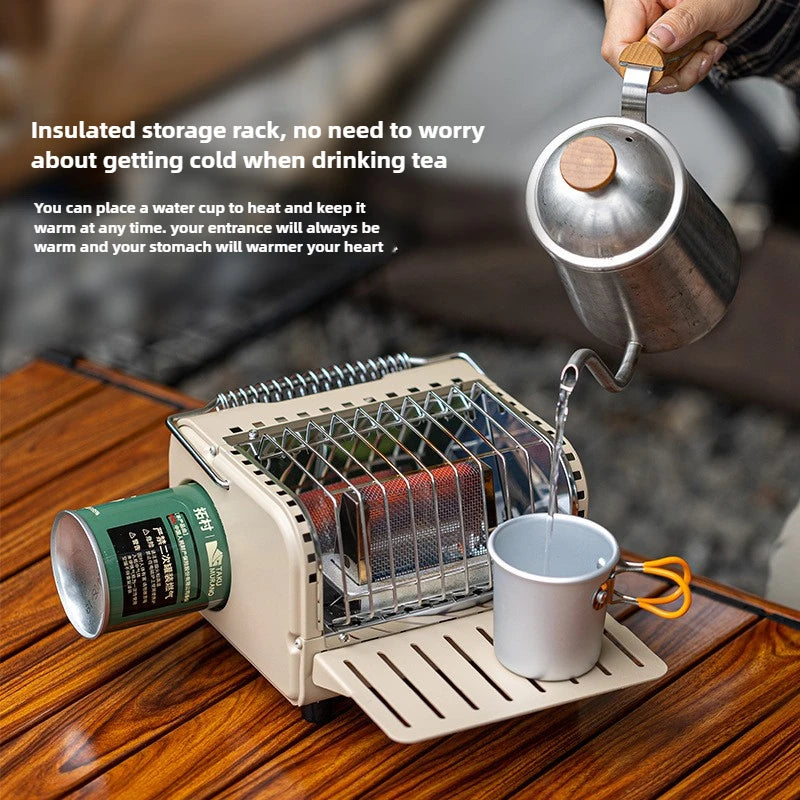
emergency heat source setup for winter camping gear — See it in action
Frequently Asked Questions
How long will a 1500 watt heater run on a 100Ah battery?
A typical 12V 100Ah battery stores around 1200Wh. After inverter losses, a 1500W heater generally operates for roughly 40–45 minutes under ideal conditions.
How long will a battery powered camping heater last?
It depends on heater wattage and battery capacity. Small 150–250W personal heaters may operate for several hours, while household-sized heaters quickly exhaust portable batteries.
Can a battery heater run all night camping?
Usually not. Only low-power heaters paired with large battery banks have a realistic chance of approaching overnight runtime.
What battery size is needed for 8 hours of heating?
Around 2000Wh may support an efficient 250W heater for approximately 8 hours under favorable conditions. Higher wattage heaters require substantially larger battery banks.
Does LiFePO4 last longer than AGM?
Yes. LiFePO4 batteries generally offer greater usable capacity, more charge cycles, lighter weight, and better long-term value.
How much power does a 1500W heater actually consume?
At full output, it consumes approximately 1500 watt-hours of energy every hour it operates.
Can a portable power station safely run a 1500W heater?
Only if the power station's continuous inverter rating equals or exceeds the heater's power draw. Always verify manufacturer specifications before connecting high-power appliances.
Does cold weather reduce battery runtime?
Yes. Cold temperatures reduce available battery capacity and shorten runtime, especially with older lithium-ion and lead-acid batteries.
Related Guide: Portable Camping Heater Comparison: Best Picks for Cold Trips