

Handheld Fan vs Neck Fan: Which Is Better for Summer?
A handheld fan is usually the better choice when you want stronger, more directional airflow and flexible positioning, while a neck fan is usually better when hands-free cooling matters most. The right option depends on how you plan to use it: commuting, travel, outdoor events, exercise, desk work, or everyday summer cooling all favor different strengths.
Handheld Fan vs Neck Fan: Quick Verdict
There is no universal winner between a handheld fan and a neck fan. A handheld fan gives you more control over exactly where the air moves, can often be positioned close to your face or body, and can be placed on a desk when the design supports it. A neck fan sits around your neck and leaves both hands available, making it convenient for walking, standing, commuting, or activities where holding a fan becomes tiring.
Choose a Handheld Fan If You Want Stronger, More Directional Airflow
A handheld fan is a strong fit when your priority is directing airflow exactly where you need it. You can hold the fan closer to your face, angle it toward your neck, or reposition it as you move. This flexibility can make the airflow feel more noticeable than a fan positioned farther away.
Handheld designs can also be easier to share or reposition. If you are sitting at a desk, waiting outdoors, traveling, or relaxing at home, you can change the fan's angle instead of keeping it fixed around your neck.
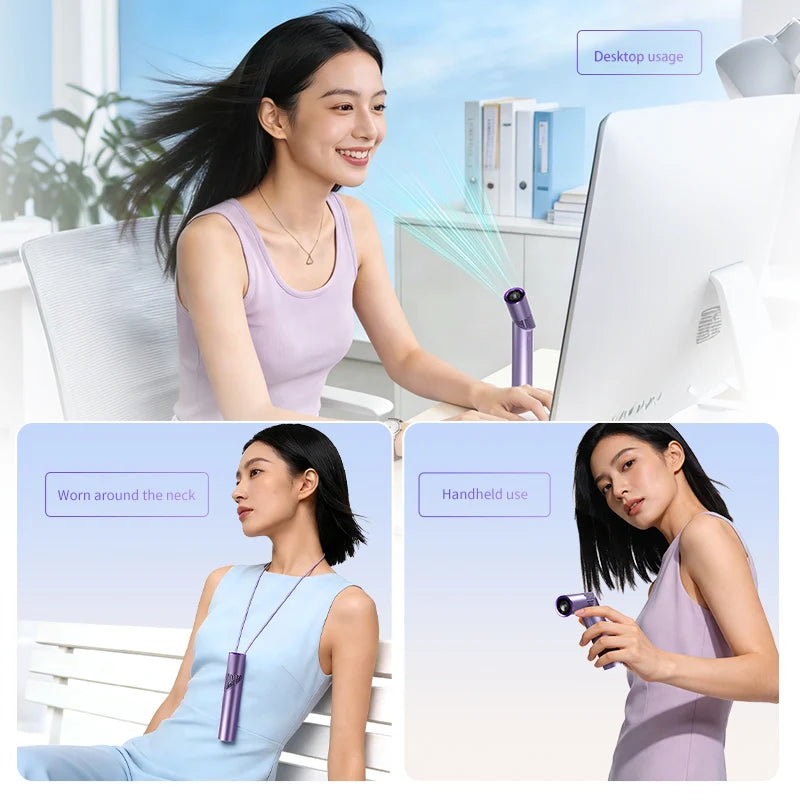
Choose a Neck Fan If You Want Hands-Free Cooling
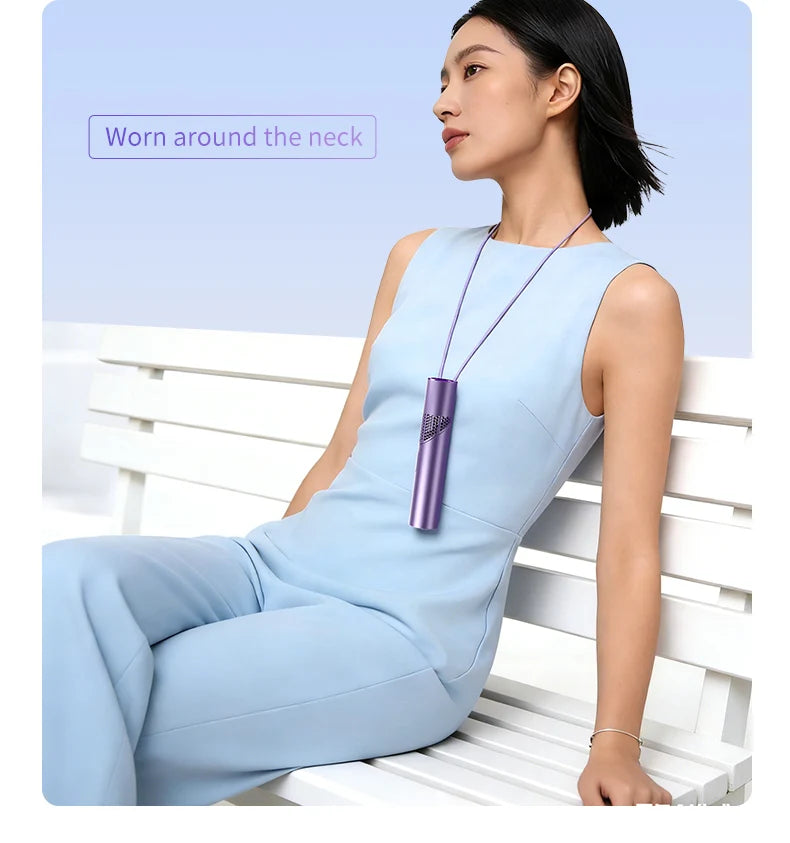
A neck fan makes more sense when holding a fan is inconvenient. Because the device rests around your neck, both hands remain available for carrying a bag, using a phone, walking, or performing another task.
The tradeoff is positioning. A neck fan is designed to deliver airflow from a fixed position around the upper body, while a handheld fan can be aimed wherever you want. Neck comfort and device weight also become important during long sessions.
The Best Choice by Summer Use Case
- Maximum directional airflow: Handheld fan.
- Hands-free cooling: Neck fan.
- Flexible travel use: Handheld fan.
- Walking while carrying other items: Neck fan.
- Desk use: Foldable handheld fan.
- Outdoor events: Either, depending on whether hands-free operation or directional airflow matters more.
- Exercise: Neck fan for hands-free use, or handheld fan for targeted airflow during breaks.
Handheld Fan vs Neck Fan: Side-by-Side Comparison
Performance Comparison Matrix
| Feature | Handheld Fan | Neck Fan |
| Directional airflow | Excellent flexibility | More fixed |
| Hands-free comfort | Requires holding unless placed on a surface | Excellent |
| Cooling distance | Can be adjusted by moving closer | Relatively fixed by placement |
| Portability | Excellent when compact | Good, but shaped for wearing |
| Foldability | Available on some models | Depends on design |
| Desk use | Strong advantage for foldable designs | Usually less flexible |
| Commuting | Good when carrying is convenient | Strong choice for hands-free use |
| Travel | Strong choice for compact storage | Good when hands-free cooling is useful |
| Outdoor activities | Strong targeted airflow | Strong hands-free convenience |
| Neck comfort | No neck weight | Depends on weight and fit |
| Hand fatigue | Can occur during extended use | Minimal holding fatigue |
Which Features Matter Most for Personal Cooling?
Do not choose a portable fan simply because it has more speed settings or a larger specification sheet. For personal cooling, airflow direction, the distance between the fan and your body, comfort, portability, noise, runtime, and ease of positioning can matter more.
Think about where you will use the fan before comparing individual specifications. A commuter may value hands-free operation, while a traveler may value folded size and flexible positioning. Someone working at a desk may care more about stability and noise than about maximum portability.
Airflow and Cooling Performance: Which Fan Is Stronger?
When comparing a handheld fan and a neck fan, "stronger" should not mean simply counting speed settings. Perceived cooling depends on how much air reaches you, how close the airflow is, where it is directed, and how consistently it reaches the areas that feel hot.
Airflow Speed and Perceived Cooling
A handheld fan can create a strong perceived cooling effect because you can move it closer to your face, neck, or upper body. Moving the fan changes the distance between the airflow source and your skin, which can significantly affect how noticeable the breeze feels.
A neck fan can provide consistent airflow without requiring you to hold it. That consistency is valuable during movement, but the airflow direction is generally less flexible than with a handheld design.
When evaluating a fan, look for transparent information about airflow performance rather than assuming that a higher advertised speed automatically means better cooling. If measurements are available, compare them using the same test conditions.
Cooling Distance and Airflow Direction
Cooling distance is especially important for handheld fans. You can adjust the distance simply by moving your hand. A closer position can make airflow feel stronger, while a farther position can create a broader and less concentrated breeze.
A neck fan has a more predictable relationship between the fan and your body because the device remains around your neck. That can be convenient, but it limits your ability to redirect airflow toward another area.
Does a Brushless DC Motor Make a Fan Better?
A brushless DC motor can be a useful feature to evaluate, but the motor type alone does not prove that one portable fan will cool better than another. Actual performance depends on the complete fan design, including the motor, blades, airflow path, power system, and speed control.
If a manufacturer highlights a brushless motor, treat it as one specification rather than the entire performance story. Compare the fan's actual airflow, noise, runtime, ergonomics, and intended use as well.
Hands-Free Comfort vs Handheld Flexibility
When Hands-Free Cooling Is the Better Choice
Hands-free cooling is valuable when you expect to move around while carrying other items or using your hands. A neck fan can be convenient for walking, standing at an outdoor event, commuting, or doing light activities where holding a fan would become annoying.
The biggest advantage is convenience rather than necessarily stronger airflow. You can keep cooling without continuously gripping a device.
When a Handheld Fan Is More Comfortable
A handheld fan can be more comfortable when you dislike having a device resting around your neck or when you want complete control over airflow direction. You can hold it only when you need cooling and put it down when you do not.
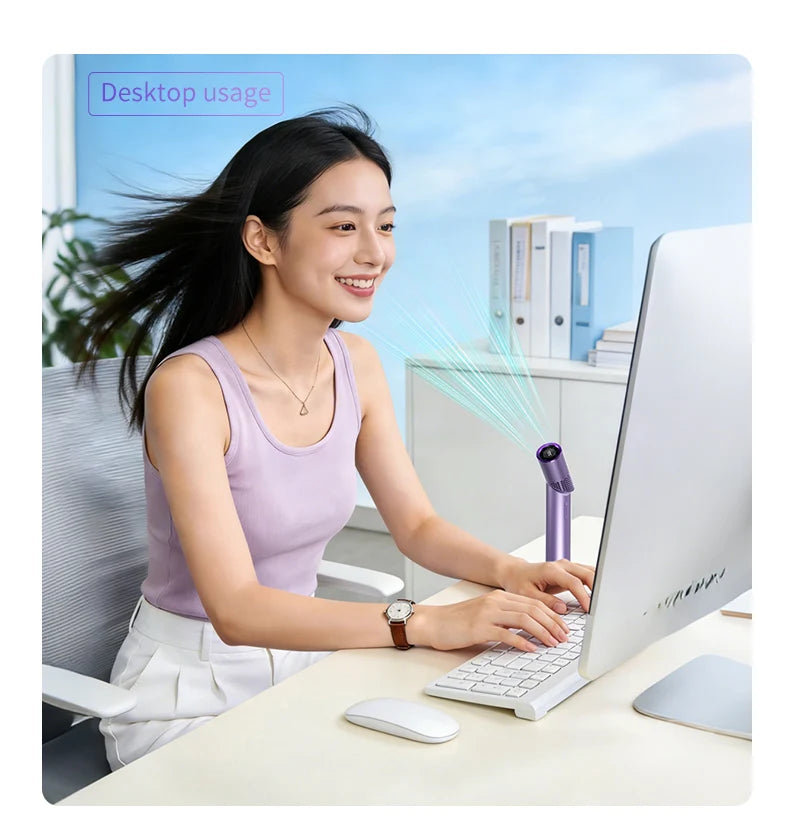
A foldable handheld design adds another advantage: it can change from a hand-held cooling device into a conveniently positioned desktop fan when the design supports stable placement.
Weight, Neck Comfort, and Long-Session Use
For a neck fan, weight distribution and fit can influence comfort during long sessions. Even a feature-rich fan may become inconvenient if the wearer dislikes the pressure or weight around the neck.
With a handheld fan, the comparable issue is hand fatigue. Holding a device continuously can become uncomfortable, especially if you need cooling for an extended period. A foldable fan that can stand on a desk reduces this limitation in stationary situations.
Battery Life, Charging, Noise, and Daily Convenience
Battery Runtime at Low, Medium, and High Speeds
Battery runtime should be evaluated at the speeds you actually expect to use. A runtime figure at the lowest setting may not represent real-world performance if you typically use a stronger airflow level in hot weather.
When comparing products, look for runtime information at multiple speeds. If a manufacturer provides only one figure, avoid assuming that the same runtime applies to every setting.
USB-C Charging and Charging Time
Charging convenience matters for travel and commuting because a portable fan is most useful when it is ready when you need it. USB-C charging can simplify cable management when your other devices use the same connector.
However, the source information for the featured foldable handheld fan does not specify USB-C support, charging time, battery capacity, or measured runtime. These details should therefore be verified from the current product specifications rather than assumed.
Noise Level: What Matters in Offices and Public Spaces?
Noise matters more in quiet environments than in outdoor settings. At a desk, a noticeable fan sound can become distracting during concentration, meetings, or calls. Outdoors, ambient noise may make the same fan sound less important.
For a meaningful comparison, noise should ideally be measured at a consistent distance and at the same operating speed. Manufacturer claims and independent measurements should be clearly separated.
Cleaning and Maintenance
Portable fans collect dust and debris through their airflow path, particularly when used frequently during summer. Regular cleaning can help keep the fan's exterior and air intake areas free of buildup.
Always follow the manufacturer's cleaning instructions. Do not assume that a fan is water-resistant simply because its exterior is made from plastic.
Which Fan Is Better for Commuting, Travel, and Outdoor Activities?
For Commuting
A neck fan is convenient when your commute involves walking while carrying a bag or using your hands. A handheld fan is better when you prefer stronger directional control and do not mind holding the device.
If your commute alternates between walking and sitting, a foldable handheld fan can offer additional flexibility because it can be repositioned or placed nearby once you reach your destination.
For Airplane and Other Travel
Travel favors compact designs that are easy to store in a personal bag. A foldable handheld fan can be particularly practical because folding reduces the space needed for storage.
A neck fan can still be useful when hands-free cooling is your priority, but its shape may make packing and storage different from a compact foldable handheld model.
For Outdoor Events and Festivals
At outdoor events, the decision comes down to whether you value targeted airflow or hands-free operation. A handheld fan can be aimed directly at your face or neck, while a neck fan allows you to keep both hands available.
For Walking and Exercising
For activities where your hands need to remain free, a neck fan has a practical advantage. For lower-intensity activity or cooling during breaks, a handheld fan can provide more control over where the airflow is directed.
For Heat-Sensitive Situations
When staying comfortable in hot conditions is especially important, prioritize a fan that you can use consistently and comfortably. A handheld fan may be preferable when you need precise airflow positioning, while a neck fan can be more practical when holding a device is difficult.
A portable fan should be considered a personal comfort tool rather than a replacement for broader heat-safety measures. In very hot environments, also pay attention to hydration, shade, rest, and the signs of heat-related illness.
Which Fan Is Better for Desk Work?
Desk Stability and Airflow Positioning
A foldable handheld fan can be especially useful at a desk because its flexible design can allow it to be positioned nearby rather than held continuously. This creates a useful middle ground between a traditional desktop fan and a purely handheld device.
The featured portable handheld fan is described as suitable for handheld, desktop, and neck-hanging personal cooling. Its compact foldable construction is designed for convenient storage and positioning.
Noise and Concentration
Desk users should prioritize a fan that provides comfortable airflow without becoming distracting. Because the available product information does not provide a measured decibel level, noise performance should not be presented as a verified advantage for this particular model.
When a Neck Fan Still Makes Sense at a Desk
A neck fan can still be useful if you move frequently between your desk and other locations or simply prefer not to keep a device on your workspace. Its main advantage remains hands-free operation.
Handheld Fan vs Foldable Fan vs Mini Fan
Foldable Fan: Best for Portability and Desk Use
A foldable fan is essentially a portability-focused design that adds flexibility in storage and positioning. Folding can make the fan easier to place inside a bag while also helping it adapt to desk use when the structure supports stable positioning.
Mini Fan: Best for Compact Everyday Carry
A mini fan emphasizes small size and easy everyday transport. It can be useful when bag space is limited, but smaller dimensions do not automatically mean stronger airflow. Compare the physical size with airflow performance, battery information, noise, and ergonomics.
How Portable Fans Compare as Personal Cooling Devices
The important distinction is not always the product label. A handheld fan may also be foldable, a foldable fan may also function as a desktop fan, and some compact personal fans may offer multiple carrying configurations.
Instead of choosing by category name alone, identify your primary requirement: directional airflow, hands-free operation, compact storage, desk stability, or easy commuting.
How We Compare Handheld and Neck Fans
Airflow Testing Method
A fair airflow comparison should test each fan under standardized conditions. The same measurement distance, operating speed, room conditions, and measurement equipment should be used for every fan.
Battery Runtime and Charging Test
Battery testing should record runtime at comparable low, medium, and high settings when those settings are available. Charging tests should record the starting battery condition, charger configuration, and time required to reach the intended charge level.
Noise Measurement
Noise measurements should be taken at the same distance and under consistent background-noise conditions. A single maximum-noise figure can be misleading if it does not specify the speed setting or measurement environment.
Portability, Weight, and Folded Dimensions
Portability should account for more than total weight. Folded dimensions, shape, storage requirements, grip comfort, and whether the fan can stand on a desk can all affect practical portability.
Measured Results vs Manufacturer Claims
Manufacturer specifications should be labeled as manufacturer specifications. Independent measurements should be presented separately. If a fan has not been independently tested for airflow, noise, runtime, or charging time, those values should not be presented as measured results.
What to Look for When Buying a Portable Fan
Airflow Speed and Direction
Choose a fan that matches the type of cooling you want. Directional airflow is particularly useful when you want to cool your face or neck directly. A broader airflow pattern may be preferable when the fan is positioned farther away.
Battery Capacity and Runtime
Check the stated battery capacity and, more importantly, the expected runtime at the speeds you use. Do not compare battery capacity alone because different fan designs can consume power at different rates.
Noise Level
Look for actual noise information when available, especially if you intend to use the fan in an office, library, bedroom, or other quiet environment.
Weight, Size, and Foldability
For travel, a compact foldable design can make storage easier. For long handheld sessions, low weight and a comfortable grip can reduce fatigue. For desk use, the ability to position the fan securely may matter more than minimum folded size.
USB-C Charging
USB-C can be convenient for travelers, but charging compatibility should be verified from the product specifications. Do not assume USB-C support unless the manufacturer confirms it.
Neck Comfort or Handheld Grip
Choose the ergonomic format you are most likely to use consistently. A neck fan reduces hand fatigue but introduces neck contact and weight. A handheld fan avoids neck weight but requires holding unless it can be placed nearby.
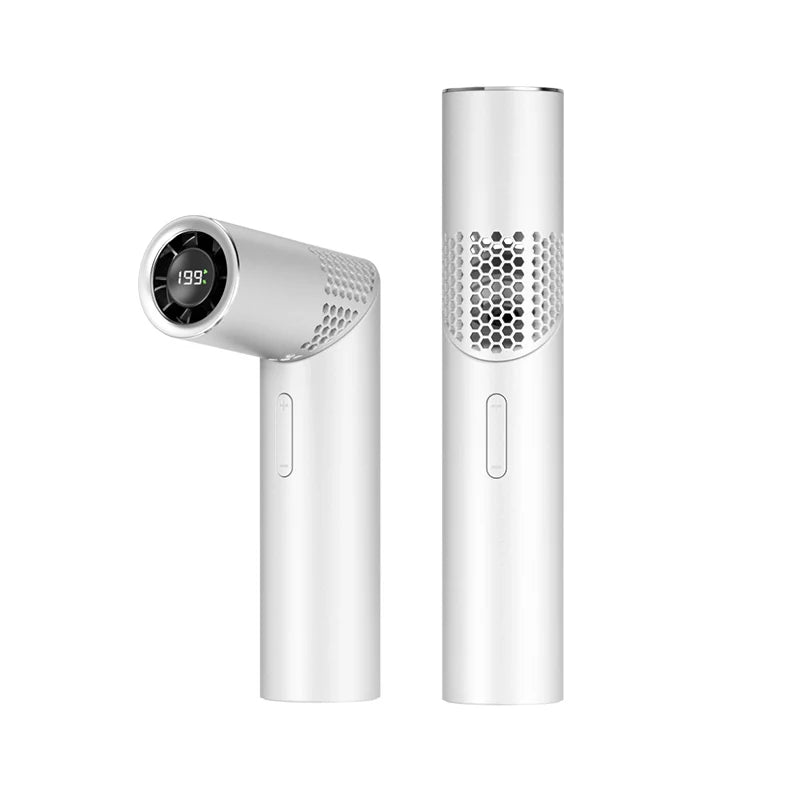
For shoppers who want a compact, flexible option, the Portable Handheld Fan | Foldable Cooling Comfort for Travel is designed around portable personal airflow. It uses an ABS plastic body, has a foldable compact design, and is described for handheld, desktop, and neck-hanging use. Available colors are white, grey, and purple.
The product information confirms electric power and a compact foldable design, but it does not provide independently measured airflow, noise, battery capacity, charging time, or speed-specific runtime. Those factors should be evaluated separately before purchase.
For shoppers comparing personal cooling options, exploring Body Care and Health Devices can also help put portable cooling products into a broader everyday self-care category.
Handheld Fan or Neck Fan: Which Should You Buy?
Best Choice for Maximum Airflow
Choose a handheld fan when directional airflow and positioning flexibility are your priorities. You can move the fan closer, change its angle, and target a specific area instead of relying on a fixed position around your neck.
Best Choice for Hands-Free Cooling
Choose a neck fan when you want cooling without continuously holding a device. This is particularly useful for walking, commuting, outdoor events, and activities where both hands are occupied.
Best Choice for Travel and Portability
A compact foldable handheld fan is a strong option when storage flexibility matters. Folding can make the fan easier to pack while retaining the ability to use it as a handheld or desktop personal cooling device.
Best Choice for Desk and Everyday Use
A foldable handheld fan can be more versatile for desk work because it can be positioned nearby and used without remaining around your neck. A neck fan remains attractive if you frequently move away from your desk and want continuous hands-free cooling.
Pros and Cons of Handheld Fans
- Pros: Flexible airflow direction, easy repositioning, compact options, potential for desk use, no neck weight, and useful for travel.
- Cons: Requires holding during handheld use, which can create fatigue during long sessions.
Pros and Cons of Neck Fans
- Pros: Hands-free operation, convenient for walking and commuting, and useful when both hands need to remain available.
- Cons: Less flexible airflow positioning and potential neck discomfort depending on weight, shape, and fit.
Frequently Asked Questions
Is a handheld fan or neck fan better for summer?
A handheld fan is generally better for directional airflow and flexible positioning, while a neck fan is generally better for hands-free cooling. The better option depends on how and where you use it.
Is a handheld fan stronger than a neck fan?
Not automatically. A handheld fan can often feel stronger because it can be moved closer to the face or body and aimed precisely. Actual fan strength should be evaluated using comparable airflow measurements rather than product type alone.
Are neck fans better for hands-free cooling?
Yes. Hands-free operation is the primary advantage of a neck fan. It can be convenient when walking, commuting, attending outdoor events, or performing activities where holding a fan is inconvenient.
Which is better for travel, a handheld fan or neck fan?
Both can work well for travel. A compact foldable handheld fan can have an advantage when bag storage and flexible positioning matter, while a neck fan can be preferable when hands-free cooling is more important.
What should I choose between a foldable fan and a mini fan?
Choose a foldable fan if you want portability plus flexible positioning or desk use. Choose a mini fan if minimum size and simple everyday carrying are your highest priorities.
Final Verdict: Handheld Fan vs Neck Fan
The best choice depends on the type of summer cooling you need rather than a universal ranking. A handheld fan is generally the better fit when you want directional airflow, flexible positioning, portability, and the option to use the fan on a desk. A neck fan is generally the better fit when hands-free cooling is the deciding factor.
For commuting, choose based on whether you need free hands or precise airflow. For travel, prioritize compact storage and convenience. For outdoor events, decide whether targeted airflow or hands-free operation matters more. For exercise, hands-free cooling can be convenient, while handheld airflow can be useful during breaks. For desk work, a foldable handheld design can provide useful positioning flexibility.
If your priority is a compact personal cooling device that can adapt between handheld and desktop use, a foldable portable handheld fan is a practical format to consider. The key is to match the fan's design and verified specifications with the way you actually expect to use it.
Pillar Article: Best Portable Handheld Fan for Travel: 2026 Tested Picks













