

Hands Free Waist Fan: Real-World Performance Tested
When outdoor work, summer sports, hiking, or commuting turns hot and sweaty, the biggest advantage of a hands free waist fan is simple: you can keep moving without holding a fan. But hands-free cooling is only useful if the airflow reaches your body, the battery lasts long enough, the clip stays secure, and the fan remains practical during movement.
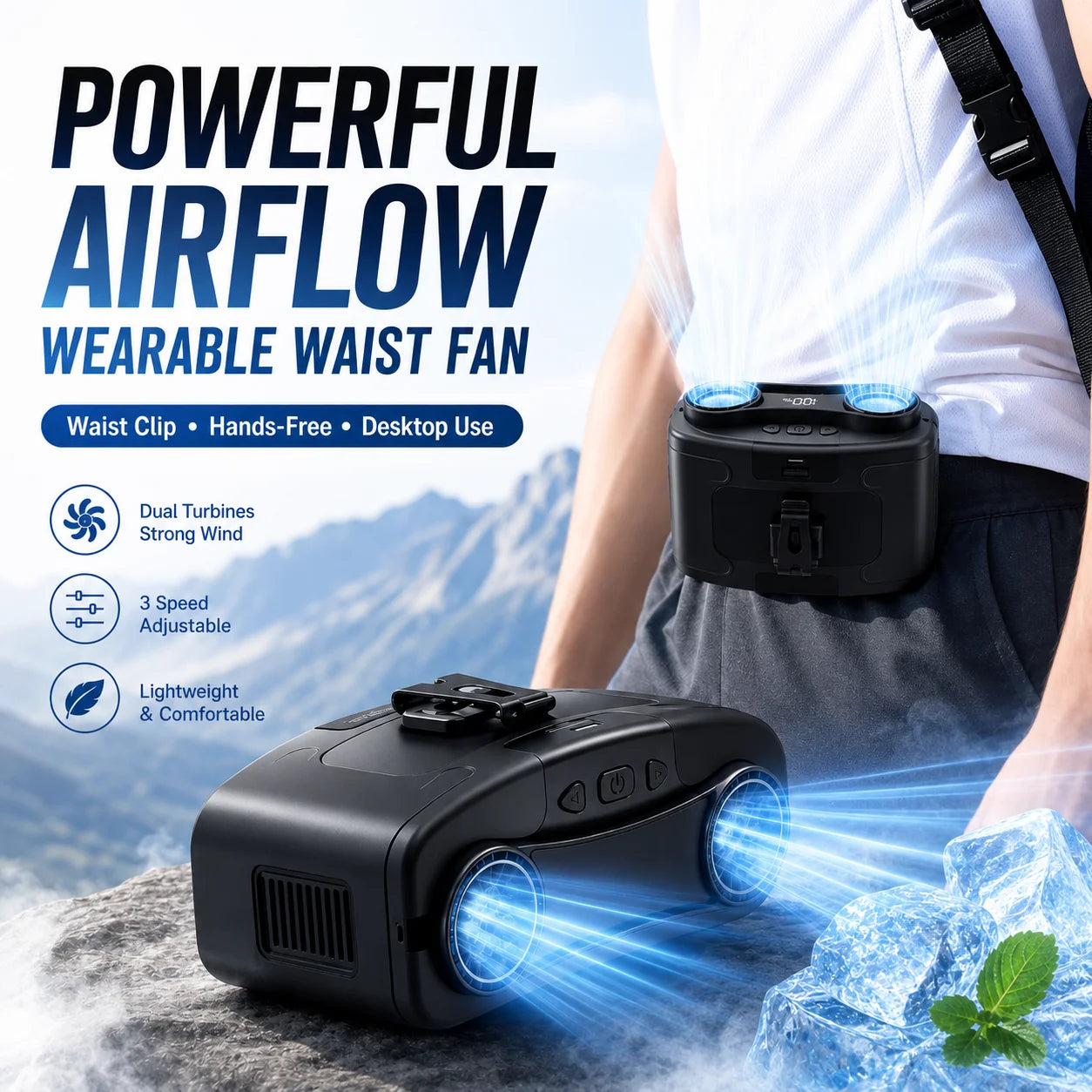
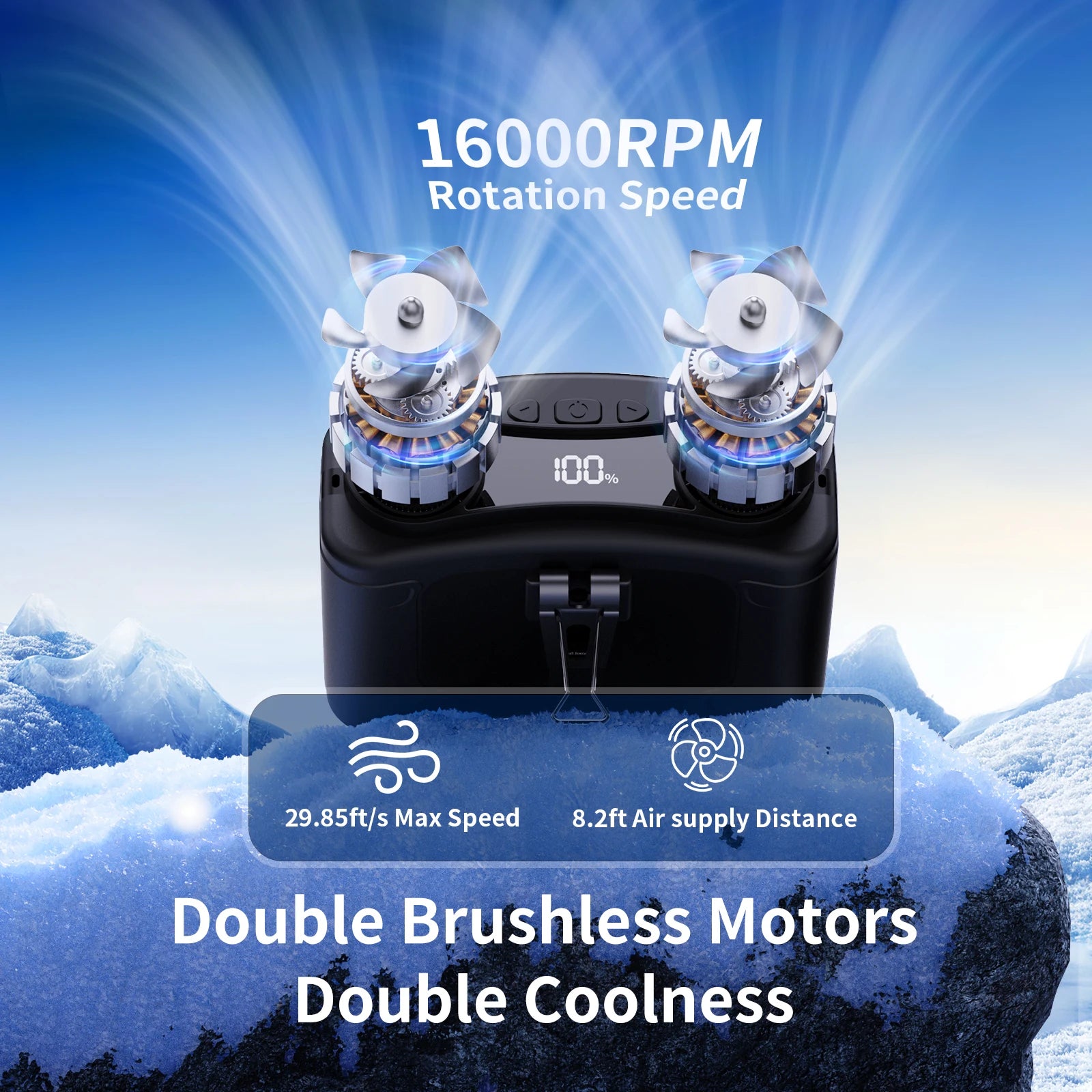
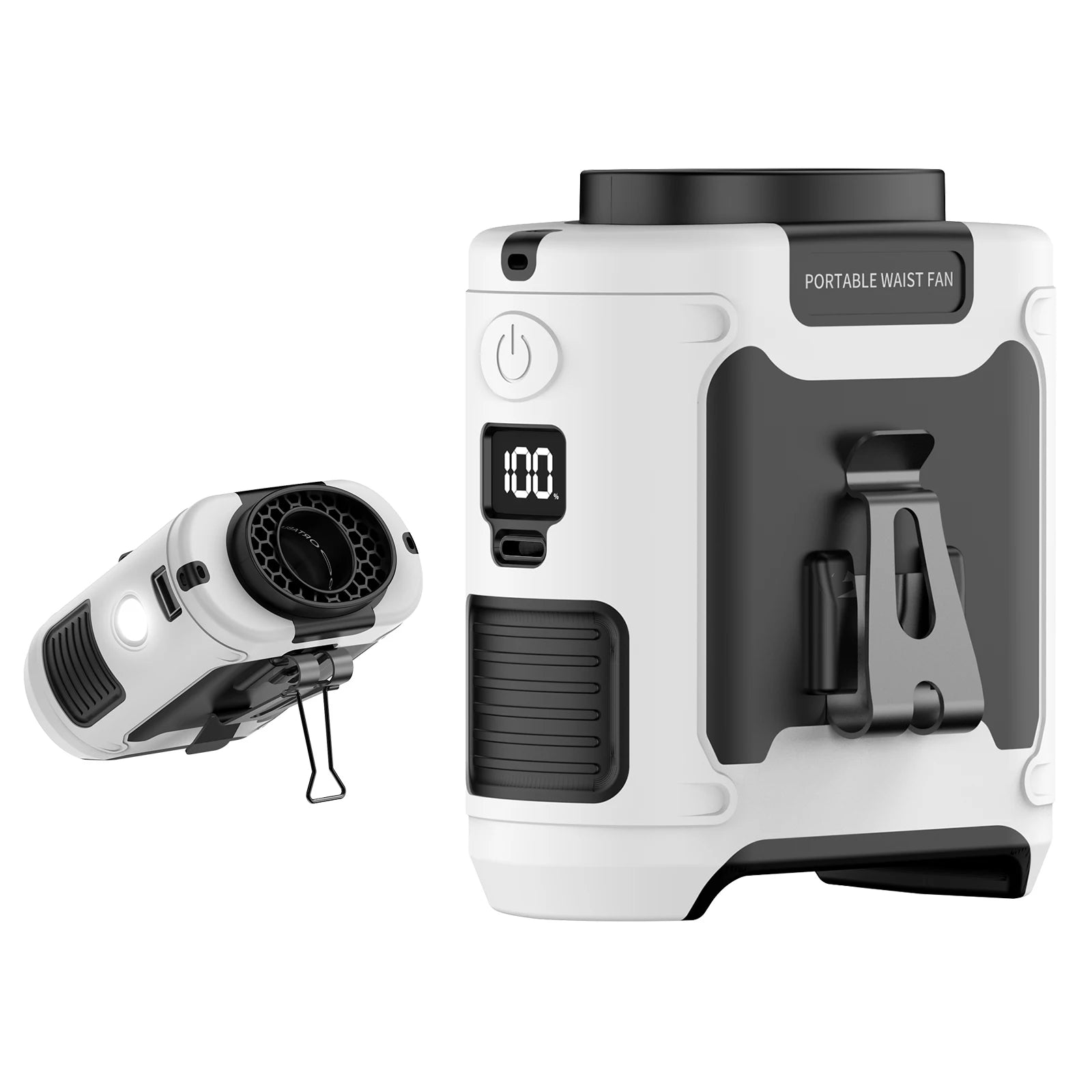
This guide evaluates what matters when choosing a wearable waist fan, using the KentDO Waist Fan Portable Cooling Device as a real-world reference point. Its published specifications include a 16,000 RPM brushless motor, 10 speed settings, a waist-buckle design, USB Type-C charging, an LED display, and 10,000mAh or 20,000mAh battery options. The product page does not publish independent CFM, decibel, clip-strength, or laboratory runtime measurements, so those figures should not be presented as independently tested results.
Hands Free Waist Fan: What We Tested
A useful waist fan comparison should separate manufacturer specifications from independently measured performance. RPM, battery capacity, and wattage describe the hardware, but they do not automatically tell you how much air reaches your body or how long the device will operate at every speed.
Airflow and CFM Testing
CFM, or cubic feet per minute, is a useful way to describe the volume of air a fan moves. A higher RPM number does not automatically mean proportionally higher CFM because blade design, motor efficiency, housing geometry, intake resistance, and outlet design all influence airflow.
The KentDO model specifies a 16,000 RPM brushless motor and describes its airflow as powerful, but it does not publish a verified CFM figure. That means a responsible buying comparison should label CFM as “not published” rather than inventing an estimate and presenting it as a test result.
Battery Runtime vs. Claimed Capacity
The fan is available with 10,000mAh or 20,000mAh rechargeable battery options. Capacity is useful for comparing versions, but mAh by itself does not establish operating time because battery voltage, usable energy, motor load, electronics efficiency, and selected fan speed all affect runtime.
The product page currently states that the 20,000mAh version is rated for approximately “40–8 hours” depending on airflow level. Because that range appears internally inconsistent, buyers should confirm the exact runtime specification for the selected battery version before relying on it for a full work shift.
Noise Testing in Decibels
Noise should be measured with a sound-level meter at a consistent distance and under the same environmental conditions. A proper comparison would record low, medium, and maximum settings and distinguish fan noise from surrounding workplace noise.
No independent dB measurements are published for this waist fan, so it would be misleading to call it “quiet” based solely on the brushless motor specification. For construction or outdoor work, ambient noise may make fan sound less noticeable; for commuting or conversations, noise can matter considerably more.
Clip Strength and Durability
A waist fan has a different durability requirement from a handheld fan because the device moves with your body. The clip needs to remain attached while walking, bending, climbing stairs, exercising, or performing repetitive work.
The KentDO design is intended to clip at the front, back, or side of the waist. That flexibility is useful because airflow direction can be changed according to clothing, activity, and personal preference. However, no quantified clip-force or drop-test rating is published, so clip strength should be treated as a practical feature rather than a laboratory-proven performance metric.
How Well Does a Hands Free Waist Fan Actually Cool You?
A hands free waist fan can provide meaningful perceived cooling by moving air across skin and clothing. It does not lower the surrounding air temperature, and it should not be treated as a substitute for shade, hydration, rest breaks, or appropriate heat-safety practices.
Airflow Strength at Low, Medium, and High Speed
Ten speed settings give a waist fan more control than a basic single-speed personal fan. Lower settings can be useful when you need continuous airflow without maximum power, while higher settings are more appropriate when activity level and perceived heat increase.
The key limitation is that the published 16,000 RPM specification describes motor speed rather than airflow volume. Without a standardized CFM measurement, the best way to evaluate the fan is to consider its airflow direction, speed control, and proximity to the body rather than treating RPM as a direct measure of cooling performance.
Cooling While Standing, Walking, and Working
Placement matters. A front-mounted waist fan can direct airflow toward the torso, while side or rear positioning can change where the air reaches. During walking or physical work, body movement also changes the relative airflow around the fan.
The biggest advantage is convenience. Unlike a handheld fan, a waist-mounted device leaves both hands available for tools, equipment, trekking poles, luggage, or exercise.
Where Waist Fans Work Best—and Where They Struggle
Waist fans are particularly well suited to hot environments where the wearer is active and needs continuous personal airflow. They can be useful for outdoor workers, warehouse employees, hikers, gardeners, commuters, event staff, and people exercising outdoors.
They have limitations. In extremely hot, humid conditions, moving air can improve comfort without eliminating the risk of heat illness. In direct sun, the fan cannot replace shade or protective clothing. And if the airflow is blocked by thick clothing, the cooling sensation can be reduced.
Hands Free Waist Fan Battery Life: Claimed vs. Real Runtime
Battery life is one of the most important buying factors for a rechargeable waist fan, particularly when the intended use involves an eight-hour workday or a long outdoor trip.
How Long Does a Hands Free Waist Fan Battery Last?
There is no defensible independent runtime figure for this model from the supplied product data. The available specifications identify 10,000mAh and 20,000mAh options, while the product page gives an unclear “40–8 hours” rating for the 20,000mAh version.
For that reason, buyers should use the advertised figure as a manufacturer claim rather than a tested runtime. A meaningful independent test would record operating time at several speed levels, beginning with a fully charged battery and ending when the fan shuts down or reaches its defined low-battery threshold.
What Battery Capacity Should You Look For?
For occasional outdoor use, a smaller battery can make sense if lower weight and portability matter more than maximum runtime. For construction, warehouse, landscaping, or extended outdoor activity, the larger 20,000mAh option may be more appropriate if its additional weight is acceptable.
Do not compare battery capacity by mAh alone when evaluating different fan models. Ideally, compare watt-hours, voltage, rated runtime, charging time, and operating power together.
Can It Last Through a Full Work Shift?
A full-shift buyer should not assume that a 20,000mAh battery automatically means eight hours of continuous maximum-speed operation. Fan speed, motor load, battery condition, temperature, and electronics efficiency all influence runtime.
If a fan is intended for an eight- or ten-hour shift, the safest buying approach is to confirm the manufacturer's runtime at the speed you expect to use rather than relying on the maximum advertised capacity.
How Loud Is a Waist Fan Compared With Other Portable Fans?
Noise is highly dependent on motor speed and fan design. A high-speed fan can produce more airflow while also generating more audible motor and air movement noise.
Waist Fan Noise Levels by Speed
The KentDO model has ten speed settings, but published specifications do not include dB measurements. Consequently, there is no reliable basis for assigning a numerical noise rating to the device.
For a serious comparison, measure each speed at the same distance with a calibrated sound-level meter. Record the background noise first, then record the fan operating at low, medium, and maximum output.
Are Waist Fans Quieter Than Handheld Fans?
Not necessarily. A waist fan may feel less intrusive because you are not holding the motor close to your face, but that does not prove that its actual sound pressure level is lower than a handheld fan.
If quiet operation is a priority for an office, classroom, conversation, or commute, look for a published or independently measured dB rating rather than relying on product-category assumptions.
Brushless Motor vs. Traditional Fan Motor
A brushless motor is an electronically commutated motor design that avoids physical brushes. In portable equipment, brushless motors can offer advantages in efficiency, durability, and motor control, although actual performance depends on the complete fan design.
The 16,000 RPM brushless motor is therefore a meaningful hardware specification, but it should be viewed alongside airflow, power consumption, noise, and battery performance.
Hands Free Waist Fan vs. Neck Fan vs. Handheld Fan
| Feature | Waist Fan | Neck Fan | Handheld Fan |
| Hands-free operation | Excellent | Excellent | Low |
| Torso-directed airflow | Excellent | Limited | Variable |
| Face-level airflow | Limited | Excellent | Excellent |
| Directional control | Good through placement | Moderate | Excellent |
| Suitability for physical work | Excellent | Good | Limited |
| Typical mobility advantage | High | High | Low |
Waist Fan: Best for Mobility and Targeted Body Cooling
A waist fan is a strong choice when your main priority is hands-free personal cooling around the torso. The waist-buckle design allows the fan to move with you while leaving your hands available.
Neck Fan: Best for Upper-Body and Face-Level Airflow
A neck fan makes more sense when airflow around the face and neck is the primary goal. It can be particularly appealing when you want the cooling sensation higher on the body rather than around the waist.
Handheld Fan: Best for Maximum Directional Control
A handheld fan remains the most flexible option when you want to point airflow precisely at your face, neck, hands, or another location. The tradeoff is that one hand is occupied whenever the fan is operating.
Quick Decision Tree: Which Portable Fan Should You Buy?
- If you need both hands for work, tools, exercise, or hiking, start with a waist fan or neck fan.
- If you specifically want airflow around your face and neck, consider a neck fan.
- If precise directional control matters more than hands-free use, choose a handheld fan.
- If torso cooling and hands-free mobility are the priority, a waist fan is the most directly aligned option.
- If long runtime matters most, compare battery capacity and verified runtime rather than mAh alone.
Best Hands Free Waist Fan for Construction, Warehouse Work, and Hiking
For Construction Workers
Construction environments put the greatest emphasis on secure attachment, durability, battery endurance, and unobstructed airflow. A waist fan is attractive because workers can keep both hands available for tools and materials.
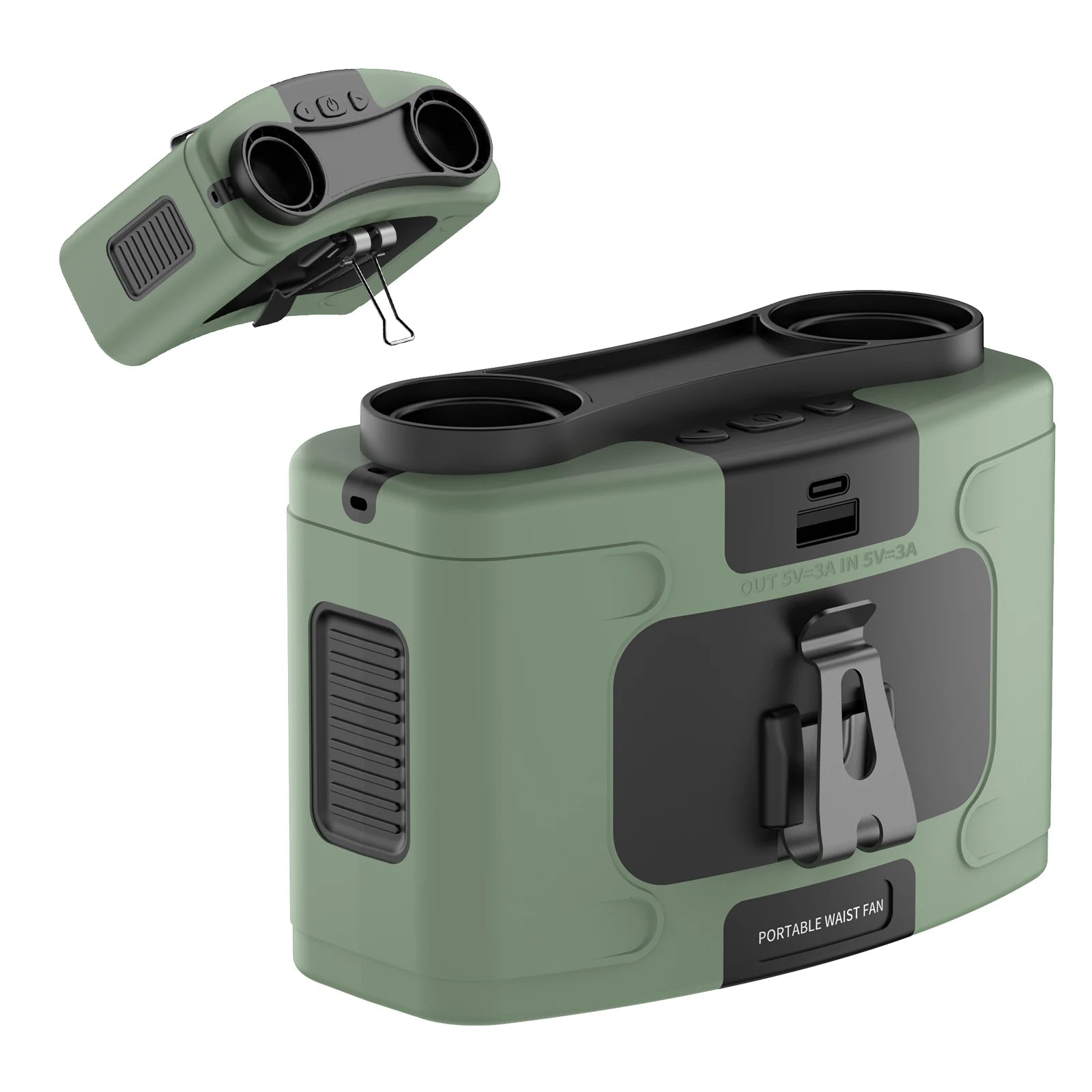
The KentDO model offers a waist-buckle configuration, ten speed settings, a brushless motor, and a choice of 10,000mAh or 20,000mAh batteries. Those specifications align well with the basic requirements of hands-free jobsite cooling. However, the available product information does not establish a dust-resistance rating, impact rating, IP rating, or clip-force measurement, so those characteristics should not be assumed.
For Warehouse and Factory Work
Warehouse workers can benefit from continuous airflow without carrying a handheld device. The LED display is useful for checking power status and speed without guessing how much battery remains.
Noise deserves additional attention in indoor work environments. Because there is no published dB measurement, buyers working around conversations, machinery, or communication equipment should evaluate actual operating noise before treating the fan as a low-noise solution.
For Hiking and Outdoor Recreation
For hiking, portability and battery efficiency become more important. A waist-mounted fan can provide personal airflow without occupying a hand needed for balance, trekking poles, or carrying equipment.
The best placement will depend on clothing and pack configuration. If a backpack interferes with the clip or airflow path, a different attachment position may be more practical.
For Commuting and Everyday Outdoor Use
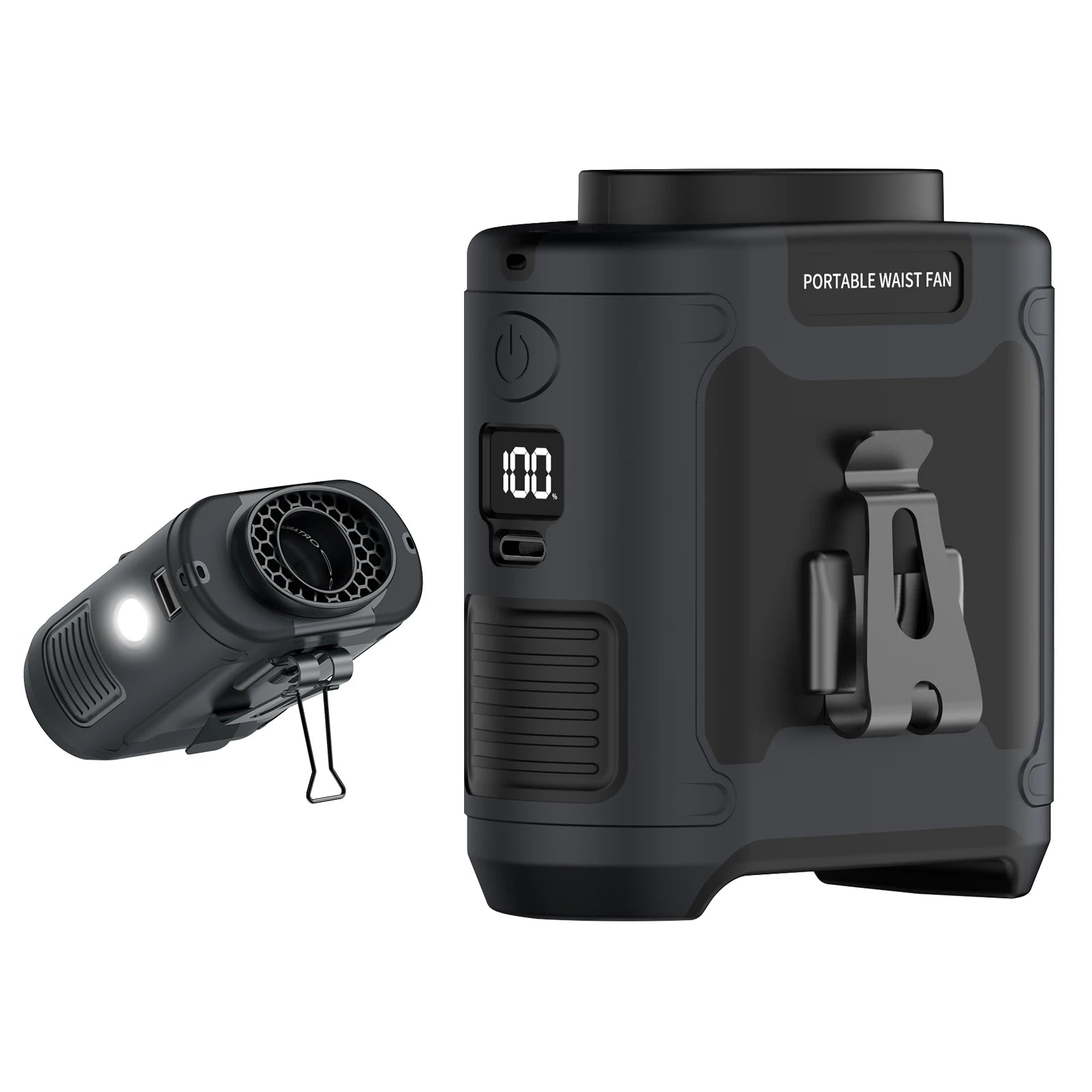
For everyday summer use, the combination of rechargeable USB Type-C charging, ten speed settings, an LED display, and hands-free operation makes this type of fan convenient for walking, outdoor events, travel, and commuting.
For broader body-care and personal-device options, you can also explore the Body Care and Health Devices collection or the Lifestyle collection.
Explore the KentDO Waist Fan Portable Cooling Device if a rechargeable, waist-mounted cooling format fits your outdoor routine.
Pros and Cons of a Hands Free Waist Fan
Pros
- Leaves both hands available during work, exercise, hiking, and outdoor activities.
- Waist placement provides a direct personal-airflow format.
- The reviewed KentDO model offers ten speed settings.
- The 16,000 RPM brushless motor is a strong published hardware specification.
- 10,000mAh and 20,000mAh battery options provide different capacity choices.
- USB Type-C charging is convenient for everyday rechargeable use.
- An LED display provides a quick view of speed and remaining power.
Cons
- No independently verified CFM airflow measurement is published.
- No independent dB noise measurement is published.
- No quantified clip-strength or impact-testing result is published.
- The listed 20,000mAh runtime statement appears inconsistent and should be confirmed before purchase.
- A waist fan cannot replace hydration, shade, rest, or appropriate heat-safety practices in dangerous heat.
- Torso-directed airflow may be less suitable than a neck or handheld fan when face-level cooling is the priority.
What to Look for When Buying a Waist Clip Fan
Airflow CFM
Look for a published airflow measurement and check how it was obtained. CFM is more useful for comparison than a vague statement that a motor is “powerful.” If CFM is unavailable, compare the motor, fan design, speed controls, and real-world airflow cautiously.
Battery Capacity and Runtime
Capacity matters, but runtime matters more. Compare watt-hours when possible, then look for runtime figures at specific speed levels. A large battery can provide longer operation while also increasing device weight.
Clip Design and Holding Strength
A good waist clip should remain stable while walking, bending, climbing, and performing repetitive movements. Buyers should look for a strong mechanical attachment and verify compatibility with the thickness of the clothing or belt they intend to wear.
Weight, Size, and Wearing Comfort
A fan that feels comfortable for ten minutes may feel very different after several hours. Consider battery size, housing dimensions, clip position, and whether the device interferes with belts, waist packs, or work equipment.
Noise, Controls, and Speed Settings
Ten speed levels can make a wearable fan more adaptable, particularly when moving between shade and direct sun or between low- and high-intensity activity. A clear display also makes battery and speed management easier.
Durability and Heat-Exposure Considerations
Outdoor equipment should be evaluated for its intended environment. Do not assume that a plastic housing automatically means a device is waterproof, dustproof, impact resistant, or suitable for extreme temperatures. Look for explicit manufacturer ratings when those properties matter.
For serious outdoor work, personal cooling should also be part of a broader heat-management plan that includes adequate fluids, rest, shade or cooling areas, suitable clothing, and awareness of heat-illness symptoms.
Hands Free Waist Fan Performance: Test Results at a Glance
| Performance Factor | KentDO Waist Fan | How to Interpret It |
| Motor | 16,000 RPM brushless | Strong published motor specification; RPM is not the same as CFM. |
| Speed control | 10 settings | Useful for adjusting airflow to activity and conditions. |
| Airflow | CFM not published | Independent airflow comparison requires an actual airflow measurement. |
| Battery | 10,000mAh or 20,000mAh | Higher capacity can support longer use but may increase weight. |
| Runtime | Manufacturer claim requires confirmation | The published “40–8 hours” wording is unclear. |
| Noise | dB not published | Do not assume quiet operation without measurement. |
| Charging | USB Type-C, 5V | Convenient rechargeable charging format. |
| Display | LED digital display | Shows speed and remaining power at a glance. |
| Attachment | Waist buckle; front, back, or side | Flexible placement for hands-free personal airflow. |
Best Choice by Use Case
- Construction: prioritize secure attachment, larger battery capacity, airflow, and durability information.
- Warehouse work: prioritize runtime, comfortable attachment, adjustable airflow, and acceptable noise.
- Hiking: prioritize portability, battery efficiency, clip stability, and compatibility with backpacks.
- Commuting: prioritize comfortable wear, manageable noise, charging convenience, and compact personal airflow.
- Outdoor sports: prioritize hands-free operation, flexible placement, and enough battery capacity for the activity.
Browse more body-care and health devices if you are comparing personal cooling with other portable wellness equipment.
Are Hands Free Waist Fans Worth Buying?
For the right user, a hands free waist fan solves a specific problem better than a handheld fan: it provides personal airflow without occupying your hands. That makes the category particularly relevant to outdoor workers, hikers, warehouse employees, gardeners, commuters, and people exercising in hot weather.
The KentDO Waist Fan Portable Cooling Device has several specifications that fit this use case: a 16,000 RPM brushless motor, ten speed settings, waist-buckle positioning, USB Type-C charging, an LED power display, and 10,000mAh or 20,000mAh battery choices.
What the available data does not establish is equally important. There is no verified CFM result, independent dB rating, quantified clip-strength test, or clear independently tested battery-runtime figure. A trustworthy buying decision should distinguish those unknowns from the published specifications rather than turning marketing claims into fake test results.
Choose a Waist Fan If You Need Hands-Free Cooling
Choose a waist fan if your main goal is continuous personal airflow while keeping both hands free. The format makes particular sense when holding a fan would interfere with work, exercise, hiking, tools, luggage, or other activities.
If the combination of waist-mounted airflow, adjustable speed, rechargeable power, and a digital display matches your needs, the KentDO Waist Fan Portable Cooling Device is a relevant option to consider.
Choose a Neck or Handheld Fan Instead If...
A neck fan may be better when face and neck airflow is your priority. A handheld fan may be better when you need precise directional control and only use the fan intermittently.
The strongest choice is therefore not necessarily the fan with the biggest RPM number or battery capacity. It is the format that delivers the airflow location, mobility, runtime, comfort, and control you actually need.
Final Verdict
A hands free waist fan is most compelling when mobility matters as much as airflow. Compared with a handheld fan, it frees both hands; compared with a neck fan, it concentrates its cooling around the torso rather than the face and neck.
The KentDO model is built around that use case with a 16,000 RPM brushless motor, ten speed settings, flexible waist placement, USB Type-C charging, a digital display, and two battery-capacity options. Those are useful specifications for shoppers looking for a rechargeable waist fan for work, summer activities, hiking, or outdoor exercise.
Just keep the performance claims in perspective. Without independent airflow, noise, runtime, and clip-strength measurements, the published specifications should be treated as product specifications rather than laboratory test results. For buyers who want hands-free personal cooling and understand those limitations, a wearable waist fan can be a practical addition to a broader hot-weather cooling strategy.
View the Waist Fan Portable Cooling Device to check the available battery and color options.
Pillar Article: Best Portable Waist Fan: 2026 Tested Picks for Cooling













