

Heating Pad Versus Heated Belt: Which Is Better?
When you are deciding between a heating pad versus a heated belt, the better option depends on how and where you want to use heat. A traditional heating pad generally makes more sense when you want broad, stationary warmth while resting at home. A heated belt is usually more practical when you want targeted abdominal warmth, hands-free use, and cordless portability.
For menstrual cramps, the choice often comes down to lifestyle as much as heat itself. If you are lying on the couch and want a larger area of warmth, a heating pad can be convenient. If you need to move around, work, read, travel, or keep warmth positioned around your abdomen without holding a pad in place, a rechargeable heated belt can offer a more practical format.
Heating Pad vs Heated Belt: Quick Answer
Choose a heating pad if you want broad, stationary warmth. Heating pads are useful when you are resting in bed, sitting on a sofa, or treating a larger area such as the lower back. Their larger surface can provide relatively wide heat coverage, but corded models can limit movement and require access to an outlet.
Choose a heated belt if you want targeted, hands-free, portable heat. A heated abdominal belt is designed to stay positioned around the waist or abdomen while you move. Rechargeable models can also eliminate the need to remain near an outlet, making them particularly useful for work, travel, reading, or everyday activities.
For period cramps specifically, neither format is universally “better.” The best choice is the one that delivers comfortable, controllable warmth in the location you need while fitting your routine.
Heating Pad vs Heated Belt: Side-by-Side Comparison
The most useful way to compare these products is to look beyond the label. Coverage, portability, power source, hands-free operation, controls, setup, and safety can make a bigger practical difference than the basic fact that both products generate heat.
| Factor | Heating Pad | Heated Belt |
| Heat coverage | Generally broader surface coverage | More targeted around the abdomen or waist |
| Heat control | Often offers multiple temperature settings | Can offer adjustable warmth and, on some models, massage settings |
| Portability | Depends on cord and size | Rechargeable cordless models are highly portable |
| Hands-free use | Limited because the pad can shift during movement | Designed to remain positioned around the body |
| Power source | Commonly plug-in, although rechargeable options exist | Rechargeable or battery-powered options are common |
| Setup | Usually requires positioning the pad and, for corded models, an outlet | Put on, adjust, and activate |
| Best fit | Resting, larger areas, home use | Targeted abdominal warmth, movement, work, and travel |
Heat coverage
A heating pad generally has the advantage when coverage is the priority. A larger pad can sit across the lower abdomen or lower back and provide warmth across a wider surface. This can make it a good choice for someone who plans to remain stationary.
A heated belt takes a different approach. Instead of maximizing surface area, it focuses heat around a defined body region. For menstrual discomfort, that can be useful when the primary goal is targeted lower-abdominal warmth rather than heating a large portion of the body.
Heat consistency and control
Heat therapy is most practical when you can control the level rather than being locked into one temperature. Adjustable settings let you choose a lower level when you only want gentle warmth and increase it when more warmth feels comfortable.
Do not assume that the highest available temperature is the best setting for cramps. Comfort and safe use matter more than maximum heat output. Always follow the manufacturer's temperature limits and session recommendations.
Portability and setup time
A conventional plug-in heating pad is simple, but the cord can become a practical limitation. You need to be close enough to an outlet, and moving around while wearing or carrying the pad can be inconvenient.
A rechargeable menstrual heating belt changes that equation. Once charged, it can provide cordless heat without requiring a wall outlet during the session. That makes the format particularly useful for commuting, working at a desk, reading, or traveling.
Hands-free use
This is one of the clearest differences between a heating pad and a heated belt. A heating pad generally needs to be positioned against the body and may move when you change position. A belt is designed to wrap around the abdomen or waist, leaving your hands available for other activities.
For someone whose menstrual discomfort occurs during a workday, hands-free positioning can be more useful than simply having a larger heating surface.
Power source
Electric heating pads traditionally rely on household power. That can be perfectly practical at home but less convenient when you need portable heat therapy.
Rechargeable heated belts use an internal battery instead. For example, a cordless period relief belt can use a rechargeable lithium battery and USB Type-C charging. The trade-off is that the battery must be charged before use, so charging habits become part of ownership.
Safety and ease of use
Heat-producing devices should be used according to their manufacturer's instructions. Look for clearly defined temperature settings, straightforward controls, appropriate session limits, and automatic shutoff when offered by the product.
For rechargeable devices, also pay attention to the condition of the battery, charging cable, fabric, controls, and heating components. Do not use a damaged device, and do not exceed the recommended temperature or session duration.
Best overall use case
There is no universal winner. A heating pad is often the better choice for broad stationary warmth, while a heated belt is often the better choice for targeted, wearable, cordless warmth. Your routine should determine the winner.
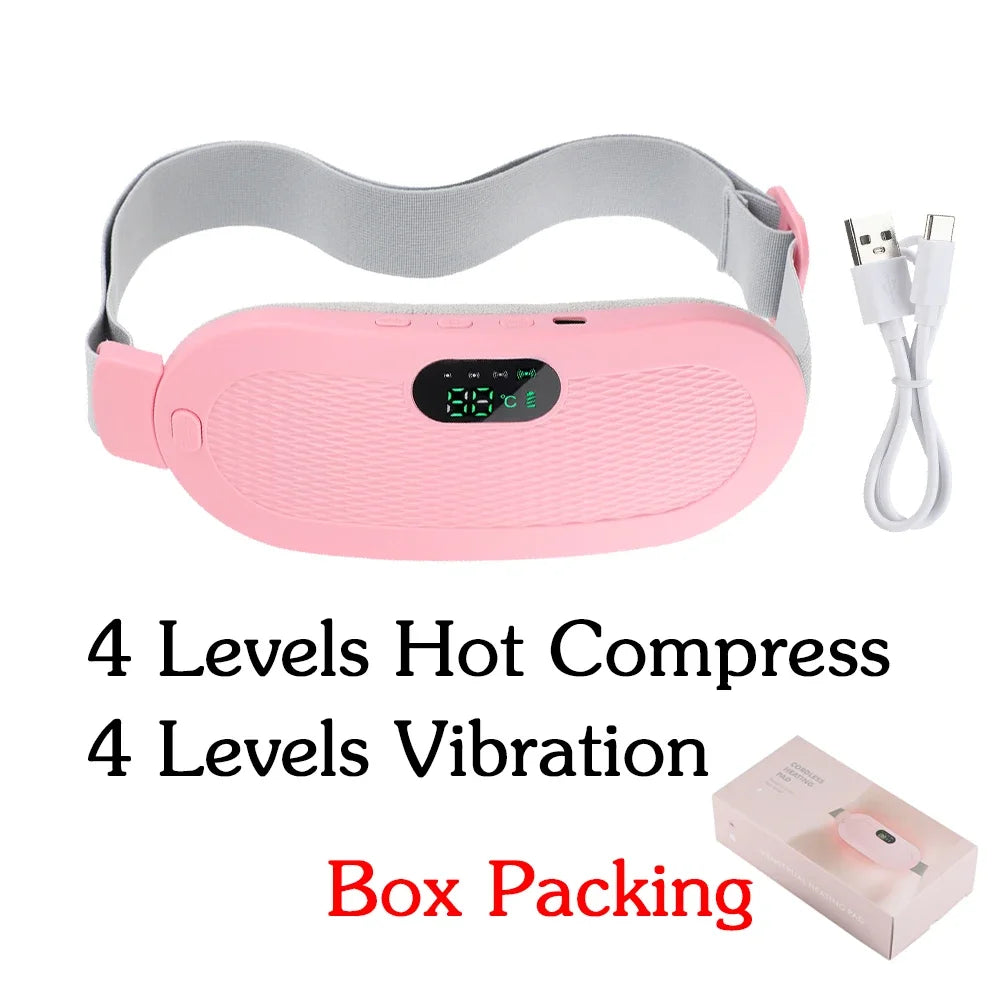
Heating Pad vs Heated Belt for Period Cramps
Heat is commonly used as a comfort measure for menstrual cramps. The practical question is not simply whether heat can be useful, but which delivery format makes it easiest for you to apply comfortable warmth where you want it.
When a heating pad may be the better choice
A heating pad can be a strong option when your period discomfort is mainly experienced while resting at home. If you want to lie down with warmth across your lower abdomen or lower back and do not need to move around, the larger surface of a pad can be convenient.
It can also be useful when you want to cover more than one area at once. For example, a larger pad may be positioned to provide warmth across part of the lower back while you rest.
The main limitation is mobility. A traditional corded heating pad is not designed around active movement, and its position may need adjustment as you change posture.
When a heated belt may be the better choice
A heated belt makes more sense when targeted abdominal warmth and portability are priorities. Its wearable design helps keep the heating area positioned around the abdomen or waist while you perform light activities.
That can matter during a workday. Instead of stopping what you are doing to hold a heat source against your abdomen, a wearable belt can be adjusted around the body and used while sitting at a desk.
The same advantage applies when traveling. A compact rechargeable device can be easier to pack than a larger heating pad and does not necessarily require access to a wall outlet during use.
What to look for in abdominal heat therapy
- Adjustable heat settings rather than one fixed temperature.
- A secure, comfortable fit around the abdomen or waist.
- Soft materials that feel comfortable against clothing or skin as directed.
- A rechargeable battery if cordless use is important.
- Simple controls that are easy to operate.
- An automatic timer or shutoff function where available.
- Clear manufacturer instructions for temperature, charging, and session duration.
If you are looking specifically for a cordless format, the Menstrual Heating Pad for Period Relief & Soothing Heat Belt combines adjustable warmth with selectable vibration, a rechargeable 1800mAh battery, and 15- or 30-minute automatic sessions. Its stated use area is the abdomen and waist, making it an example of the targeted heated-belt format.
For shoppers exploring related wellness devices, the Body Care and Health Devices collection can also help put wearable heat and massage products into a broader category context.
4 Practical Alternatives to a Heating Pad
Hot water bottle
A hot water bottle is a simple, non-electric heat source that can provide localized warmth without a power cord. It can be inexpensive and convenient at home, but it requires handling hot water and does not provide the same temperature-control interface as an electronic heating device.
Check the bottle and stopper for damage before use, avoid excessively hot water, and follow the manufacturer's instructions for filling and positioning.
Heated belt
A heated belt is the wearable alternative when targeted warmth and mobility matter. Rechargeable models can be particularly convenient because they combine heat with cordless operation.
Some products also add vibration massage. This creates a different experience from a basic heating pad, but vibration should be treated as a comfort feature rather than assumed to provide a medical treatment.
Microwavable heat pack
A microwavable heat pack provides cordless warmth without a battery or electrical cable. It can be useful at home and is easy to store, but it needs to be reheated as it cools. Heating time also needs to be controlled carefully according to the manufacturer's instructions.
Warm compress
A warm compress is one of the simplest options for short periods of localized warmth. It requires little equipment but generally offers less temperature control and shorter-lasting warmth than an electronic heating device.
If your broader interest is in at-home self-care technology, you can also browse the Beauty & Self-Care Blog for related device and routine content.
Decision Matrix: Which Heat Therapy Option Fits Your Needs?
| Your priority | Best fit | Why |
| Broad warmth while resting at home | Heating pad | Larger surface area can cover a wider region |
| Targeted abdominal warmth | Heated belt | Designed to sit around the abdomen or waist |
| Working while using heat | Heated belt | Wearable design supports hands-free use |
| Travel | Rechargeable heated belt | Cordless operation reduces dependence on an outlet |
| Simple low-tech warmth | Hot water bottle | No electrical connection or battery required |
| Short localized warmth | Warm compress | Simple and quick to prepare |
| Menstrual cramps with a need for mobility | Heated belt | Targeted, wearable abdominal warmth |
| Extended rest at home | Heating pad or heated belt | Choose based on coverage, positioning, and manufacturer-approved session limits |
Best for home use
If your primary goal is relaxing on the sofa or in bed, a heating pad is often the straightforward choice. Its larger footprint can provide broad warmth without requiring a wearable fit.
Best for work and everyday movement
A heated belt has the advantage when you want to remain mobile. A cordless abdominal belt can be worn while sitting, reading, working, or completing light tasks, provided the product is intended for that type of use.
Best for travel
For travel, prioritize compact design, rechargeable power, simple controls, and a secure fit. A rechargeable heating belt can eliminate the need to find an outlet during each use, although you still need to keep its battery charged.
The Lifestyle collection is another relevant place to explore portable products designed around everyday convenience and mobility.
Best for menstrual cramps
If your main concern is lower-abdominal warmth during menstruation, a heated belt can be especially practical because its design focuses warmth around the abdomen. A heating pad remains a reasonable choice when you prefer larger stationary coverage.
Best for sleep or extended rest
Do not assume that any heating device is appropriate for overnight use. Follow the specific manufacturer's instructions, including stated session duration and automatic shutoff guidance. A timer can help create a defined session rather than leaving a heat source running indefinitely.
How to Choose a Heated Belt
Once you decide that a wearable format fits your routine better than a traditional heating pad, compare the device itself rather than choosing solely by appearance or advertised maximum temperature.
Heat settings and temperature control
Multiple heat levels give you more control over comfort. A product advertised with a maximum temperature of up to 65°C, for example, should not be interpreted as a recommendation to use the highest setting against the body. Look at the available settings and follow the manufacturer's operating instructions.
Coverage and fit
A heated belt should stay in reasonable contact with the intended area without feeling excessively tight. Check where the manufacturer says the device should be worn and whether the design accommodates the abdomen, waist, or both.
For menstrual use, targeted abdominal coverage can be more important than maximum belt size because the goal is to keep warmth where you want it.
Battery life and rechargeability
Rechargeability is especially useful if you want heat away from a wall outlet. Look for battery capacity, charging connection, and charging requirements. A USB Type-C connection can make charging more convenient because the cable standard is widely used across modern devices.
Controls and convenience
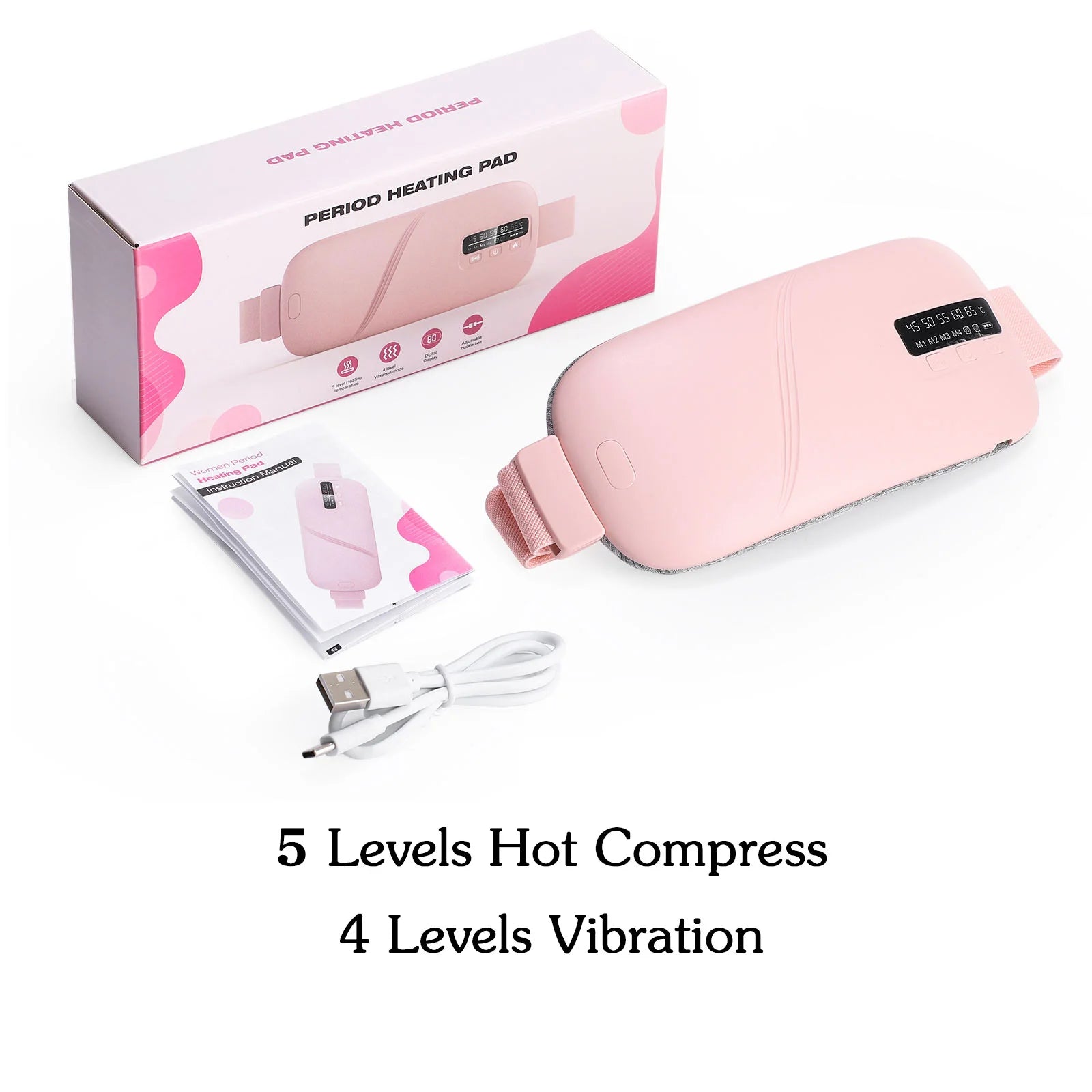
Controls should be easy to understand while the belt is being worn. Features such as adjustable heat, selectable vibration intensity, and automatic 15- or 30-minute sessions can simplify use.
A product that combines heat and vibration can also appeal to users who want more than passive warmth. However, vibration intensity is a comfort preference, so buyers should choose a setting that feels gentle and appropriate rather than assuming stronger vibration is better.
Safety features
Automatic session timers are useful because they create a defined operating period. Temperature regulation, clear charging instructions, and an accessible control system can also improve everyday usability.
Before purchasing, review the manufacturer's instructions for charging, cleaning, temperature settings, intended body location, and session duration. For any heat-producing consumer device, proper use is more important than simply selecting the product with the highest advertised temperature.
For readers who want a product that matches these criteria, the rechargeable menstrual heating belt offers adjustable warmth, selectable gentle vibration, a 1800mAh rechargeable battery, USB Type-C charging, and automatic 15- or 30-minute sessions. These features make it a practical example of what to look for when portability and targeted abdominal use are priorities.
Heating Pad vs Heated Belt: Pros and Cons at a Glance
Heating pad pros and cons
- Pros: Broad coverage, straightforward operation, useful for stationary rest, and often available with multiple heat settings.
- Cons: Corded models require an outlet, can restrict movement, and may shift when you change position.
Heated belt pros and cons
- Pros: Targeted abdominal warmth, wearable positioning, hands-free use, and cordless portability when rechargeable.
- Cons: Smaller heat coverage than many full-size pads, requires charging for cordless use, and fit can affect comfort.
Hot water bottle pros and cons
- Pros: Simple, cordless, reusable, and does not require an electrical power source.
- Cons: Requires hot water, loses heat over time, and needs careful handling to avoid burns or leaks.
Safety Tips for Using Heat Therapy
Follow the manufacturer's temperature and usage instructions
Every heating device has its own operating limits. Follow the manufacturer's instructions for temperature, placement, charging, cleaning, and session duration. Do not modify the device or use it in a way the manufacturer does not recommend.
Avoid excessive or prolonged heat exposure
More heat is not automatically better. Use the lowest comfortable setting that meets your needs and respect any automatic timer or recommended session duration. Avoid placing a heat source directly against skin for longer than instructed, particularly at higher temperatures.
Check the device before use
Inspect heating pads, belts, cables, connectors, fabric, controls, and battery components before use. Stop using a device if you notice damaged wiring, frayed materials, swelling, unusual odors, exposed components, or other signs of damage.
For rechargeable products, use the recommended charging equipment and follow the manufacturer's charging instructions. Do not use a damaged battery or continue charging a device that shows signs of malfunction.
Know when to seek medical advice
Heat therapy is a comfort strategy, not a substitute for medical evaluation. Severe, unusual, persistent, or worsening menstrual pain deserves attention from a qualified healthcare professional, particularly when symptoms are significantly different from your normal cycle or interfere substantially with daily life.
Heating Pad Versus Heated Belt: Which Should You Choose?
The simplest decision rule is this: choose a heating pad for broad, stationary warmth and choose a heated belt for targeted, portable, hands-free warmth.
If you spend your period days resting at home and want coverage across your abdomen or lower back, a traditional heating pad may be all you need. If you want to keep moving, work at a desk, travel, or maintain targeted warmth around your abdomen without staying beside an outlet, a rechargeable heated belt can be the more convenient format.
For shoppers who prioritize those wearable features, the Menstrual Heating Pad for Period Relief & Soothing Heat Belt is designed around adjustable warmth, gentle vibration, cordless operation, and timed sessions. The key is not choosing the most powerful heat device, but choosing the format that fits your routine and using it according to the manufacturer's safety guidance.
Pillar Article: Best Heated Abdominal Belt for Women: Top Picks for Comfort













