

Does a smart dust sensor really improve cleaning results?
A smart dust sensor can improve cleaning results by detecting microscopic particles in real time and automatically adjusting device performance based on actual dust levels. Instead of running at a fixed power setting, devices with automatic dust detection can increase suction when debris levels are high and reduce energy use when surfaces are cleaner. This adaptive response helps remove hidden particles more effectively, improves cleaning efficiency, and supports better indoor air quality.
Understanding Dust Sensor Technology: How Smart Detection Improves Air Quality and Cleaning
A home can look clean while still containing invisible particles such as fine dust, pollen, pet dander, and other airborne debris. These particles can remain suspended in indoor air, settle into carpets and flooring, and contribute to reduced indoor air quality over time.
Dust sensor technology helps address this problem by allowing smart devices to detect and respond to changing particle levels automatically. Used in vacuum cleaners, air purifiers, air quality monitors, and smart home systems, dust detection technology enables appliances to adjust their operation according to real environmental conditions instead of relying on fixed settings.
⏱ 5 min read
Unlike traditional devices that operate with the same power level regardless of the environment, appliances equipped with smart dust sensors continuously analyze particle concentration and optimize performance when needed. This technology improves cleaning precision, supports healthier indoor spaces, and creates a more efficient smart home experience.

Smart dust sensor detects hidden debris and boosts dust removal in home See it in action
What Is Dust Sensor Technology?
Dust sensor technology refers to electronic sensing systems designed to detect and measure airborne particles, including dust, smoke, pollen, and microscopic debris. A dust sensor collects information about particle concentration and converts those measurements into electrical signals that connected devices can interpret.
The primary dust sensor function is to help devices understand their surrounding environment. Modern dust detection technology is commonly integrated into vacuum cleaners, robot vacuums, air purifiers, HVAC systems, and indoor air quality monitors. By continuously tracking particle levels, these systems can automatically adjust suction power, increase filtration performance, or provide real-time air quality information.
Definition of dust detection technology
Dust detection technology uses sensing methods such as optical, infrared, or laser-based measurement to identify particles moving through a sensor chamber. When particles interact with a controlled light source, the sensor detects changes in light scattering or intensity and uses this information to estimate the amount of dust present.
Unlike simple timers or manual controls, dust detection systems respond to actual environmental changes. This allows connected devices to operate more efficiently because they deliver additional power or filtration only when particle levels require it.
How dust sensors differ from general air quality sensors
Although dust sensors and general air quality sensors both monitor indoor environments, they often focus on different measurements. A dust sensor primarily detects particulate matter by analyzing suspended particles, while broader air quality monitoring systems may also measure factors such as gases, humidity, temperature, or volatile organic compounds (VOCs).
An air quality dust sensor is specifically valuable for tracking particle-based pollutants such as fine dust, smoke particles, and airborne allergens. This makes it especially useful in devices where rapid particle detection is needed, including air purifiers and smart vacuum cleaners.
Why hidden dust matters more than visible dirt
Visible dirt represents only a small portion of household particles. Many fine particles are too small to see but can accumulate in fabrics, carpets, furniture surfaces, and indoor air. These particles may continue circulating through living spaces even when floors and surfaces appear clean.
Smart dust sensors help identify these hidden particles by monitoring changes in particle concentration. This allows cleaning and filtration systems to target areas that may require additional attention rather than depending only on what users can see.
Why automatic dust detection matters
Automatic dust detection allows devices to make real-time adjustments without constant manual input. When particle levels increase, a smart dust sensor can trigger stronger suction, faster airflow, or enhanced filtration. When conditions improve, the system can return to a lower operating mode.
This adaptive approach helps balance cleaning performance, energy efficiency, and user comfort. Instead of wasting power by operating at maximum capacity continuously, smart devices respond only when additional performance is necessary.
How Dust Sensors Work
Understanding how dust sensors work begins with their ability to detect particles suspended in the air. Most modern dust detection technology uses light-based measurement methods, where particles interact with a light source inside a small sensing chamber.
The sensor analyzes these interactions, converts them into electrical signals, and processes the data to estimate particle concentration. The final measurement allows a connected device to decide whether it should increase suction, adjust airflow, or provide an air quality alert.
Optical light-scattering detection principle
Optical dust sensors operate by directing light from an LED or laser source through a detection chamber. When airborne particles pass through this light beam, they scatter light in different directions. A photodiode detects the scattered light and measures its intensity.
The amount of detected scattering provides an estimate of particle concentration. More particles generally create stronger scattering signals, allowing the sensor to identify changes in dust levels and communicate this information to the device controller.
Infrared dust sensor technology
An infrared dust sensor uses an infrared light emitter and receiver system to identify particles passing through the sensing area. When dust particles interrupt or scatter infrared light, the receiver detects changes in the signal pattern.
These changes allow the sensor to estimate relative particle density and determine whether dust levels are increasing or decreasing. Infrared sensors are widely used in consumer devices because they provide a practical balance between performance, size, and cost.
Laser particle counting sensors
Laser particle counting sensors provide more detailed measurements by using a focused laser beam and highly sensitive detectors. When particles move through the beam, the sensor analyzes their light-scattering patterns to estimate particle size and concentration.
These advanced sensors are often used in air quality monitoring equipment, industrial environments, and applications where more precise particulate measurements are required.
Signal conversion and particle measurement
After detecting scattered light, the sensor converts the optical signal into electrical data. Internal processing circuits analyze signal strength, frequency, and patterns to estimate the amount of particulate matter present.
The processed information is then sent to the device’s control system. In a vacuum cleaner, this may trigger automatic suction adjustments. In an air purifier, it may control fan speed or filtration intensity based on current indoor air conditions.
Components Inside a Dust Sensor Module
Although a dust sensor module is compact, it contains multiple components that work together to detect particles accurately. Each part plays an important role in collecting air samples, measuring particle interactions, and converting observations into usable data.
Light source and emitter
The light source is one of the most important parts of a dust sensor. Depending on the design, the sensor may use an LED, infrared emitter, or laser diode to create a controlled beam of light inside the sensing chamber.
This light interacts with passing particles and creates measurable changes that the detector can analyze. The stability and intensity of the light source directly influence measurement consistency.
Photodiode detector
The photodiode detector captures light scattered by dust particles inside the chamber. It converts changes in light intensity into electrical signals that represent relative particle concentration.
Higher-quality detectors can identify smaller changes in particle levels, improving the accuracy and responsiveness of smart dust sensor systems.
Air intake chamber
The air intake chamber controls how particles enter the sensor. It guides airflow through the detection area so dust particles can interact with the light beam under more consistent conditions.
Some sensor modules use airflow channels or small fans to maintain stable sampling. Proper airflow design helps improve measurement reliability by reducing inconsistent readings caused by uneven particle movement.
Signal processing circuitry
Signal processing circuitry converts raw sensor data into information that connected devices can use. These electronic components filter signals, analyze measurements, and communicate particle data to the main control system.
In smart appliances, this processing allows automatic decisions such as adjusting vacuum suction, changing purifier fan speed, or updating indoor air quality readings.
Dust Sensor in Vacuum Cleaners
Many modern vacuum cleaners use dust sensor technology to detect hidden debris that may not be visible during normal cleaning. By analyzing the concentration of particles moving through the airflow path, a vacuum cleaner with a dust sensor can identify areas with higher dust levels and adjust cleaning performance automatically.
This intelligent detection system helps improve cleaning consistency by allowing the vacuum to respond to real conditions instead of using the same power level across every surface. The result is more targeted cleaning, better energy management, and a smoother user experience.
How smart cleaning sensor technology adjusts suction
Smart cleaning sensor technology allows a vacuum to increase suction when it detects higher concentrations of dust, dirt, or fine particles. For example, when the sensor identifies debris trapped inside carpet fibers or concentrated in high-traffic areas, the vacuum can automatically boost airflow and suction power to improve particle removal.
When the detected dust level decreases, the system can reduce suction output to conserve battery power, lower operating noise, and improve overall efficiency. This adaptive approach allows cordless vacuum cleaners to balance strong cleaning performance with longer runtime.
Automatic dust detection during floor cleaning
Automatic dust detection enables vacuum cleaners to adapt to different flooring types and contamination levels without requiring constant manual adjustments. Hard floors with minimal debris may require less power, while carpets, rugs, and areas with accumulated dust can trigger stronger cleaning performance.
By continuously monitoring particle levels during operation, a dust sensor in vacuum cleaner systems helps users focus cleaning power where it is most needed. This is especially useful for homes with pets, frequent foot traffic, or areas where fine dust collects easily.
Explore how this technology works in practice with the cordless handheld vacuum cleaner , which combines powerful airflow with intelligent dust detection.
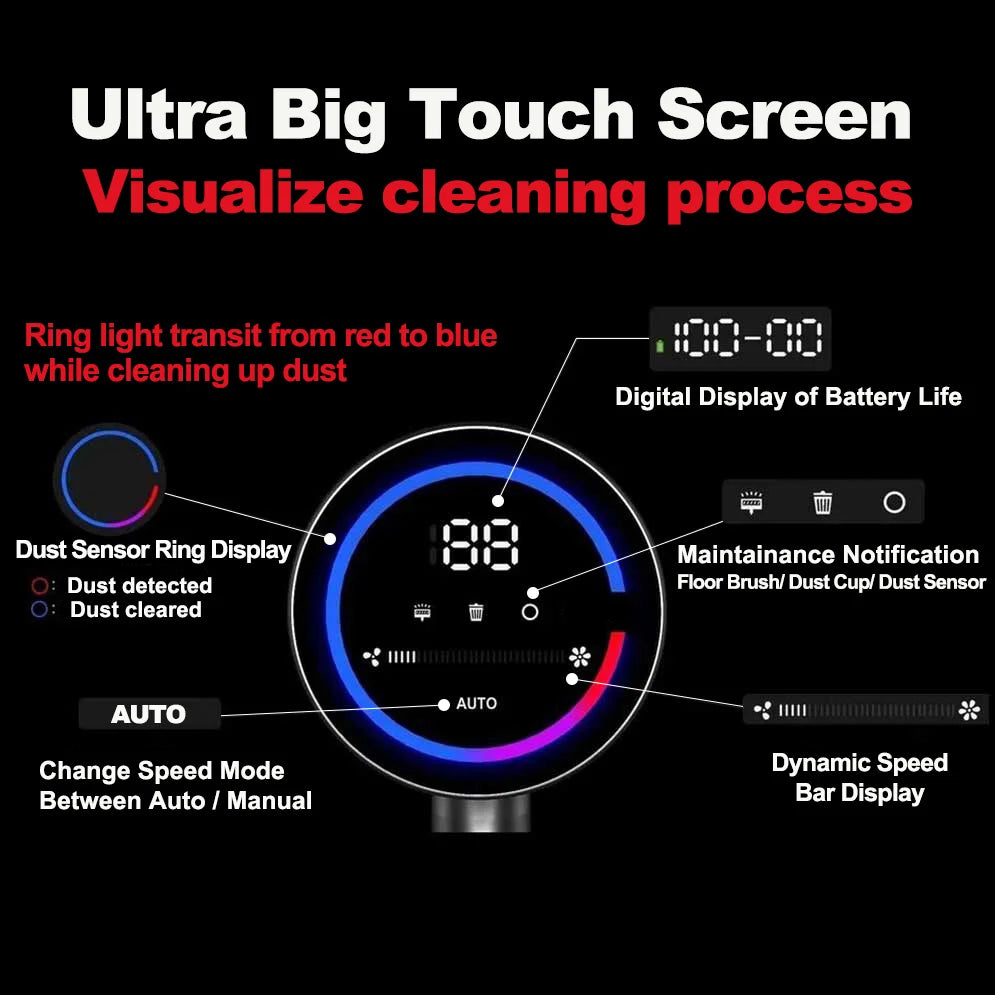
Sensor vacuum adjusts suction instantly for smarter dust removal in home See it in action
Dust Sensors in Air Purifiers and Air Quality Monitors
Air purifiers and air quality monitoring systems use dust sensors to measure airborne particle levels continuously. These sensors allow devices to detect changes in indoor air conditions and respond automatically by adjusting airflow, filtration intensity, or purification settings.
An air quality dust sensor provides valuable information about particulate pollution inside homes and buildings. By monitoring particle concentration in real time, smart air systems can react faster to changes caused by cooking, outdoor pollution, smoke, pet activity, or increased dust accumulation.
Air purifier dust sensor function
The main air purifier dust sensor function is to monitor airborne particles and control purifier performance based on current air conditions. When the sensor detects increased particle levels, the purifier can increase fan speed to move more air through its filtration system and capture pollutants more efficiently.
When air quality improves, the system can reduce fan speed to save energy and maintain quieter operation. This automatic adjustment helps air purifiers operate efficiently without requiring users to manually change settings throughout the day.
Real-time indoor air monitoring
Real-time indoor air monitoring uses dust detection technology to estimate concentrations of particulate matter such as PM2.5 and PM10. These measurements help users understand changes in indoor air quality and make informed decisions about ventilation, filtration, and cleaning routines.
Unlike occasional manual checks, continuous monitoring provides ongoing information about environmental conditions. This makes smart air quality systems more responsive and useful for maintaining healthier indoor spaces.
Dust Sensor Technology in HVAC and Industrial Systems
Beyond consumer appliances, dust sensor technology plays an important role in HVAC systems, commercial buildings, and industrial environments. These sensors help monitor airborne particles, improve filtration management, and support automated environmental control.
HVAC air monitoring
HVAC systems use dust detection technology to monitor air quality throughout ventilation networks. By tracking particle levels in supply and return air pathways, sensors can help identify changes in indoor conditions and determine when filtration performance needs adjustment.
Advanced HVAC systems may use dust sensor data to optimize airflow, monitor filter efficiency, and provide maintenance alerts before air quality problems become more noticeable. This supports more efficient operation and helps maintain cleaner indoor environments.
Industrial dust control
Industrial facilities rely on high-precision dust sensors to monitor airborne particles generated during manufacturing, processing, and other production activities. Continuous particle monitoring helps organizations evaluate air conditions, improve workplace safety measures, and maintain required environmental standards.
Industrial dust detection technology can also support predictive maintenance by identifying changes in particle levels that may indicate equipment wear, filtration issues, or ventilation problems.
IoT and smart building integration
Modern dust sensors can connect with IoT platforms and smart building systems to create automated environmental management solutions. Sensor data can be collected, analyzed, and used to control ventilation, filtration, and air quality systems across large facilities.
By integrating dust monitoring with building automation, organizations can improve energy efficiency, respond quickly to changing conditions, and create healthier indoor environments through data-driven control.
Advantages and Limitations of Dust Sensor Technology
Dust sensor technology helps modern cleaning and air management devices make smarter decisions by measuring real environmental conditions instead of relying on fixed operating settings. While these sensors improve automation, efficiency, and monitoring accuracy, their performance can also be affected by environmental factors and design limitations.
Strengths of optical dust detection
Optical dust sensors provide fast, real-time measurements of airborne particles and can operate continuously inside compact devices. Their ability to detect changes in particle concentration makes them suitable for applications such as vacuum cleaners, air purifiers, and air quality dust sensor systems.
One of the main advantages of optical detection is its balance between performance, size, energy consumption, and cost. These sensors can provide responsive particle monitoring without requiring complex equipment, allowing consumer devices to automatically adjust cleaning or filtration performance.
Factors affecting sensor accuracy
Although modern dust sensors provide reliable particle measurements, accuracy can vary depending on particle size, composition, airflow conditions, and calibration quality. Different particles scatter light differently, meaning a sensor may estimate concentrations rather than directly identify every type of particle.
Advanced dust detection technology uses improved algorithms and calibration methods to reduce measurement errors and provide more consistent readings across different environments.
Humidity and environmental interference
Environmental conditions such as humidity can influence dust sensor performance. High moisture levels may cause particles to behave differently inside the sensing chamber, potentially affecting light-scattering measurements.
Airflow patterns, temperature changes, and contamination inside the sensor chamber can also impact readings over time. Quality devices often include compensation algorithms and protective designs to maintain more stable performance in changing conditions.
Sensor lifespan
The lifespan of a dust sensor depends on the sensor type, operating environment, and maintenance routine. Sensors used in clean indoor environments may continue working effectively for many years, while devices exposed to heavy dust loads may require more frequent cleaning or inspection.
Regular maintenance, proper airflow, and manufacturer-recommended care help preserve measurement accuracy and extend sensor reliability.
Frequently Asked Questions
How accurate is a dust sensor?
Most consumer dust sensors provide relative measurements of particle concentration rather than laboratory-grade analysis. However, modern optical sensors are accurate enough for applications such as vacuum cleaners, air purifiers, and indoor air quality monitoring systems.
The accuracy depends on sensor quality, calibration, airflow design, and environmental conditions. Higher-end systems may use advanced algorithms and reference calibration methods to improve measurement consistency.
What types of dust sensors exist?
The most common types of dust sensors include infrared dust sensors, optical light-scattering sensors, and laser particle counters. Each technology detects airborne particles using different light-based measurement methods.
Infrared sensors are commonly used in compact consumer devices, optical sensors provide a practical balance of performance and cost, and laser particle counters are often selected for applications requiring more detailed particle analysis.
Do dust sensors detect pollen and smoke?
Yes. Many air quality dust sensors can detect airborne particles such as pollen, smoke particles, and fine particulate matter depending on their sensitivity and calibration.
However, dust sensors typically measure particle concentration rather than identify the exact source of the particles. Additional sensors may be required when a system needs to distinguish between different types of pollutants or gases.
How are dust sensors calibrated?
Dust sensors are calibrated by comparing their measurements with reference instruments under controlled conditions. Manufacturers adjust signal processing algorithms so detected light-scattering patterns correspond more accurately with estimated particle concentrations.
Calibration helps reduce measurement differences caused by sensor variation, environmental conditions, or changes in particle characteristics.
Can dust sensors measure PM2.5 and PM10?
Many advanced dust sensors can estimate particulate matter levels such as PM2.5 and PM10 by analyzing particle size and concentration. These measurements are commonly used in indoor air quality monitoring systems to evaluate pollution levels.
How often should a dust sensor be calibrated?
Calibration frequency depends on the device design, operating environment, and manufacturer recommendations. Consumer devices may rely on factory calibration, while professional monitoring systems may require periodic verification to maintain accuracy.
Does humidity affect dust sensor accuracy?
Yes. High humidity can influence how particles interact with light inside the sensor chamber, which may affect readings. Many modern dust sensors include compensation methods to reduce the impact of humidity changes.
How long does a dust sensor typically last?
A dust sensor can often operate for several years when used in suitable conditions and maintained properly. Keeping the sensing area clean and preventing excessive contamination helps support longer service life.
Get yours now — limited stock! Discover how the cordless handheld vacuum cleaner brings intelligent cleaning into your daily routine.













