
850 nm Light: What the 850 nm Wavelength Is and Why It's Widely Used
Why Understanding 850 nm Matters
The 850 nm wavelength is one of the most widely used regions of the near-infrared (NIR) spectrum. Although invisible to most people, 850 nm infrared light plays an essential role in security cameras, biometric authentication, industrial sensors, optical communication, and photobiomodulation therapy.
Understanding what 850 nm means helps explain why manufacturers choose this wavelength over alternatives such as 808 nm or 940 nm. Its unique combination of CMOS sensor sensitivity, tissue penetration, LED efficiency, and illumination range makes it one of the most practical infrared wavelengths available today.
- 850 nm sits just beyond visible red light in the near-infrared spectrum
- It offers strong performance for CCTV, sensors, and imaging systems
- It penetrates biological tissue more effectively than visible light
- It is brighter and more efficient than 940 nm for most camera applications
What Is 850 nm Light?
850 nm refers to light with a wavelength of 850 nanometers. It falls within the near-infrared portion of the electromagnetic spectrum, just beyond visible red light.
Where 850 nm Sits in the Electromagnetic Spectrum
The electromagnetic spectrum spans from gamma rays to radio waves. Visible light occupies only a narrow band between roughly 400 nm and 700 nm.
The 850 nm wavelength sits just beyond red light in the near-infrared region, typically ranging from 700 nm to 1400 nm. This position allows strong interaction with silicon-based imaging sensors while remaining mostly invisible to the human eye.
What Is the 850 nm Wavelength?
A wavelength of 850 nanometers is shorter than thermal infrared wavelengths but longer than visible red light. This allows efficient transmission through certain materials and strong detection by CMOS and CCD sensors used in imaging systems and machine vision.
Is 850 nm Light Visible?
Most 850 nm light is invisible to the human eye. However, high-power 850 nm LEDs often produce a faint deep-red glow due to partial overlap with the visible red spectrum. This is why many night vision illuminators appear to emit a dim red point of light.
How 850 nm Infrared Light Works
How Infrared Radiation Is Produced
Infrared LEDs generate photons when electrical current passes through semiconductor materials. The semiconductor composition determines the emitted wavelength, including 850 nm. This is the basis of modern infrared LED technology used in CCTV illumination and sensing systems.
Absorption, Reflection, and Penetration at 850 nm
At 850 nm, different materials absorb and reflect light in specific ways. Human tissue allows relatively deep penetration compared to visible wavelengths, which is why this range is studied in photobiomodulation. At the same time, silicon sensors remain highly sensitive, making detection efficient.
How Cameras and Sensors Detect 850 nm Infrared Light
CMOS and CCD sensors convert incoming infrared photons into electrical signals. Because sensor sensitivity peaks near this wavelength range, 850 nm provides bright infrared images with relatively low power consumption, especially in machine vision and night surveillance systems.
Why the 850 nm Wavelength Is So Widely Used
Excellent Balance Between Performance and Efficiency
Compared with many infrared wavelengths, 850 nm offers an optimal balance between brightness, cost, efficiency, and sensor compatibility.
- High radiant output
- Strong CMOS and CCD sensor response
- Long illumination range for CCTV systems
- Lower energy consumption than many alternatives
- Wide availability in commercial infrared LEDs and VCSELs
Real-World Applications of 850 nm Infrared Light
Night Vision Cameras and CCTV
Security systems use 850 nm infrared illumination to capture clear images in low-light environments. The light is invisible in darkness but highly detectable by camera sensors.
Biometric Recognition
Facial recognition systems and iris scanners often use 850 nm light due to its ability to produce high-quality imaging while remaining mostly unobtrusive to users.
Optical Communication
Short-range fiber optic systems frequently operate near 850 nm, using VCSEL (Vertical-Cavity Surface-Emitting Laser) technology for efficient data transmission in multimode fiber.
Motion Sensors and Industrial Automation
Industrial systems use 850 nm infrared light for object detection, distance sensing, and automated monitoring in machine vision environments.
Medical Imaging
Near-infrared imaging systems use 850 nm wavelengths to study tissue behavior, as this range provides improved penetration compared to visible light.
850 nm Light Therapy
Photobiomodulation research explores how 850 nm infrared light may influence cellular processes such as energy production and circulation.
850 nm vs 940 nm Infrared Light
Both wavelengths are widely used in near-infrared applications but serve different priorities in imaging and illumination.
Visibility of 850 nm vs 940 nm LEDs
- 850 nm: faint red glow visible at the source
- 940 nm: almost completely invisible
Night Vision Performance Comparison
| Feature | 850 nm | 940 nm |
|---|---|---|
| Brightness | Higher | Lower |
| Camera Range | Longer | Shorter |
| Visibility | Faint red glow | Nearly invisible |
| Image Quality | Stronger signal | Weaker signal |
When Should You Choose 850 nm or 940 nm?
- Choose 850 nm: CCTV, machine vision, long-range imaging, better sensitivity
- Choose 940 nm: covert surveillance, minimal visibility, discreet monitoring
808 nm vs 850 nm
Although both are near-infrared wavelengths, they are optimized for different technologies.
Main Differences
- 808 nm is commonly used in laser-based medical applications
- 850 nm is widely used in LEDs and imaging systems
- 850 nm aligns better with silicon sensor sensitivity
- 808 nm is more common in therapeutic laser systems
850 nm Light Therapy and Biological Effects
How Photobiomodulation Works
Photobiomodulation uses red and near-infrared light to stimulate cellular activity. Research suggests wavelengths around 850 nm may influence mitochondrial function and energy production in cells.
Current Research
Studies continue to examine effects on muscle recovery, inflammation, circulation, and tissue repair. Outcomes depend heavily on dosage, irradiance, and treatment protocols.
Benefits and Limitations
- May support recovery and reduced soreness
- May improve circulation
- Effects vary depending on condition and device
- Not a substitute for medical treatment
Is 850 nm Infrared Light Safe?
Eye Safety Considerations
Infrared light is invisible, so natural blink reflexes may not provide adequate protection. Direct exposure to high-intensity infrared LEDs or lasers should be avoided unless devices are specifically designed for safe use.
Recommended Exposure Levels
Therapy and consumer devices should always be used according to manufacturer instructions. Higher power does not always mean better results; irradiance and exposure time are equally important factors.
How to Choose Devices That Use 850 nm Light
When evaluating infrared devices, wavelength alone is not enough to determine performance.
- Peak wavelength accuracy
- Optical power output
- Irradiance levels (mW/cm²)
- Beam angle and coverage
- Cooling system efficiency
- Safety certifications
- Manufacturer testing data
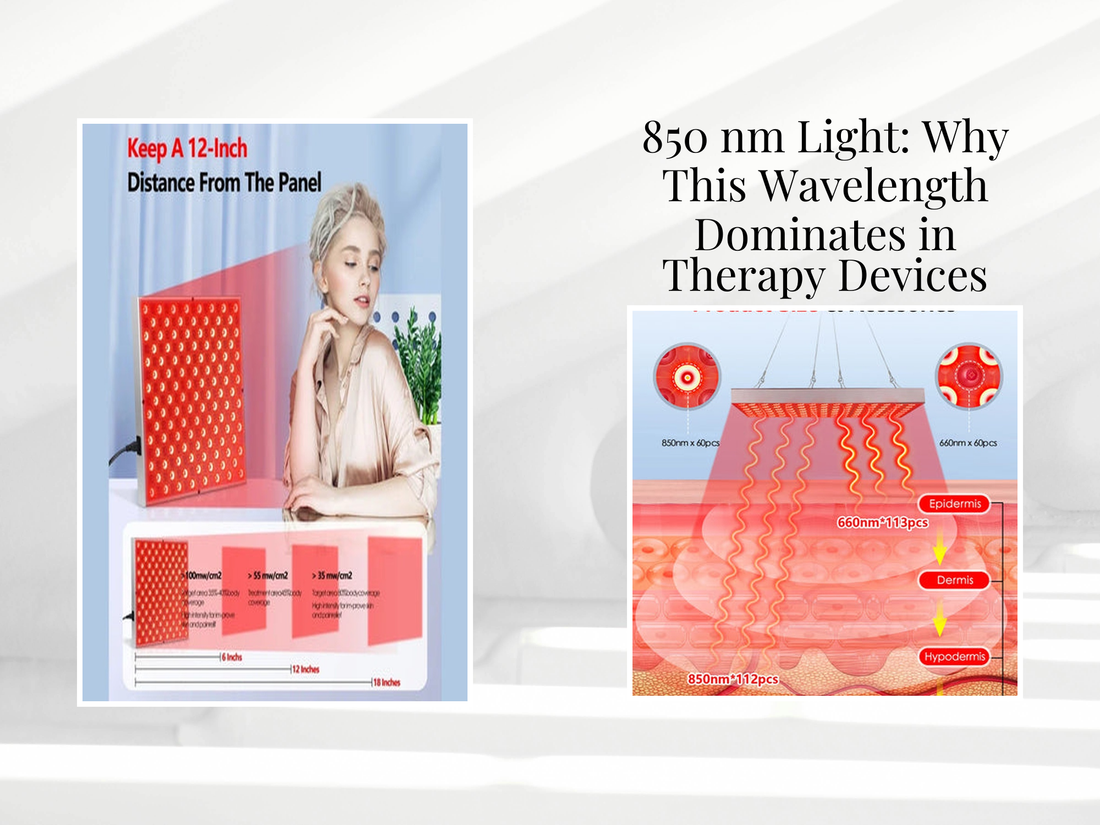
One example is the KentDO 45W Red Light Therapy Panel , which combines visible red light with 850 nm infrared light for both surface and deeper tissue exposure.

850 nm infrared light therapy panel — combines red and near-infrared wavelengths
- 660 nm: surface skin support, collagen stimulation
- 808 nm: laser therapy, deeper medical applications
- 850 nm: imaging, CCTV, photobiomodulation, machine vision
- 940 nm: covert surveillance, minimal visibility systems
Infrared Spectrum Overview
Visible light transitions into infrared wavelengths used in modern technology:
Visible → 660 nm → 808 nm → 850 nm → 940 nm
Frequently Asked Questions (FAQ)
What is 850 nm wavelength?
It is a near-infrared wavelength just beyond visible red light used in imaging, sensing, and therapy applications.
Is 850 nm visible?
Mostly no, but high-power LEDs may produce a faint red glow.
Is 850 nm infrared?
Yes, it belongs to the near-infrared spectrum.
What is 850 nm used for?
It is used in CCTV cameras, biometric systems, optical communication, and photobiomodulation devices.
850 nm vs 940 nm?
850 nm is brighter and better for imaging; 940 nm is more discreet and less visible.
808 nm vs 850 nm?
808 nm is mainly used in medical laser systems, while 850 nm is common in LED-based imaging and sensing.
Does 850 nm penetrate skin?
Yes, near-infrared light can penetrate deeper into tissue compared to visible light.
Is 850 nm safe?
It is generally safe when used according to device guidelines.
Can smartphones detect 850 nm?
Yes, many smartphone cameras can detect infrared light, including 850 nm.
Why do security cameras use 850 nm?
Because it provides strong illumination and excellent compatibility with camera sensors.
Related Articles
- Does Red Light Therapy Work for Pain? Real User Reviews Explained
- Benefits of Near Infrared Light: What Most Reviews Don’t Tell You
- Red Light Therapy for Joint Pain: 5 Best Options That Actually Work
- Best Home Red Light Therapy Machine: What Buyers Wish They Knew Before Choosing













