

Best EMS Machines for Home Use: 2026 Picks Compared
The best EMS machine for home use depends on what you actually want from electrical muscle stimulation. A compact pad-based EMS unit may make more sense for simple muscle activation, while a multi-head system is better suited to users who want broader treatment-area flexibility and a more structured body-sculpting routine. For shoppers focused on targeted muscle stimulation, adjustable intensity or frequency, multiple treatment areas, and convenient sessions matter more than a generic “strongest” claim.
This 2026 comparison takes a practical approach: stimulation type, frequency control, treatment coverage, controls, setup, session length, portability, comfort, and safety come first. It also separates legitimate muscle-stimulation benefits from exaggerated promises about effortless fat loss or dramatic body transformation.
Best EMS Machines for Home Use: Quick Comparison
Our Top Home EMS Picks
- Best for targeted muscle toning: MYOSLIM EMS Body Sculpting Machine — Best suited to users who want adjustable stimulation across larger muscle groups and prefer a touchscreen, multi-head system.
- Best for flexible treatment areas: MYOSLIM — Four detachable treatment heads and support for the abdomen, buttocks, thighs, arms, and back make it more versatile than a single-area device.
- Best for structured short sessions: MYOSLIM — Its stated 20–30 minute session format fits users looking for a defined routine rather than an open-ended stimulation session.
- Best for simple portability: A compact pad-based EMS device — Better when travel size, minimal setup, and a small controller matter more than broad treatment coverage.
- Best for pain-focused electrical stimulation: A TENS-oriented device rather than a general EMS body-sculpting machine — TENS is designed around nerve stimulation and pain-management applications, so it should not automatically be treated as interchangeable with EMS.
How We Compared the Devices
For this comparison, the most important factors are stimulation purpose, adjustable intensity or frequency, electrode or treatment-head configuration, muscle-group coverage, session controls, comfort, ease of setup, and safety information. We also give extra weight to whether a product's marketing language matches what electrical stimulation can realistically accomplish.
For shoppers comparing other devices, the Body Care and Health Devices collection is a useful place to evaluate related home wellness technologies alongside EMS equipment.
How to Choose the Best EMS Machine for Home Use
Stimulation Modes and Waveforms
Do not judge an EMS machine by its frequency number alone. Electrical stimulation devices can use different pulse characteristics, programs, intensities, and electrode configurations to produce different sensations and muscle responses. A larger range can be useful for customization, but it does not automatically mean that one device is more effective than another.
For a body-sculpting routine, look for controls that let you make gradual adjustments rather than forcing you into a single preset. The goal is controlled, tolerable stimulation that fits the intended muscle group.
EMS Intensity Control
Intensity control is one of the most important home-use features. Beginners should be able to start gently and increase stimulation gradually. Stronger is not automatically better; excessive intensity can make a session uncomfortable and may increase the risk of skin irritation or other adverse effects.
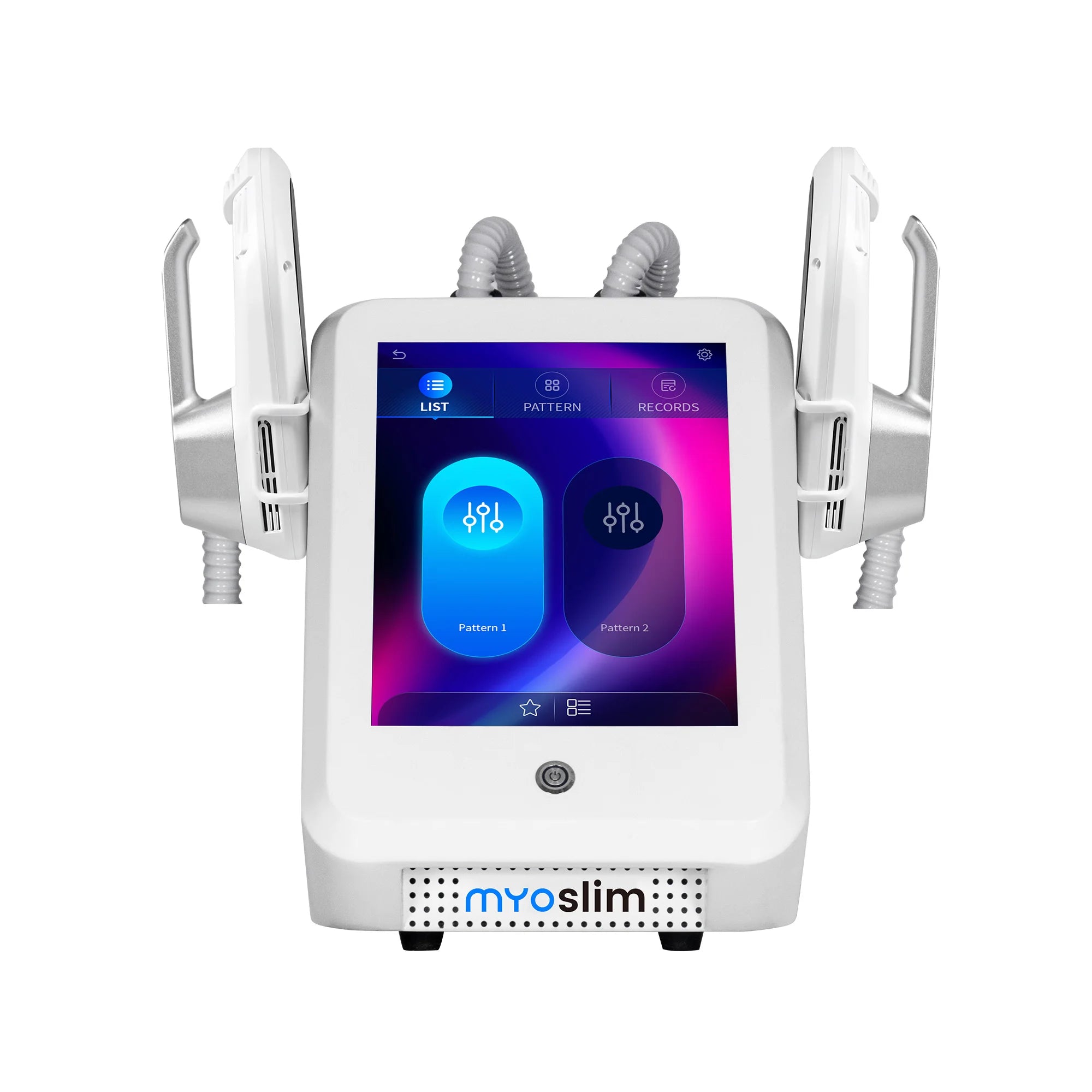
The MYOSLIM system lists an adjustable 20–100 Hz frequency range. Its 10-inch HD color touchscreen also provides a more structured control interface than the minimal controller found on many basic electrical-stimulation products.
Electrode Pads and Placement Options
Traditional EMS devices commonly rely on adhesive electrodes connected to a controller. These can be convenient for targeted muscle activation, but placement and adhesion become increasingly important as you move between muscle groups.
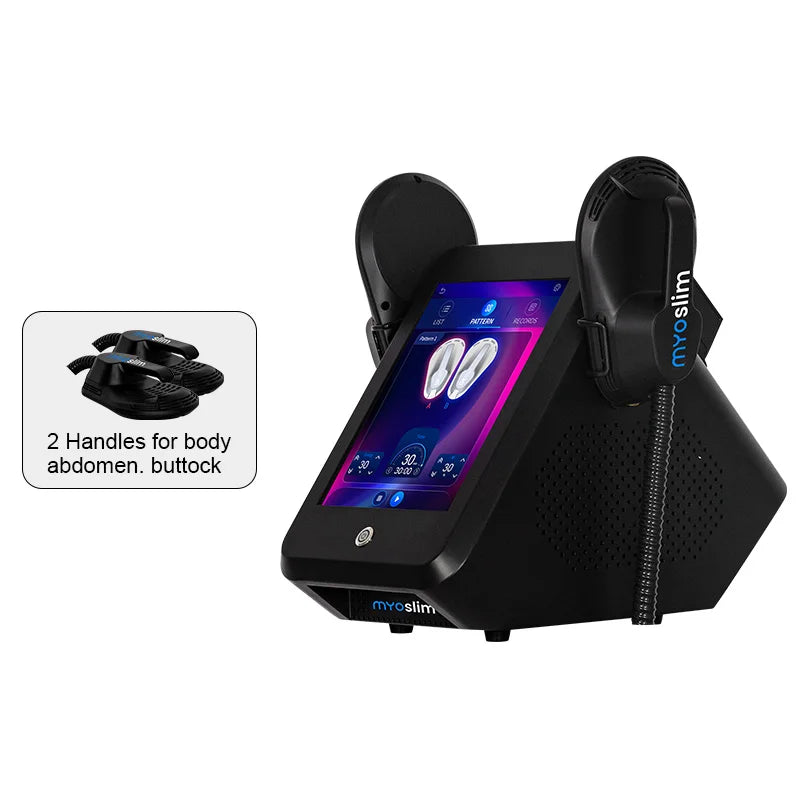
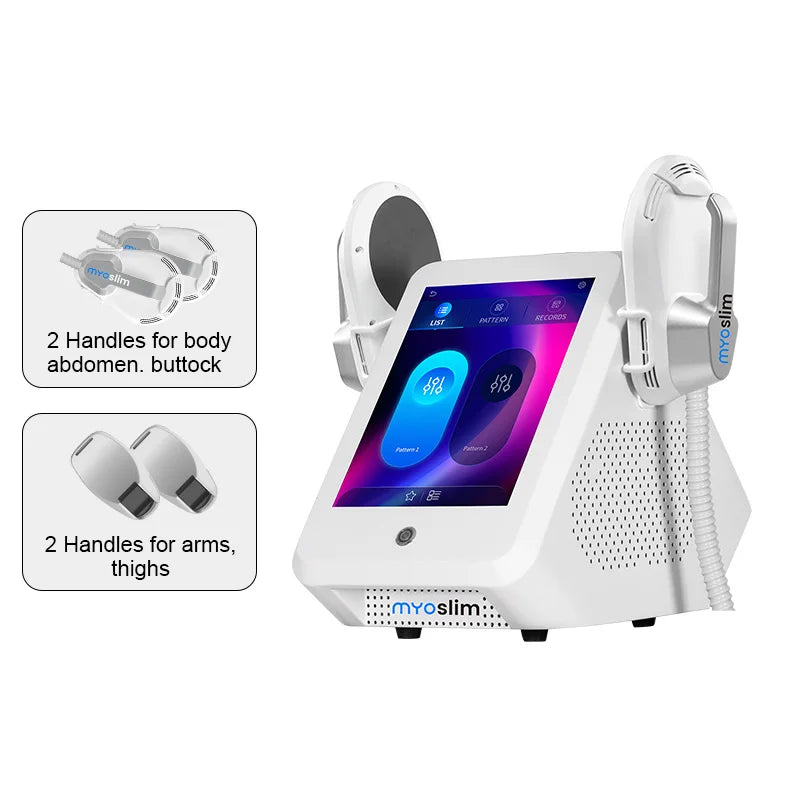
A multi-head system changes that workflow. MYOSLIM uses four detachable treatment heads and is designed for areas including the abdomen, glutes, thighs, arms, and back. That makes it particularly relevant for shoppers searching for an EMS machine for multiple body areas rather than a single-purpose abdominal stimulator.
Portability, Battery Life, and Controls
Compact EMS units usually win on portability. A larger touchscreen system makes a different trade-off: more substantial hardware in exchange for a more centralized interface and broader treatment configuration.
MYOSLIM is therefore better thought of as a dedicated home wellness or professional-setting system than as a pocket-sized travel stimulator. Its listed 20–30 minute sessions can, however, fit easily into a planned routine.
Comfort and Ease of Use
A good home EMS routine should not require a complicated learning curve. Clean, dry skin, correct positioning, gradual intensity increases, and following the manufacturer's instructions are more important than chasing maximum output.
Before purchasing, consider how often you will change treatment areas. If you want to move between the abdomen, glutes, thighs, arms, and back, flexible treatment heads can be more practical than a device optimized for one electrode arrangement.
Safety Features and Device Quality
Electrical muscle stimulators should be treated as electrical devices, not simply as fitness accessories. The FDA notes that electrical muscle stimulators are regulated medical devices in the United States and has received reports involving shocks, burns, bruising, skin irritation, pain, and interference with implanted devices from some products. :contentReference[oaicite:0]{index=0}
When evaluating a device, look for clear instructions, appropriate labeling, controlled intensity adjustment, quality electrodes or treatment heads, session controls, and manufacturer guidance that explains intended use. IEC 60601-2-10 is a recognized consensus standard covering basic safety and essential performance requirements for nerve and muscle stimulators. :contentReference[oaicite:1]{index=1}
Best EMS Machines for Different Goals
Best for Muscle Stimulation
If your priority is muscle activation, focus on stimulation control and muscle-group coverage rather than cosmetic marketing. A useful home system should let you control stimulation comfortably and position treatment elements over the intended muscle group.
MYOSLIM is a strong fit for this particular use case because it combines EMT and EMS technology, provides adjustable 20–100 Hz frequency, and includes multiple detachable treatment heads. Those specifications make it more adaptable for targeted muscle-stimulation routines than a device designed around only one small muscle area.
Pros:
- Adjustable 20–100 Hz frequency
- Four detachable treatment heads
- Designed for several major muscle groups
- 10-inch HD touchscreen control
Cons:
- Larger than a basic portable pad-based EMS unit
- Not the right category if your primary objective is pain management
- Product specifications alone cannot establish a specific clinical outcome
Best for Muscle Recovery
Recovery is a different buying goal. Users looking for rehabilitation or medically supervised muscle re-education should not assume that a consumer body-sculpting device is equivalent to a clinical NMES system. FDA guidance describes powered muscle stimulators in medical contexts such as muscle re-education, prevention of disuse atrophy, and maintaining range of motion, generally within appropriate clinical use. :contentReference[oaicite:2]{index=2}
For ordinary wellness use, adjustable stimulation and comfortable session controls may make an EMS device convenient, but anyone using electrical stimulation for a medical recovery problem should follow professional guidance.
Best for Toning-Focused Routines
MYOSLIM EMS Body Sculpting Machine is best positioned here. Its product configuration is built around targeted muscle stimulation and body-contouring routines rather than pain relief. It supports sessions aimed at the abdomen, glutes, thighs, arms, and back and allows two areas to be addressed together through its treatment-head configuration.
Importantly, “toning” should not be interpreted as automatic fat removal. A systematic review of whole-body electromyostimulation found evidence of improvements in muscle mass and strength, while evidence for body-fat reduction has been less consistent across studies. :contentReference[oaicite:3]{index=3}
Best for Beginners
Beginners should prioritize simplicity over maximum specifications. A straightforward controller and clearly marked intensity settings may be preferable if you are learning electrode placement for the first time.
MYOSLIM can make sense for beginners who specifically want a larger body-sculpting system because its touchscreen interface provides a centralized control point. However, first-time users should still begin conservatively and follow the supplied instructions for treatment placement and intensity.
Best Overall Value
Value depends on what you will actually use. A small EMS device can be the better value for someone who needs occasional stimulation of one muscle group. A multi-head system can provide better functional value for someone who wants one device covering several body areas.
For the latter buyer, MYOSLIM's combination of four detachable heads, 20–100 Hz adjustment, touchscreen controls, and 20–30 minute sessions gives it a strong feature-to-use-case fit.
If you are building a broader home wellness setup, you can also browse the Body & Face Blog for related guidance on body-care technologies and routines.
For shoppers whose goal is specifically targeted muscle stimulation and body contouring, explore the MYOSLIM EMS body sculpting system and compare its treatment-area flexibility with the simpler devices you may already be considering.
EMS vs TENS vs NMES: What's the Difference?
Electrical Muscle Stimulation (EMS)
EMS generally refers to electrical stimulation intended to produce muscle contractions. In practical terms, the device delivers electrical impulses through electrodes or treatment elements, activating nerves associated with the target muscles.
Transcutaneous Electrical Nerve Stimulation (TENS)
TENS is primarily associated with electrical nerve stimulation for pain-management applications. That makes it a different purchasing category from an EMS body-sculpting machine. If pain relief is your main objective, a TENS-oriented product may be more appropriate than selecting an EMS device simply because both use electrical stimulation.
Neuromuscular Electrical Stimulation (NMES)
NMES is used to describe electrical stimulation intended to activate nerves and produce muscle contractions, particularly in rehabilitation and muscle-function applications. The terminology can overlap with EMS, so shoppers should examine the actual intended use, regulatory status, controls, and instructions instead of relying only on the label.
Which Type Is Right for Home Use?
- Muscle activation or toning-focused routines: Look for an appropriately designed EMS/NMES-type muscle stimulation device.
- Pain-management goals: Consider a TENS device designed and labeled for that purpose.
- Rehabilitation or impaired muscle function: Follow clinician guidance and use a device appropriate for the medical application.
- Multi-area body-sculpting routines: A system with multiple treatment heads and adjustable stimulation may offer greater practical flexibility.
EMS Machine Specification Matrix
| Feature | Why It Matters | MYOSLIM |
| Technology | Determines the type of stimulation and intended routine | EMT + EMS |
| Frequency | Allows stimulation to be adjusted to the selected program | 20–100 Hz |
| Treatment heads | Influences treatment-area flexibility | 4 detachable heads |
| Target areas | Determines how broadly the system can be used | Abdomen, buttocks, thighs, arms, back |
| Controls | Affects setup and day-to-day usability | 10-inch HD color touchscreen |
| Session length | Helps users build a consistent routine | 20–30 minutes |
| Power | Indicates the electrical specification listed by the manufacturer | 6500W listed |
| Voltage | Important for electrical-device specifications and safety | <50V AC listed |
What the Specs Mean in Real Use
The most useful specifications are the ones that affect your actual routine. Four detachable heads matter if you regularly switch between muscle groups. A 20–100 Hz adjustment range matters if you want more control over stimulation settings. A touchscreen matters if you prefer a larger interface to a small handheld controller.
By contrast, a large wattage figure should not be treated as a direct measurement of effectiveness. Technical power specifications are not interchangeable with muscle-building results, and shoppers should avoid assuming that higher numbers automatically mean better outcomes.
EMS Electrode Placement: Where and How to Use the Pads
General Electrode Placement Principles
Place electrodes or treatment heads only where the manufacturer indicates for the selected program. Skin should generally be clean and dry, and the stimulation elements should make appropriate contact without forcing them onto unsuitable areas.
Placement is not a cosmetic detail. Moving electrodes changes which nerves and muscles are stimulated, which is why a generic internet placement diagram should not replace the device's own instructions.
Common Muscle Areas
Common muscle groups used with appropriately designed stimulation devices include the abdomen, glutes, thighs, and arms. MYOSLIM additionally lists the back among its intended treatment areas.
For abdominal or glute-focused routines, the objective should be appropriate muscle activation rather than trying to place stimulation directly over an area simply because it contains visible body fat.
Where Not to Place EMS Electrodes
Follow the manufacturer's warnings closely. FDA guidance for powered muscle stimulators includes precautions against stimulation across the chest, over the neck or mouth, across the head, and over swollen, infected, inflamed, or otherwise unsuitable tissue. It also warns that stimulation may interfere with implanted cardiac devices. :contentReference[oaicite:4]{index=4}
Do not improvise electrode placement or use a device over an area that the instructions specifically exclude.
How to Use an EMS Machine at Home
Step 1: Prepare Your Skin and Device
Check the device, treatment heads, cables, and controls before beginning. Prepare clean, dry skin and make sure the system is configured according to its instructions.
Step 2: Position the Electrodes
Use the manufacturer's placement guidance for the specific muscle group and program. Do not assume that placement for the abdomen can simply be copied to the glutes, thighs, arms, or back.
Step 3: Start at a Comfortable Intensity
Begin at a low, comfortable level and increase gradually if the device instructions allow it. A strong sensation is not proof of a better session. The goal is controlled stimulation rather than discomfort.
Step 4: Follow the Session Timer and Program
Follow the recommended program and session duration. MYOSLIM specifies typical sessions of approximately 20–30 minutes depending on the selected program and treatment area. Consistency with the manufacturer's directions is more useful than extending sessions simply to chase faster results.
Step 5: Remove and Store the Pads Correctly
After the session, remove treatment elements carefully, check the skin for unusual irritation, and store the components according to the manufacturer's instructions. Damaged cables, worn electrodes, or deteriorating conductive surfaces should not be ignored.
Are EMS Machines Safe to Use at Home?
Important EMS Safety Precautions
Home EMS is not risk-free. The FDA has reported adverse events associated with some electrical muscle stimulators, including burns, shocks, bruising, skin irritation, and pain. It also emphasizes proper device design, labeling, instructions, and compliance with applicable regulatory requirements. :contentReference[oaicite:5]{index=5}
- Follow the manufacturer's instructions and warnings.
- Do not use damaged equipment, cables, or treatment elements.
- Start at a comfortable stimulation level.
- Stop if you experience significant pain, burning, unusual symptoms, or persistent skin irritation.
- Keep electrical stimulation equipment away from children.
- Do not use a portable stimulator while driving or operating machinery when involuntary contractions could create a safety risk. :contentReference[oaicite:6]{index=6}
Who Should Avoid or Ask a Clinician Before Use
Electrical stimulation is not appropriate for everyone. FDA guidance identifies important precautions involving implanted cardiac devices, pregnancy, suspected or diagnosed heart problems, epilepsy, recent surgery, impaired sensation, and certain skin or vascular conditions. :contentReference[oaicite:7]{index=7}
If any of these situations apply to you, do not assume a consumer EMS machine is appropriate simply because it is marketed for home use. Ask a qualified clinician and follow the specific device's labeling.
Can You Use an EMS Machine Every Day?
There is no universal “every day” rule that applies to every EMS machine. Appropriate frequency depends on the device, program, intensity, treatment area, and individual circumstances. Published whole-body EMS studies have used substantially different schedules, demonstrating why one generic frequency recommendation should not be applied to every device. :contentReference[oaicite:8]{index=8}
What EMS Can—and Cannot—Do
Potential Benefits of Muscle Stimulation
Electrical stimulation can cause muscles to contract, and research on whole-body electromyostimulation has reported improvements in muscle mass and strength under particular protocols. However, research protocols are not automatically equivalent to every consumer EMS product or home routine. :contentReference[oaicite:9]{index=9}
EMS and Muscle Recovery
Electrical stimulation has legitimate applications in rehabilitation and muscle-function settings. That does not mean every consumer EMS device should be marketed as a medical recovery treatment. For rehabilitation after injury, surgery, neurological problems, or significant weakness, professional assessment is more appropriate than self-prescribing a stimulation routine.
EMS for Fat Loss and Body Sculpting
This is where careful buying decisions matter most. EMS can stimulate muscle contractions, but it should not be treated as a replacement for exercise, nutrition, or a comprehensive weight-management strategy.
The FDA specifically states that EMS devices should not be assumed to produce weight loss or girth reduction, and notes that repeated stimulation may strengthen or tone muscles to some extent without producing the major appearance changes implied by some advertisements. :contentReference[oaicite:10]{index=10}
Research on whole-body EMS is more encouraging for muscle-related outcomes than for straightforward fat loss, with systematic reviews reporting stronger evidence for muscle mass and strength than for body-fat reduction. :contentReference[oaicite:11]{index=11}
That distinction is important when evaluating an “EMS body sculpting machine.” A reasonable claim is targeted muscle stimulation that may support a toning-focused routine. An unreasonable assumption is that electrical stimulation alone will automatically eliminate stubborn fat.
How to Decide Which EMS Machine Is Right for You
Choose Based on Your Primary Goal
- Want targeted muscle stimulation: Prioritize adjustable intensity or frequency and reliable treatment-area coverage.
- Want a toning-focused body routine: Consider a multi-area EMS system such as MYOSLIM, while keeping expectations centered on muscle stimulation rather than automatic fat loss.
- Want pain management: Investigate a properly indicated TENS device instead of assuming EMS and TENS are interchangeable.
- Want clinical rehabilitation: Discuss NMES or other electrical-stimulation options with a healthcare professional.
- Want maximum portability: A compact pad-based system may be more practical than a larger touchscreen machine.
Choose Based on Device Features
Before buying, compare frequency or program adjustment, intensity control, treatment-head or electrode configuration, target-area coverage, session timer, interface, power requirements, and safety instructions.
For someone who wants one system for abdominal, glute, thigh, arm, and back routines, the MYOSLIM EMS body sculpting machine is a logical option to consider because its four detachable heads and adjustable 20–100 Hz frequency are specifically aligned with that multi-area use case.
When to Choose an Alternative
Choose another category when your primary goal does not match the device. TENS may be more appropriate for a pain-focused application. Clinically indicated NMES may be more appropriate for rehabilitation. A conventional exercise program remains important when the objective is comprehensive fitness, cardiovascular conditioning, mobility, or long-term health.
For a broader wellness approach, the Lifestyle collection can complement a device-focused routine with other products intended for everyday wellness.
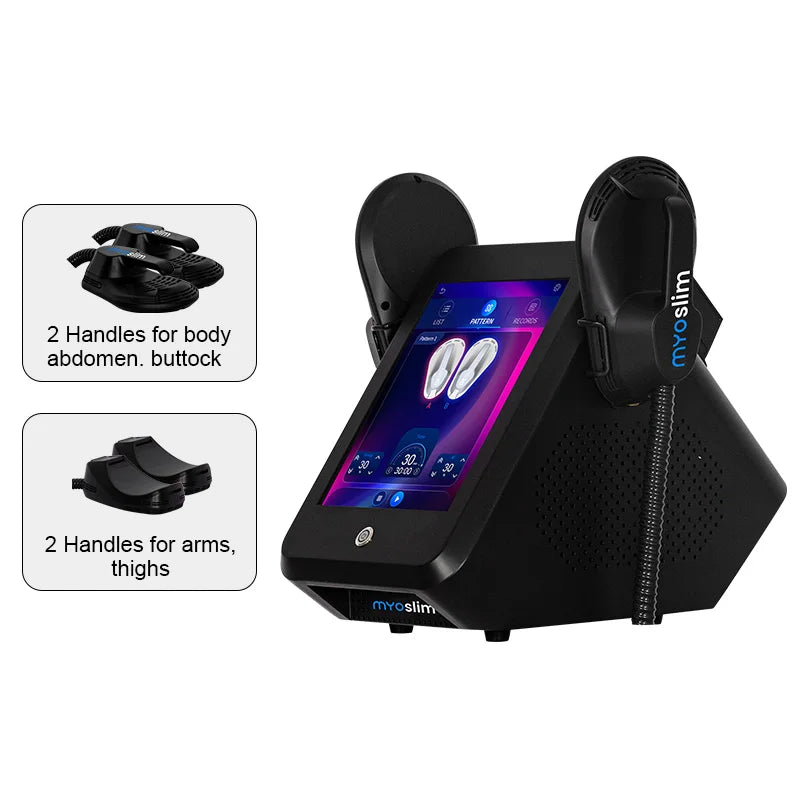
If your specific goal is targeted muscle stimulation across several body areas without adding another long workout session, see the MYOSLIM EMS body sculpting machine and review its treatment-head configuration, frequency range, touchscreen controls, and stated 20–30 minute session format before deciding.
Final Verdict: Which EMS Machine Is Best for Home Use?
There is no single best EMS machine for every home user. The right choice depends on whether you need compact muscle stimulation, pain-focused TENS, rehabilitation-oriented NMES, or a multi-area body-sculpting system.
For shoppers specifically seeking an EMS machine for muscle toning and targeted body-contouring routines, MYOSLIM stands out within the supplied product range because its feature set is built around multi-area stimulation: four detachable treatment heads, 20–100 Hz adjustment, a 10-inch touchscreen, and 20–30 minute sessions. Its best fit is the buyer who values treatment flexibility more than ultra-portable hardware.
The smartest EMS purchase is therefore not the device with the biggest marketing claim. It is the one whose stimulation technology, controls, treatment configuration, comfort, safety guidance, and intended use match your actual routine.
For readers ready to compare a multi-area option against simpler EMS devices, explore the MYOSLIM EMS Body Sculpting Machine for targeted muscle stimulation and make the decision based on your primary goal rather than specifications alone.
Pillar Article: Best Abdominal Muscle Stimulation Devices in 2026













