

Muscle Electrical Stimulation Machine: 2026 Comparison Guide
A muscle electrical stimulation machine can look simple on a product page, yet the differences between models can be substantial. Stimulation technology, frequency range, intensity control, treatment channels, electrode or treatment-head design, preset programs, target areas, controls, safety documentation, and intended use all affect whether a machine actually fits your routine.
For buyers comparing EMS machines for muscle toning, body contouring, conditioning, or targeted muscle stimulation, the right question is not simply “Which machine has the most power?” It is “Which specifications match my goal, treatment area, experience level, and intended frequency of use?”
Electrical stimulation can produce involuntary muscle contractions, and NMES has been studied for muscle strengthening and rehabilitation. However, research does not support treating electrical stimulation as a universal replacement for conventional exercise. Evidence varies by protocol, population, and outcome. :contentReference[oaicite:0]{index=0}
What Is a Muscle Electrical Stimulation Machine?
A muscle electrical stimulation machine delivers controlled electrical impulses through electrodes or treatment heads to stimulate nerves and produce muscle contractions. Depending on the device, electrical stimulation may be used for muscle activation, conditioning, rehabilitation, or other specified purposes.
The important distinction for shoppers is that “electrical stimulation” describes a broad category. EMS, TENS, and NMES are related technologies, but they are not interchangeable.
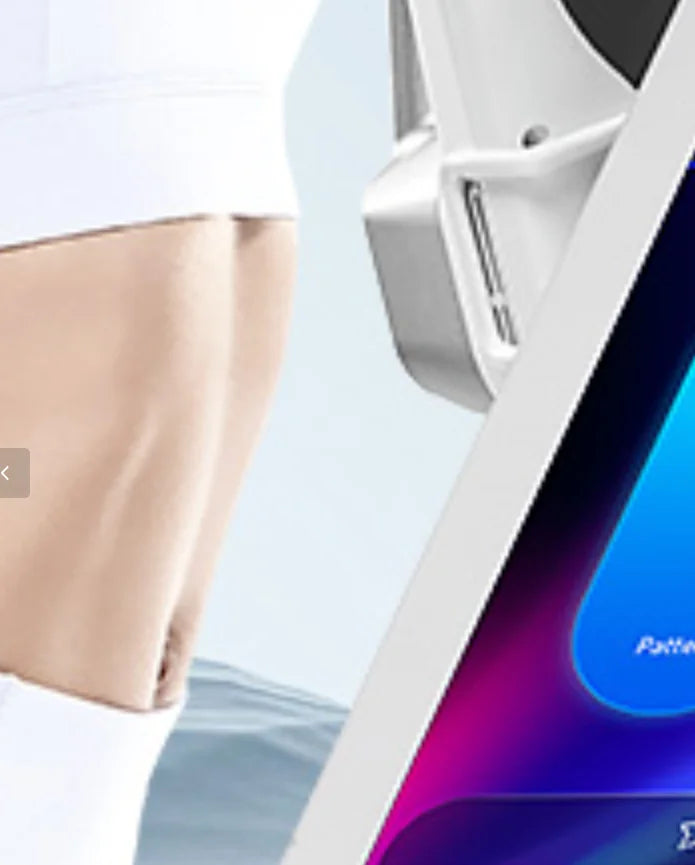
How electrical stimulation creates muscle contraction
Electrical stimulation applies pulses that can activate motor nerves. When the stimulation reaches an appropriate threshold, the targeted muscle contracts. Frequency, pulse characteristics, intensity, electrode position, and treatment duration can all influence the resulting contraction and the user's experience. Research on NMES shows that parameters such as pulse frequency, duration, duty cycle, and amplitude can affect torque production, discomfort, fatigue, and muscle response. :contentReference[oaicite:1]{index=1}
EMS vs TENS vs NMES
- EMS: Electrical Muscle Stimulation generally refers to stimulation intended to activate muscles through electrical impulses.
- NMES: Neuromuscular Electrical Stimulation is a more specific clinical and research term for electrically evoked muscle contractions and is commonly discussed in rehabilitation and muscle-function research.
- TENS: Transcutaneous Electrical Nerve Stimulation is primarily associated with sensory nerve stimulation and pain-management applications rather than directly training muscles.
When comparing products, do not assume that a machine marketed as an EMS device has the same intended use, output characteristics, or regulatory status as a clinical NMES system. The manufacturer's intended use and documentation matter.
Common goals: strengthening, recovery, and conditioning
NMES has evidence supporting improvements in muscle strength in some populations, particularly when protocols are appropriately designed. At the same time, systematic reviews indicate that results can vary and that electrical stimulation should not automatically be considered superior to conventional resistance training. :contentReference[oaicite:2]{index=2}
For a consumer considering muscle toning or body contouring, this distinction is especially important: stimulation can create targeted muscle contractions, but it should not be presented as an effortless substitute for a complete fitness program, nutrition strategy, or medically supervised treatment when those are appropriate.
Muscle Electrical Stimulation Machine Comparison: Key Specifications
The fastest way to compare muscle electrical stimulation machines is to move past marketing phrases and examine the specifications that affect actual use.
Comparison matrix: what to evaluate before buying
- Stimulation technology: Determine whether the machine uses EMS, NMES, electromagnetic stimulation, or a combination of technologies.
- Frequency range: A broader adjustable range can provide more programming flexibility, but a higher maximum frequency does not automatically mean better results.
- Intensity control: Look for meaningful adjustment rather than a simple low/high setting.
- Channels or treatment heads: More channels or heads can make simultaneous or multi-area treatment more practical.
- Programs: Preset programs can simplify operation, while manual controls can provide more customization.
- Electrode or treatment-head design: Examine contact area, placement, cleaning requirements, replacement needs, and compatibility.
- Target areas: Confirm that the machine is designed for the muscles you actually want to address.
- Controls and display: A clear interface makes repeatable sessions easier, particularly for frequent users.
- Power source: Consider whether the unit is mains-powered, rechargeable, or portable.
- Documentation: Check intended use, warnings, operating instructions, warranty, regulatory information, and available support.
Which specifications matter most?
For most buyers, adjustable stimulation control, appropriate treatment areas, usable treatment heads or electrodes, safety documentation, and ease of operation should rank ahead of headline power numbers.
Frequency deserves particular attention. A machine offering 20–100 Hz, for example, provides an adjustable frequency range, but frequency by itself does not establish effectiveness. Research protocols use different combinations of frequency, pulse duration, intensity, duty cycle, placement, and treatment duration. :contentReference[oaicite:3]{index=3}
Feature-priority matrix by user type
- Beginner at home: Prioritize intuitive controls, clear instructions, conservative intensity adjustment, comfortable treatment contact, and straightforward maintenance.
- Muscle-toning user: Prioritize adjustable stimulation, appropriate muscle-area coverage, repeatable programs, and practical session scheduling.
- Frequent multi-area user: Prioritize multiple treatment heads or channels, durable construction, easy cleaning, replacement-part availability, and flexible controls.
- Recovery-focused user: Prioritize controllable stimulation, comfort, program flexibility, and appropriate intended-use documentation.
- Professional environment: Prioritize intended-use labeling, documentation, durability, workflow efficiency, regulatory status where applicable, warranty support, and staff training requirements.
For shoppers focused specifically on body-focused devices, the Body Care and Health Devices collection provides a broader category context before narrowing down to a specific machine.
Where the MYOSLIM EMS machine fits
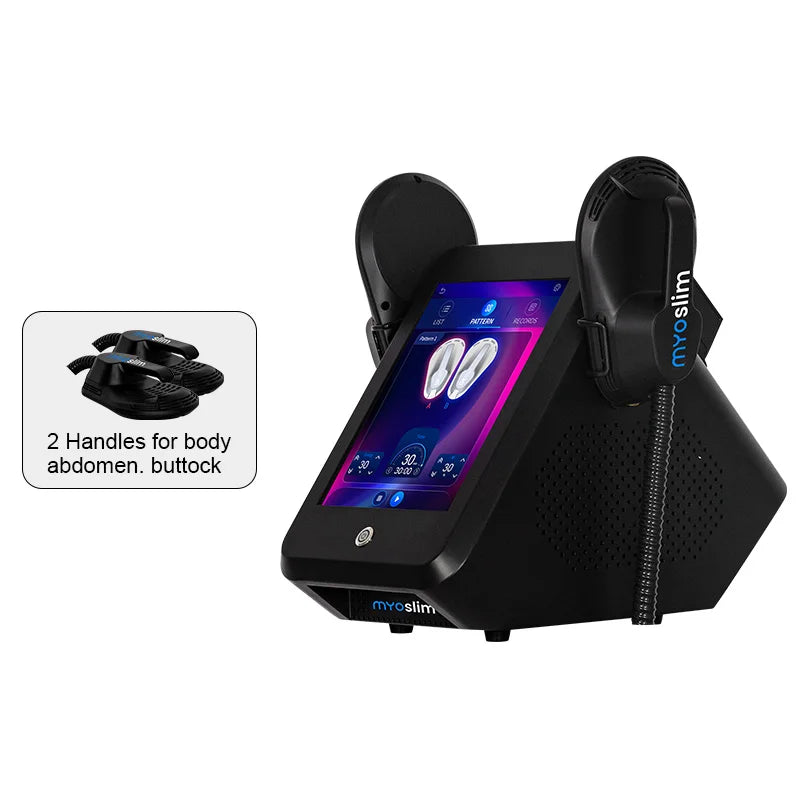
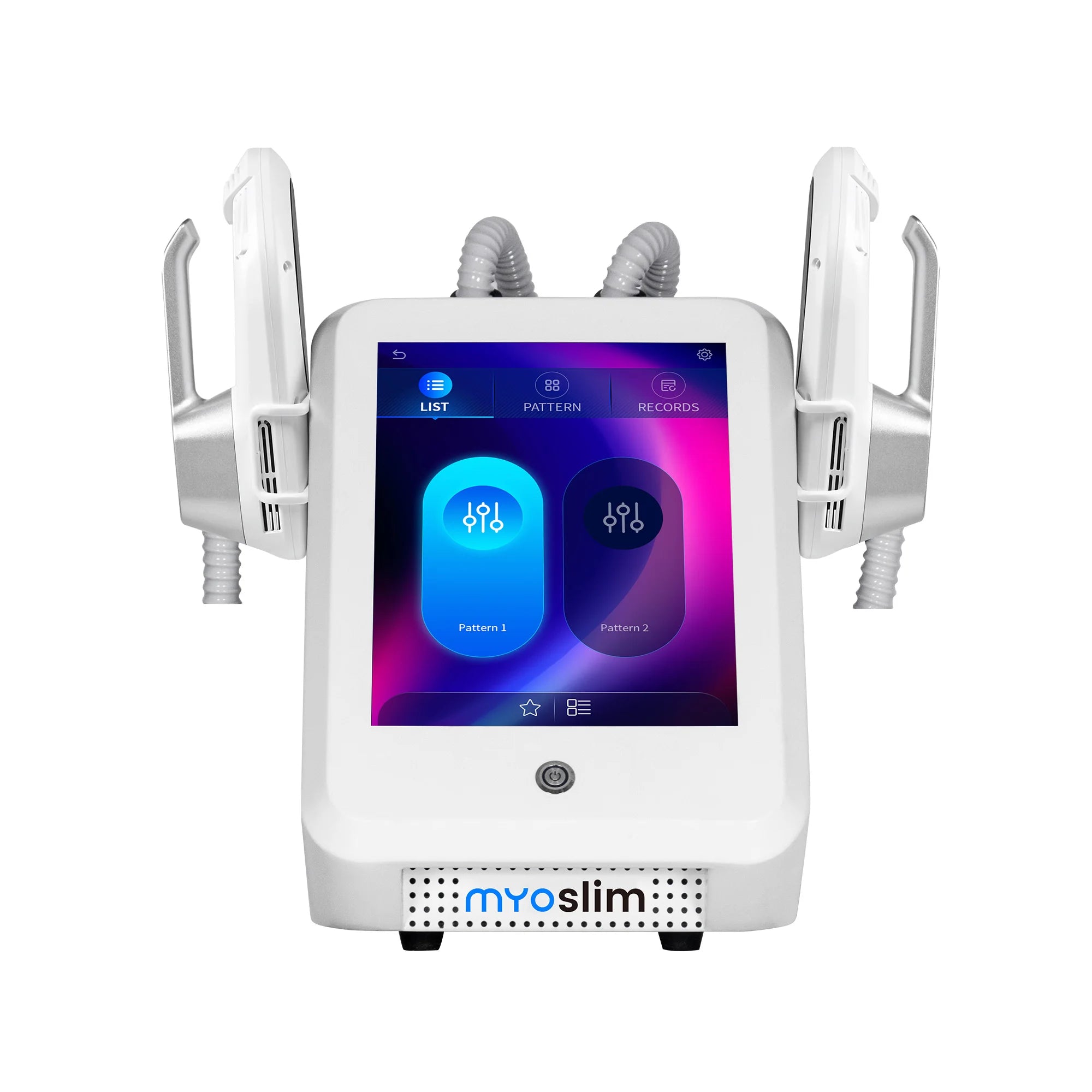
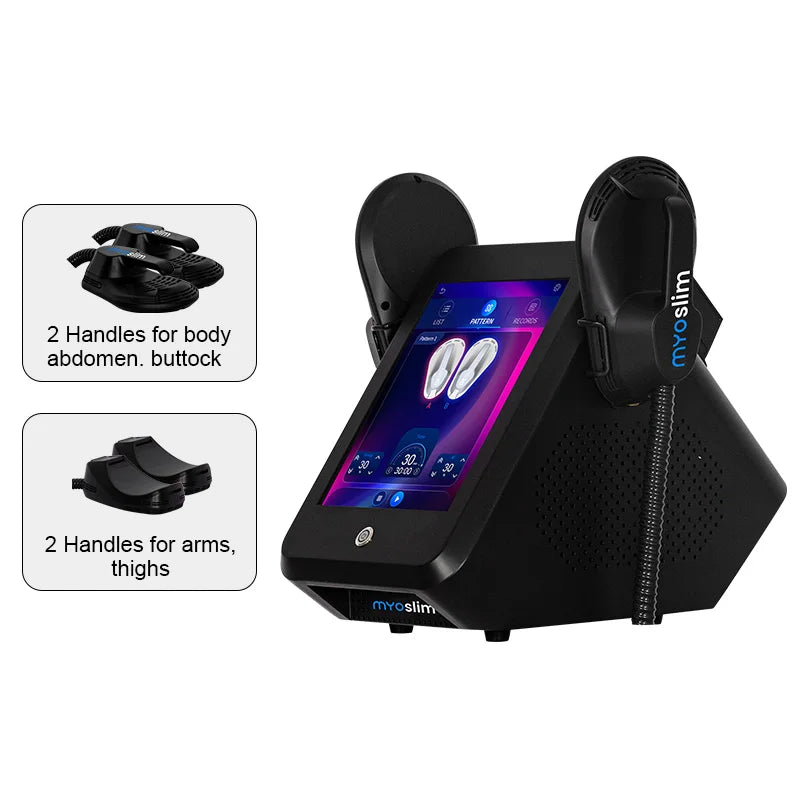
The MYOSLIM EMS Body Sculpting Machine for muscle toning and contouring is positioned around targeted body-sculpting use rather than a small electrode-pad consumer stimulator. According to the supplied product specifications, it combines EMT and EMS technology, includes four detachable treatment heads, offers a 20–100 Hz adjustable frequency range, and uses a 10-inch HD color touchscreen.
Its stated target areas include the abdomen, buttocks, thighs, arms, and back. Sessions are typically described as 20–30 minutes, making the format relevant to users looking for targeted muscle stimulation without adding a lengthy workout session.
Those specifications make it particularly relevant to buyers who value multiple treatment areas, adjustable frequency, a larger touchscreen interface, and simultaneous treatment flexibility. They do not, by themselves, establish that the machine will produce a particular cosmetic or fitness outcome for every user.
For additional beauty-device context, you can also explore the Skin and Beauty Care Devices collection.
Best Muscle Electrical Stimulation Machine Features to Look For
Stimulation modes and intensity range
Adjustability is usually more valuable than a single impressive specification. A useful machine should allow the user to select an appropriate stimulation level and increase it gradually as tolerated.
Do not assume that maximum intensity equals maximum effectiveness. Electrical stimulation can cause discomfort and fatigue, and research specifically identifies parameter selection as important for balancing contraction quality with discomfort and fatigue. :contentReference[oaicite:4]{index=4}
EMS channels and simultaneous treatment areas
Channel configuration affects how many stimulation zones can be managed independently or simultaneously. A single-channel unit may be sufficient for one targeted area, while multi-channel or multi-head systems can make a broader routine more efficient.
The MYOSLIM system uses four detachable treatment heads and is described as allowing two areas to be treated together. That configuration can be useful for users who want to incorporate multiple target areas into a structured session.
Preset programs and customization
Preset programs can reduce setup time, especially for beginners. More advanced users may prefer adjustable parameters that allow sessions to be customized around different muscle groups or comfort levels.
When comparing listings, look for actual information about what can be adjusted rather than relying on phrases such as “professional grade” or “advanced technology.”
Electrode pads and electrode systems
Traditional electrical muscle stimulators commonly use adhesive electrode pads. Buyers should consider pad size, adhesion, skin contact, reusability, replacement cost, connector compatibility, and cleaning requirements.
Systems using dedicated treatment heads require a different evaluation. Examine head design, contact area, placement guidance, cleaning instructions, durability, and whether replacement heads or accessories are available.
Portability, controls, battery, and display
Portable stimulators can be convenient for personal use, while larger professional-style systems may sacrifice portability for a larger interface and broader treatment functionality.
A touchscreen can be particularly useful when a machine offers multiple settings. The MYOSLIM specification lists a 10-inch HD color display, which places greater emphasis on guided operation than the minimal controls found on compact personal stimulators.
Safety features, certifications, and manufacturer documentation
Safety claims deserve more scrutiny than marketing claims about results. In the United States, FDA explains that electrical muscle stimulators are regulated medical devices and that firms marketing such devices must meet applicable premarket requirements. FDA also cautions that EMS products should only be marketed for uses supported by the device's established or supported indications. :contentReference[oaicite:5]{index=5}
Before buying, verify the product's actual intended use, applicable regulatory information, warnings, instructions, warranty, and manufacturer documentation. Do not treat CE marking, a retailer statement, or a generic “FDA approved” phrase as interchangeable claims.
How to Choose a Muscle Electrical Stimulation Machine for Your Goal
For muscle strengthening and conditioning
Look for adjustable stimulation parameters, reliable muscle contact, appropriate placement guidance, and repeatable programs. NMES research supports its ability to improve muscle strength in certain settings, but conventional resistance training remains an important benchmark when comparing outcomes. :contentReference[oaicite:6]{index=6}
For muscle recovery
Prioritize comfort, controllability, program variety, and appropriate intended use. Recovery-focused stimulation should not be confused with a device specifically indicated for treating a medical condition.
For beginners using a machine at home
Choose simplicity over unnecessary complexity. Clear controls, readable instructions, sensible intensity adjustment, accessible treatment-area guidance, and strong safety documentation can be more valuable than an unusually large number of settings.
For frequent or multi-area users
Multi-head or multi-channel systems can make a larger routine more practical. Also consider durability, cleaning, replacement accessories, warranty support, and whether the machine's session format fits your schedule.
For someone who wants a dedicated body-sculpting system with adjustable frequency and multiple detachable treatment heads, the MYOSLIM EMS body sculpting system is a specification-driven option to evaluate against those criteria.
For professional or clinic environments
Professional use requires more than additional features. Intended-use labeling, training requirements, regulatory documentation, durability, technical support, warranty coverage, and workflow should all be evaluated before purchase.
Muscle Targeting and Electrode Placement Basics
Common muscle groups and placement considerations
Commonly discussed targets include the quadriceps, hamstrings, calves, glutes, abdominal muscles, and selected upper-body muscles. Placement should always follow the specific manufacturer's diagrams because electrode position and treatment-head placement are device-dependent.
Electrical stimulation research shows that stimulation site and parameters influence motor-unit recruitment and the resulting muscle response. :contentReference[oaicite:7]{index=7}
Why electrode size and position affect stimulation
Contact area, spacing, skin contact, and position can change how stimulation is perceived and how effectively the intended muscle is recruited. Poor contact can create uneven sensations, while incorrect placement may stimulate an unintended area.
Placement mistakes to avoid
- Do not improvise placement when the manufacturer provides a placement diagram.
- Do not place electrodes on prohibited areas simply because the location appears convenient.
- Do not use damaged electrodes, cables, or treatment heads.
- Do not increase intensity aggressively to compensate for poor placement.
- Do not assume that identical placement instructions apply to different EMS machines.
How to Use a Muscle Electrical Stimulation Machine at Home
Step 1: Prepare the skin and electrodes
Start with clean, dry skin and inspect the electrodes, cables, or treatment heads. Proper contact is important for consistent stimulation. Follow the manufacturer's preparation instructions rather than applying products that could interfere with contact.
Step 2: Position the electrodes correctly
Use the device's specific placement guidance for the selected muscle group. Placement should be deliberate rather than based on trial and error.
Step 3: Select the appropriate program
Choose the program or stimulation mode that corresponds with the device's documented use. If a machine provides frequency or intensity controls, understand what each setting changes before beginning.
Step 4: Start at a comfortable intensity and adjust gradually
Begin conservatively and increase stimulation gradually as tolerated. A strong contraction does not require painful stimulation. Research has linked parameter selection with both contraction performance and treatment discomfort. :contentReference[oaicite:8]{index=8}
Step 5: Finish, remove electrodes, and maintain the device
Complete the manufacturer's recommended session duration, stop the stimulation before removing treatment contacts, and clean or store components according to the instructions. Regular maintenance is particularly important for machines used frequently.
For related wellness-device content, the Body & Face Blog can provide additional context around body-focused routines.
Are Muscle Electrical Stimulation Machines Safe?
Electrical stimulation can be safe when a device is appropriately designed, correctly used, and operated according to its instructions. It is not appropriate for everyone, however, and the safety profile depends on the specific device and intended use.
When electrical stimulation may be inappropriate
Users with implanted electronic devices or certain medical conditions should not assume that an EMS machine is appropriate. FDA guidance for powered muscle stimulators specifically identifies cardiac demand pacemakers as a contraindication and warns against certain electrode locations. :contentReference[oaicite:9]{index=9}
Pregnancy, implanted electronic or medical devices, significant medical conditions, recent surgery, and other circumstances may require professional guidance or may be listed as restrictions by the manufacturer. When in doubt, consult a qualified healthcare professional before using electrical stimulation.
Where electrodes should not be placed
Never improvise placement over sensitive areas. FDA guidance for powered muscle stimulators warns against stimulation over the carotid sinus nerves and against placement over the neck or mouth for the covered devices. :contentReference[oaicite:10]{index=10}
The manufacturer's own warnings should take priority for the specific machine because different technologies and intended uses can have different restrictions.
What normal stimulation should feel like
A user may perceive tingling followed by a controlled muscle contraction, depending on the technology and setting. Sharp pain, burning, unusual discomfort, dizziness, or another concerning response is a reason to stop the session and reassess the setup or seek appropriate advice.
How to verify safety claims
Look for a complete instruction manual, stated intended use, contraindications, warnings, manufacturer identity, warranty information, and applicable regulatory documentation. FDA specifically advises consumers to select legally marketed electrical muscle stimulators because unreviewed devices may not have been evaluated for reasonable assurance of safety and effectiveness. :contentReference[oaicite:11]{index=11}
Home vs Professional Muscle Electrical Stimulation Machines
Home-use machines
Home machines generally emphasize convenience, straightforward controls, compact design, and ease of use. They can be appropriate for buyers who want a repeatable personal routine without the complexity of professional equipment.
Professional machines
Professional systems may emphasize larger interfaces, multiple treatment areas, more extensive controls, durability, documentation, and workflow efficiency. A professional-looking enclosure does not automatically make a machine clinically superior, so buyers should still evaluate intended use and regulatory documentation.
Which type offers better value?
Value depends on utilization. Someone using stimulation occasionally for one area may not benefit from a large multi-head system. A frequent user treating multiple areas may find additional treatment heads, adjustable settings, and a larger interface more useful.
How Much Does a Muscle Electrical Stimulation Machine Cost?
What drives the purchase price?
Machine cost can reflect the number of channels or treatment heads, stimulation technology, control options, preset programs, display quality, construction, included accessories, intended-use classification, warranty, and manufacturer support.
A higher price is worthwhile only when the additional features solve a real need. For example, paying more for simultaneous treatment capability may make sense for someone who regularly works with multiple target areas, while an occasional single-area user may not need it.
Total cost of ownership
Do not evaluate only the purchase price. Consider replacement electrodes or treatment accessories, cables, chargers, batteries where applicable, maintenance requirements, warranty coverage, and availability of replacement components.
Price-to-performance checklist
- Does the machine provide the stimulation type you actually need?
- Is the intensity sufficiently adjustable?
- Are the target areas compatible with your intended routine?
- Can you treat multiple areas efficiently?
- Are treatment contacts durable and maintainable?
- Are instructions and safety information complete?
- Does the warranty justify the purchase price?
- Are replacement accessories realistically available?
Muscle Electrical Stimulation Machine Buying Checklist
10 specifications to verify before buying
- Stimulation type: Identify whether the device uses EMS, NMES, EMT, or another technology.
- Frequency range: Confirm the actual adjustable range rather than relying on a headline maximum.
- Intensity control: Check how precisely stimulation can be adjusted.
- Channels or treatment heads: Determine whether simultaneous treatment is supported.
- Programs: Review preset and customizable options.
- Target areas: Confirm that your intended muscles are supported.
- Power requirements: Check voltage, power source, and operating environment.
- Safety documentation: Read warnings, contraindications, placement instructions, and intended use.
- Warranty: Verify coverage period and what components are included.
- Replacement parts: Check whether electrodes, treatment heads, cables, or other consumables can be replaced.
Red flags in product listings
- Unusually broad promises about weight loss or permanent body transformation.
- No clear intended use or treatment instructions.
- Vague claims about being “FDA approved” without identifying the actual regulatory status.
- No meaningful information about stimulation parameters.
- No contraindications or safety warnings.
- No manufacturer information or warranty terms.
- No information about replacement accessories.
- Claims that electrical stimulation completely replaces exercise without qualification.
FDA notes that many promotional claims made for electrical muscle stimulators have not been supported by scientific information, reinforcing the importance of evaluating the actual intended use and evidence rather than relying on advertising language. :contentReference[oaicite:12]{index=12}
If your priority is a dedicated body-focused system rather than a compact electrode-pad stimulator, the MYOSLIM EMS Body Sculpting Machine is worth comparing against your checklist for frequency adjustment, treatment-head configuration, interface, target areas, and session format.
Pros and Cons of the MYOSLIM EMS Body Sculpting Machine
Pros
- Combines EMT and EMS technology according to the supplied product specifications.
- Offers a 20–100 Hz adjustable frequency range.
- Includes four detachable treatment heads.
- Designed for multiple body areas, including the abdomen, glutes, thighs, arms, and back.
- Uses a 10-inch HD color touchscreen.
- Supports stated 20–30 minute session durations.
- Suitable for buyers seeking a more comprehensive body-sculpting setup than a basic single-channel stimulator.
Cons
- It is a larger, more specialized system than a small portable EMS unit.
- The product's frequency range should not be interpreted as a guarantee of superior results.
- Users should verify intended use, regulatory documentation, contraindications, and operating instructions before purchase.
- It is not a substitute for conventional resistance training when the goal is comprehensive strength and fitness development.
- Users with relevant medical conditions or implanted electronic devices may require professional guidance before electrical stimulation.
Final Verdict: What Makes the Best Muscle Electrical Stimulation Machine?
The best muscle electrical stimulation machine is not necessarily the device with the highest advertised frequency, largest power figure, or longest feature list. It is the machine whose stimulation technology, intensity control, treatment configuration, target areas, controls, safety documentation, and ownership requirements match the way you intend to use it.
For beginners, usability and safety documentation should come first. For frequent multi-area users, treatment-head or channel flexibility becomes more important. For professional environments, intended-use documentation, regulatory status, durability, support, and workflow deserve greater weight.
For shoppers specifically seeking targeted body stimulation and contouring support, the MYOSLIM EMS Body Sculpting Machine for Muscle Toning and Contouring offers a combination of EMT and EMS technology, four detachable treatment heads, a 20–100 Hz adjustable frequency range, a touchscreen interface, and stated 20–30 minute sessions. Evaluate those features against your own target areas, routine, experience, and safety requirements rather than assuming that more features automatically mean better results.
The most useful approach is specification-first: identify your goal, verify the machine's intended use, compare stimulation controls and treatment configuration, review safety documentation, calculate total ownership cost, and only then decide which system offers the best fit.
Pillar Article: Best Abdominal Muscle Stimulation Devices in 2026













