
⏱ 7 min read
Best Straightening Brush for Curly Hair: Top Picks for Thick, Coarse & Frizzy Curls
Finding the best straightening brush for curly hair depends on your curl pattern, hair thickness, frizz level, and styling goals. Unlike flat irons, a hair straightening brush for curly hair combines heated bristles with ionic or ceramic technology to smooth curls while preserving natural volume and reducing styling time.
Whether you're managing loose waves, thick curls, or coarse coils, the right straightening brush can help create smoother, shinier hair with less effort. Below, we compare the best options for thick curly hair, frizz control, and everyday styling performance.
See price — stock low!
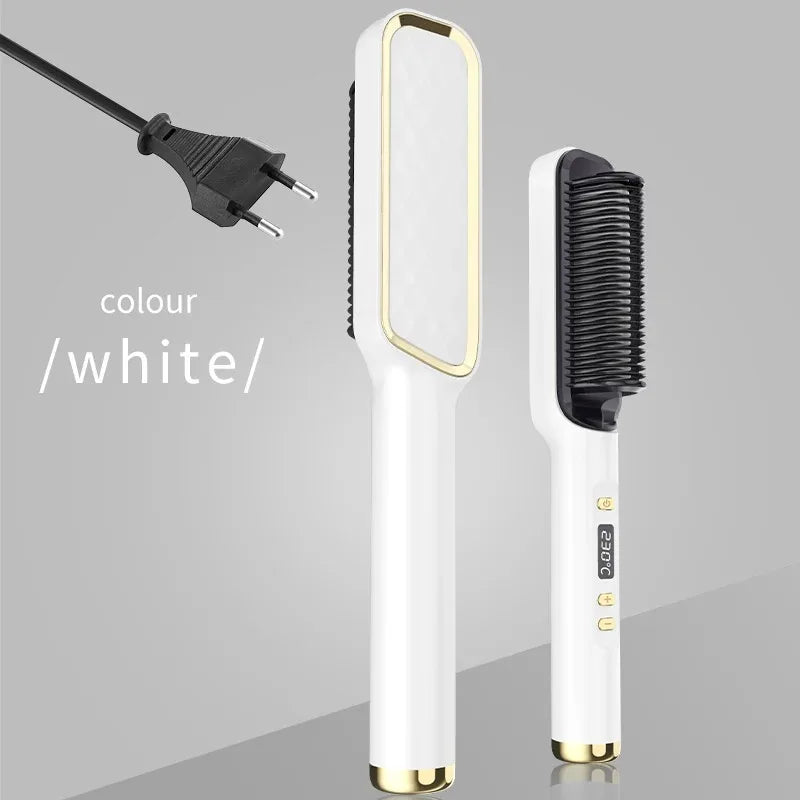
See it in action: ionic hair brush straightener for curly and coarse hair
Quick Comparison: Best Straightening Brushes for Curly Hair
Choosing the best straightening brush depends on your hair density, curl pattern, and styling goals. Thick hair typically requires stronger heat output and denser bristles than loose curls or waves.
| Category | Recommended Type | Best For |
|---|---|---|
| Best Overall | KentDO Ionic Hair Brush Straightener | Balanced smoothing and frizz control |
| Best for Thick Hair | TYMO Ring Plus | Dense curls and coarse textures |
| Best Budget | REVLON Heated Straightening Brush | Occasional styling |
| Best for Coarse Hair | MEGAWISE Pro Ceramic Brush | 3C–4C textures |
| Best for Frizz Control | MiroPure Ionic Straightening Brush | Smoothing and shine |
- Best Overall: Best balance of smoothing, speed, and curl control
- Best for Thick Hair: Wide brush design with strong heat performance
- Best Budget: Affordable option for occasional styling
- Best for Coarse Hair: High heat and dense bristles for resistant curls
Heat Range Comparison
- Fine or wavy hair: 300–350°F
- Medium curls: 350–410°F
- Thick or coarse curls: 410–450°F
Bristle Type Comparison
- Short ceramic bristles: improved heat transfer
- Long detangling bristles: easier glide through thick hair
- Mixed bristles: best overall performance on curly hair
Do Straightening Brushes Work on Curly Hair?
Yes, straightening brushes can work on curly hair, especially when the goal is smoother, stretched, less frizzy hair rather than completely flat-ironed results. A straightening brush on curly hair works by combining heated bristles with tension to relax curls while maintaining more natural movement.
What Results Should You Expect?
- Reduced frizz and improved shine
- Faster styling compared with traditional blow-drying
- Smoother curls with more natural volume
- Less precision than a flat iron for pin-straight results
For thick curly hair or coarse textures, choose a brush with adjustable high temperatures, dense bristles, and strong heat distribution. Most users achieve a soft blowout-style finish rather than the ultra-flat appearance produced by traditional flat irons.
Best Straightening Brush for Curly Hair (Top Picks Reviewed)
The best brush to straighten curly hair depends on your hair density, curl pattern, and styling needs. We evaluated heat performance, bristle quality, frizz control, ease of use, and results across multiple curl types.
Best Overall: Performance, Speed & Smooth Results
The KentDO Ionic Hair Brush Straightener offers an excellent balance of heat performance, ionic smoothing technology, and ease of use for most curly hair types.
- Best for: Most curly hair types
- Key features: Adjustable temperature, ceramic heating, ionic technology
- Ideal result: Smooth, polished curls with reduced frizz
Best for Thick Curly Hair & Dense Hair
Tools like the TYMO Ring Plus perform well on dense curls because of their stronger heating elements and wider coverage area.
- High heat output
- Wide brush surface
- Dense bristle structure
Best for Coarse 3C–4C Hair
Very coarse curls require maximum heat settings and strong bristle grip. Heated comb designs and wide ceramic brushes typically produce the best results.
Best for Fine Curly Hair
Fine curls benefit from lower heat settings, ceramic coatings, and gentler bristle designs that minimize unnecessary heat exposure.
Best Wide Brush for Faster Styling
Extra-wide brush heads help reduce styling time significantly by covering larger sections of thick hair in fewer passes.
How We Tested Straightening Brushes for Curly Hair
Each straightening brush was evaluated based on the factors that matter most for curly and textured hair.
Heat Performance & Temperature Accuracy
We compared temperature ranges, heat consistency, recovery speed, and overall effectiveness across different curl densities.
Frizz Reduction & Shine Results
Ionic technology, ceramic surfaces, and bristle design were evaluated for their ability to smooth frizz and improve shine retention.
Ease of Use on Different Curl Patterns
Performance was assessed across curl patterns ranging from loose waves to tightly coiled textures, with emphasis on comfort and styling speed.
How Hair Straightening Brushes Work
Hair straightening brushes combine the detangling action of a paddle brush with heated surfaces that gradually relax curls while brushing. Instead of clamping strands like a flat iron, they smooth hair through repeated passes and controlled heat exposure.
Ceramic vs Tourmaline vs Ionic Technology
- Ceramic: Provides consistent heat distribution.
- Tourmaline: Enhances ionic smoothing performance.
- Ionic technology: Helps reduce frizz and static buildup.
Why Bristle Design Matters for Curly Hair
Dense bristles improve contact with thick hair and help maintain tension while brushing. Sparse bristles often fail to penetrate coarse curls effectively.
Infrared Heating: Is It Worth It?
Some premium brushes include infrared heating technology, which may help distribute heat more evenly and reduce surface overheating. While not essential, infrared technology can improve comfort and reduce styling time for some users.
Premium tools like the KentDO Ionic Hair Brush Straightener combine heated comb teeth with ionic smoothing technology to help reach deeper layers of thick hair while reducing frizz.
Best Straightening Brush by Curl Type (2C–4C Guide)
Best Brushes for 2C–3A Waves & Loose Curls
These curl types usually respond well to medium heat settings and brushes designed for smoothing rather than maximum straightening power.
Best Brushes for 3B–3C Curls
Medium-to-tight curls often require higher temperatures and stronger bristle grip to reduce shrinkage and improve smoothness.
Best Brushes for 4A–4C Coarse Hair
Coarse curls typically need high heat capability, dense bristles, and strong ionic performance to manage thickness and resistance effectively.
Try the KentDO Ionic Straightening Comb today
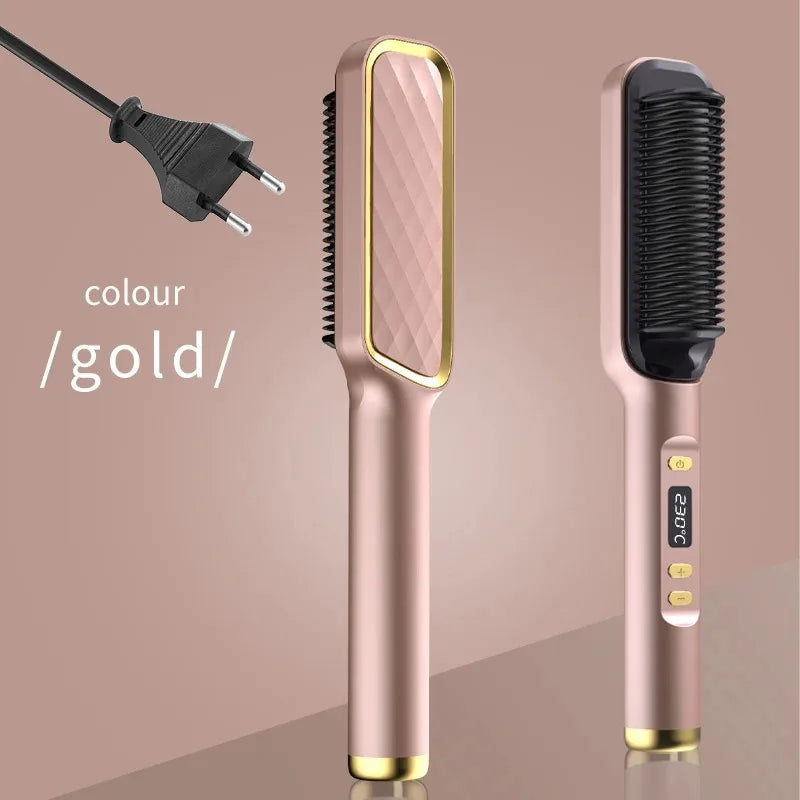
Ionic heat for hair straightening brush curly hair results—no fry, just shine
How to Use a Straightening Brush on Curly Hair Without Damage
Step-by-Step Straightening Method
- Start with clean, dry hair.
- Apply a heat protectant to help protect curly hair from heat damage.
- Section your hair.
- Brush slowly from root to tip.
- Finish with a smoothing serum.
Best Temperature Settings by Hair Type
- Loose waves: 330–370°F
- Medium curls: 370–410°F
- Coarse curls: 410–450°F
How to Prevent Heat Damage and Frizz
- Use ionic straightening brushes
- Work in smaller sections
- Apply heat protectant before styling
- Use anti-frizz finishing products
Buying Guide: Choosing the Best Hair Straightening Brush for Curly Hair
Heat Range & Temperature Control
Curly hair benefits from adjustable temperatures. Fine curls often require lower heat, while thick curls may need temperatures above 400°F.
Brush Width and Coverage Area
Wide brush heads reduce styling time and work especially well for dense hair textures.
Bristle Type and Hair Grip
Dense bristles improve contact with thick hair, while softer bristles help prevent damage on finer textures.
Ionic Technology for Frizz Control
Ionic technology helps reduce static, improve shine, and create smoother styling results.
Safety Features and Auto Shut-Off
Look for automatic shut-off, anti-scald protection, and precise temperature controls for safer styling.
Straightening Brush vs Flat Iron for Curly Hair
Which Gives Straighter Results?
| Feature | Flat Iron | Straightening Brush |
|---|---|---|
| Heat Damage Risk | Higher | Lower |
| Time to Style | 15–30 minutes | 5–15 minutes |
| Volume Preservation | Low | High |
| Ease of Use | Moderate | Beginner-friendly |
Which Causes Less Heat Damage?
Straightening brushes generally expose hair to less concentrated heat than flat irons because they do not clamp strands between heated plates.
Which Is Better for Thick Curly Hair?
Brush straighteners are often better for everyday styling, while flat irons remain the best option for ultra-straight finishes.
Shop the ionic straightening brush now
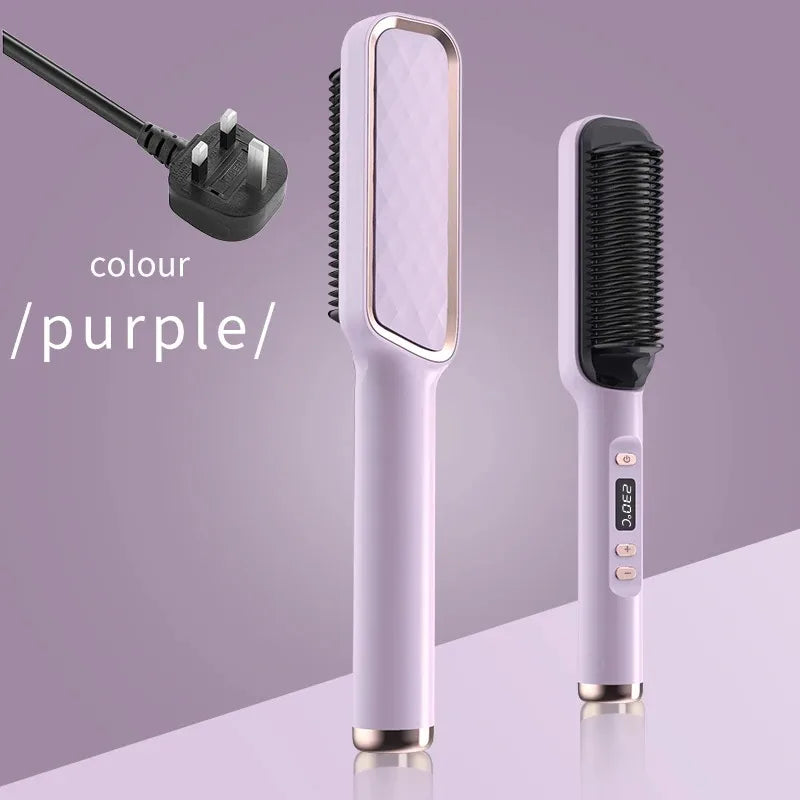
Brush straighteners for coarse hair—gentle, fast, and frizz-free
Are Straightening Brushes Bad for Your Hair?
Hair straightening brushes are generally safe when used correctly. Because they apply heat gradually instead of clamping strands between plates, they often cause less concentrated heat damage than flat irons.
- Use heat protectant products
- Avoid maximum heat settings unless necessary
- Limit heat styling to two or three times weekly
FAQs About Hair Straightening Brushes for Curly Hair
Can You Use a Straightening Brush on 4C Hair?
Yes, but results depend on heat range, brush design, and technique. Models reaching 450°F with dense bristles perform best.
Do Straightening Brushes Work on Thick Curly Hair?
Yes, but thick curly hair usually requires a brush with higher heat settings, strong bristle coverage, and ionic technology to control frizz.
Are Straightening Brushes Safer Than Flat Irons?
Straightening brushes may reduce heat exposure because they often require fewer passes, but heat protection remains essential.
Are Straightening Brushes Bad for Your Hair?
They are generally less damaging than flat irons because they distribute heat more gradually.
How Often Can You Use a Straightening Brush?
Limit heat styling to two or three times per week and always use heat protection.
Pillar Article: What Is Negative Ion Technology & Does It Actually Help Your Hair?
Other Related Articles:
Explore More:













