
Aerial Yoga Hammock for Home: How to Choose, Install & Use Safely
Can you safely set up an aerial yoga hammock at home? Potentially, but purchasing the hammock is only one part of creating a suitable aerial yoga environment. Your ceiling structure, available room height, floor clearance, suspension hardware, equipment specifications, and installation quality all influence whether residential aerial yoga is practical.
An aerial yoga hammock can introduce new ways to explore supported stretching, flexibility exercises, balance challenges, and low-impact fitness. However, not every home has a suitable structural attachment point, and not every hammock is designed for the same movements. A product's advertised weight capacity also does not establish that your ceiling or suspension system can safely support it.
This guide explains how to evaluate an aerial yoga hammock for home use, compare different aerial equipment configurations, understand installation responsibilities, and make an informed decision before purchasing. It also covers beginner considerations, equipment maintenance, and situations where supervised studio practice is a better starting point.
Can You Safely Set Up an Aerial Yoga Hammock at Home?
Yes, an aerial yoga hammock may be suitable for home practice when the building structure, attachment points, complete suspension system, available clearance, equipment specifications, and installation have been appropriately assessed by qualified professionals.
However, a hammock's advertised load capacity cannot establish whether a residential ceiling is suitable. A safe setup requires attention to the entire suspension system, not simply the fabric or an individual connector.
What Makes a Home Suitable for Aerial Yoga?
Five factors determine whether a residential space is a realistic candidate for aerial yoga:
- Verified structural attachment points: The proposed attachment location must be assessed for the intended suspension application. A finished ceiling surface does not reveal the condition or capacity of the structure behind it.
- Sufficient ceiling height: The available height must accommodate the hammock configuration and intended movements.
- Adequate floor clearance: The practice area needs sufficient unobstructed space below and around the equipment.
- Usable room dimensions: Furniture, walls, ceiling fixtures, windows, and other obstacles can restrict movement.
- Installation permission: Homeowners and renters should establish whether permanent or temporary equipment installation is permitted.
Why Buying a Hammock Does Not Guarantee a Safe Installation
There is an important difference between a suitable aerial yoga product and a suitable residential installation.
The manufacturer is responsible for communicating product specifications, intended applications, limitations, and inspection requirements. A structural engineer or appropriately qualified building professional evaluates whether the relevant building structure is appropriate for the proposed application. A qualified aerial rigger or installer evaluates the suspension arrangement, component compatibility, and installation requirements.
These responsibilities should not be confused. Even a hammock advertised with a 200kg capacity cannot independently establish that a particular ceiling attachment is appropriate.
Ordinary decorative ceiling hooks, drywall anchors, and unverified structural members should never be treated as substitutes for an appropriately assessed aerial suspension system.
Quick Home Aerial Yoga Suitability Checklist
- Has the proposed structural attachment location been professionally assessed?
- Are the intended equipment and suspension components documented?
- Is the proposed installation compatible with manufacturer requirements?
- Is there sufficient ceiling height for the intended practice?
- Is the floor area free from furniture and other obstacles?
- Are doors, windows, ceiling fans, and light fixtures outside the intended movement area?
- Are permanent installation restrictions or rental agreements understood?
- Is qualified instruction available for learning unfamiliar movements?
If any structural or installation requirement remains uncertain, postpone use until it has been appropriately assessed.
How Much Space Do You Need for an Aerial Yoga Hammock at Home?
There is no single ceiling-height or floor-clearance measurement that works for every aerial yoga hammock. Requirements depend on the hammock's dimensions, suspension configuration, intended poses, user dimensions, available adjustment, and manufacturer instructions.
Planning should account for the complete movement area rather than measuring only the space directly beneath a proposed attachment point.
Ceiling Height and Suspension Height Considerations
Ceiling height describes the distance from the floor to the ceiling. Suspension height describes the final position of the hammock after the complete installation has been assessed and configured.
These measurements are related but not interchangeable. Suspension components, fabric length, adjustment arrangements, and intended movements all influence the final position.
Before choosing equipment, check whether the manufacturer's documentation provides installation dimensions and configuration limitations. Do not assume that a longer suspension arrangement or additional extension component will automatically make a setup appropriate.
Floor Clearance and Movement Space
Aerial yoga involves more than sitting in a suspended fabric seat. Depending on the practice, movements can involve supported stretching, balance adjustments, changes in body position, and transitions between supported poses.
Consequently, the surrounding floor area matters. A crowded room can introduce additional obstacles and restrict access to the equipment.
Consider the space needed for normal entry and exit, instructor-approved movements, and the possibility of losing balance. The exact clearance requirements should be established according to the equipment instructions and intended activity.
Room Dimensions, Furniture, and Surrounding Obstacles
Evaluate the entire room rather than focusing exclusively on ceiling height.
- Walls: Nearby walls may restrict movement or create contact hazards.
- Ceiling fans: Rotating equipment should not overlap the intended practice area.
- Lighting: Pendant lights and other ceiling fixtures can interfere with available space.
- Furniture: Desks, tables, cabinets, and chairs should not obstruct the practice area.
- Windows and doors: Their position can affect room layout and access.
- Floor surfaces: A stable, unobstructed practice area is preferable to a crowded or uneven environment.
How to Plan Your Home Aerial Yoga Layout
Use this planning sequence before purchasing equipment:
- Measure the available room dimensions and ceiling height.
- Identify furniture, fixtures, and other potential obstacles.
- Document the known ceiling construction and any installation restrictions.
- Define the intended practice area and equipment configuration.
- Have the proposed installation assessed by appropriately qualified professionals.
- Confirm that the selected hammock and its suspension components are compatible with the approved arrangement.
Planning first can prevent purchasing equipment that cannot reasonably be used in the available space.
Aerial Yoga Hammock vs Yoga Swing vs Aerial Silks: What's the Difference?
Aerial yoga hammocks, yoga swings, and aerial silks all use suspended fabric, but their configurations and intended applications differ. Choosing between them requires understanding the movements you want to practice and the equipment's specific suspension requirements.
Comparison Matrix: Three Types of Aerial Equipment
| Comparison Factor | Aerial Yoga Hammock | Yoga Swing | Aerial Silks |
| Configuration | Typically continuous fabric forming a supportive loop | Often a fabric seat with handles or support straps | Long, open-ended fabric lengths |
| Fabric characteristics | Varies by model; may be elastic or non-elastic | Varies according to design | Generally designed for specialized aerial applications |
| Intended practice | Supported yoga, stretching, and selected aerial movements | Supported stretching and selected inversion-oriented exercises | Aerial arts, climbing, wrapping, and advanced techniques |
| Beginner accessibility | Can support introductory instruction with appropriate supervision | Depends on the configuration and intended exercise | Generally requires specialized instruction |
| Suspension requirements | Compatible attachment and suspension system required | Compatible attachment and suspension system required | Specialized aerial rigging assessment required |
| Home considerations | Structural suitability, dimensions, and clearance | Hardware compatibility and intended use | Advanced training and specialized rigging requirements |
What Is an Aerial Yoga Hammock?
An aerial yoga hammock typically uses a continuous piece of fabric arranged to create a supportive suspended surface. Practitioners use it for selected stretching positions, supported body positioning, balance activities, and instructor-led aerial yoga movements.
Some designs prioritize low-stretch support, while others use more elastic aerial fabric. The configuration affects how the fabric responds to movement and how it is intended to be used.
What Is a Yoga Swing?
A yoga swing commonly incorporates a fabric seat, handles, or supporting straps. Depending on its design, it may be intended for supported stretching, relaxation-oriented positions, and selected inversion exercises.
The term yoga swing is used for different product configurations. Buyers should examine the actual construction rather than assuming every swing provides the same functionality as a continuous aerial hammock.
What Are Aerial Silks?
Aerial silks use long, open-ended fabric lengths associated with aerial performance and specialized fitness training. Their applications can include climbing, wrapping, and more complex aerial techniques.
Because these activities involve specialized fabric management and movement skills, aerial silks generally require dedicated instruction and professional rigging considerations. They should not automatically be considered an interchangeable alternative to a beginner-oriented yoga hammock.
Which Equipment Is Most Appropriate for Home Practice?
The appropriate choice depends on your experience, intended movements, room conditions, and installation options.
- Consider an aerial yoga hammock if your primary interest is supported aerial yoga and stretching.
- Consider a yoga swing if its particular seat and handle configuration matches your intended exercises.
- Consider aerial silks if your objective involves learning aerial arts under specialized instruction.
None of these equipment types is universally safest. Structural assessment, equipment documentation, and appropriate instruction remain essential.
How to Choose the Right Aerial Yoga Hammock for Home
Once you have established that home practice may be practical, evaluate the equipment itself. A useful aerial yoga hammock buying guide should consider material, dimensions, elasticity, manufacturer ratings, included components, and suspension compatibility.
Fabric Material: Nylon, Polyester, and Other Aerial Fabrics
Fabric composition is an important purchasing consideration, but material names alone do not establish equipment suitability.
Commonly marketed aerial fabrics include nylon, polyester, and specialized textile constructions. Their properties can differ according to weave, density, manufacturing quality, elasticity, surface texture, and intended application.
Nylon parachute fabric is commonly selected for lightweight textile products. However, an aerial hammock must be evaluated according to its actual construction, manufacturer documentation, and intended use rather than simply being described as nylon.
When comparing products, check:
- Exact fabric composition and construction.
- Whether the fabric is elastic or non-elastic.
- Published dimensions and manufacturer tolerances.
- Stitching and finishing information.
- Intended application and product limitations.
- Cleaning, inspection, and replacement requirements.
Hammock Width and Length
Hammock dimensions influence the available fabric surface and the range of configurations supported by a particular design.
Width affects how much material is available for supported positioning and wrapping. Length influences the overall configuration and the manufacturer's permitted suspension arrangements.
Do not assume that a larger hammock is automatically better. Compare the dimensions with the manufacturer's sizing guidance and the intended installation environment.
Fabric Stretch and Elasticity
Elasticity influences how a hammock responds when weight is applied. A low-stretch design generally provides a firmer feel, while more elastic fabric can produce a different movement response.
Neither characteristic is universally superior. The appropriate option depends on the type of practice, equipment design, and manufacturer instructions.
For example, the Aerial Yoga Hammock – 200KG Heavy-Duty Support Swing uses non-elastic 210T parachute nylon, according to its product specifications. This characteristic may appeal to buyers who prefer a firmer fabric response, but it does not independently establish the product's suitability for a particular suspension installation.
Weight Capacity, Working Load Limit, and Breaking Strength
These three technical terms should never be treated as interchangeable.
- Breaking strength: A rating associated with the load at which a component or material fails under specified test conditions.
- Working Load Limit (WLL): An established allowable working load under defined rating conditions for a particular component or system.
- User weight limit: A manufacturer-defined restriction describing the maximum permitted user weight for a product under its specified conditions.
A product's stated user capacity is not necessarily the same as a component's WLL or breaking strength.
Movement also matters. Static body weight is not the only force involved in aerial activities. Swinging, transitions, sudden movements, and changes in body position can create dynamic loading that differs from a stationary load.
For this reason, an advertised weight capacity must not be used as a structural calculation or as permission to combine independently selected hardware components.
The complete system needs to be evaluated, including the building structure, attachment points, connectors, suspension components, and fabric.
Suspension Components and Hardware Compatibility
An aerial suspension system can involve several components:
- Structural attachment points: The assessed locations connecting the system to an appropriate supporting structure.
- Suspension straps: Components used in manufacturer-approved suspension arrangements.
- Carabiners: Connectors that must have appropriate ratings and compatible configurations.
- Swivel connections: Components used in certain systems to accommodate specific movement requirements.
- Attachment hardware: Other components specified by the equipment manufacturer and qualified installation professional.
Compatibility involves more than comparing the numbers printed on individual components. Ratings, orientation, loading conditions, connection geometry, inspection requirements, and manufacturer instructions must all be considered.
Aerial Yoga Hammock Buying Checklist
- Confirm the fabric material and construction.
- Compare the published hammock width and length.
- Check whether the fabric is elastic or non-elastic.
- Review the manufacturer-stated user weight restriction.
- Request clarification of documented component ratings where relevant.
- Identify which suspension components are included.
- Check whether additional extension straps or mounting equipment are required.
- Review hardware compatibility requirements.
- Check fabric inspection and maintenance instructions.
- Confirm manufacturer support and intended-use documentation.
One example worth examining is the Aerial Yoga Hammock – 200KG Heavy-Duty Support Swing. Its published specifications provide a starting point for comparing fabric construction, dimensions, and included components.
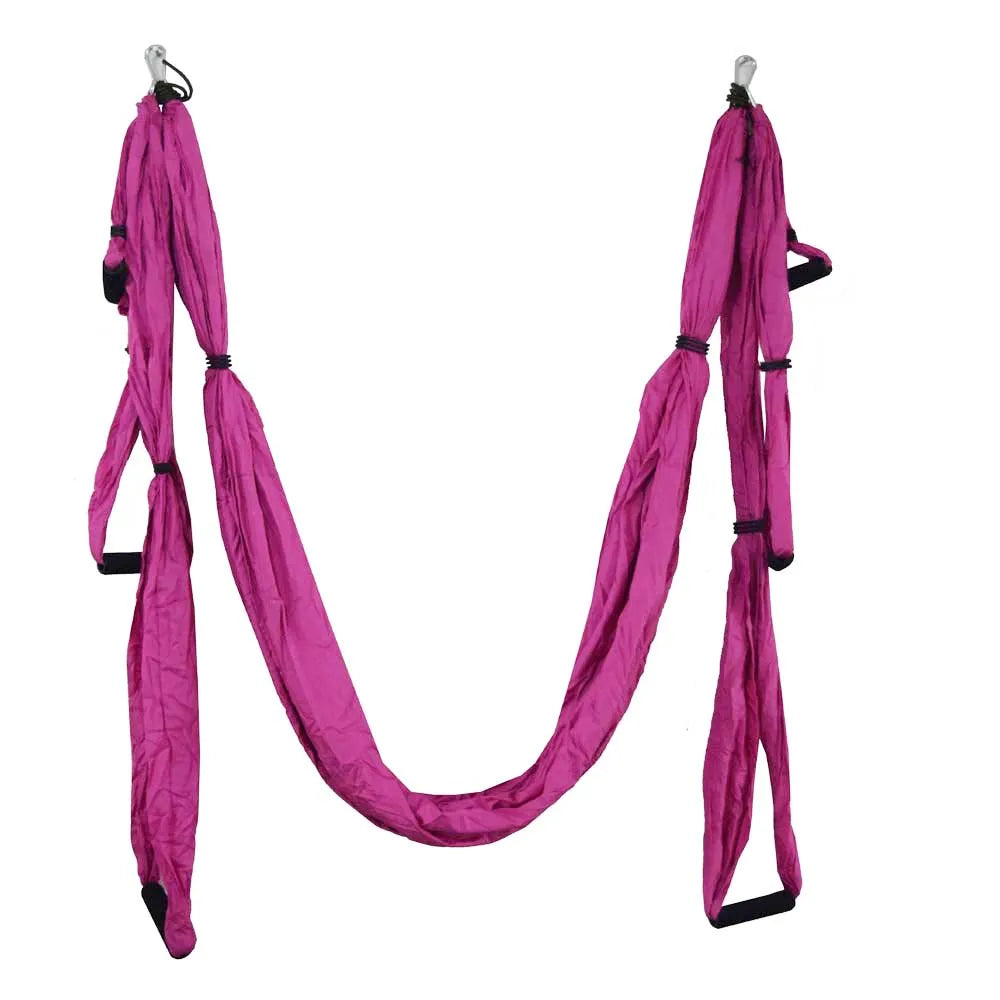
The product specifications identify 210T non-elastic nylon parachute fabric, a main hammock size of 250 × 150 cm, and a stated capacity of up to 200kg (440 lbs). These are manufacturer-provided product details, not independent certification or approval of a residential installation.
Explore the specifications and included components before deciding whether this type of aerial yoga hammock matches your intended practice.
Ceiling-Mounted Hammock vs Freestanding Aerial Rig: Which Should You Choose?
Residential aerial yoga setups generally involve two broad approaches: a professionally assessed ceiling-mounted installation or a suitable manufacturer-approved freestanding aerial rig.
The choice depends on the property, available floor space, installation restrictions, and equipment requirements.
Ceiling-Mounted Aerial Yoga Hammock Systems
A ceiling-mounted system can preserve floor space because the suspension equipment is attached to an assessed building structure.
However, the visible ceiling surface cannot establish whether the underlying structure is suitable. Ceiling construction, structural member condition, connections, proposed attachment location, and load paths all require appropriate consideration.
Professional assessment and installation are particularly important because aerial equipment introduces movement-related forces that ordinary household ceiling fixtures are not designed to accommodate.
Freestanding Aerial Rigs for Residential Use
A freestanding aerial rig can be an alternative when permanent ceiling installation is restricted or impractical.
These systems have their own requirements, including:
- Manufacturer-documented load specifications.
- Approved equipment compatibility.
- Appropriate ground support.
- Assembly and operating restrictions.
- Available footprint and surrounding clearance.
- Portability and storage considerations.
A freestanding rig is not automatically safer simply because it does not require a permanent ceiling attachment. Its complete configuration must still meet manufacturer requirements.
Decision Tree: Ceiling Anchor or Freestanding Rig?
- Is the building structure suitable? If unknown, obtain professional assessment before considering a ceiling-mounted system.
- Is permanent installation permitted? If not, investigate a manufacturer-approved freestanding alternative.
- Is sufficient room available? Consider the complete footprint and movement clearance.
- Can the complete system meet its documented requirements? If compatibility or structural suitability cannot be established, do not proceed.
- Are neither options practical? Studio-based aerial yoga may be the more appropriate choice.
Why Ordinary Ceiling Hooks and Drywall Anchors Are Not Suitable Substitutes
Decorative hooks and general-purpose drywall anchors are designed for different applications. Their presence in a ceiling does not demonstrate that they are appropriate for aerial suspension.
Similarly, identifying a visible beam does not establish that it can support a proposed aerial installation. Material, dimensions, condition, connections, and load paths all influence structural suitability.
For additional home fitness equipment ideas, explore body care and health devices while keeping the requirements of aerial suspension equipment separate from those of ordinary fitness accessories.
Understanding Aerial Rigging, Structural Attachment Points, and Dynamic Loading
One of the most important differences between ordinary home fitness equipment and aerial equipment is the suspension system. A hammock does not operate independently of its supporting structure.
What Are Structural Attachment Points?
A structural attachment point is a connection location that has been assessed for its intended application. It is different from the visible ceiling finish, decorative covering, or an unverified structural member.
The relevant question is not simply whether a ceiling contains wood or concrete. It is whether the complete structural arrangement has been evaluated for the proposed use.
Ceiling Joists vs Structural Beams
Residential buildings can contain different structural members, including ceiling joists and beams. Their dimensions, material, orientation, condition, connections, and relationship with other structural elements affect their suitability for particular loads.
Two visually similar ceiling members may have very different structural roles. A homeowner should not determine aerial suspension suitability based on appearance alone.
What Is Dynamic Loading in Aerial Yoga?
Dynamic loading refers to forces that change during movement rather than remaining constant.
In aerial activities, swinging, transitions, changes in body position, and other movements can produce forces different from a stationary body-weight load.
This is why comparing a person's weight with an advertised hammock capacity is insufficient to establish the suitability of the complete installation.
Why Professional Aerial Rigging Matters
A qualified aerial rigger evaluates the suspension system and the compatibility of its components. A structural engineer or appropriately qualified building professional evaluates the relevant building structure.
These professionals consider the complete load path rather than relying on an isolated connector rating. Manufacturer instructions also remain important because not every hammock or component is approved for every configuration.
Relevant industry guidance and applicable standards should be considered by the professionals responsible for the specific installation. Standards such as applicable ASTM requirements may be relevant to particular equipment or applications, but a general reference to a standard is not proof that a product or residential installation is certified.
Home Aerial Yoga Installation: Who Is Responsible for Each Step?
Installation decisions should involve clear responsibilities. Buying a complete-looking aerial yoga swing set does not necessarily mean that every component needed for a residential installation is included.
What the Equipment Manufacturer Should Specify
Product documentation should identify:
- Intended equipment applications.
- Fabric material and dimensions.
- Manufacturer-defined user restrictions.
- Included and excluded components.
- Approved suspension configurations.
- Hardware compatibility requirements.
- Inspection, cleaning, and maintenance instructions.
For example, the featured aerial hammock package lists the hammock, handles, four metal buckles, telescopic buckles, and a carry bag. Extension straps and ceiling hanging trays must be purchased separately. This distinction matters when evaluating the actual scope of a product package.
What a Structural Professional Should Assess
The structural professional should evaluate the relevant building structure, proposed attachment location, load path, and suitability for the intended suspension application.
The assessment should be specific to the property and proposed system rather than based on a generic residential installation assumption.
What a Qualified Aerial Rigger or Installer Should Verify
The qualified installer should consider the complete suspension arrangement, including equipment compatibility, connector orientation, component ratings, installation documentation, and final system inspection.
Where specialist structural assessment is necessary, installation decisions should be coordinated with the appropriately qualified structural professional.
Installation Responsibility Checklist
- Homeowner: Establish installation permission, room suitability, and intended use.
- Manufacturer: Provide product specifications, restrictions, and documentation.
- Structural professional: Assess the building structure and proposed application.
- Qualified aerial rigger or installer: Evaluate system compatibility and installation requirements.
- Aerial instructor: Provide appropriate instruction and guidance on technique.
Review the equipment specifications and installation requirements before selecting your home aerial yoga setup. If essential documentation is unavailable, request clarification rather than assuming compatibility.
How to Start Practicing Aerial Yoga at Home as a Beginner
Owning an aerial yoga hammock does not automatically provide the knowledge needed to use it. Beginners should develop familiarity with aerial equipment through qualified instruction before attempting unfamiliar movements independently.
What Beginners Should Learn Before Using a Home Hammock
Foundational instruction should cover equipment familiarization, supported positioning, body alignment, balance awareness, and appropriate movement limitations.
Entry and exit procedures are particularly important because unfamiliarity with the equipment can increase the possibility of losing balance or becoming disoriented.
Beginners should also understand the difference between supported stretching and more advanced aerial techniques. A movement that appears simple in a photograph may require specific body positioning and instructor guidance.
A Beginner Aerial Yoga Progression Framework
A gradual learning framework helps separate basic familiarity from more advanced practice.
- Stage 1 – Qualified instruction: Learn equipment terminology, limitations, and basic safety awareness with an appropriately qualified instructor.
- Stage 2 – Foundational familiarity: Develop an understanding of grounded and supported movement concepts under supervision.
- Stage 3 – Instructor-approved positions: Learn appropriate introductory hammock positions and body alignment.
- Stage 4 – Balance and coordination: Develop movement awareness gradually with suitable feedback.
- Stage 5 – Advanced training: Progress to complex transitions and specialized techniques only after appropriate instruction and assessment.
Should Beginners Attempt Inversions at Home?
Beginners should not independently experiment with inversion techniques simply because an aerial hammock is marketed for inversion exercises.
Inversions can involve balance changes, disorientation, falls, and additional physical demands. Learning appropriate positioning, entry and exit techniques, and movement limitations under qualified supervision is important before considering independent practice.
Equipment ownership does not replace instruction or establish that a particular movement is suitable for an individual.
When Should You Choose Studio Classes Instead?
Studio instruction may be preferable when:
- You have no previous aerial yoga experience.
- Your home installation has not been professionally assessed.
- Your available room has insufficient clearance.
- You are unfamiliar with supported positioning and equipment limitations.
- You need instructor feedback or supervised practice.
- You want to learn inversion techniques or advanced movements.
Explore aerial yoga equipment according to your intended practice, and build your equipment decisions around qualified instruction rather than attempting to learn advanced techniques through product demonstrations alone.
Aerial Yoga at Home vs Studio Classes: Which Is Better?
Home aerial yoga and studio classes offer different experiences. Home equipment can provide scheduling flexibility, but it also introduces responsibilities involving installation, maintenance, equipment inspection, and training.
Home Practice vs Studio Practice Comparison
| Factor | Home Practice | Studio Classes |
| Supervision | Requires separate arrangements for instruction | Usually provides access to instructor supervision |
| Installation responsibility | Homeowner must arrange appropriate assessment and installation | Studio manages its established equipment environment |
| Learning environment | Depends on available instruction and individual preparation | Provides a structured learning environment |
| Convenience | Flexible scheduling after appropriate setup | Requires travel and class scheduling |
| Ongoing costs | Equipment, installation, inspection, and maintenance | Class fees or membership costs |
When Buying an Aerial Yoga Hammock Makes Sense
Home equipment ownership may be practical when you have established foundational experience, a suitable room, professionally assessed installation arrangements, compatible equipment, and access to appropriate instruction.
It can also be appealing to people who prefer flexible scheduling and have the resources to maintain an appropriate practice environment.
When Studio Membership Is the Better Investment
Studio classes may offer better value for beginners, renters with installation restrictions, people with limited room space, and those who need regular instructor feedback.
Studios also provide an opportunity to experience different equipment configurations before deciding which type of aerial yoga hammock or swing may be appropriate for home use.
Aerial Yoga Hammock Maintenance and Safety Inspection
Regular equipment inspection is an important part of responsible aerial equipment ownership. Fabric, stitching, connectors, and other suspension components can deteriorate over time.
Follow the manufacturer's inspection and retirement requirements, and distinguish routine visual checks from formal professional inspections.
How to Inspect Aerial Fabric and Stitching
Look for visible changes such as:
- Cuts or punctures.
- Fraying or abrasion.
- Unusual stretching or deformation.
- Discoloration or contamination.
- Damaged or separating stitching.
- Other signs of material deterioration.
Questionable fabric should be removed from use until its condition has been appropriately assessed.
Inspecting Carabiners and Suspension Hardware
Hardware inspection should follow manufacturer instructions and applicable professional requirements.
Visible warning signs can include deformation, cracks, corrosion, damaged gates, unusual movement, and incompatible connections.
A component that appears undamaged is not automatically approved for use. Its documentation, rating, compatibility, and inspection history also matter.
Storage, Cleaning, and Equipment Replacement
Follow the manufacturer's recommendations for washing, drying, storage, and replacement. Avoid exposing aerial fabric to unapproved cleaning chemicals, excessive heat, or storage conditions that could accelerate deterioration.
Equipment should be protected from sharp objects, unnecessary abrasion, moisture-related damage, and other conditions identified in the manufacturer's care instructions.
When to Stop Using an Aerial Yoga Hammock
Stop using the equipment and seek appropriate assessment if you identify:
- Damaged or deteriorating fabric.
- Compromised stitching.
- Questionable connectors or suspension hardware.
- Uncertain structural attachment points.
- Unexpected changes in the suspension arrangement.
- Missing or incomplete manufacturer documentation.
- Equipment that has reached its specified retirement requirements.
Do not attempt to resolve a questionable equipment condition by improvising replacement components.
Who Should Be Careful Before Practicing Aerial Yoga at Home?
Aerial yoga is not appropriate for every person or every movement. Individual mobility, balance, physical limitations, and health considerations can influence which activities are suitable.
Balance Limitations and Fall-Related Concerns
People experiencing balance difficulties, coordination limitations, reduced mobility, or difficulty entering and exiting supported positions may need additional assessment and supervision.
The suspended nature of aerial equipment introduces different movement demands from ordinary floor-based stretching. Beginners should avoid assuming that previous yoga experience automatically transfers to aerial practice.
Inversions and Individual Health Considerations
Inversion positions can introduce additional physical demands and may be unsuitable for people with certain health conditions.
Individuals with cardiovascular concerns, blood pressure conditions, certain eye disorders, spinal or joint limitations, or balance-related problems should seek appropriate healthcare advice before considering inversion-based activities.
Pregnancy and other individual circumstances may also change which movements are appropriate. A qualified healthcare professional can help assess personal considerations, while an aerial instructor can explain technique-related limitations.
Why Supervision Matters for Higher-Risk Movements
Inversions, advanced wraps, complex transitions, and movements requiring specialized spotting should not be treated as beginner exercises.
Qualified instruction helps individuals understand the relevant technique, movement limitations, and equipment requirements before considering more advanced practice.
Final Aerial Yoga Hammock Buying Checklist: Choose Equipment for Your Home
The right aerial yoga hammock is not necessarily the product with the highest advertised capacity or the most accessories. It is equipment whose documented specifications, intended application, and suspension requirements match a professionally assessed practice environment.
The Five-Step Home Equipment Selection Framework
- Assess room and structural suitability: Establish available space, ceiling conditions, installation permission, and structural assessment requirements.
- Define intended movements and experience: Decide whether your primary interest is supported yoga, stretching, swing-chair movements, or specialized aerial training.
- Compare fabric and dimensions: Evaluate material, construction, length, width, and elasticity.
- Verify manufacturer specifications: Review user restrictions, component documentation, and compatible suspension requirements.
- Confirm the installation approach: Arrange professional assessment and installation or evaluate an appropriately documented freestanding system.
What to Check Before Purchasing an Aerial Yoga Hammock
- Does the manufacturer identify the intended application?
- Are the fabric material and dimensions clearly documented?
- Is the fabric elastic or non-elastic?
- Is the stated user weight restriction clearly communicated?
- Are the included components listed individually?
- Are additional straps or mounting components required?
- Are the manufacturer's suspension and hardware requirements available?
- Are inspection, cleaning, and replacement instructions provided?
- Can the intended residential configuration be professionally assessed?
- Is appropriate beginner instruction available?
Explore an Aerial Yoga Hammock for Your Home Practice
For shoppers comparing non-elastic aerial yoga equipment, the Aerial Yoga Hammock – 200KG Heavy-Duty Support Swing is one option to examine.
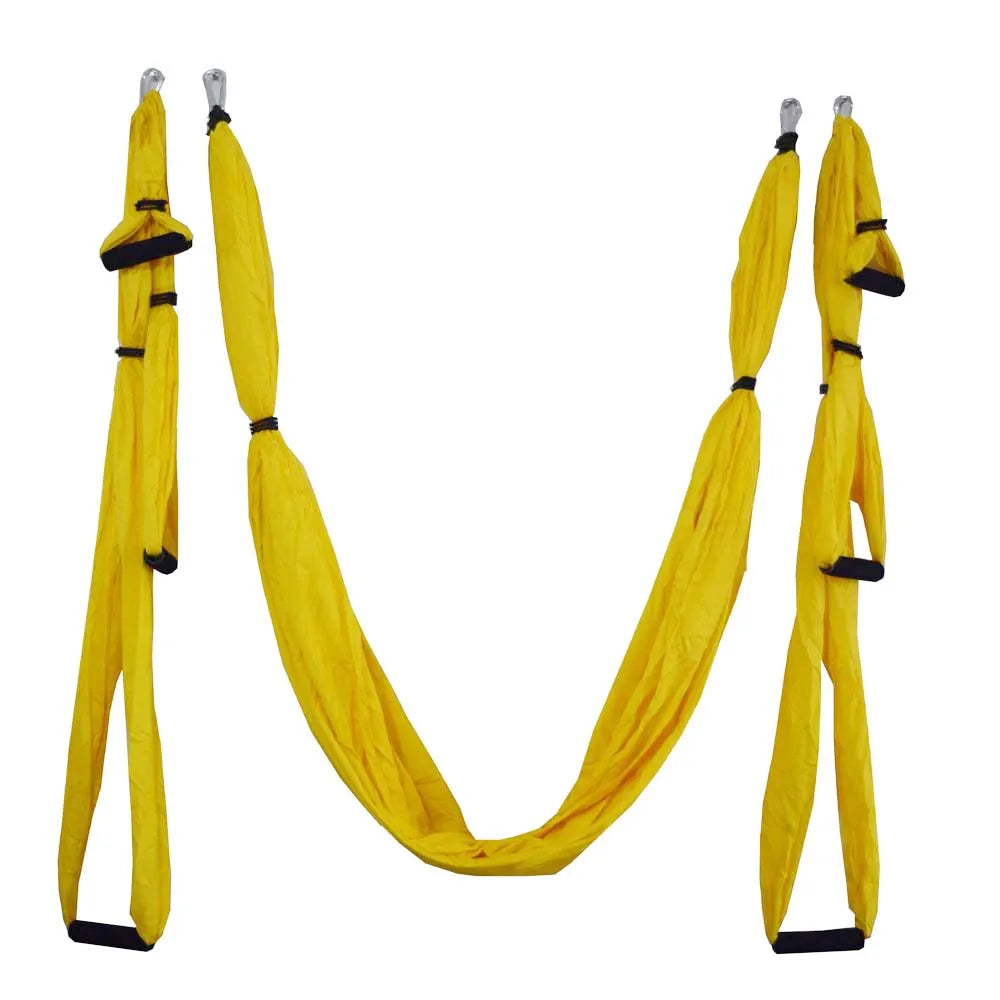
According to its published specifications, this model offers:
- Model: YGYB04SET.
- Material: 210T nylon parachute fabric.
- Fabric characteristics: Non-elastic construction.
- Main hammock dimensions: 250 × 150 cm.
- Handle lengths: 30 cm, 85 cm, and 135 cm.
- Stated load capacity: Up to 200kg (440 lbs).
- Product weight: Approximately 1.2 kg (2.65 lbs).
- Color options: 20.
- Package contents: Hammock, handles, four metal buckles, telescopic buckles, and carry bag.
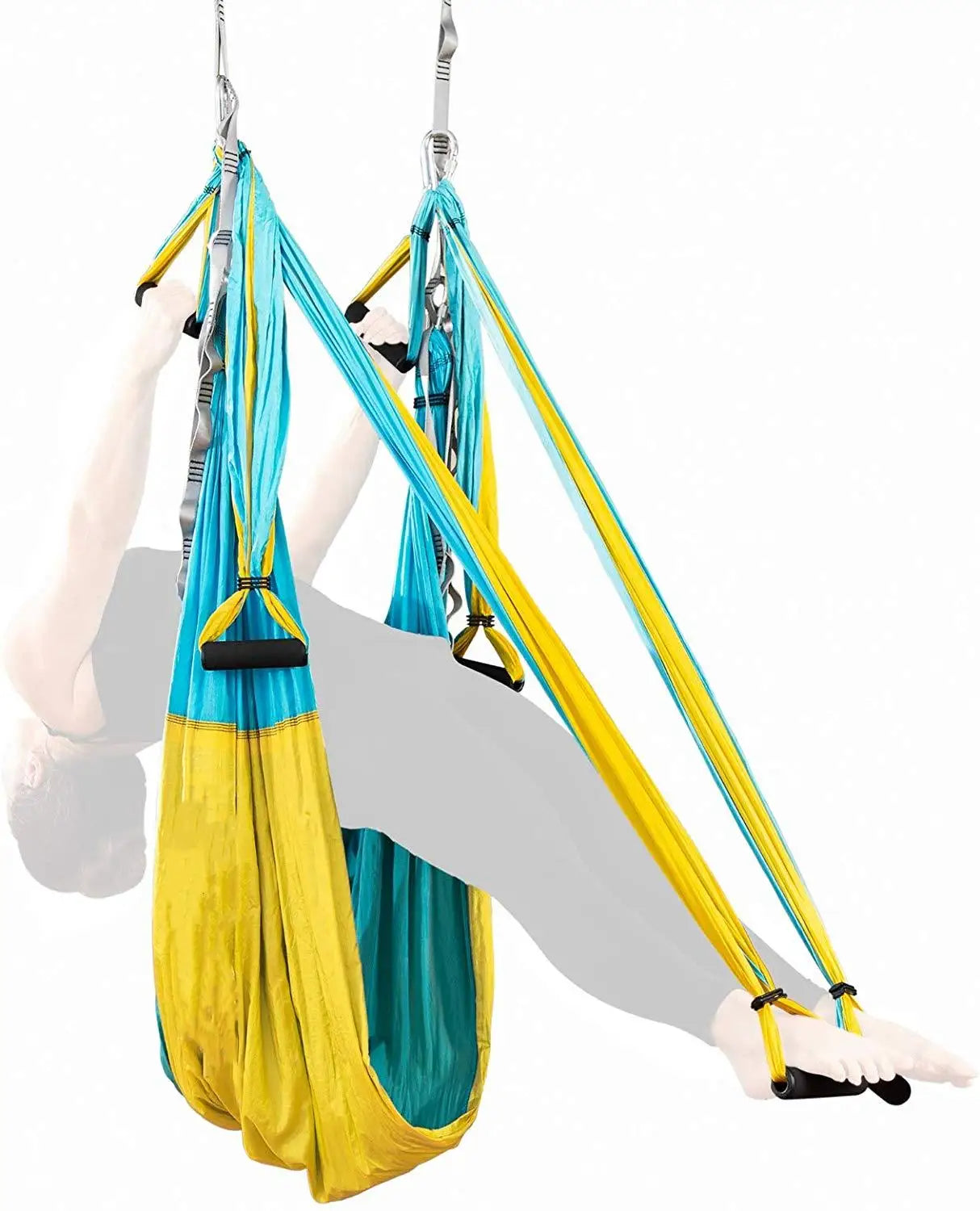
One detail worth checking before purchasing is that extension straps and ceiling hanging trays are not included in the listed package and must be purchased separately. Their compatibility and suitability should be established through the relevant manufacturer and professional installation guidance.
The stated 200kg capacity is a product specification, not independent verification of a complete aerial suspension installation. It should not be interpreted as proof that any residential ceiling, anchor, or combination of hardware is suitable.
Explore this non-elastic aerial yoga hammock and review its fabric specifications, included components, limitations, and manufacturer guidance before making a purchasing decision.
Frequently Asked Questions About Aerial Yoga Hammocks for Home
Can you safely install an aerial yoga hammock in your home?
Home installation may be possible when the structural attachment points, complete suspension system, equipment specifications, room clearance, and installation have been appropriately assessed. Ordinary ceiling hooks, drywall anchors, and unverified beams are not substitutes for qualified structural and rigging assessment.
How much ceiling height and floor clearance do you need for an aerial yoga hammock?
There is no universal measurement for every hammock or movement. Requirements depend on ceiling height, suspension configuration, fabric dimensions, intended poses, user dimensions, manufacturer instructions, and surrounding obstacles. Assess the entire movement area rather than measuring only the space beneath the attachment point.
Is a ceiling-mounted aerial yoga hammock better than a freestanding aerial rig?
Ceiling-mounted systems can save floor space but require professionally assessed structural attachment points and compatible installation hardware. Freestanding rigs avoid permanent ceiling installation but require suitable ground support, sufficient footprint, and compliance with manufacturer specifications. Neither option is automatically safer without appropriate assessment.
What is the difference between an aerial yoga hammock, a yoga swing, and aerial silks?
An aerial yoga hammock typically uses continuous fabric for supported yoga and stretching. A yoga swing commonly incorporates a seat and handles, while aerial silks use long, open-ended fabric for specialized aerial arts. Their configurations, intended movements, training requirements, and suspension systems differ.
Can beginners practice aerial yoga at home without attending studio classes?
Beginners may eventually develop a home practice after receiving appropriate instruction and confirming equipment and installation suitability. Qualified supervision is particularly important for learning foundational techniques, equipment familiarity, controlled positioning, and inversions before independent practice.
Conclusion: Make Your Home Aerial Yoga Setup an Informed Decision
An aerial yoga hammock can introduce new possibilities for supported stretching, balance activities, flexibility practice, and home fitness. However, choosing suitable equipment involves more than comparing fabric dimensions or advertised weight capacities.
Before purchasing an aerial yoga hammock for home, evaluate five essential factors: structural suitability, available room space, equipment specifications, compatible suspension components, and appropriate instruction.
Compare aerial hammocks, yoga swings, and aerial silks according to your intended practice. Review the manufacturer's documentation, understand the distinction between user weight limits and component ratings, and obtain qualified structural and rigging advice where necessary.
For beginners, supervised instruction should come before independent experimentation with unfamiliar aerial movements or inversions. Regular equipment inspection and responsible maintenance also remain important throughout ownership.
The best home aerial yoga decision is one that matches your available space, experience, equipment requirements, and professionally assessed installation conditions. Take time to compare specifications and establish a suitable practice environment before choosing your equipment.
Pillar Article: Aerial Fitness Equipment: Complete Comparison & Buying Guide for Home Training