

Air Cooler or Desk Fan: Which Is Better for You?
Choosing between an air cooler and a desk fan depends less on which device is “better” and more on what kind of cooling you actually need. A desk fan moves air across your skin to improve personal comfort, while an evaporative air cooler uses water evaporation to provide a cooler-feeling airflow in suitable conditions. For humid rooms, simple desk cooling, and low energy use, a desk fan is often the practical choice. For hot, dry, well-ventilated spaces where stronger personal cooling is useful, an air cooler can have the advantage.
Air Cooler or Desk Fan: The Quick Answer
If your priority is direct personal airflow, low electricity use, simple maintenance, and reliable performance in humid conditions, choose a desk fan. If you are dealing with hot, dry air and want the added cooling effect of water evaporation, an air cooler may be more effective.
Choose a desk fan for personal airflow, low energy use, and humid rooms
A desk fan is straightforward: it circulates air toward you and helps sweat evaporate from your skin. It does not need a water reservoir, and it generally uses less electricity than an air cooler. That makes it a strong option for a home office, bedroom, study area, or any humid space where adding moisture would not be helpful.
Choose an air cooler for stronger cooling in dry, well-ventilated spaces
An evaporative air cooler can provide a cooler airflow by passing air over or through water so that evaporation absorbs heat. This effect works best when the surrounding air is relatively dry. Because the process adds moisture to the air, ventilation is important, particularly in small spaces.
Decision matrix: air cooler vs desk fan
| Factor | Air Cooler | Desk Fan |
| Cooling method | Evaporative cooling plus airflow | Direct airflow |
| Personal cooling | Strong in suitable conditions | Very effective for targeted airflow |
| Room temperature effect | Can provide a cooling effect when humidity is suitable | Does not substantially lower room temperature |
| Humidity suitability | Best in dry air | Works well in humid conditions |
| Electricity use | Generally low, but depends on the unit | Generally very low |
| Maintenance | Requires water and regular cleaning | Usually simpler to maintain |
| Portability | Good for compact models, with water requirements | Usually very easy to move |
| Best environment | Hot, dry, ventilated spaces | Desks, bedrooms, offices, and humid rooms |
How an Air Cooler and Desk Fan Actually Cool You
How a desk fan works
A desk fan creates moving air with rotating blades. When that airflow reaches your skin, it increases evaporation of moisture from the skin surface. This can make you feel cooler even though the fan is not actually removing heat from the room in the way an air conditioner does.
This distinction matters when comparing a fan with an air cooler. A desk fan is primarily a personal comfort device. Its biggest advantage is that it can direct airflow exactly where you need it, such as toward your face, hands, or upper body while you work.
How an evaporative cooler works
An evaporative cooler uses water as part of the cooling process. As water evaporates, it absorbs heat from the surrounding air. The resulting airflow can feel cooler than ordinary room air when environmental conditions are favorable.
The amount of cooling depends heavily on the starting temperature, relative humidity, airflow, and ventilation. An evaporative cooler should therefore not be treated as a miniature air conditioner. It works through evaporation rather than refrigeration.
Evaporative cooling vs direct airflow
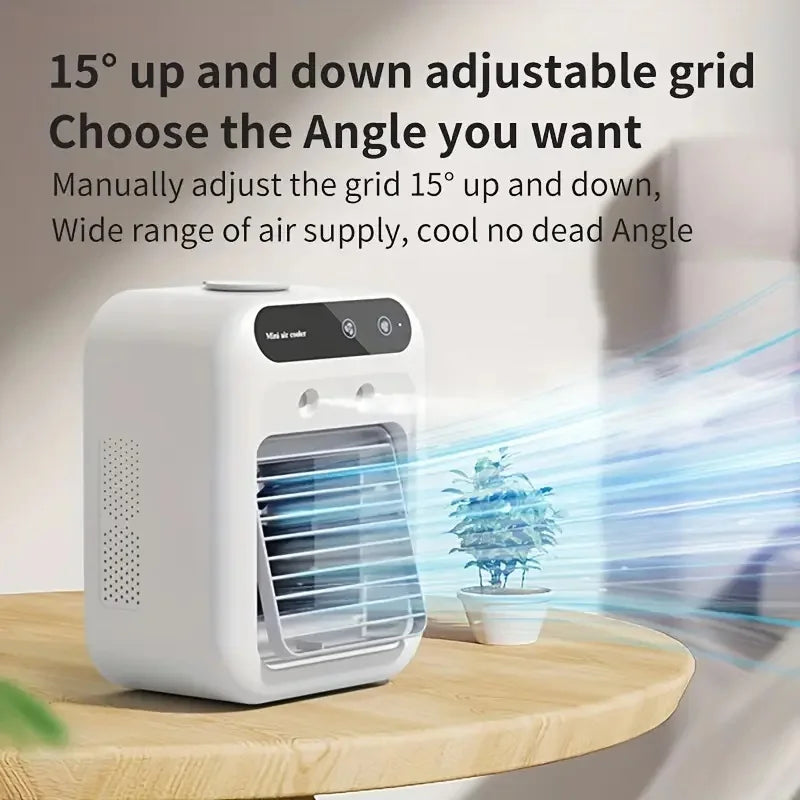
The simplest distinction is this: a desk fan primarily improves how you feel by moving air across your body, while an evaporative cooler combines airflow with the cooling effect of water evaporation.
That difference explains why neither device is universally better. A fan can remain useful when humidity is high because it does not depend on evaporation into already-moist air. An evaporative cooler can be more appealing when the air is hot and dry enough for evaporation to work effectively.
Air Cooler vs Desk Fan: Performance Comparison
Cooling effectiveness and cooling capacity
For personal cooling, both options can be useful, but they approach the problem differently. A desk fan is especially effective when you are sitting in one place because it can provide continuous airflow directly toward you.
An air cooler can provide a cooler-feeling stream of air in suitable conditions, but performance depends on room size, humidity, temperature, and ventilation. A compact unit should be viewed primarily as personal or localized cooling rather than a replacement for whole-room air conditioning.
Humidity and relative humidity
Humidity is one of the most important variables in an air cooler versus desk fan decision. Evaporative cooling becomes less effective as relative humidity rises because the air has less capacity to accept additional moisture.
In a dry climate, an evaporative cooler can make much more sense. In a humid room, a desk fan may provide more consistent comfort because its cooling effect comes from air movement rather than adding moisture.
Energy efficiency and electricity use
A desk fan generally has a simple motor and fan assembly, so electricity consumption is usually low. Actual energy use depends on the motor, speed setting, operating hours, and specific model.
An air cooler also can be relatively energy efficient compared with large cooling appliances, but it adds components such as water circulation or evaporation systems depending on its design. The best way to compare operating cost is to look at the device's actual power rating and multiply it by the number of hours you expect to use it.
For example, a device rated at 20 watts running for 8 hours uses about 0.16 kWh. A lower-power device running for the same period uses less energy, while longer operating time increases total consumption. The exact cost depends on your electricity rate.
Noise
Noise depends on the motor, blade design, airflow speed, and construction of the individual device. A desk fan can be very quiet at a low setting, while an air cooler may produce additional sound from airflow and water-related components.
For sleeping, studying, or office work, compare the actual noise level and speed settings rather than assuming that one category is always quieter. A compact personal air cooler with a quiet airflow system can still be appropriate when low-disruption cooling is important.
Maintenance and indoor air quality
A desk fan generally requires less maintenance because there is no water reservoir. Routine cleaning is still important because dust can collect around the blades and housing.
An evaporative cooler requires more attention because water is part of its operation. Reservoirs, cooling surfaces, filters, or pads, where applicable, should be kept clean according to the manufacturer's instructions. Stagnant water and poorly maintained components can reduce hygiene and performance.
Ventilation also matters. An evaporative cooler adds moisture to the surrounding air, so using one continuously in a sealed room may reduce comfort as humidity increases.
Portability and space requirements
A desk fan is usually easy to pick up and reposition. Compact air coolers can also be highly portable, but their water reservoir adds another consideration: you need access to water and may need to refill the unit during extended use.
For a crowded desk or small workspace, a compact personal cooling device can make more sense than a large floor appliance. The important question is whether you want simple airflow or airflow combined with evaporative cooling.
Is an Air Cooler Good for Your Climate?
Air coolers in dry climates
Dry climates are generally more favorable for evaporative cooling because the air can accept more water vapor. When temperatures are high and humidity is relatively low, evaporation can provide a noticeable cooling effect.
This is where an air cooler can have a meaningful advantage over a conventional desk fan. Instead of relying only on airflow across your skin, it uses evaporation as part of the cooling process.
Air coolers in humid climates
Humid climates are more challenging for evaporative coolers. As relative humidity rises, evaporation becomes less effective. Adding more moisture can also make a room feel less comfortable.
In a humid room, a desk fan is often the simpler choice. It provides direct airflow without depending on low humidity, making it particularly useful for personal cooling at a desk or beside a bed.
Why ventilation matters
Ventilation is essential when using evaporative cooling. Because water vapor is introduced into the air, the space needs a way for humid air to escape. This is another important difference from an air conditioner, which is designed around a different cooling mechanism.
For a small room, consider airflow through a door, window, or other suitable ventilation path rather than treating the cooler as a sealed-room appliance.
Air Cooler or Desk Fan for Different Room Sizes and Uses
For a desk or home office
A desk fan is often the most practical choice when you primarily need targeted airflow while working. It is simple, portable, and does not require water.
An air cooler can make sense when your workspace is particularly hot and the surrounding air is dry enough for evaporative cooling. A compact rechargeable model can also be convenient when you want personal cooling without taking up much desk space.
For a bedroom
For bedroom use, noise, humidity, maintenance, and airflow direction all matter. A desk fan is straightforward for nighttime airflow, particularly in humid conditions. An air cooler may be useful in a dry environment, but the water reservoir requires additional cleaning and attention.
For a small room
A compact air cooler can work well for localized cooling in a small room when humidity and ventilation are favorable. However, do not expect a small evaporative cooler to perform like a room-sized air-conditioning system.
If your goal is simply to keep one person comfortable at a desk, reading chair, or bed, personal airflow may be more important than attempting to cool the entire room.
For dry, hot spaces
Hot and dry conditions are where evaporative cooling is most compelling. When the air has relatively low humidity, adding water to the cooling process can produce a more refreshing airflow than a standard fan alone.
For humid rooms
When a room already feels damp or muggy, a desk fan is usually the more straightforward option. Direct airflow can improve personal comfort without introducing additional moisture.
Air Cooler vs Desk Fan: Which One Costs Less to Run and Maintain?
Typical electricity considerations
Desk fans generally have the advantage for simple low-energy operation. An air cooler can still be economical to operate, but its energy use varies by design and operating mode.
Instead of relying on a category-wide claim, compare the wattage listed for the specific device and estimate consumption based on your expected daily runtime. This gives you a more realistic operating-cost comparison.
Water, cleaning, and replacement costs
An evaporative cooler has additional maintenance considerations because it uses water. Regular reservoir cleaning and attention to cooling components can add time compared with a basic fan.
A desk fan has fewer water-related maintenance requirements, although dust removal and routine cleaning are still important for maintaining airflow.
Total-value tradeoff
The lowest electricity consumption does not automatically mean the best value. If a hot, dry workspace would benefit from evaporative cooling, the additional water and maintenance requirements may be worthwhile. Conversely, if you are in a humid climate and only need airflow at your desk, a fan's simplicity can make it the better overall choice.
Air Cooler or Desk Fan: Pros and Cons
Air cooler pros and cons
- Can provide a cooler-feeling airflow through water evaporation.
- Best suited to hot, dry conditions.
- Useful for personal cooling in compact spaces.
- Requires water and regular cleaning.
- Performance decreases as relative humidity increases.
- Works best with appropriate ventilation.
Desk fan pros and cons
- Provides simple, direct personal airflow.
- Generally uses very little electricity.
- Works well in humid conditions.
- Easy to move and position.
- Requires less maintenance than a water-based cooling device.
- Does not substantially lower the actual room temperature.
Which Should You Choose: Air Cooler or Desk Fan?
Choose a desk fan if...
Choose a desk fan if you primarily want personal airflow, use the device in a humid climate, want the simplest maintenance routine, or care most about low operating energy use. It is especially practical for desks, offices, bedrooms, and focused personal cooling.
Choose an air cooler if...
Choose an air cooler if you live or work in a hot, relatively dry environment and want more than direct airflow alone. It can be particularly useful for personal cooling in a ventilated workspace or small room where evaporative cooling is appropriate.
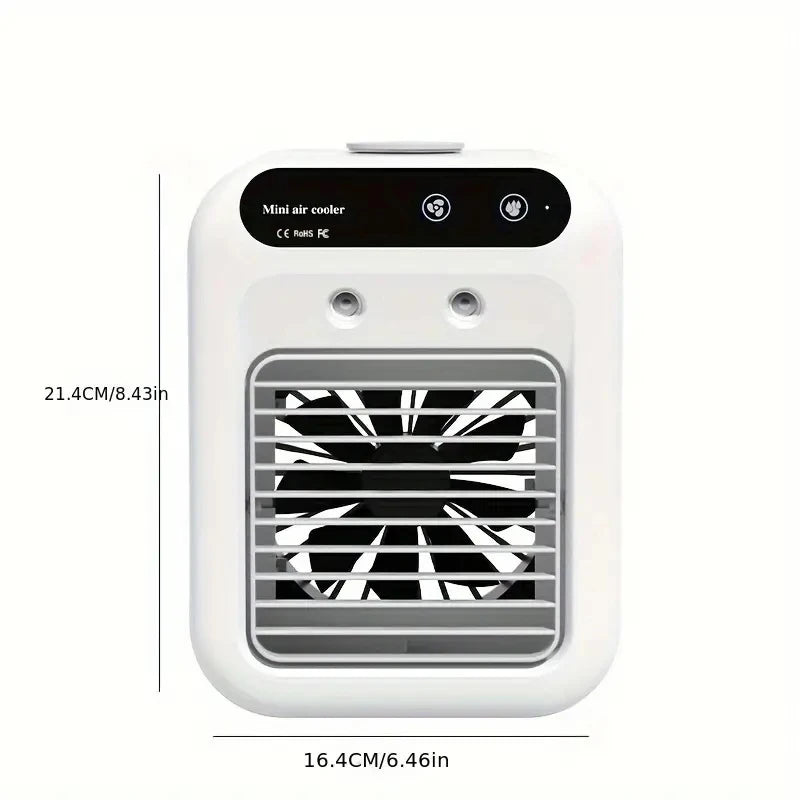
For readers who want a compact option for desks, bedrooms, offices, and other personal spaces, the Portable Air Cooler Fan combines a 500ml water capacity with a rechargeable battery, USB charging, and a 9-blade airflow design. Its compact format is intended for localized personal cooling rather than whole-room air conditioning.
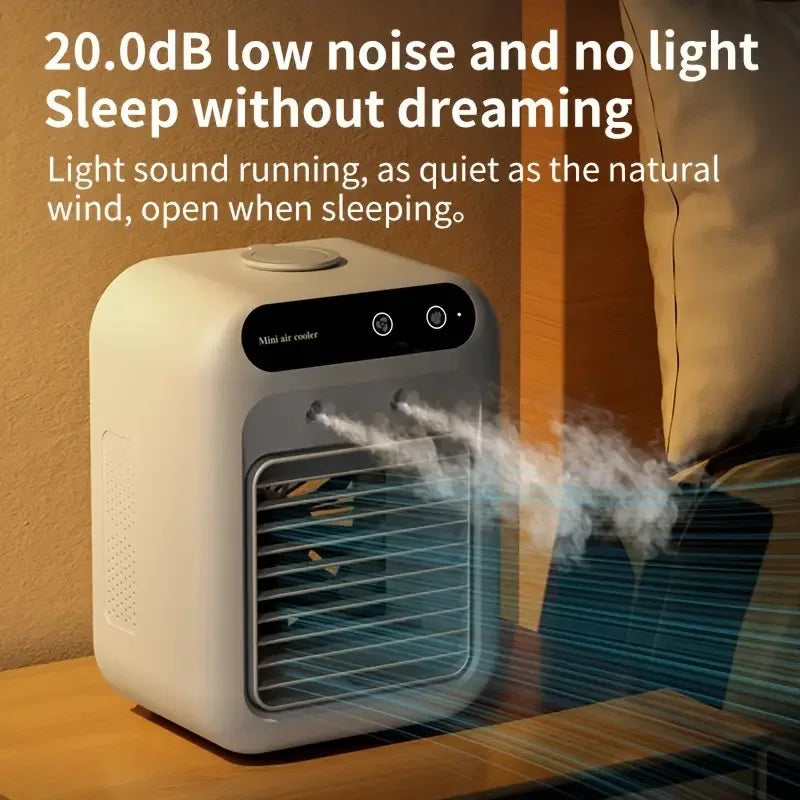
The unit's rechargeable design can be useful when you do not want to remain beside an outlet, while the 500ml reservoir provides water for its cooling function. It is designed for desks, bedrooms, offices, and other small personal spaces.
If you are comparing cooling devices, focus on the environment first rather than choosing by product category alone. Your climate, humidity level, room size, ventilation, desired airflow, noise tolerance, and maintenance preferences will determine which option makes the most sense.
The simplest decision rule
Hot and dry + ventilated + stronger cooling need: an air cooler is worth considering.
Humid + personal airflow + low energy use + simple maintenance: a desk fan is usually the better fit.
Neither option is universally better. A desk fan is the practical winner for straightforward personal airflow and humid conditions, while an air cooler can be the stronger choice when evaporative cooling is suitable. Match the device to your climate and cooling goal, and you are much more likely to get comfortable without buying more cooling capacity than you actually need.
Pillar Article: Best Bedroom Cooling Devices for 2026: Compare Your Options













