

Best Bedroom Air Cooling Options: How to Choose the Right Cooler for Better Sleep
A hot bedroom does not always need the same solution as a hot sleeper. The best bedroom cooling device depends on whether you need to lower the temperature of the entire room or simply make your sleeping area feel cooler. A portable air conditioner can provide genuine room-temperature reduction, while a fan or compact air cooler is usually better for personal airflow and localized comfort.
For bedrooms, the most important factors are not just cooling power. Noise, airflow direction, humidity, room size, energy use, portability, nighttime controls, and installation requirements can determine whether a device is comfortable enough to use every night. The goal is to match the cooling method to the actual problem rather than choosing the largest or most heavily advertised appliance.
What Is the Best Way to Cool a Bedroom?
Quick answer: choose based on whether you need personal or whole-room cooling
If your priority is lowering the actual temperature of an enclosed bedroom, an appropriately sized air conditioner is generally the strongest choice. If the room is tolerable but you feel hot in bed, at a desk, or beside a window, a fan or personal air cooler can provide more targeted comfort with less equipment.
Evaporative air coolers occupy the middle ground. They use water evaporation to make the moving air feel cooler, but their effectiveness depends heavily on ambient humidity. They should not be treated as miniature air conditioners.
Best option by bedroom situation
- Small bedroom or dorm: A personal fan, desk fan, or compact evaporative air cooler can work well when you mainly need localized cooling.
- Hot sleeper: Choose strong, adjustable airflow directed toward the sleeping area. If the entire room remains extremely hot, consider actual air conditioning.
- Light sleeper: Prioritize low-distraction airflow, adjustable speeds, timers, and sleep-oriented controls over maximum output.
- Renter: Compact fans and air coolers require little installation. Portable AC units can cool more aggressively but generally require an exhaust connection to a suitable window.
- Humid climate: Fans remain useful for personal comfort, while air conditioning is generally more appropriate when you also need humidity control. Evaporative cooling becomes less advantageous as humidity rises.
- Bedside cooling: A compact personal cooling device is often more practical than a large appliance when only one person needs additional airflow.
Bedroom Air Cooling Options Compared
Bedroom cooling devices work in fundamentally different ways. Understanding the cooling method is more useful than comparing product names alone.
Portable air conditioners
A portable air conditioner uses a refrigeration cycle to remove heat from indoor air and discharge that heat through an exhaust system. Unlike an ordinary fan, it can lower the temperature of the room when correctly sized and installed.
Best for: Bedrooms that become genuinely hot and where whole-room temperature reduction matters.
- Pros: Actual temperature reduction, stronger whole-room cooling potential, useful in hot weather.
- Cons: More energy use than a basic fan, compressor noise, larger footprint, and exhaust requirements.
A portable AC is usually a poor substitute for a tiny bedside fan when only one sleeper needs relief. It makes more sense when the bedroom itself is the problem.
Evaporative air coolers
An evaporative air cooler passes air across a water-moistened medium or reservoir so that evaporation can reduce the temperature of the moving air. The resulting airflow can feel refreshing, particularly in dry conditions.
Best for: Personal or localized cooling in relatively dry environments.
- Pros: Compact designs are portable, water can enhance the cooling sensation, and many models use less electricity than air conditioners.
- Cons: Performance is humidity-dependent, water reservoirs require maintenance, and they do not provide the same room-temperature control as refrigerated air conditioning.
A portable water air cooler is therefore best understood as a personal comfort device rather than a guaranteed replacement for an AC.
Tower fans
Tower fans move a relatively broad column of air and are useful when several areas of a bedroom need airflow. Their slim shape can also be convenient where floor space is limited.
Best for: Broad bedroom airflow without refrigeration or water.
- Pros: Good air circulation, compact vertical footprint, simple operation, and useful directional airflow.
- Cons: A fan generally does not lower the room's actual temperature; it mainly improves perceived comfort through moving air across the skin.
Desk and personal fans
Desk and personal fans focus airflow on a smaller area. They are especially useful for bedside tables, workspaces, dorm rooms, and situations where one person feels warmer than the rest of the household.
Best for: Personal cooling, bedside airflow, and small spaces where a large appliance would be excessive.
- Pros: Small footprint, easy positioning, portable operation, and generally simple controls.
- Cons: Limited area coverage and little or no direct reduction in room temperature.
Other compact cooling options
Window air conditioners can provide strong room cooling but require a suitable window and installation. Miniature cooling products may be convenient for personal use, but their compact size should not be confused with the capacity required to cool an entire bedroom.
Bedroom Cooling Comparison Matrix
Cooling method, noise, energy use, and room coverage
- Portable AC: Refrigeration-based cooling; generally higher energy demand; compressor noise is possible; designed for whole-room temperature reduction; low portability compared with personal fans.
- Evaporative air cooler: Water-based evaporative cooling; generally lower electrical demand than AC; fan noise varies by model; best for personal or localized cooling; highly dependent on humidity.
- Tower fan: Airflow only; generally low electrical demand compared with AC; broad airflow; suitable for personal and room air circulation; does not normally lower room temperature.
- Desk or personal fan: Focused airflow; generally low electrical demand; compact and easy to position; best for one person or a small zone.
- Window AC: Refrigeration-based whole-room cooling; higher electrical demand than basic fans; installation required; effective when correctly sized and installed.
Which devices actually lower bedroom temperature?
Air conditioners are designed to remove heat from indoor air and therefore can reduce room temperature. Fans primarily move air. That moving air can help sweat evaporate and make a person feel cooler, but it does not mean the fan has significantly lowered the room temperature.
Evaporative coolers can reduce the temperature of the air moving through the device under suitable conditions, but the effect depends on moisture in the surrounding air. This distinction is crucial when comparing an air cooler vs. portable fan or an evaporative cooler vs. air conditioner.
For a bedroom where the primary problem is personal heat discomfort, a compact personal cooling device can be more practical than paying for whole-room cooling. For a bedroom that remains excessively hot for hours, a true air-conditioning solution may be necessary.
How to Choose a Bedroom Cooler by Room Size
Small bedrooms and dorm rooms
Small rooms do not automatically require the smallest cooling device. Sun exposure, insulation, ceiling height, windows, occupants, and heat-producing electronics can substantially affect the cooling load.
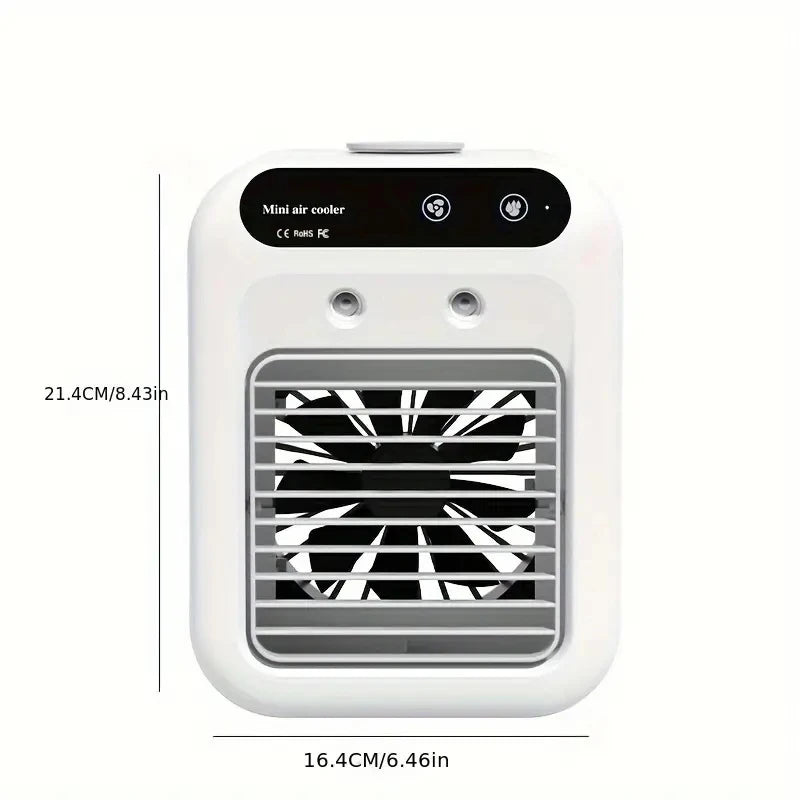
For a compact bedroom where the main goal is bedside or personal cooling, a rechargeable mini air cooler or personal fan can be convenient. A device such as a portable air cooler fan with a 500ml water capacity and nine-blade airflow system is designed around localized comfort rather than claiming to replace a full-size AC.
Medium bedrooms
Medium bedrooms often benefit from broader airflow or appropriately sized air conditioning. A tower fan can circulate air across a larger area than a tiny desk fan, while an evaporative cooler may be useful in dry climates.
If the bedroom temperature itself is consistently too high, choose a cooling system based on the room's actual heat load rather than relying on a compact personal device.
Large bedrooms and open layouts
Large bedrooms and open-plan sleeping areas expose the limitations of mini cooling devices. A small personal cooler may make the air immediately around one sleeper more comfortable without meaningfully changing conditions elsewhere in the room.
Whole-room cooling becomes more important as room volume increases. In these situations, correctly sized air conditioning or another appropriately rated room-cooling system is generally a better match.
Why advertised coverage can be misleading
Square-footage claims rarely tell the complete story. A sunny top-floor bedroom with poor insulation can require considerably more cooling than a shaded, insulated room of the same size. Open doors, frequent window opening, high ceilings, electronics, and outdoor temperature can also change results.
Use advertised coverage as a starting point, not as the only purchase criterion.
Best Bedroom Cooling Option for Different Sleep Needs
Best for hot sleepers
Hot sleepers often benefit from direct, adjustable airflow because moving air across exposed skin can improve perceived comfort. A personal fan or compact air cooler can be positioned near the bed without cooling unused parts of the room.
If the bedroom remains dangerously or uncomfortably hot despite airflow, however, personal cooling may not be enough. In that situation, prioritize actual room-temperature reduction.
Best for light sleepers
Noise matters because a device can be technically effective but still unsuitable for sleep. Listen for the overall character of the sound, not just a manufacturer's description. Fan motors, compressor cycling, rattling, vibration, and tonal hum can all affect sleep comfort.
Adjustable speeds and timers can also be more useful at night than maximum airflow. A quiet portable air cooler can be a practical option when you want localized airflow without the footprint of a larger appliance.
Best for bedside cooling
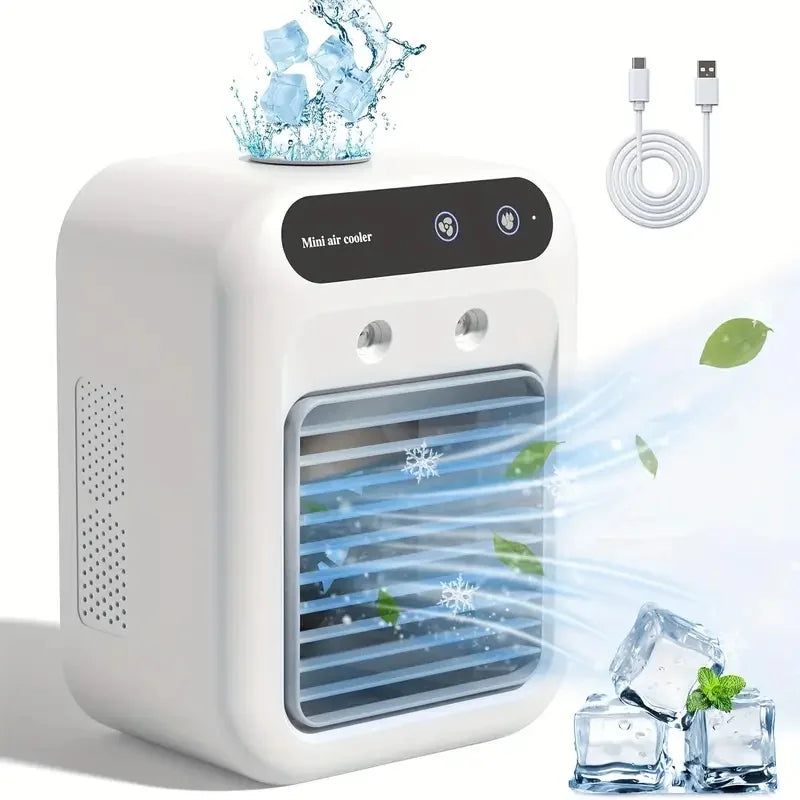
Bedside cooling favors compactness and directional airflow. A personal device can sit closer to the sleeping area and direct airflow where it is needed instead of attempting to circulate an entire bedroom.
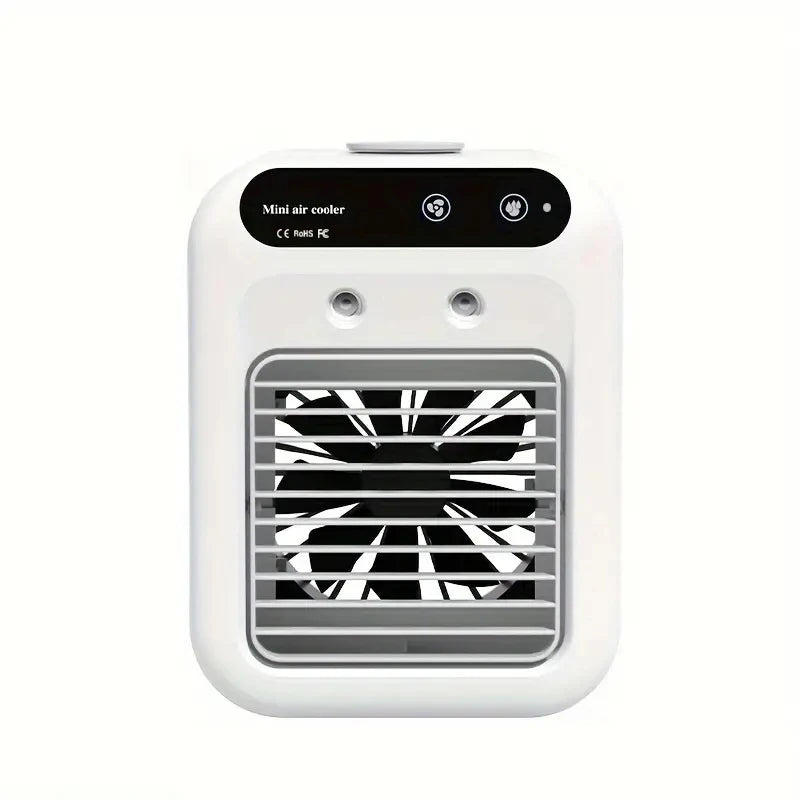
The portable air cooler fan described here combines rechargeable operation, USB charging, a 500ml water reservoir, and a nine-blade fan design. Those features make it more relevant to personal cooling than whole-bedroom air conditioning.
Best for renters
Renters often benefit from devices that require little or no permanent installation. Fans and compact air coolers can be moved between rooms without window modifications.
Portable AC units are also movable, but they still require appropriate exhaust routing. Before purchasing one, confirm that the room has a workable window configuration and that the exhaust arrangement is permitted.
Best for humid climates
Humidity changes the decision substantially. Evaporative cooling depends on evaporation, so adding moisture to already humid air provides less useful cooling potential than it does in dry conditions.
In humid weather, a fan can still improve personal comfort by increasing airflow across the skin. If you need the room to become both cooler and less humid, air conditioning is generally the more appropriate technology.
Best for low energy use
Fans generally require less electricity than air conditioners because they are moving air rather than operating a refrigeration cycle. Evaporative coolers can also be relatively economical to operate, depending on the specific design and conditions.
However, energy efficiency should be judged against the cooling result. A low-power personal fan that does not lower the temperature of a very hot bedroom is not providing the same service as an air conditioner.
Noise and Sleep Comfort: What to Look For
How cooling-device noise affects sleep
Bedroom noise is more complicated than a single decibel number. A steady, unobtrusive airflow sound may be easier to sleep through than intermittent rattling, vibration, compressor cycling, or a high-pitched motor tone.
When shopping for a bedroom cooling device, consider whether the sound remains comfortable at the speed you actually need overnight. Maximum airflow is not necessarily the best sleep setting.
Features that matter at night
- Adjustable airflow speeds
- Timer functions
- Sleep modes where available
- Display-off controls where available
- Stable construction that reduces vibration
- Airflow adjustment or oscillation
- Convenient controls that do not require getting out of bed
Airflow direction matters too
Strong airflow directly across the face or body can become uncomfortable even when the bedroom temperature is high. Aim the airflow toward the sleeping zone rather than automatically pointing the strongest setting directly at your head.
For compact personal devices, positioning is one of the easiest ways to improve comfort without increasing fan speed.
Cooling Method vs. Climate: Why Humidity Changes the Choice
Dry climates
Evaporative cooling can be useful in dry environments because the surrounding air has greater capacity to accept additional moisture. The evaporation process can make the moving air feel cooler.
This is where a water air cooler can offer an advantage over a conventional fan for personal comfort, provided expectations remain realistic.
Humid climates
In humid conditions, evaporation becomes less effective because the air already contains substantial moisture. An evaporative cooler may therefore provide less noticeable cooling than it would in dry air.
Fans can remain useful because they improve air movement without depending on evaporation. Air conditioners have another advantage: they can remove moisture as part of the cooling process.
Fans vs. air conditioners in humid weather
A fan primarily changes how hot you feel. An air conditioner is designed to change the condition of the indoor air by removing heat and, depending on operation, moisture.
That difference explains why a fan can feel refreshing in a humid bedroom while still leaving the room objectively hot.
Energy Use and Bedroom Cooling Costs
Which cooling devices generally use the least electricity?
In broad terms, simple fans typically consume less electricity than refrigeration-based air conditioners. Evaporative coolers can also use less electrical power than AC because they do not perform the same refrigeration work.
Exact energy use depends on the model, speed, operating time, and local electricity rate, so avoid treating a category-level comparison as a guaranteed operating cost.
Why cooling performance and energy use must be considered together
The most efficient device is not necessarily the cheapest solution if it cannot solve the cooling problem. If a bedroom is extremely hot, repeatedly running several small personal devices may not provide the same result as one properly sized air conditioner.
Conversely, using whole-room AC when only one person needs a small amount of additional airflow can be unnecessary. Match the cooling system to the area and level of comfort you actually need.
How to reduce nighttime cooling energy use
- Close curtains or shades before the room heats up.
- Limit unnecessary heat-producing electronics.
- Use timers or sleep settings when appropriate.
- Keep doors and windows managed according to the cooling method being used.
- Reduce direct sunlight entering the bedroom during the hottest part of the day.
- Use personal airflow when whole-room cooling is unnecessary.
How to Set Up a Bedroom Cooler for Better Results
Where to place a fan or air cooler
Give the device clear intake space and avoid placing it behind bedding, curtains, or other objects that restrict airflow. For a personal cooler, position it so the airflow reaches the area where you actually need relief.
A compact rechargeable unit can be particularly convenient beside a desk or bedside area because it can be repositioned without moving a larger appliance.
Where to place a portable AC
Keep a portable AC near an appropriate window so the exhaust hose can be routed efficiently. Maintain the clearance specified by the manufacturer and avoid unnecessary bends or obstructions in the exhaust path.
Use timers and sleep modes overnight
Nighttime cooling does not always require maximum output for the entire night. If your device offers a timer, adjustable speed, or sleep mode, use those features to balance airflow, comfort, and energy consumption.
Keep the bedroom from reheating
Cooling equipment works against a smaller heat load when the room is protected from direct sunlight and unnecessary heat sources. Close shades during peak sunlight, keep exterior doors and windows managed appropriately, and reduce heat-producing electronics where practical.
Bedroom Cooling Buying Checklist
Check these 8 factors before buying
- Cooling method: Decide whether you need airflow, evaporative cooling, or actual refrigeration.
- Room size: Match the device to the area that needs cooling, not just the available shelf space.
- Climate: Consider humidity before choosing an evaporative water cooler.
- Noise: Think about motor, compressor, vibration, and cycling sounds at night.
- Airflow: Look for suitable direction, speed adjustment, and coverage.
- Energy use: Compare expected electricity consumption with the cooling result you need.
- Portability: Consider whether you need to move the device between bedroom, desk, office, or other spaces.
- Nighttime usability: Timers, sleep settings, stable placement, and convenient controls can make a major difference.
Red flags that indicate a device may be too weak for your bedroom
- The product is marketed as cooling an entire room without clearly explaining its cooling method.
- A very small device promises the same room-temperature reduction as a full-size air conditioner.
- Humidity limitations are not discussed for an evaporative cooler.
- Advertised square footage is presented without considering sunlight, insulation, ceiling height, or outdoor temperature.
- The product emphasizes cold-feeling airflow but does not distinguish personal comfort from actual room cooling.
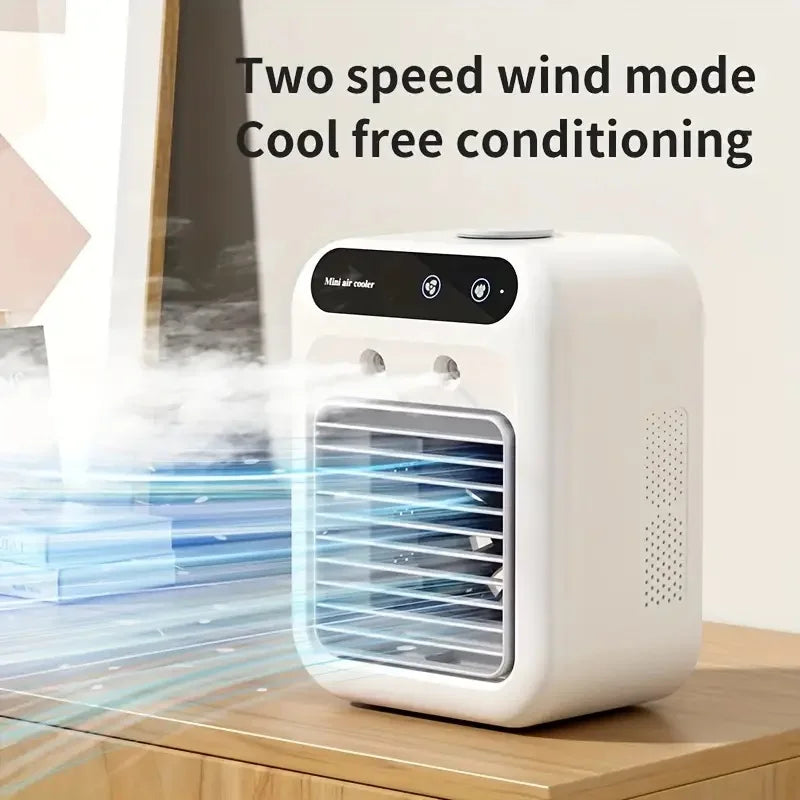
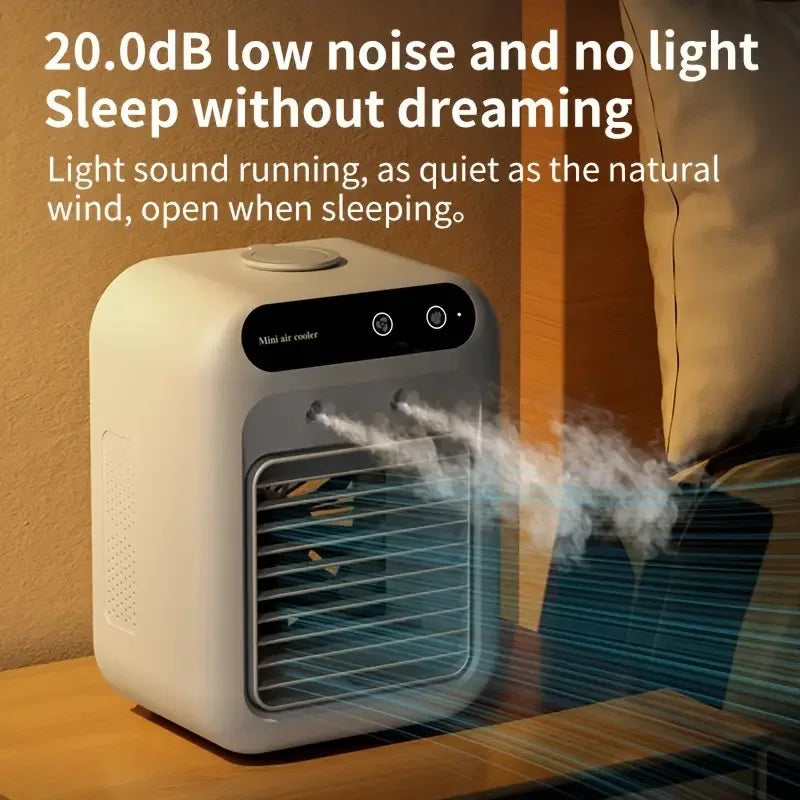
For shoppers who primarily need focused cooling beside a bed or desk, the Portable Air Cooler Fan is designed around that use case. Its rechargeable battery and USB charging support portable operation, while the 500ml water reservoir and nine-blade airflow system provide a compact water-based personal cooling setup.
It is best viewed as a personal cooling solution rather than a substitute for whole-room air conditioning. That distinction makes it a better fit for hot sleepers who want localized airflow, small bedrooms where personal cooling is sufficient, desks, offices, and other compact spaces.
For additional home and personal-use devices, explore the Lifestyle collection and the Body Care and Health Devices collection when you are comparing compact devices for everyday comfort and convenience.
Final Verdict: Which Bedroom Cooling Device Is Right for You?
The best bedroom cooling device depends on the problem you are trying to solve. If your goal is to lower the temperature of an entire hot bedroom, choose an appropriately sized air conditioner and account for installation, exhaust requirements, noise, and energy use.
If you mainly need personal comfort, a fan can be simpler and more energy-conscious. An evaporative air cooler can add a cooler-feeling breeze when conditions are favorable, especially in dry climates. In humid environments, however, a fan or air conditioner may be a better match depending on whether you need personal airflow or actual temperature and humidity control.
For bedside or small-space use, a compact rechargeable air cooler can offer a practical middle ground. The Portable Air Cooler Fan combines a 500ml water capacity, nine-blade airflow, quiet operation, rechargeable battery power, and USB charging in a portable format designed for personal cooling.
The most important buying decision is therefore simple: choose a personal cooling device when you need to feel cooler, and choose whole-room cooling when you need the bedroom itself to become cooler. Matching that distinction to your room size, climate, sleep sensitivity, and cooling expectations is the best way to avoid buying a device that is either unnecessarily large or simply too weak for the job.
Related Articles:
- Best Compact Air Cooler for Workspace: 2026 Comparison Guide
- Best Battery Powered Fan: Runtime, Cooling & Use-Case Picks
- Best Quiet Portable Air Coolers of 2026: Tested Picks for Sleep, Desks & Travel
- Quiet Mini Air Cooler for Bedroom: Best Options Compared
- Portable Water Air Cooler Buying Guide: How to Choose the Right One
- Portable Water Cooler Fan for Desk: Compact 500ml Cooling
- Best Personal Air Cooler Fans of 2026: Compared & Tested
- Rechargeable Mini Cooler for Office: Best Picks Tested
- Nine Blade Fan: Does More Blades Mean Better Airflow?
- Hot Stuffy Room Cooling: Practical Ways to Cool Any Space
- Air Cooler or Desk Fan: Which Is Better for You?













