

Best Battery Powered Fan: Runtime, Cooling & Use-Case Picks
Choosing the best battery powered fan is not simply a matter of picking the model with the largest battery or the highest advertised runtime. A fan that lasts longer on its lowest setting may provide less useful airflow than a smaller model running at a more practical speed. For desk work, bedside cooling, travel, outdoor use, or emergency backup, the better choice depends on the balance between usable runtime, airflow, noise, charging convenience, portability, and stability.
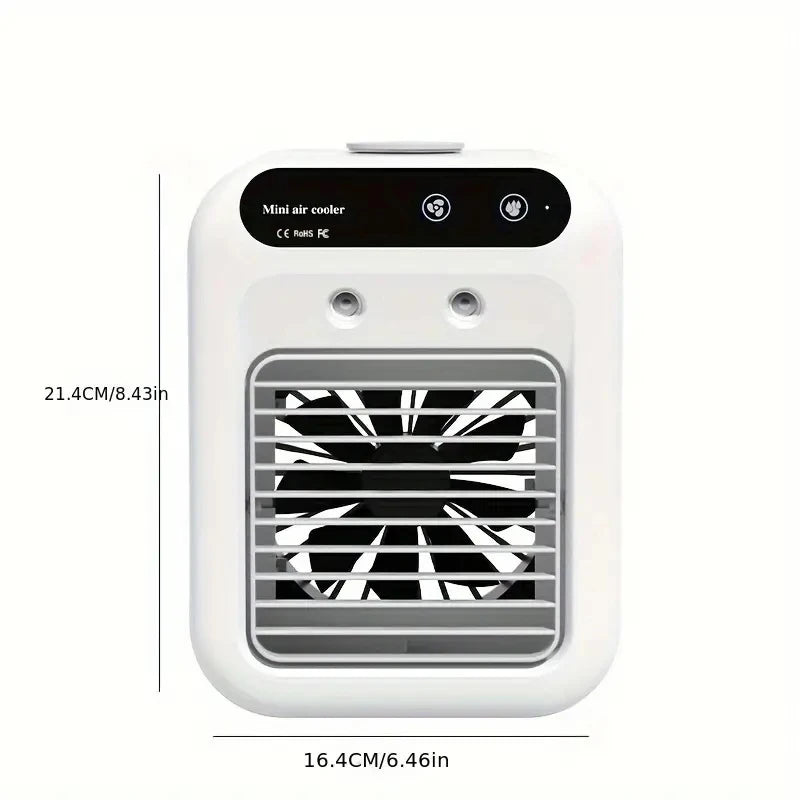
This guide uses a runtime-versus-cooling framework rather than relying on popularity claims. The verified product information available for this comparison identifies a compact rechargeable portable air cooler fan with a 500ml water reservoir, nine-blade airflow design, rechargeable battery, USB charging, and quiet operation. Manufacturer specifications are treated separately from performance observations; where a specification such as exact battery capacity, CFM, charging time, weight, or measured runtime is not provided, it is not presented as a tested fact.
Best Battery Powered Fans at a Glance
For a buyer comparing battery operated fans, the most useful starting point is a decision matrix. It shows which specifications are actually available and which performance claims still need verification. The product supplied for this article is designed primarily for personal cooling in desks, bedrooms, offices, and other small spaces rather than whole-room air conditioning.
Comparison Matrix: Runtime, Airflow, Noise, Charging & Portability
| Feature | Verified Portable Air Cooler Fan | What Buyers Should Check |
| Battery operation | Rechargeable battery | Battery capacity and usable runtime at the desired speed |
| Charging | USB charging | Charging time, cable compatibility, and charging flexibility |
| Water capacity | 500ml | Reservoir size and how frequently it needs refilling |
| Airflow design | 9-blade fan | Airflow strength, reach, speed settings, and CFM where available |
| Noise | Designed for quieter personal cooling | Measured noise at low, medium, and maximum settings |
| Form factor | Compact portable design | Desk footprint, weight, stability, and carrying convenience |
| Best fit | Desk, bedroom, office, and small-space personal cooling | Match the device to the intended environment |
| Voltage | Under 20V | Exact electrical specifications and charging requirements |
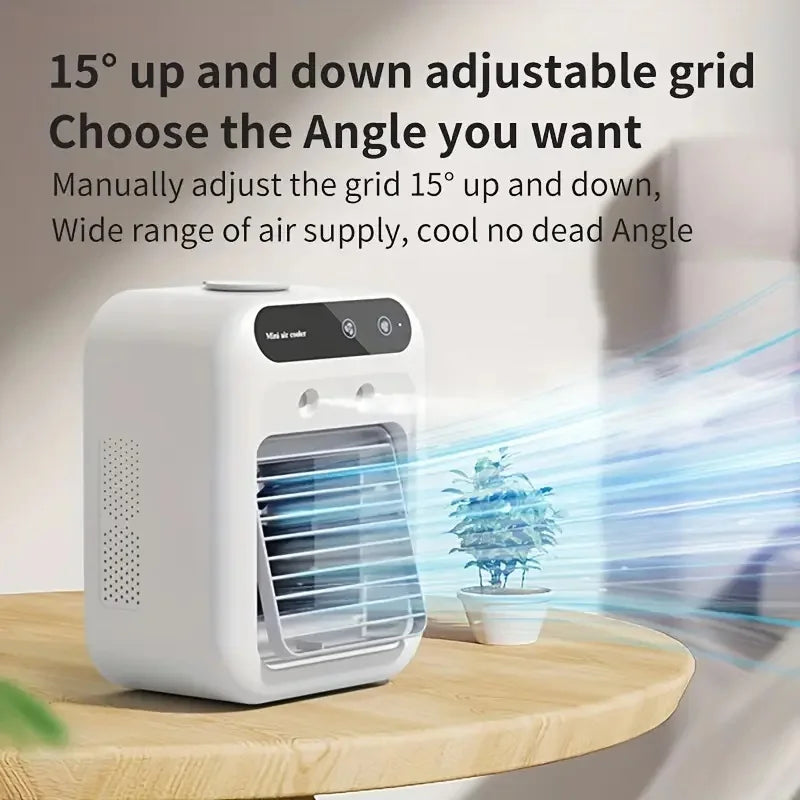
The supplied product uses a nine-blade airflow system and a 500ml water capacity. It is rechargeable and uses USB charging, which makes it useful when you want personal cooling without remaining beside a fixed wall outlet.
Quick Picks by Use Case
- Desk cooling: A compact rechargeable air cooler is a practical fit when footprint, directional airflow, and reduced fan noise matter.
- Bedroom cooling: Prioritize low-speed noise, stable placement, adjustable airflow direction, and realistic overnight runtime.
- Travel: Look for a small form factor, cordless operation, USB charging, and manageable weight.
- Outdoor events: Strong personal airflow and battery endurance become more important because there is no enclosed room for the air to circulate.
- Camping: Battery life, charging flexibility, portability, and stability should be evaluated together.
- Power outages: A rechargeable fan can continue operating without grid power when its battery is charged.
How We Evaluate Battery Powered Fans
A useful battery powered fan comparison should distinguish manufacturer specifications from independently observed performance. Battery life is affected by operating speed, airflow demand, oscillation, lighting or display features, ambient conditions, and other electrical loads. For that reason, a maximum runtime number should never automatically be treated as the runtime a buyer will experience during stronger cooling.
Runtime and Battery Life
Runtime is one of the most important buying criteria, but it is also one of the easiest specifications to misunderstand. A manufacturer may publish a maximum runtime based on a low-speed setting. Higher airflow normally requires more electrical power, so the same fan may run for substantially less time at a stronger setting.
When comparing a rechargeable fan, ask which speed was used to obtain the advertised runtime. Also check whether oscillation, lighting, displays, timers, or power-bank functions were active. A practical comparison should separate maximum rated runtime from usable runtime at the speed you actually expect to use.
Cooling and Airflow Performance
Airflow is more relevant to cooling performance than battery capacity alone. A high-capacity battery can keep a weak airflow system running for a long time without delivering the cooling intensity a buyer wants.
CFM, or cubic feet per minute, can provide a useful comparison when manufacturers publish measurements obtained under comparable conditions. However, CFM should not be treated as a universal measure of perceived cooling. Airflow direction, distance from the user, fan geometry, room conditions, and operating speed all affect the experience.
A personal air cooler is also fundamentally different from an air conditioner. A compact device can direct air toward one person, but it should not automatically be expected to reduce the temperature of an entire room.
Noise and Sleep-Friendliness
Noise needs to be evaluated at the operating speed that matters for the intended use. A fan can be quiet at its lowest setting while becoming noticeably louder at maximum airflow. For bedroom use, low-speed performance may therefore be more important than peak airflow.
For a workspace, quiet operation can also reduce distraction during calls, reading, studying, or concentrated computer work. The supplied portable air cooler is specifically described as offering quiet operation with less distracting fan noise.
Charging, Controls and Stability
USB charging makes a cordless fan easier to integrate into a modern workspace because the same general charging ecosystem can be used with computers, power adapters, and compatible portable power sources. The supplied model uses USB charging and a rechargeable battery.
Buyers should still check charging time, cable requirements, battery indicators, controls, adjustable angle, oscillation, and base stability before purchasing. These details can determine whether a fan is genuinely convenient in daily use.
Best Battery Powered Fan for Desk Use
Desk cooling is one of the strongest use cases for a compact rechargeable fan. The goal is not to cool an entire office. Instead, the goal is to create a focused personal airflow zone around the person working at the desk.
What Matters Most on a Desk
- Compact footprint: The fan should not consume valuable keyboard, notebook, or monitor space.
- Stable placement: A lightweight device still needs a base that stays secure while operating.
- Directional airflow: Personal cooling is more effective when airflow can be aimed toward the user.
- Low noise: Quiet operation is particularly useful during work and video calls.
- Useful runtime: Consider the speed you actually need instead of relying only on the maximum advertised runtime.
- Rechargeable operation: Cordless use reduces dependence on a nearby outlet.
Best Choice and Main Trade-Off
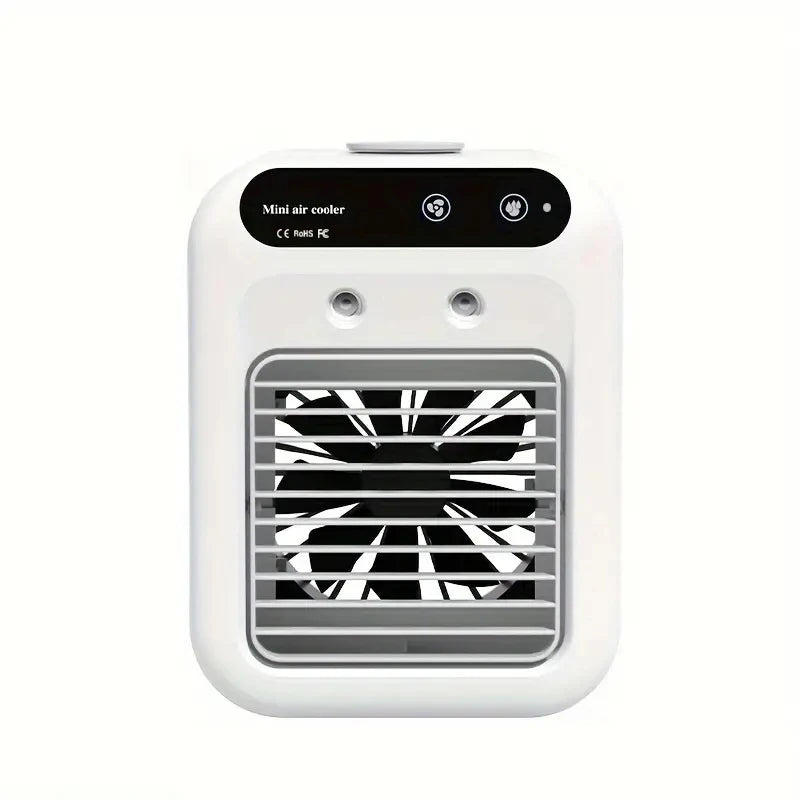
The verified portable air cooler fan is particularly well matched to desk environments because it combines compact personal cooling with rechargeable operation, USB charging, a nine-blade airflow system, and a 500ml water reservoir. Its product specifications identify desks and offices among the intended use cases.
The main limitation is that the supplied specifications do not establish a precise battery capacity, measured runtime at each speed, CFM rating, charging time, weight, or noise level in decibels. Those values should therefore be checked before making a performance-based comparison against another specific fan.
For shoppers who want water-assisted personal cooling in a compact workspace, the Portable Air Cooler Fan is a reasonable option to investigate rather than assuming that a conventional battery fan will provide the same type of cooling experience.
Best Battery Powered Fan for Travel and Camping
Travel changes the priorities. A fan that performs well on a desk may be inconvenient to carry if it is heavy, bulky, or dependent on a proprietary charging system.
Travel-Friendly Features to Prioritize
- Rechargeable battery operation
- USB charging
- Compact dimensions
- Low carrying weight
- Stable placement on uneven surfaces
- Simple controls
- Practical runtime at useful airflow levels
- Easy access to compatible charging power
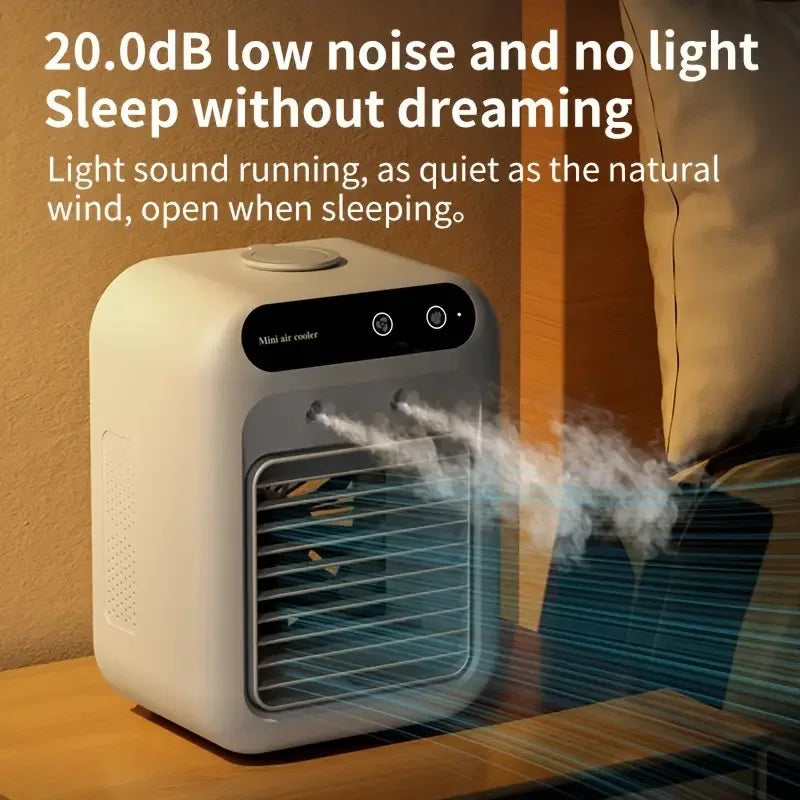
The supplied portable air cooler is rechargeable and USB-chargeable, which supports portable use away from a fixed outlet. Its compact positioning also makes it suitable for bedrooms, offices, desks, and other personal spaces.
Outdoor Airflow vs Battery Runtime Trade-Off
Outdoor use exposes an important limitation of every portable fan: stronger airflow usually comes at an energy cost. In an open environment, air disperses quickly, so users may naturally choose higher speeds. That can reduce usable runtime.
A better strategy is to use the lowest setting that creates a meaningful airflow zone and reserve higher speeds for periods when stronger cooling is necessary. When traveling, also consider how easily the fan can be recharged between uses.
Best Battery Powered Fan for Outdoor Events
Outdoor cooling is primarily personal airflow. A battery powered fan cannot provide the same enclosed cooling effect as an air conditioner because there is no room envelope holding conditioned air in place.
How Much Airflow Do You Need Outdoors?
For outdoor events, airflow reach and speed become especially important. A weak airflow may feel effective at close range but provide little benefit when the fan is positioned farther away. Buyers should therefore consider the distance between the fan and their body and whether the fan can maintain useful airflow at that distance.
Stability, Runtime and Controls in Outdoor Use
A stable base is important at outdoor events because tables and other surfaces may be crowded or uneven. Directional adjustment can also be valuable because the fan may need to be repositioned throughout the event.
Battery indicators, simple speed controls, and predictable charging are useful additions. If the fan does not provide verified power-bank functionality, do not assume its battery can recharge another device.
Best Battery Powered Fan for Bedside Cooling
Bedside cooling has different priorities from outdoor cooling. Maximum airflow is not always the goal. For sleep, a comfortable low-speed breeze, quiet operation, stable positioning, and useful runtime can matter more.
Noise, Low-Speed Runtime and Airflow Direction
A bedroom fan should be evaluated at the speed you expect to use overnight. If a product is only quiet at its lowest setting but requires maximum speed to create useful airflow, the headline noise claim may not tell the complete story.
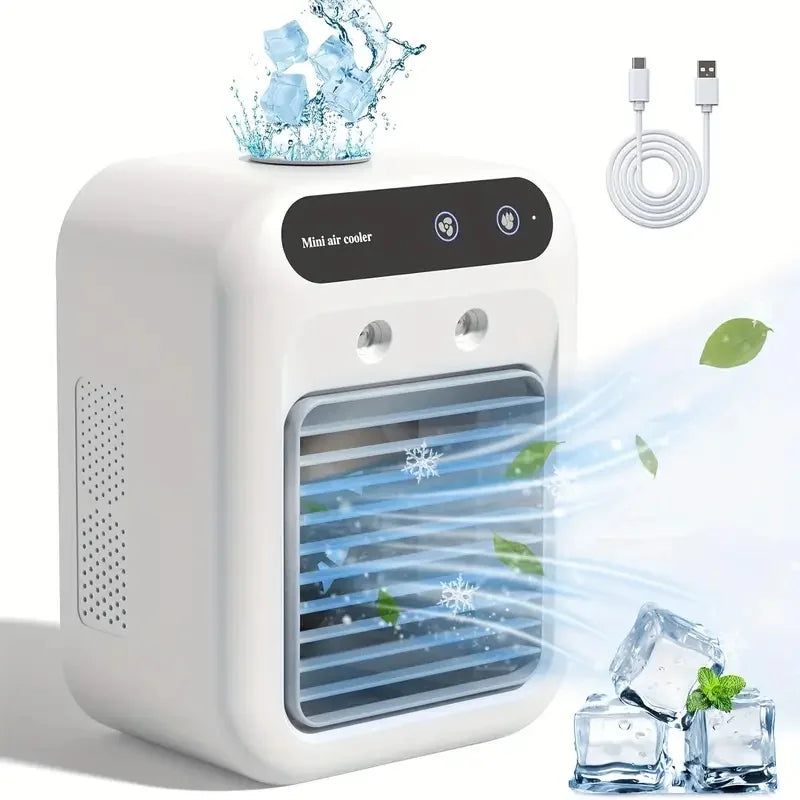
The supplied portable air cooler is positioned as a quiet personal cooling solution and is intended for bedroom use. However, no decibel measurements or overnight runtime figures are provided in the available product specifications, so those performance characteristics should not be presented as independently verified.
When a Cordless Fan Makes More Sense Than a Plug-In Fan
A rechargeable fan makes sense when outlet access is inconvenient or when you want the flexibility to reposition the device. Cordless operation can also become valuable during temporary power interruptions.
The trade-off is that battery-powered operation eventually requires recharging. For consistent overnight use, buyers should understand the expected runtime at their preferred speed and establish a charging routine.
Best Battery Powered Fan for Power Outages and Emergency Cooling
Can a Rechargeable Fan Run During a Power Outage?
Yes. A rechargeable fan can operate without grid power when its internal battery has sufficient charge. This makes battery powered cooling useful as a personal comfort measure during an outage.
It should not, however, be treated as a substitute for an air conditioner or whole-home cooling system. A portable fan primarily moves air around the user.
Power-Bank Functionality and Backup Charging
Some rechargeable fans can also function as power banks, but this feature must be confirmed in the product specifications. The supplied portable air cooler is documented as rechargeable and USB-chargeable, but the available information does not state that it can charge another device.
How to Maximize Runtime During an Outage
- Charge the fan before severe weather or anticipated outages.
- Use the lowest speed that provides adequate personal airflow.
- Disable unnecessary features when possible.
- Keep charging cables and compatible power sources available.
- Do not assume maximum advertised runtime represents high-speed operation.
Battery Runtime: What the Numbers Really Mean
Rated Runtime vs Usable Runtime
Advertised maximum runtime generally needs context. A long runtime number may be measured at the lowest airflow setting, while the buyer may expect to operate the fan at medium or high speed.
For a meaningful comparison, identify the runtime at the setting you expect to use. A shorter runtime at stronger airflow can be more useful than an exceptionally long runtime at barely perceptible airflow.
What Changes Fan Runtime?
Fan speed is one of the most obvious variables, but it is not the only one. Oscillation, displays, lighting, motor efficiency, battery condition, ambient temperature, and other functions can affect power consumption.
Because the supplied product information does not provide a battery-capacity figure or speed-specific runtime test, an exact runtime claim cannot be responsibly calculated from the available specifications. The product is confirmed as rechargeable, but buyers should obtain the manufacturer's current runtime information for the desired operating mode before relying on it for overnight or emergency use.
How to Compare Battery Capacity Fairly
Battery capacity should ideally be compared using watt-hours when voltage information is available. Comparing mAh alone can be misleading because two batteries with the same milliamp-hour rating can store different amounts of energy if their voltages differ.
This is why a larger mAh number should not automatically be treated as proof that one battery powered fan will run longer than another.
Airflow, CFM and Cooling Performance Explained
What Is CFM and Why Does It Matter?
CFM means cubic feet per minute and is commonly used to describe the volume of air a fan moves. When two products publish comparable CFM measurements under similar conditions, the figure can help buyers understand relative airflow capability.
However, CFM is only one part of the performance picture. The distance between the fan and user, airflow concentration, blade design, speed setting, and surrounding environment can all affect perceived cooling.
Why Higher CFM Is Not Always Better
More airflow can be useful outdoors or when the fan needs to move air over a greater distance. But maximum airflow may also mean more noise and faster battery consumption.
For bedside or desk use, moderate focused airflow may therefore be preferable to maximum output. The best battery powered fan is the one that produces enough airflow for the situation without creating unnecessary noise or draining its battery faster than necessary.
Brushless Motors and Fan Efficiency
Brushless motors can offer advantages in some fan designs, including efficient operation and potentially improved durability. However, the presence of a brushless motor alone does not prove that a particular fan has superior cooling or battery performance.
Motor design should be evaluated alongside airflow, power consumption, noise, battery capacity, and actual runtime.
Battery Powered Fan Buying Guide: 8 Features That Matter
1. Battery Capacity and Realistic Runtime
Look beyond the headline runtime. Find out how long the fan operates at the speed you actually expect to use.
2. Airflow and CFM
Check airflow specifications when available, but also consider airflow reach and whether the fan is designed for personal or broader circulation.
3. USB-C Charging and Charging Time
USB charging is convenient, but charging time still matters. Confirm the charging interface and expected recharge duration before buying.
4. Noise Level
Match noise performance to the environment. A work fan and a bedside fan can have very different acceptable noise thresholds.
5. Oscillation and Adjustable Angle
Directional adjustment allows airflow to be positioned where it provides the most benefit. Oscillation can distribute airflow over a wider area when available.
6. Size, Weight and Stability
A portable fan should be easy to move without becoming unstable. A compact footprint is particularly useful for desks and bedside tables.
7. Controls and Battery Indicators
Speed controls, timers, displays, and battery indicators can make a fan easier to use. These features should support the primary cooling purpose rather than add unnecessary complexity.
8. Power-Bank Functionality
If emergency charging is important, verify whether the fan explicitly supports power-bank output. Do not infer this capability simply because the fan itself charges through USB.
Which Battery Powered Fan Should You Buy?
There is no universal winner for every situation. The strongest choice depends on what you value most.
Choose for Maximum Runtime
Choose a model with verified speed-specific runtime information and sufficient battery capacity for the duration you need. Do not judge battery life from the maximum runtime claim alone.
Choose for Strongest Personal Airflow
Prioritize airflow reach, available speed settings, and CFM where reliable measurements are provided. Remember that stronger airflow can reduce battery endurance.
Choose for Quiet Bedside Use
Prioritize low-speed noise, stable placement, airflow direction, and overnight usability. The supplied portable air cooler is designed around quiet personal cooling, but exact decibel and overnight-runtime measurements are not provided in the available specifications.
Choose for Travel and Outdoor Use
Look for rechargeable operation, USB charging, compact size, easy carrying, stable placement, and enough airflow for the environment. The supplied product's rechargeable design and USB charging make it relevant to this use case.
Choose for Emergency Backup
Prioritize a dependable internal battery and confirmed runtime. If power-bank capability matters, verify that the product explicitly supports output charging. A rechargeable fan can provide personal airflow during an outage as long as its battery was charged beforehand.
Battery Powered Fan FAQs
How long does a battery powered fan usually run?
Runtime varies substantially according to battery size, fan speed, motor efficiency, and additional features. Maximum advertised runtime often represents low-speed operation, so buyers should look for runtime information at the airflow level they actually plan to use. The supplied portable air cooler is confirmed to use a rechargeable battery, but the available specifications do not provide a speed-specific runtime figure.
Are battery powered fans strong enough to cool a room?
Most compact battery powered fans are designed primarily for personal airflow rather than replacing an air conditioner. They can make a person feel more comfortable by moving air directly toward the body, but they should not be expected to provide whole-room cooling comparable to an air-conditioning system.
What is the best battery powered fan for outdoor use?
The best choice depends on airflow reach, battery endurance, stability, portability, and charging flexibility. Outdoor environments generally require more focused or stronger airflow because air disperses quickly. A fan with excellent low-speed runtime may not be the best outdoor choice if it cannot deliver sufficient airflow at a useful distance.
Can a rechargeable fan run during a power outage?
Yes. A rechargeable fan can operate from its internal battery without grid electricity as long as the battery has been charged. The supplied product is explicitly rechargeable and uses USB charging.
What should I look for when buying a battery powered fan?
Focus on usable runtime, battery capacity, airflow, CFM when available, noise, USB charging, portability, stability, controls, oscillation, adjustable angle, and confirmed power-bank functionality. Match those specifications to the environment rather than choosing based only on battery size or a generic “best fan” label.
Final Verdict
The best battery powered fan is the one that balances the characteristics you actually need: usable runtime, personal airflow, acceptable noise, charging convenience, portability, and stability. For desk and small-space cooling, a compact rechargeable air cooler can be particularly useful because it combines focused airflow with a small footprint.
The verified Portable Air Cooler Fan offers a rechargeable battery, USB charging, a nine-blade fan, 500ml water capacity, quiet-operation positioning, and a compact design intended for desks, bedrooms, offices, and other personal spaces.
Its specifications do not establish exact battery capacity, measured CFM, decibel output, charging duration, or speed-specific runtime, so those figures should be confirmed before using it for requirements where precise endurance matters. That distinction is important: transparent specifications are more useful than unsupported superlatives.
If your priority is compact personal cooling while working or resting, the product's combination of rechargeable operation, USB charging, 500ml water capacity, nine-blade airflow, and quiet-focused design makes it worth considering.
Pillar Article: Best Bedroom Cooling Devices for 2026: Compare Your Options













