

Best Compact Air Cooler for Workspace: 2026 Comparison Guide
A compact air cooler for workspace use can be a practical middle ground when your desk feels too hot but running whole-room air conditioning feels excessive. A desktop fan is simple and inexpensive, but it mainly moves existing air. A water-assisted personal cooler can add a different type of airflow experience while keeping the device small enough for a desk, bedroom, cubicle, or home office.
The key is knowing what you are actually buying. Compact cooling devices are designed primarily for personal-zone comfort, not for replacing a central HVAC system or compressor-based air conditioner. Before choosing one, compare airflow, cooling method, noise, power source, water capacity, portability, maintenance, and suitability for your local humidity.
Compact Air Cooler for Workspace: What to Look For
The best compact air cooler for a workspace should deliver useful personal airflow without consuming valuable desk space or becoming a distraction during focused work. Look beyond marketing terms and evaluate the complete operating experience.
Best features for desk and workspace cooling
- Airflow: Look for consistent, directional airflow that can reach your personal zone without requiring the unit to run at maximum speed constantly.
- Cooling method: Determine whether the device is simply a fan, uses water-assisted or evaporative cooling, or uses compressor-based refrigeration. These technologies have very different capabilities.
- Noise: Quiet operation matters during video calls, studying, reading, and concentrated office work.
- Power: USB charging and rechargeable batteries make a compact cooler easier to position than a device that must remain beside a wall outlet.
- Water capacity: A larger reservoir can reduce refill frequency, although a larger tank can also increase the device footprint.
- Footprint: Measure the available desk area before buying. A cooling device should not force your monitor, keyboard, notebook, or other equipment into an awkward position.
- Portability: A compact rechargeable unit is useful for hybrid workers who move between a home office, bedroom, and other personal spaces.
- Maintenance: Any device that uses water requires attention to the reservoir and water-contact components. Easy cleaning is an important part of long-term value.
Personal-zone cooling vs. whole-room cooling
This distinction is critical. A compact personal air cooler is intended to improve comfort around the person using it. It does not automatically have the airflow capacity, refrigeration system, or heat-removal capability needed to lower the temperature throughout an entire office.
If only your desk gets uncomfortable while the rest of the room is tolerable, personal cooling can make more sense than cooling the entire room. If everyone in the room is overheating, humidity is excessive, or you need measurable room-temperature reduction, a larger cooling system may be the better solution.
2026 Compact Air Cooler Comparison
For workspace use, the most useful comparison is not simply “which unit is coldest?” Instead, consider which cooling approach matches your environment and how you intend to use the device.
Comparison matrix: cooling, noise, power, tank, size and portability
| Cooling option | Airflow | Water | Power approach | Workspace fit | Best for |
| Compact water-assisted personal cooler | Personal, directional airflow | Yes, depending on model | Often USB/rechargeable | Excellent for small desks | Personal comfort and portability |
| Desktop fan | Air movement | No | USB or wall power | Excellent | Simple airflow with minimal maintenance |
| Portable air conditioner | Stronger room airflow | Typically no cooling reservoir | Wall power | Requires substantially more space | Room-level temperature reduction |
| Central or split air conditioning | Whole-room or whole-building | Refrigeration system | Wall/electrical installation | Not a personal desktop solution | Whole-room temperature and humidity control |
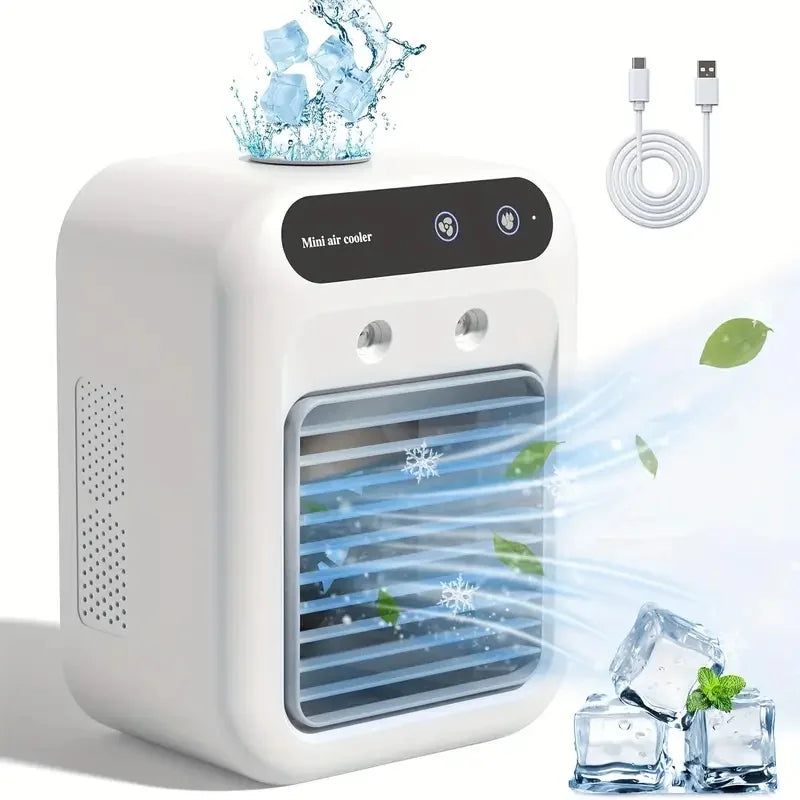
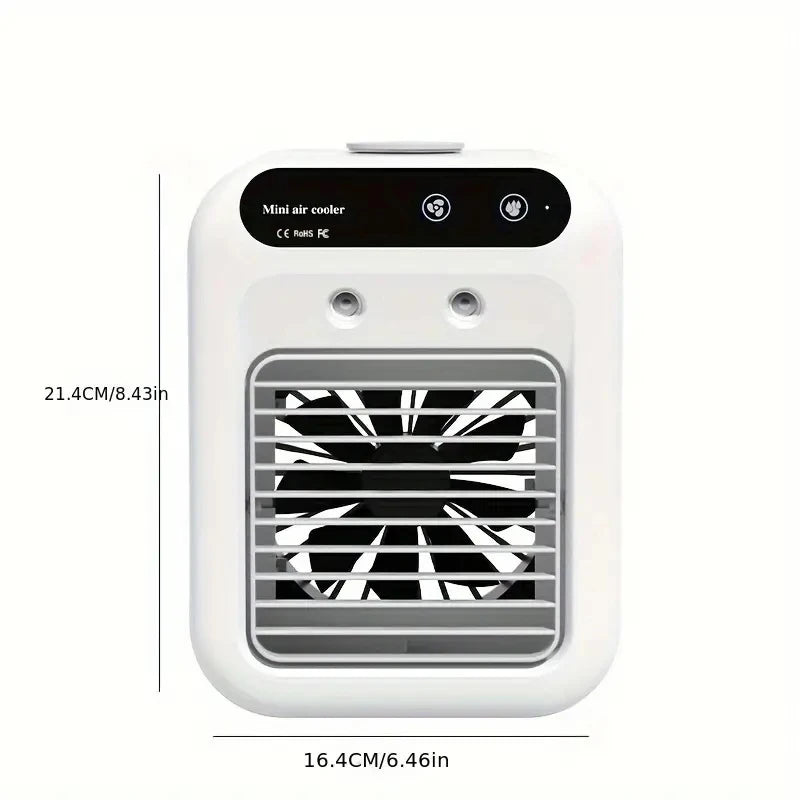
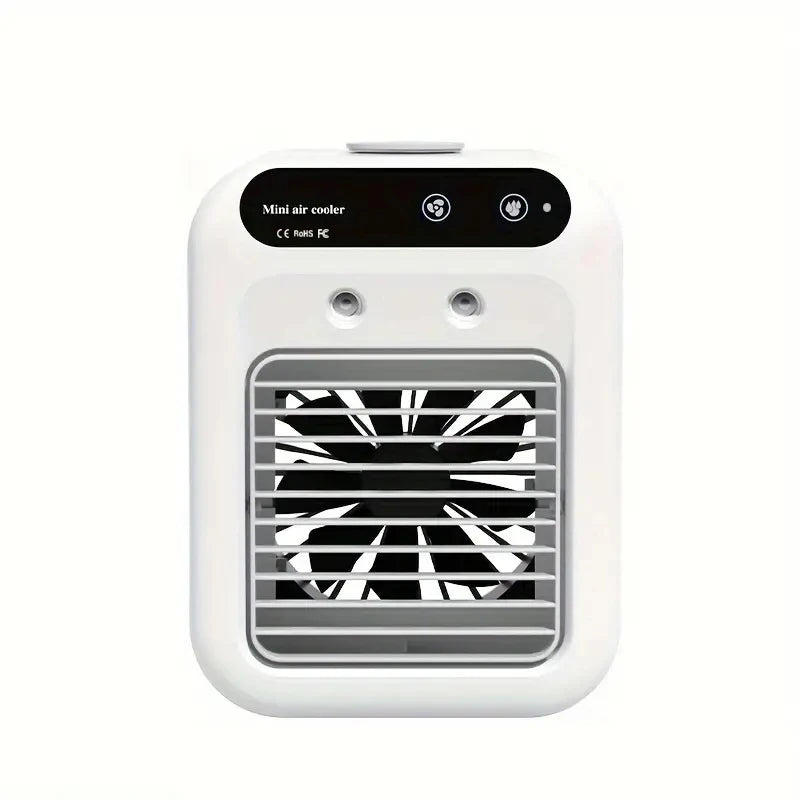
For readers specifically looking for a rechargeable mini air cooler for a desk, the KentDO Portable Air Cooler Fan is designed around personal-space use. Its stated specifications include a 500ml water capacity, nine-blade fan design, rechargeable battery, USB charging, and compact positioning for desks, bedrooms, offices, and other small spaces.
Best compact air cooler for a home office
A home office gives you more flexibility than a shared workplace, but noise and desk ergonomics still matter. A compact rechargeable cooler can be useful when your workstation is warmer than the rest of the home or when you do not want to lower the temperature of the entire house just to make one desk comfortable.
The KentDO model has a 500ml reservoir and rechargeable USB design, making it suited to personal cooling sessions where moving the device or positioning it near your workspace is important. Its nine-blade airflow system is designed to provide consistent personal airflow, while the product description emphasizes quieter operation.
For broader home-office cooling, however, do not confuse a personal device with an air conditioner. The appropriate choice depends on whether the problem is localized desk heat or an overheated room.
Best compact air cooler for a cubicle or shared office
Shared offices create an additional constraint: your cooling solution should not unnecessarily disturb coworkers. Compact dimensions, directional airflow, rechargeable operation, and quiet performance become more important than maximum cooling coverage.
A personal cooler can be positioned so that airflow is directed toward the user rather than across an entire workspace. That can be preferable to increasing the room thermostat or using a large fan that creates noticeable airflow for everyone nearby.
Best compact air cooler for a small desk
For a small desk, footprint should be treated as a performance criterion. A device that consumes too much workspace can create more inconvenience than the heat it solves.
Look for a compact body, accessible controls, cable flexibility, and enough reservoir capacity to avoid constant refilling. Rechargeability is particularly useful when your preferred cooling position is not directly beside a power outlet.
Evaporative Cooling vs. Desktop Fan vs. Air Conditioning
Not every device marketed as an “air cooler” uses the same cooling technology. Understanding the difference prevents unrealistic expectations.
How evaporative cooling works
True evaporative cooling uses water evaporation to transfer heat from the air-water system. As water changes from liquid to vapor, it absorbs heat. Air passing through or across a wetted cooling medium can therefore become cooler under suitable conditions.
The effectiveness depends strongly on relative humidity. Dry air has greater capacity to accept additional water vapor, so evaporative cooling generally performs better in dry environments. As humidity approaches saturation, the potential for additional evaporation falls and the cooling effect becomes less pronounced.
A water reservoir alone does not prove that a particular device is a true evaporative cooler. Buyers should check the manufacturer's stated cooling mechanism rather than assuming that every water-based personal fan provides the same type of temperature reduction.
How a desktop fan differs from a personal air cooler
A conventional desktop fan primarily moves air. When moving air reaches your skin, it can increase convective and evaporative heat loss, making you feel cooler even though the room's air temperature has not necessarily decreased.
A water-assisted personal cooler may provide airflow plus a cooling function, depending on its design. This makes the cooling experience different from a basic fan, but the distinction should not be overstated: neither option automatically provides the whole-room cooling and dehumidification of an air conditioner.
When compressor cooling is the better choice
Compressor-based air conditioning is the better choice when your priority is actual room-temperature reduction combined with meaningful dehumidification. Air conditioners remove heat from indoor air and reject that heat elsewhere, rather than simply moving or locally conditioning airflow.
If your office is consistently hot throughout the room, several people need cooling, or humidity is a major problem, a personal water cooler may be insufficient.
Does a Compact Air Cooler Work in a Hot, Humid Workspace?
It can improve personal comfort, but humidity is one of the most important limitations to understand before purchase.
Why relative humidity changes evaporative cooling performance
Relative humidity describes how much water vapor is already present in the air compared with the maximum amount the air can hold at that temperature. When relative humidity is high, there is less capacity for additional evaporation.
That means a water-assisted or evaporative cooler generally has a smaller performance advantage in humid conditions than it does in dry conditions. In a hot, humid workspace, strong airflow from a conventional fan may still be useful for personal comfort, while air conditioning becomes more appropriate when humidity and room temperature both need to be controlled.
Signs you should choose a fan or air conditioner instead
- Choose a desktop fan when you mainly need moving air and want the simplest maintenance.
- Choose a personal air cooler when you want localized airflow, compact operation, and the added functionality of a water reservoir.
- Choose air conditioning when the entire room is too hot, humidity is high, or you need reliable temperature reduction rather than localized comfort.
How Much Electricity Does a Desktop Personal Cooling Device Use?
Compact personal cooling devices can have a much smaller electrical demand than compressor-based air conditioning, but actual energy consumption depends on the device and how it is operated.
Low-power cooling compared with air conditioning
A small rechargeable fan or personal cooler does not have to power a compressor designed to move heat from an entire room. That can make compact cooling attractive when your objective is simply to improve comfort around one workstation.
However, do not judge operating cost from voltage alone. Voltage describes electrical potential, not total energy consumption. To estimate energy use accurately, you need the device's power draw in watts and the amount of time it operates.
What affects real-world energy use
- Fan speed and airflow setting
- Whether a water pump or cooling function operates continuously
- Battery charging efficiency
- Total runtime per day
- USB power source and charging behavior
- Local electricity rates
The KentDO portable air cooler is specified as rechargeable with USB charging and a voltage rating below 20V. Because a specific wattage and runtime profile are not provided in the supplied product specifications, it would be inappropriate to promise a particular daily electricity cost.
Noise, Airflow and Workspace Ergonomics
How to evaluate noise level for focused work
Noise matters differently depending on your workspace. A sound that is acceptable in a bedroom may become distracting during a video conference or quiet office meeting. Look for manufacturer noise specifications when available, and consider whether the unit has adjustable airflow levels.
The KentDO product description specifically positions its nine-blade airflow system as a quieter personal-cooling solution. Because no measured decibel figure is supplied here, the safer comparison is its stated quiet-operation positioning rather than assigning it an unsupported dB rating.
How to position airflow without creating discomfort
Place the unit close enough to reach your personal zone without forcing concentrated airflow directly into your face for long periods. A position beside or slightly forward of the monitor can create useful personal airflow while keeping the keyboard and display area clear.
For overnight bedroom use, avoid positioning any cooling device where airflow creates an uncomfortable draft. Adjust the direction and intensity according to your personal comfort.
Footprint, cable placement and workspace clutter
Compact cooling works best when it reduces rather than adds to desk clutter. Check where the USB cable will run, whether the reservoir is easy to access, and whether the unit can be moved without disturbing your monitor or other equipment.
Rechargeable operation can simplify this setup because the cooler does not have to remain permanently tethered to an outlet while operating.
Water Tank Capacity, Runtime and Maintenance
How much water tank capacity do you need?
There is a practical tradeoff between tank size and portability. A larger reservoir can reduce refill frequency, but it also tends to require more physical space.
A 500ml reservoir is a useful compact-workspace specification because it provides a defined water capacity without requiring a large room-scale appliance. The actual operating time per fill depends on the device's cooling mode, airflow setting, water usage, and environmental conditions, so tank capacity should not be presented as a guaranteed runtime figure.
Daily cleaning and maintenance basics
Water-contact devices need more maintenance than a simple dry fan. Follow the manufacturer's cleaning instructions, keep the reservoir clean, empty standing water when appropriate, and allow components to dry as directed.
Do not assume that adding water makes a device self-cleaning. Regular maintenance helps prevent unpleasant odors and buildup and keeps the cooling system in better working condition.
Portable vs. permanently positioned workspace units
A fixed home-office setup can justify a larger appliance if room cooling is the priority. A portable rechargeable cooler makes more sense when the same device needs to move between a desk, bedroom, reading area, or other personal space.
Which Compact Air Cooler Is Right for Your Workspace?
Choose a compact air cooler if you need personal-zone cooling
A compact air cooler is most compelling when your discomfort is localized. If the desk gets too hot while the surrounding room is manageable, a personal cooling device can target the area where you actually need relief.
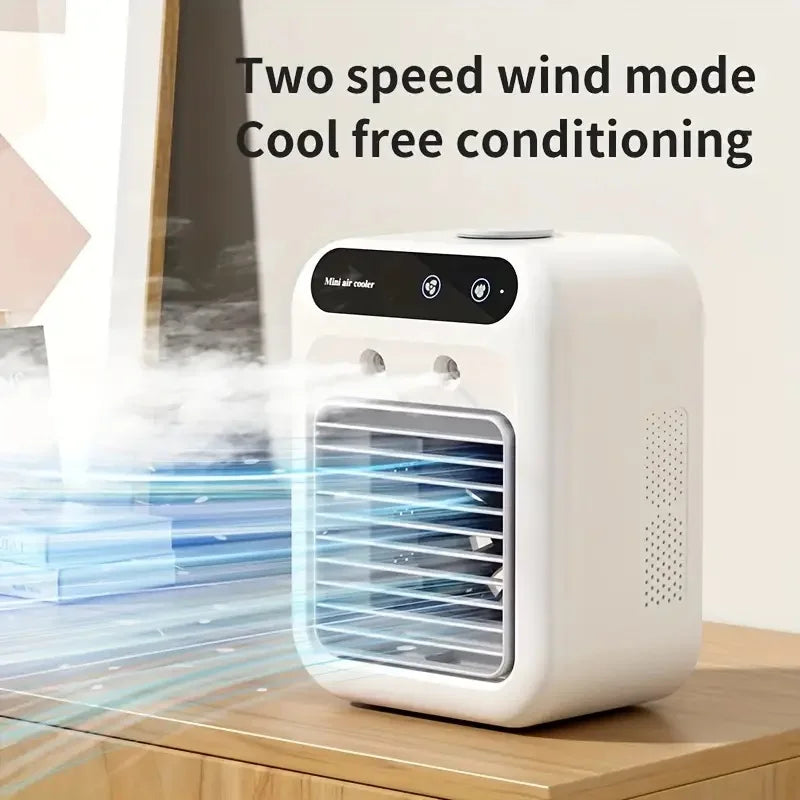
The KentDO Portable Air Cooler Fan is particularly aligned with this use case because its stated design combines rechargeable operation, USB charging, a 500ml water reservoir, nine-blade airflow, quiet operation, and compact positioning for desks and small spaces.
Choose a desktop fan if airflow is enough
If your main problem is stagnant air rather than high temperature or humidity, a standard desktop fan may be the better choice. It requires no water, avoids reservoir maintenance, and provides straightforward air movement.
Choose air conditioning if the whole room needs cooling
If the entire workspace remains hot, several people need cooling, or humidity is uncomfortable, step up to a system designed for room-level climate control. A personal cooler should not be purchased with the expectation that it will perform like an air conditioner.
Explore Lifestyle devices if you are building a broader collection of practical personal-use devices, or compare other options in the Body Care and Health Devices collection.
How to Set Up a Compact Air Cooler at Your Desk
Place the cooler where airflow reaches your personal zone
Start by identifying your normal seated position. Place the unit where its airflow can reach your upper body without blocking your monitor, keyboard, or frequently used workspace. Slightly off-center positioning can help preserve desk space while still directing airflow toward you.
Use water and cooling modes appropriately
If your device supports water-assisted cooling, fill the reservoir according to the manufacturer's instructions and avoid exceeding its stated capacity. The KentDO model holds up to 500ml.
Remember that water-assisted cooling is intended to enhance personal comfort under suitable conditions. It should not be treated as a substitute for air conditioning when the room itself needs significant temperature or humidity reduction.
Keep the unit clean and unobstructed
Keep air inlets and outlets clear of books, monitors, curtains, and other objects. Empty and clean the water reservoir according to the manufacturer's maintenance instructions, especially if the device will not be used for an extended period.
For additional personal-care and everyday-use devices, the Skin and Beauty Care Devices collection and Eye Care Devices collection provide related product categories.
Pros and Cons of Using a Compact Air Cooler at Work
Advantages
- Compact footprint: Easier to fit on a small desk than room-scale cooling equipment.
- Personal airflow: Direct cooling toward the person who needs it instead of conditioning the entire room.
- Rechargeable convenience: USB charging can make placement more flexible.
- Water reservoir: Water-assisted operation can provide a different cooling experience from a basic fan when environmental conditions are suitable.
- Portability: A small device can move between workspaces and personal areas.
- Potentially lower power demand: Compact fan-based or water-assisted devices generally require less electrical infrastructure than compressor-based room cooling.
Limitations
- Humidity sensitivity: Evaporative cooling becomes less effective as relative humidity rises.
- Limited coverage: A compact personal device is designed for localized comfort rather than whole-room cooling.
- Water refills: Water-based operation introduces an extra maintenance task compared with a conventional fan.
- Cleaning: Reservoirs and water-contact components require routine care.
- No automatic room cooling guarantee: A compact cooler should not be expected to deliver air-conditioning-level temperature reduction.
- Performance varies by environment: Temperature, humidity, airflow, placement, and operating mode all influence the perceived result.
The Bottom Line: Is a Compact Air Cooler Worth It for a Workspace?
The best compact air cooler for workspace use is not necessarily the device with the largest water tank or the most aggressive airflow. It is the device whose capabilities match the actual problem.
If your desk gets hot while the rest of the room is acceptable, a compact personal cooling device can be a practical way to target your immediate comfort without installing or running full-room air conditioning. If you only need moving air, a desktop fan is simpler. If the entire room needs meaningful temperature reduction or dehumidification, air conditioning is the more appropriate technology.
For shoppers seeking a rechargeable mini air cooler for a desk, bedroom, or small office, the KentDO Portable Air Cooler Fan offers a workspace-focused combination of nine-blade airflow, a 500ml water capacity, rechargeable battery operation, USB charging, and compact personal cooling.
The strongest buying decision comes down to one question: Do you need to cool yourself, or do you need to cool the room? If the answer is yourself, a compact personal cooling device can make considerably more sense than a bulky room-cooling appliance.
Pillar Article: Best Bedroom Cooling Devices for 2026: Compare Your Options













