

Best Quiet Portable Air Coolers of 2026: Sleep, Desk & Travel Picks
A quiet portable air cooler sounds simple until you actually need one beside your bed, on a crowded desk, or next to you while working. A unit that provides noticeable airflow at a high setting may become distracting at night, while a very small cooler may feel comfortable close to your body but disappoint if you expect it to cool an entire bedroom.
The better approach is noise-first selection: choose the cooling method, airflow strength, operating sound, water capacity, battery setup, and intended coverage together rather than treating “quiet” as a standalone feature.
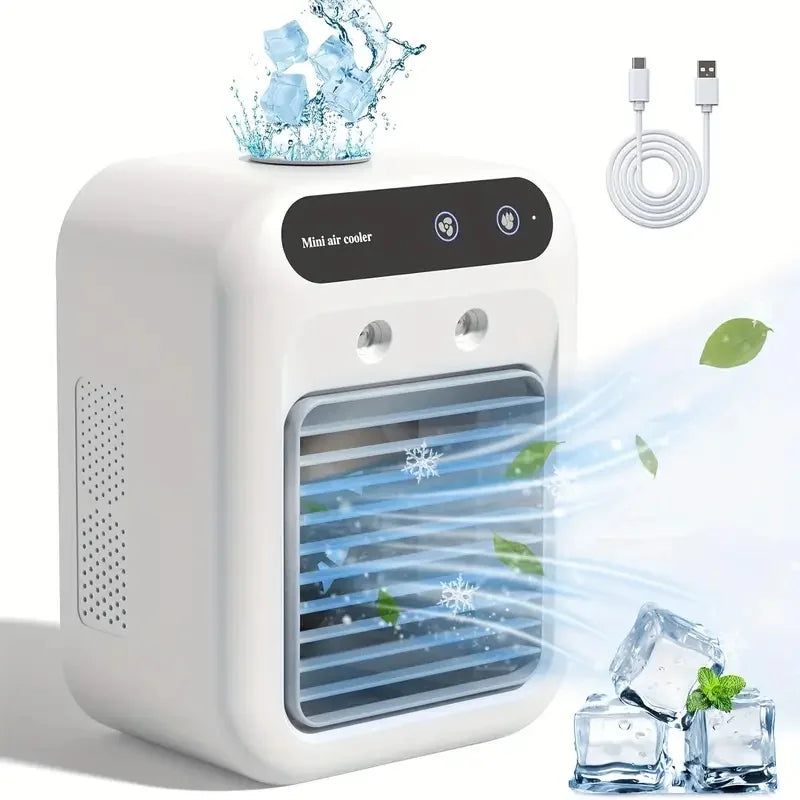
This guide focuses on portable personal cooling for desks, bedrooms, offices, travel, and other small spaces. It also separates verified product specifications from general category expectations. For the featured KentDO portable air cooler fan, the available product information confirms a 500ml water capacity, rechargeable battery, USB charging, nine-blade fan design, compact construction, and quiet operation. A specific decibel rating is not published, so it should not be presented as having a verified numerical dB level.
Best Quiet Portable Air Coolers of 2026: Quick Comparison
The most important comparison is not simply which cooler produces the strongest breeze. It is which device provides enough personal cooling at a noise level you can comfortably tolerate.
| Cooling option | Noise information | Cooling method | Water capacity | Power | Best use |
| KentDO Portable Air Cooler Fan | Marketed as quiet; numerical dB rating not published | Water-assisted personal airflow | 500ml | Rechargeable battery; USB charging | Desk, bedroom, office, personal cooling |
| Rechargeable personal fan | Depends on motor and speed; dB often varies by model | Airflow only | None | Rechargeable battery | Travel, desk, personal airflow |
| Misting fan | Fan and pump noise can vary | Airflow plus water mist | Varies | Battery or USB depending on model | Outdoor and personal cooling |
| Portable evaporative cooler | Fan and pump noise vary by design | Evaporative cooling | Varies | USB, battery, or wall power depending on model | Personal zones and dry climates |
| Portable air conditioner | Typically louder and more mechanically complex | Refrigeration | Not the primary cooling mechanism | Wall power | Stronger room cooling |
How We Compared Quiet Portable Air Coolers
This roundup uses a noise-first framework built around eight factors: operating noise, cooling mechanism, airflow control, water capacity, battery and runtime information, charging method, portability, and intended coverage.
There is an important trust distinction. A manufacturer description such as “quiet operation” is not the same thing as an independently measured decibel result. If a product does not publish a standardized dB measurement, the absence of a number should be disclosed rather than replaced with an estimated figure.
For the KentDO model, the verified specifications are its 500ml reservoir, nine-blade fan, rechargeable battery, USB charging, compact design, and stated quiet operation. Because runtime and dB measurements are not supplied in the product information provided for this comparison, those figures are not invented here.
Quietest Options at a Glance
- Best for desk use: a compact personal cooler that can direct airflow toward the user without occupying much workspace.
- Best rechargeable mini air cooler: a battery-powered unit with convenient USB charging and manageable water capacity.
- Best for sleep: a cooler with genuinely comfortable low-speed operation, minimal vibration, controllable airflow, and practical nighttime controls.
- Best for dry climates: an evaporative-style cooler can make sense when the surrounding air has enough capacity to absorb additional moisture.
- Best for whole-room cooling: a properly sized air conditioner is generally a better choice than a small personal air cooler.
For shoppers who specifically want a compact water-based personal cooling device, the KentDO Portable Air Cooler Fan is the featured option in this guide. Product details are available at https://kentdohealthybeauty.com/products/portable-air-cooler-fan.
What Is a Quiet Portable Air Cooler?
A quiet portable air cooler is a compact cooling device designed to move air around a personal space while keeping operating sound relatively unobtrusive. Depending on the design, it may use ordinary fan airflow, water-assisted cooling, evaporation, or another method of producing a cooler-feeling airstream.
The term “air cooler” should not automatically be treated as a synonym for air conditioner. A small personal cooler does not use the same refrigeration cycle as a compressor-based portable AC, and it should not be expected to deliver equivalent whole-room temperature control.
Portable Air Cooler vs. Fan
A conventional fan primarily moves air. The moving air can make you feel cooler because airflow increases heat transfer from your skin and supports evaporation of perspiration.
A water-based or evaporative-style air cooler adds another mechanism. Water can evaporate into moving air, changing the temperature and humidity of the airstream. The exact performance depends heavily on design and environmental conditions.
For a desk worker sitting directly in front of the device, either technology can provide useful personal comfort. The key question is whether you value water-assisted cooling enough to accept the added maintenance of a reservoir.
Evaporative Air Cooler vs. Portable Air Conditioner
A portable air conditioner uses refrigeration to remove heat from indoor air. A small evaporative cooler instead relies on airflow and evaporation, making the two devices fundamentally different.
Evaporative cooling is generally more suitable for hot, dry conditions than hot, humid conditions because evaporation becomes less effective as the air becomes more saturated with moisture. This is one reason a small water-based cooler should be positioned as personal comfort equipment rather than a guaranteed replacement for air conditioning.
Personal Air Cooler vs. Misting Fan
A personal air cooler and misting fan can both use water, but their construction and intended use may differ. A misting fan disperses water droplets into the surrounding airflow, while an evaporative cooler is designed around evaporation as part of the cooling process.
For indoor desk or bedroom use, water management matters. You want the device to be easy to refill and clean, while avoiding unnecessary moisture around electronics, bedding, documents, or other sensitive surfaces.
How Quiet Is Quiet? Understanding Portable Air Cooler Noise Levels
“Quiet” is useful as a buying signal, but it is not a standardized performance number. A decibel, or dB, rating provides a numerical measurement, yet the result can depend on measurement distance, background noise, fan speed, room acoustics, and testing method.
What Does a dB Rating Actually Tell You?
A dB value can help compare products when the measurements were obtained under comparable conditions. It should not be treated as an absolute description of how a device will sound beside your pillow or directly in front of your monitor.
For example, a cooler measured at one distance on its lowest speed cannot automatically be compared with another cooler measured at maximum speed from a different distance. The measurement conditions matter.
When a manufacturer does not publish a dB specification, look instead for useful secondary signals: multiple speed settings, a low-speed mode, stable construction, vibration control, and reviews that specifically discuss sleep or desk use.
What dB Level Is Quiet Enough for Sleeping?
There is no single universal dB number that guarantees comfortable sleep for every person. Sensitivity to continuous noise, tonal sounds, vibration, and changes in airflow varies significantly between sleepers.
For nighttime use, the most practical target is a device that provides sufficient airflow at its lowest effective setting. A lower fan speed can also make it easier to balance cooling against sound.
Why Maximum-Speed Noise Can Be Misleading
Many cooling devices become noticeably louder as airflow increases. That does not necessarily make the product unsuitable for sleep; it means the maximum setting may not be the setting you use at night.
When comparing a quiet portable air cooler, ask a better question: Can this device provide enough personal cooling without needing maximum speed?
Best Quiet Portable Air Cooler for Sleeping
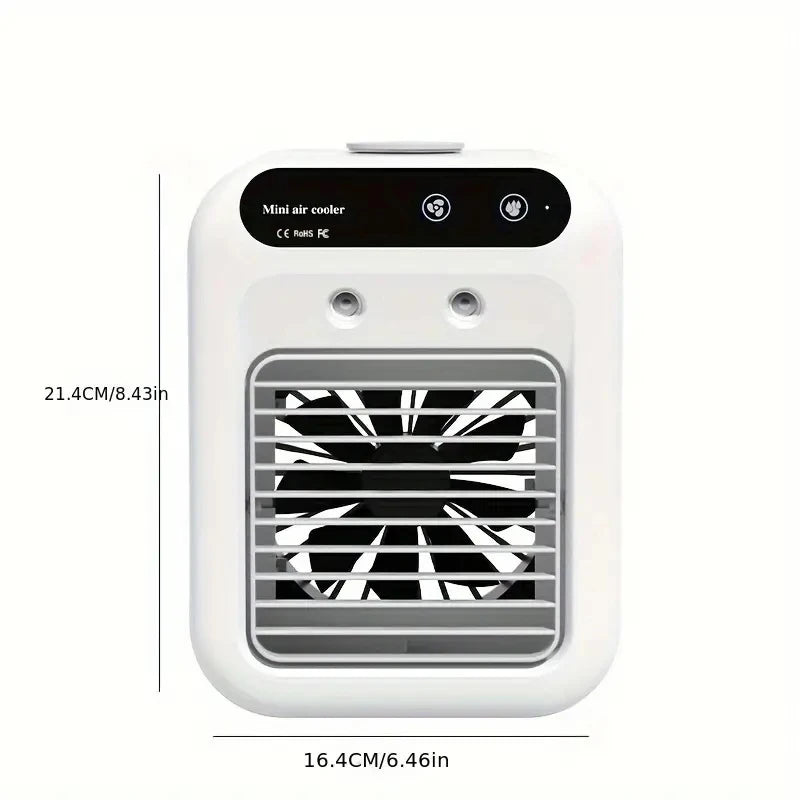
For sleeping, the ideal personal cooler is not necessarily the most powerful model. The better match is one that produces useful airflow at a tolerable sound level and does not create unnecessary vibration, glare, maintenance, or operating interruptions.
Features That Matter Most at Night
- Low-speed airflow that remains useful at night.
- Stable construction that does not rattle against the furniture.
- Simple controls that are easy to operate in darkness.
- A manageable water reservoir that does not require constant refilling.
- Charging flexibility when a wall outlet is not immediately beside the bed.
- Reasonable placement options so airflow reaches the sleeper without blasting directly at the face.
The KentDO portable air cooler fan is designed for bedrooms and personal spaces and combines a 500ml water capacity with a nine-blade airflow system. Its product description specifically highlights quiet operation, but because no numerical dB measurement is supplied, shoppers who require a strict measured-noise threshold should confirm that specification before purchasing.
How to Position a Cooler for Quieter Sleep
Start with a stable surface rather than a hollow or resonant piece of furniture. Keep the intake and exhaust areas unobstructed, and position the unit close enough to create a useful personal airflow zone without expecting it to condition the entire room.
If the device has multiple speeds, begin low and increase only when necessary. This noise-first approach often makes more sense at night than automatically selecting maximum airflow.
For shoppers comparing the featured model's compact design and cooling use cases, see https://kentdohealthybeauty.com/products/portable-air-cooler-fan.
Best Rechargeable Mini Air Cooler
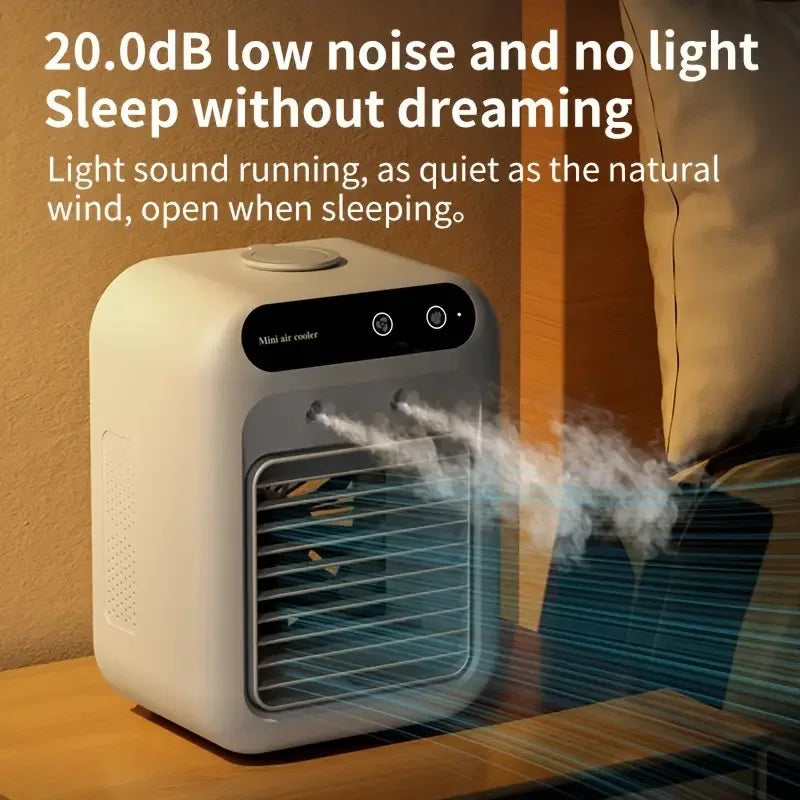
A rechargeable mini air cooler is particularly useful when you want cooling without committing a permanent section of your room or desk to a large appliance. Battery operation can also make placement more flexible.
Battery Capacity and Realistic Runtime
Battery capacity alone does not tell you how long a cooling device will operate. Runtime changes with fan speed, cooling functions, battery condition, charging behavior, and other power demands.
When shopping for a rechargeable air cooler fan, do not compare advertised battery capacities as if they directly translate into identical operating hours. A larger battery may offer longer operation, but the device's power consumption matters just as much.
The KentDO model is confirmed to use a rechargeable battery and USB charging. A specific battery capacity and runtime are not included in the supplied product specifications, so those figures should be verified from the current product listing before making a runtime-based purchasing decision.
USB-C Charging: What to Look For
USB charging can simplify placement because you can potentially use a compatible power source rather than keeping the device beside a conventional outlet. For travel and workspace use, charging flexibility can be more important than maximum battery capacity.
Check whether the actual product uses USB-C or another USB connector before purchasing. The supplied specifications identify USB charging but do not explicitly confirm USB-C for this model.
Best Quiet Portable Air Cooler for Desk Use
A hot desk can make a productive workspace uncomfortable, especially when the room itself is warm but you do not want to run a large appliance just to cool one person.
Desk-Friendly Features to Prioritize
- Small footprint that leaves room for a keyboard, monitor, notebook, or other equipment.
- Directional airflow that can target the person rather than the entire room.
- Low-speed operation for meetings, calls, reading, and focused work.
- Rechargeable operation for flexible placement.
- A water reservoir that is easy to manage without creating clutter.
- Stable construction that does not shift when controls are used.
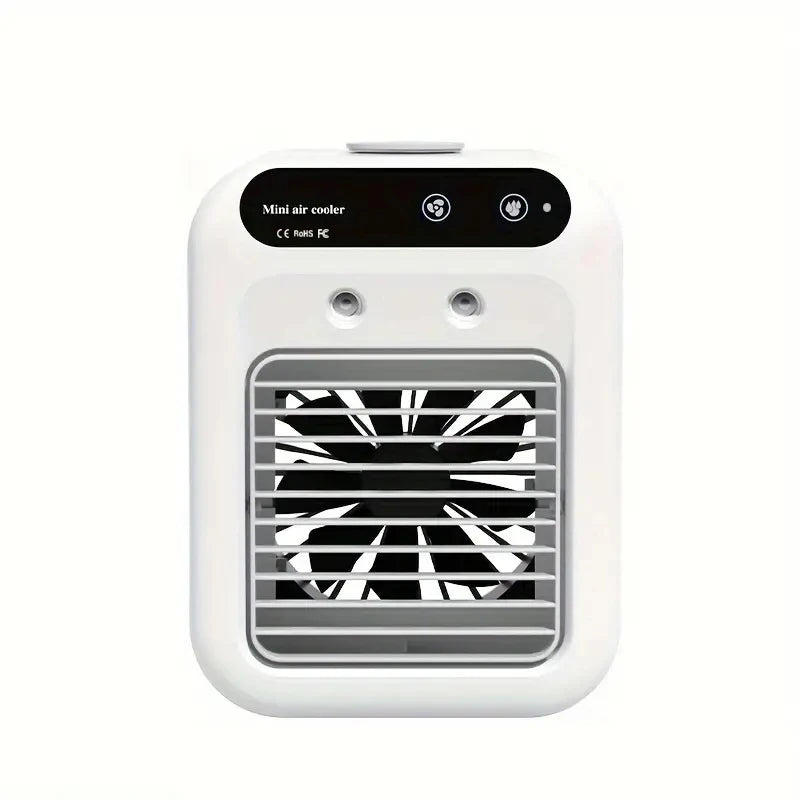
The KentDO portable air cooler fan fits the personal-desk use case through its compact design, rechargeable battery, USB charging, 500ml water capacity, and nine-blade fan system.
When a Small Personal Air Cooler Beats a Large Unit
If only one person is uncomfortable, personal-zone cooling can be more practical than attempting to change the temperature of an entire workspace. The objective is to create a comfortable airflow zone around the user.
This distinction is particularly important in offices. A mini air cooler should not be marketed as a substitute for a building HVAC system or a properly sized room air conditioner.
Best Quiet Portable Air Cooler for Larger Personal Spaces
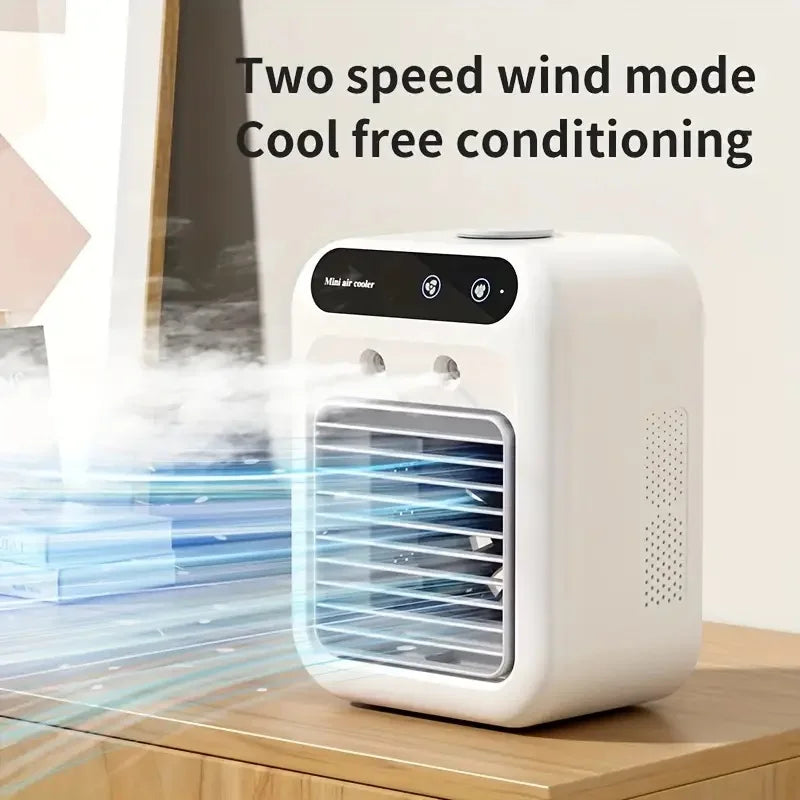
Bedrooms and larger personal areas require a more realistic assessment. A small cooler can provide useful airflow near the bed, chair, or desk, but its physical size limits how much air it can move compared with a full-size room-cooling appliance.
Airflow vs. Noise: Finding the Right Balance
Higher airflow generally requires the fan to work harder, which can increase sound. For a larger personal zone, the best strategy is to position the cooler so the airflow reaches the person efficiently rather than simply increasing the fan speed until the entire room feels turbulent.
A nine-blade fan design can be useful for consistent airflow, but the number of blades alone cannot establish a specific noise level or cooling performance. Motor design, blade geometry, speed, housing, airflow resistance, and construction all influence the final experience.
Why Small Evaporative Coolers Should Not Be Treated Like AC
A personal water-based cooler can make the air immediately around you feel more comfortable, but it should not automatically be described as a device that lowers the temperature of an entire bedroom to the same degree as air conditioning.
For users who need reliable whole-room temperature control, especially in humid conditions, a properly sized air conditioner is the more appropriate technology.
How Evaporative Cooling Affects Noise and Cooling Performance
Evaporative cooling uses the heat-absorbing effect of water evaporation. Air moving across a wet cooling surface can become cooler while gaining moisture. The result depends on ambient temperature, humidity, airflow, and the design of the cooling system.
How Evaporative Cooling Works
In a basic direct evaporative system, moving air interacts with water. Some water evaporates, drawing heat from the air and producing a cooler, more humid airstream.
That is fundamentally different from refrigeration. A portable air conditioner uses a refrigeration system to move heat out of the conditioned space, while an evaporative cooler depends on environmental conditions that allow water to evaporate effectively.
“Evaporative coolers are used in dry climates.” — U.S. Environmental Protection Agency
This is why climate should be part of any serious portable air cooler comparison.
Do Portable Evaporative Air Coolers Work in Humid Climates?
They can still move air and provide a cooling sensation, but evaporation generally becomes less effective as relative humidity rises. In humid environments, the air already contains more moisture, leaving less capacity for additional evaporation.
For someone in a hot and humid region, a conventional fan may sometimes be the simpler personal-cooling choice, while air conditioning is better suited to dehumidification and dependable room-temperature control.
Dry Climate vs. Humid Climate Performance
| Condition | Personal airflow | Evaporative potential | What to prioritize |
| Hot and dry | Useful | Generally more favorable | Airflow, water capacity, noise, placement |
| Warm and moderately humid | Useful | More limited | Airflow and climate suitability |
| Hot and very humid | Useful | Often substantially limited | Fan airflow or air conditioning depending on the goal |
What to Look for When Buying a Quiet Portable Air Cooler
Noise Level and Fan-Speed Control
Look for an actual dB rating when available, but inspect how that rating was measured. Multiple speed settings are valuable because the lowest useful setting may be considerably more comfortable than maximum speed.
Cooling Method
Determine whether the product is primarily a fan, an evaporative cooler, a misting fan, or a refrigeration-based air conditioner. These technologies solve different problems and behave differently in humid conditions.
Airflow Settings
Adjustable airflow lets you balance cooling and noise. Directional airflow is especially valuable for personal cooling because it lets you target the person instead of trying to condition an entire room.
Water Tank Capacity and Maintenance
A larger water reservoir can reduce refill frequency, but it also means more water to clean and manage. The KentDO model has a 500ml capacity, making the tank size straightforward to understand before purchase.
Empty and clean water reservoirs according to the manufacturer's instructions. Avoid leaving stagnant water sitting in a device longer than recommended, and keep the cooling components maintained so airflow remains unobstructed.
Battery Capacity and Runtime
Battery-powered operation is useful for desks, bedrooms, travel, and locations without a convenient outlet. Compare battery capacity with the manufacturer's stated runtime rather than relying on capacity alone.
USB Charging and Portability
USB charging can make a portable cooler easier to position around a desk or bedroom. For travel, also consider the device's physical dimensions, weight, water-handling requirements, and whether the battery setup fits your intended trip.
Controls and Nighttime Usability
For bedroom use, controls matter almost as much as raw cooling. Look for sleep modes, timers, dimmable displays, simple buttons, and low-speed operation where available.
Quiet Portable Air Cooler vs. Other Cooling Options
| Feature | Portable air cooler | Rechargeable fan | Misting fan | Portable AC |
| Personal airflow | Yes | Yes | Yes | Yes |
| Uses water | Often | No | Yes | Not for primary cooling |
| Evaporative cooling | Depending on design | No | Depending on design | No |
| Humidity effect | Can increase with direct evaporation | None | Can add moisture | Can dehumidify |
| Battery operation | Some models | Common | Some models | Uncommon |
| Whole-room cooling | Limited for small units | No | Limited | Yes, when properly sized and installed |
Portable Air Cooler vs. USB-C Rechargeable Fan
Choose a rechargeable fan when simplicity, low maintenance, and direct airflow are your priorities. Choose a water-based cooler when you specifically want the additional cooling effect associated with water and evaporation and your climate is suitable.
Portable Air Cooler vs. Misting Fan
A misting fan may make more sense for outdoor situations where moisture can disperse freely. For a desk or bedroom, water handling and humidity deserve more attention.
Portable Air Cooler vs. Portable Air Conditioner
A portable AC is the stronger choice when the objective is actual room-temperature control. It generally requires substantially more power and installation considerations, including exhaust management, but it uses refrigeration rather than relying primarily on evaporation.
How to Make a Portable Air Cooler Quieter
Use the Lowest Effective Fan Speed
Start with the lowest setting that provides enough personal airflow. This is especially useful while sleeping, reading, attending video calls, or working in a quiet office.
Choose a Stable, Non-Resonant Surface
Place the unit on a stable surface. A hollow or vibrating desk can amplify mechanical sounds, making a modest fan seem louder than it actually is.
Keep the Water Tank and Cooling Components Clean
Regular maintenance supports consistent airflow and helps prevent buildup from interfering with normal operation. Follow the manufacturer's cleaning instructions and use fresh water as recommended.
Avoid Blocking Air Intake or Exhaust
Do not push the cooler against walls, papers, bedding, or other objects that restrict airflow. A blocked intake or outlet can reduce effectiveness and may change the sound produced by the fan.
Who Should Buy a Quiet Portable Air Cooler?
Best for Sleepers
Choose a model that can provide useful airflow on a low setting and that does not create distracting vibration or controls that are difficult to manage at night. The KentDO model is designed for bedroom and personal-space use, with a 500ml water reservoir and stated quiet operation.
Because no numerical noise measurement is supplied, treat “quiet” as a manufacturer-stated characteristic rather than a verified sleep-noise guarantee.
Best for Desk Workers
A compact rechargeable cooler makes sense when the desk gets too hot but you do not need to cool the entire office. Prioritize footprint, directional airflow, low-speed performance, USB charging, and easy water management.
Best for Travel
Travel shoppers should prioritize portability first. A rechargeable mini air cooler can be convenient where access to outlets is limited, but check battery specifications and transportation rules for your particular trip before relying on it as a travel cooling solution.
Best for Personal Bedrooms and Larger Zones
Use a small cooler as a personal comfort device rather than assuming it will replace room air conditioning. Position it close enough to create an effective airflow zone and adjust the speed according to the balance between cooling and noise.
Quiet Portable Air Cooler Buying Checklist
Before You Buy, Check These 10 Specifications
- Noise rating: Is a measured dB figure actually published?
- Low-speed operation: Can it provide useful airflow without maximum fan speed?
- Cooling method: Is it a fan, evaporative cooler, misting fan, or AC?
- Airflow settings: Can you adjust cooling intensity?
- Water tank: How much water does it hold, and how easy is it to clean?
- Battery capacity: What battery specification is provided?
- Runtime: Is the advertised runtime tied to a specific speed or mode?
- Charging: Does the connector and charging method fit your setup?
- Dimensions: Will it fit comfortably on your desk, nightstand, or travel bag?
- Coverage: Is it designed for personal airflow or actual room cooling?
The KentDO model checks several practical boxes for personal cooling: 500ml water capacity, nine-blade airflow, rechargeable battery operation, USB charging, compact construction, and stated quiet operation. The missing pieces for a strict noise-and-runtime comparison are a published dB rating and specific battery-runtime figures.
Pros and Cons of the Featured Portable Air Cooler Fan
| Pros | Cons |
| 500ml water reservoir | No published numerical dB rating in the supplied specifications |
| Rechargeable battery operation | Specific battery capacity is not provided in the supplied specifications |
| USB charging | Specific runtime is not provided |
| Nine-blade airflow design | Not a substitute for whole-room air conditioning |
| Compact design for desks and bedrooms | Water-based cooling can be less effective in humid environments |
| Stated quiet operation | Actual perceived noise depends on speed, placement, and surroundings |
Our Noise-First Verdict
The best quiet portable air cooler is not automatically the product with the smallest advertised noise number or the strongest maximum airflow. It is the device that provides enough cooling for your intended personal zone without creating more sound, maintenance, moisture, or power demands than you want.
For a desk, bedroom, or small personal space, the KentDO Portable Air Cooler Fan is a straightforward option to consider because its verified specifications combine a compact design, rechargeable operation, USB charging, a 500ml water capacity, and a nine-blade airflow system. Its product information also specifically describes operation as quiet.
However, shoppers who require a strict noise comparison should not assume a numerical dB performance that has not been published. Likewise, shoppers who need whole-room cooling should consider a properly sized air conditioner rather than expecting a small personal air cooler to perform the same job.
If your priority is personal cooling beside a desk or bed, review the product specifications here: https://kentdohealthybeauty.com/products/portable-air-cooler-fan.
Frequently Asked Questions About Quiet Portable Air Coolers
What is the quietest type of portable air cooler?
There is no universal quietest type because noise depends on motor design, fan speed, airflow resistance, pump operation, housing, and construction. For sleeping or focused work, prioritize low-speed performance and verified noise measurements when available.
How many decibels is considered quiet for a portable air cooler?
There is no single dB threshold that guarantees a quiet experience for every person. Measurement distance and test conditions also matter. Compare dB ratings only when the measurement methods are reasonably comparable.
Can a quiet portable air cooler be used while sleeping?
Yes, if the device provides enough airflow at a comfortable sound level. Low-speed operation, stable placement, unobstructed airflow, manageable water maintenance, and practical nighttime controls are particularly important.
Do portable evaporative air coolers work in humid climates?
They can still move air and provide personal airflow, but evaporative cooling generally becomes less effective as humidity increases. Water-based cooling is usually better suited to hot, dry conditions than hot, humid environments.
How long does a rechargeable mini air cooler run on a full charge?
Runtime varies by battery capacity, fan speed, cooling mode, and power consumption. The supplied specifications for the featured KentDO model confirm rechargeable operation but do not provide a specific runtime, so a precise number should not be assumed.
Are portable air coolers quieter than portable air conditioners?
Not necessarily in every individual product comparison, but small air coolers generally use simpler fan-based or water-assisted mechanisms, while portable AC units include compressors and refrigeration components. Compare actual noise specifications where available.
Is an evaporative air cooler better than a fan for sleeping?
It depends on the room and climate. A fan may be simpler and easier to maintain, while a suitable evaporative cooler can provide a different cooling sensation through water-assisted airflow. In humid conditions, the advantage of evaporation can be reduced.
Can a small portable air cooler cool an entire bedroom?
A small personal cooler should generally be treated as a personal-zone cooling device rather than a guaranteed whole-bedroom air conditioner. Placement close to the person can make better use of its available airflow.
How often should you clean a portable air cooler water tank?
Follow the manufacturer's cleaning schedule and instructions. In general, water reservoirs should not be neglected because standing water and mineral buildup can become maintenance concerns. Empty and clean the tank as directed.
What is the best quiet portable air cooler for a desk?
The best choice is one that fits the desk, directs airflow toward you, operates comfortably at lower speeds, and has a practical charging and water-management setup. The KentDO model is designed around this personal-use scenario and provides a 500ml reservoir, rechargeable operation, USB charging, compact construction, and nine-blade airflow.
Final Buying Decision
If your problem is a hot, stuffy desk, bedroom, or small personal space, start by deciding whether you need personal airflow or actual room-temperature control. Then evaluate noise, cooling method, climate suitability, airflow settings, water capacity, battery operation, charging, and maintenance.
For personal cooling, the featured KentDO portable air cooler fan offers a compact combination of a 500ml water reservoir, nine-blade airflow, rechargeable battery operation, USB charging, and stated quiet operation. It is best evaluated as a personal cooling device rather than as a replacement for a full-size air conditioner.
The strongest purchase decision is therefore the one that matches your actual cooling zone. If you need a quiet device beside your desk or bed, prioritize low-speed comfort and placement. If you need dependable whole-room cooling in hot or humid conditions, move up to the appropriate cooling technology rather than expecting a mini cooler to do more than its design allows.
For a closer look at the featured portable air cooler fan, visit https://kentdohealthybeauty.com/products/portable-air-cooler-fan.
For related lifestyle and personal comfort products, explore the Lifestyle collection at https://kentdohealthybeauty.com/collections/lifestyle and the Body Care and Health Devices collection at https://kentdohealthybeauty.com/collections/body-care-and-health-devices-1.
Pillar Article: Best Bedroom Cooling Devices for 2026: Compare Your Options













