

Facial Analysis Tool Guide: What Can It Really Measure?
A facial analysis tool uses facial images, specialized imaging, or sensor data to identify visible skin characteristics and generate measurements or algorithmic estimates. Depending on the technology, a scan may assess wrinkles, pores, pigmentation, redness, texture, oiliness, hydration-related indicators, facial symmetry, or contours. The important distinction is that not every score represents a direct measurement. Results depend on the imaging method, lighting, camera quality, calibration, software, and the algorithm used to interpret the image.
What Is a Facial Analysis Tool?
A facial analysis tool is a technology system that analyzes facial images or other captured data to identify specific characteristics of the face or skin. Basic tools may rely on an ordinary smartphone camera, while professional systems can use controlled illumination, high-resolution cameras, multiple wavelengths, or specialized sensors.
Facial Skin Analysis vs. General Facial Recognition
Facial skin analysis and facial recognition are not the same technology. Facial recognition is primarily concerned with identifying or verifying a person from facial characteristics. Facial skin analysis instead focuses on characteristics such as pigmentation, pores, wrinkles, texture, tone, oiliness, and other skin-related features.
Facial landmark detection is another related concept. Software can locate points around the eyes, nose, mouth, jaw, and other facial regions to establish consistent areas for analysis. These landmarks can support measurements of symmetry, proportions, or the location of visible skin features.
How AI Image Analysis Turns a Face Scan Into Scores
AI facial analysis generally follows a sequence of image capture, facial detection, landmark identification, segmentation, feature detection, and scoring. Computer vision models examine patterns in the captured image and compare them with the characteristics the system has been designed to recognize.
The resulting number or rating should therefore be interpreted according to the system's methodology. A score can represent a direct image-derived observation, a calculated measurement, a comparison with a reference population, or an algorithmic estimate.
How Facial Analysis Tools Work: From Image Capture to Results
1. Standardized Facial Image Capture
The first step is capturing a usable facial image. Lighting, camera position, distance, focus, facial expression, background conditions, and image resolution can all influence the information available to the software.
This is one reason a casual smartphone selfie may produce different results from a professional skin analysis system. Controlled capture makes it easier to repeat the same imaging conditions when tracking changes over time.
2. Facial Landmark Detection and Region Mapping
After capture, software identifies the face and establishes important landmarks. The system can then divide the face into analyzable regions, such as the forehead, cheeks, nose, eye area, and chin.
Consistent regional mapping allows the software to examine comparable areas from one scan to another rather than treating the entire face as a single image.
3. Feature Detection and Computer Vision Analysis
Computer vision can identify image-visible patterns associated with wrinkles, pigmentation, redness, pores, texture, and other characteristics. More specialized imaging systems can introduce additional wavelengths or controlled illumination to capture information that ordinary visible-light photography may not show as clearly.
4. Scoring, Benchmarking, and Recommendations
The final stage converts image observations into reports, scores, comparisons, or recommendations. This is where users should pay close attention to terminology. An algorithmic score is not automatically equivalent to a laboratory measurement or medical diagnosis.
For professional consultations, the value can come from organizing multiple observations into a repeatable report. The report can then support a discussion about skincare priorities and help track changes across standardized scans.
What Can a Facial Analysis Tool Measure?
Modern facial analysis systems can assess a wide range of visible characteristics, but the measurement method matters. Some characteristics are primarily image-visible, while others require dedicated sensors or specialized imaging to measure more directly.
Wrinkles and Fine Lines
Image analysis can identify the appearance and distribution of visible wrinkles and fine lines. However, ordinary two-dimensional photography does not necessarily provide a direct measurement of wrinkle depth. Specialized imaging can provide greater control when depth or surface geometry is important.
Skin Texture
Texture analysis focuses on visible surface irregularity, roughness, and pattern variation. Consistent lighting and image capture are particularly important because shadows and reflections can change how texture appears in a photograph.
Pigmentation and Dark Spots
Facial imaging can identify visible differences in pigmentation and tone. Controlled or multispectral imaging may provide additional information beyond standard RGB photography by capturing the skin under different wavelengths.
Redness and Visible Vascular Features
Image-based systems can detect areas that appear more red or visually different from surrounding skin. These outputs can be useful for cosmetic skin assessment, but redness detection should not be confused with diagnosing a dermatological condition.
Pores and Sebum-Related Appearance
Facial analysis can estimate the visible appearance of pores and identify patterns associated with oiliness or sebum-related appearance. Results can change with lighting, facial preparation, cosmetics, and image quality.
Hydration and Skin Moisture
This is an important measurement distinction. Ordinary RGB facial images generally provide appearance-related indicators rather than a direct measurement of skin hydration. Actual moisture measurement may require dedicated sensors or validated measurement methods.
Facial Symmetry and Proportions
Landmark-based analysis can calculate geometric relationships between facial features. These calculations can describe mathematical symmetry or proportions, but mathematical symmetry should not automatically be interpreted as an aesthetic or medical judgment.
Facial Structure and Contours
A standard 2D image can provide limited information about facial contours and proportions. Depth cameras and 3D imaging can measure facial geometry more directly than a conventional flat photograph.
Facial Analysis Tool Categories: AI Apps to Clinical Imaging
AI Facial Analysis Apps
AI apps typically analyze uploaded or live smartphone images. They are convenient and accessible, making them useful for skincare education, basic visualization, and routine tracking. Their results are strongly influenced by smartphone cameras and capture conditions.
Smartphone-Based Facial Skin Analyzers
Camera-assisted analyzers can provide a more structured workflow than an ordinary selfie. Depending on the system, they may guide positioning, capture repeatable images, and organize analysis results for future comparison.
Professional Skin Analysis Systems
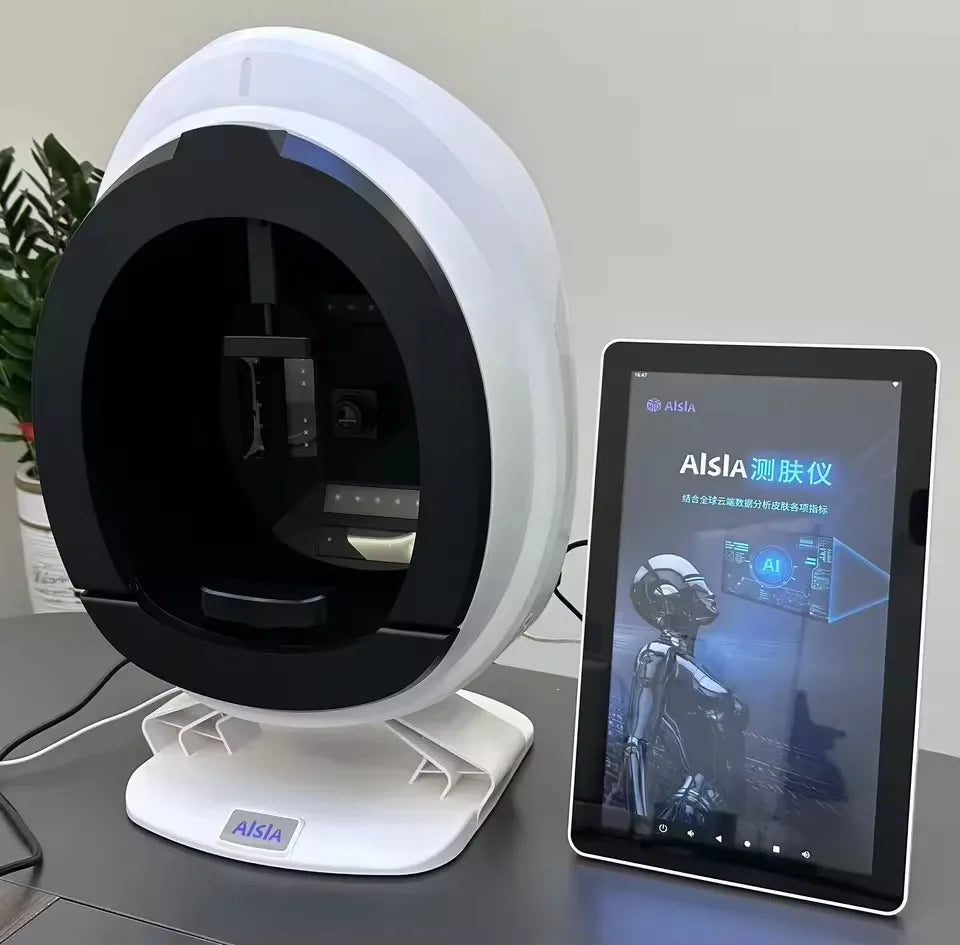
Professional systems are designed around consultation workflows. They may combine controlled imaging, standardized positioning, multiple skin indicators, digital reporting, image tracking, and client data management.
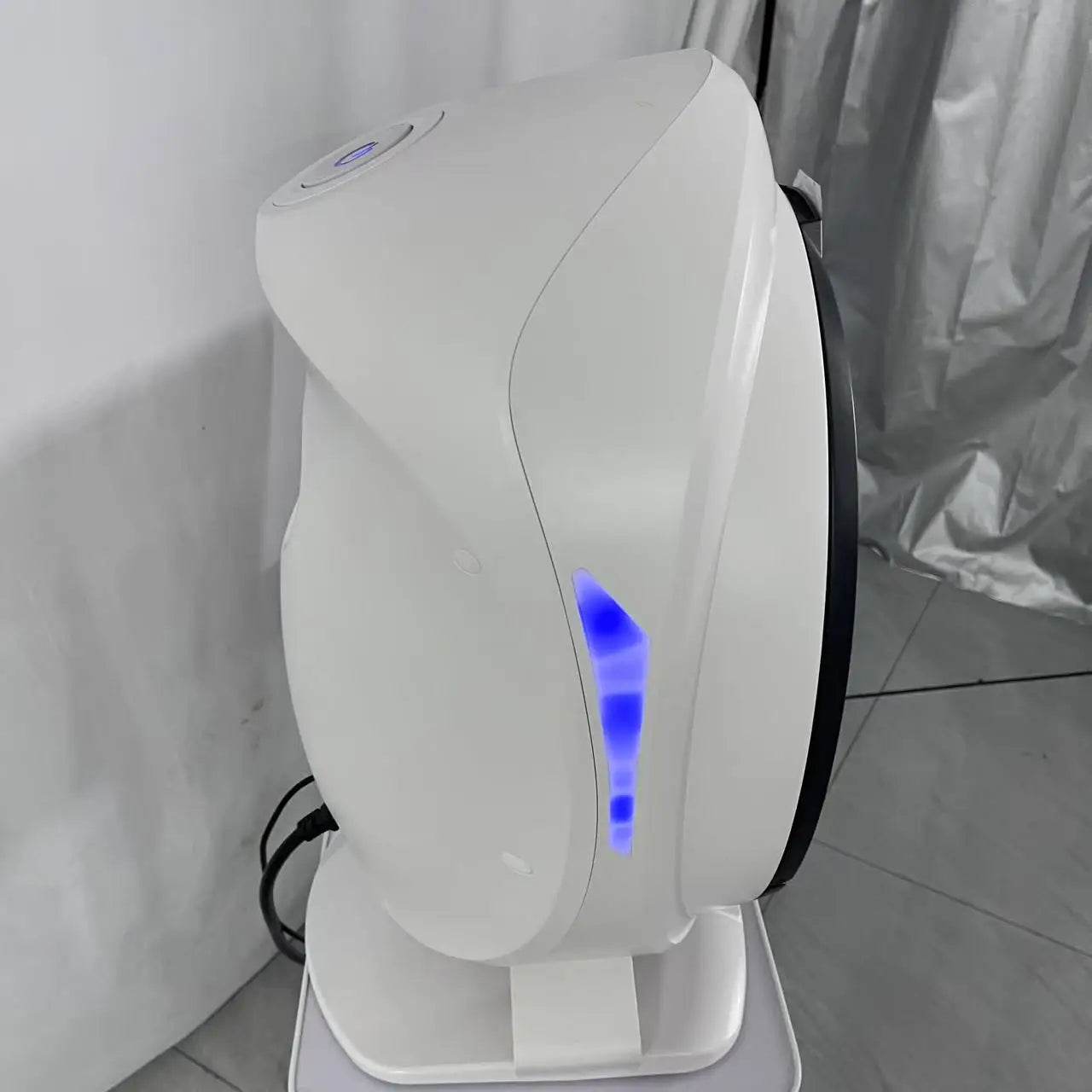
For salons, clinics, and professional skincare businesses, a professional AI skin analyzer can serve as an example of this category. The listed system combines 36MP industrial HD imaging with AI and 8-spectrum imaging and reports characteristics including acne, pigmentation, pores, wrinkles, moisture, sebum, skin tone, and elasticity.
Clinical Imaging and Digital Dermoscopy
Clinical imaging represents a more specialized category with greater emphasis on controlled visualization and clinical context. Digital dermoscopy and other specialized systems can provide information that should not be equated with the outputs of a general-purpose cosmetic facial analyzer.
Multispectral and Specialized Skin Imaging
Multispectral imaging captures information across multiple wavelengths. This can reveal patterns that are less apparent under ordinary visible-light photography. The additional information can be particularly useful when pigmentation or other optical characteristics are being evaluated.
How Accurate Are Facial Analysis Tools?
The accuracy of a facial analysis tool cannot be judged simply by whether it uses AI. Accuracy depends on what is being measured, how the image is captured, how the algorithm was developed, and how its output was validated.
What “Accuracy” Means in Facial Analysis
Several concepts can matter: repeatability, agreement with reference measurements, sensitivity, specificity, and prediction accuracy. A system can produce highly repeatable scores without those scores necessarily representing a clinically validated measurement.
Lighting, Camera Quality, and Capture Conditions
Changes in illumination, shadows, white balance, camera distance, focus, and exposure can alter the appearance of skin. A tool that does not control these variables may produce less consistent results when the same person is scanned under different conditions.
Skin Tone, Dataset Bias, and AI Generalization
AI systems should be evaluated across diverse skin tones, ages, and facial characteristics. A model trained or validated on a narrow population may not perform equally well across all groups.
Calibration and Standardized Imaging
Controlled imaging can improve consistency, especially when the objective is longitudinal tracking. Standardized positioning, lighting, camera settings, and repeatable capture procedures make comparisons more meaningful.
Why a Facial Score Is Not a Medical Diagnosis
A cosmetic facial score should not be treated as a diagnosis. Automated analysis can organize visual observations and support skincare discussions, but medical concerns may require assessment by an appropriately qualified healthcare professional.
Consumer vs. Professional Facial Analysis Tools
Consumer Tools
Consumer tools prioritize convenience, accessibility, education, and routine tracking. They can help users visualize changes in their skin, but casual image capture can make results less consistent.
Professional Tools
Professional tools are better suited to structured consultations where standardized imaging, reporting, client records, and repeat analysis are important. They can help estheticians and skincare businesses create a more systematic consultation process without replacing clinical evaluation where medical assessment is required.
Quick Comparison: Consumer vs. Professional
| Factor | Consumer Tool | Professional System |
| Image capture | Usually smartphone-based | More controlled imaging |
| Repeatability | Depends heavily on user technique | Designed for more standardized capture |
| Parameters | Often focused on basic visual indicators | Can combine multiple skin indicators |
| Reporting | Often simplified | Structured digital reports may be available |
| Workflow | Individual use | Consultation and client-management workflows |
| Best use | Education and basic tracking | Professional skincare consultations |
If you are evaluating equipment for a broader professional beauty workflow, the skin and beauty care devices collection provides a relevant category to explore alongside facial analysis equipment.
Real-World Uses for Facial Analysis Technology
Skincare Consultations
A facial analysis report can give a consultation a structured starting point. Instead of relying entirely on visual inspection, professionals can discuss specific image-based indicators and establish priorities for a skincare routine.
Before-and-After Tracking
Repeat imaging is one of the most practical uses of facial analysis technology. The key is consistency. If lighting, camera position, expression, and capture distance change substantially between scans, apparent differences may reflect imaging conditions rather than actual skin changes.

Professional Treatment Planning
Analysis results can help organize cosmetic treatment discussions by identifying areas that deserve attention. The system should support professional judgment rather than dictate a treatment or substitute for clinical evaluation.
Consumer Skincare Tracking
For consumers, facial analysis can make changes easier to visualize and can support routine monitoring. However, users should focus on consistent measurement conditions rather than treating every change in an automated score as a meaningful biological change.
Facial Analysis Tool Limitations and Privacy Risks
Image Quality and Environmental Variability
Facial images are sensitive to lighting, camera settings, makeup, skin preparation, facial expression, and positioning. These variables can introduce measurement variability even when the person's actual skin condition has not changed.
Algorithmic Bias and Model Transparency
When evaluating an AI system, look for information about training data, validation populations, performance metrics, and reproducibility. Transparency helps users understand whether an impressive-looking score has meaningful methodological support.
Facial Image Privacy and Data Storage
Facial images are sensitive personal data. Before using a facial analysis service, check whether images are stored locally or in the cloud, how long they are retained, whether they are shared, whether they can be deleted, and whether they may be used for model training.
Medical and Cosmetic Boundaries
Cosmetic analysis and medical diagnosis are different applications. Automated scores can support education and skincare consultation, but suspected medical conditions should be evaluated through appropriate clinical channels.
How to Evaluate a Facial Analysis Tool Before You Use or Buy It
1. Identify the Parameters You Actually Need
Start with the outputs that matter. If your priority is visible pigmentation, you may need different imaging capabilities than if you primarily want facial symmetry, texture, or moisture-related indicators.
2. Check the Imaging Method
Determine whether the tool uses standard RGB imaging, controlled illumination, 3D capture, multispectral imaging, or dedicated sensors. The technology should match the type of information you expect it to provide.
3. Look for Validation and Methodology Transparency
Look for published validation, reference standards, sample diversity, performance metrics, and information about reproducibility. Avoid assuming that a large number of AI-generated scores automatically means greater accuracy.
4. Evaluate Privacy and Data Controls
Review consent procedures, image storage, retention periods, deletion options, sharing practices, and model-training policies before introducing facial analysis into a professional workflow.
5. Consider Workflow and Total Cost
Purchase price is only one part of the decision. Consider calibration, software, subscriptions, reporting, staff training, maintenance, setup requirements, and how easily the system fits into existing consultations.
For professionals comparing equipment categories, it can also be useful to review broader body care and health devices when planning an integrated device offering rather than evaluating a facial analyzer in isolation.
Facial Analysis Tool Decision Framework: Which Type Fits Your Goal?
Choose an AI App If...
Choose an AI app when convenience, accessibility, skincare education, and lightweight image-based tracking are the main priorities. It can be appropriate when you do not need controlled professional imaging.
Choose a Professional Skin Analyzer If...
A professional skin analyzer is more appropriate when standardized facial imaging, multiple skin indicators, digital reports, image tracking, and consultation workflows are important. Professional systems can make recurring assessments more structured and easier to document.
Choose Specialized or Clinical Imaging If...
Choose specialized or clinical imaging when you require greater measurement control, specialized wavelengths, depth information, or clinical context. The appropriate system depends on the specific parameter being assessed and the level of validation required.
Facial Analysis Tool FAQs
What is a facial analysis tool?
A facial analysis tool analyzes facial images or sensor data to identify characteristics such as wrinkles, pigmentation, texture, pores, redness, symmetry, or other facial and skin indicators.
How accurate are facial analysis tools?
Accuracy varies by parameter, imaging method, capture conditions, algorithm, calibration, and validation. AI-generated scores should not automatically be considered clinically validated measurements.
What can a facial analysis tool measure?
Depending on the system, it may assess wrinkles, texture, pigmentation, redness, pores, oiliness, skin tone, symmetry, and other characteristics. Hydration and structural measurements may require specialized imaging or sensors.
Are AI facial analysis tools accurate for skin assessment?
They can provide useful image-based analysis, but results depend on standardized capture, image quality, model performance, and the specific parameter being assessed. They should be interpreted according to the system's methodology.
What is the difference between consumer and professional facial analysis tools?
Consumer tools generally emphasize convenience and basic tracking, while professional systems typically provide more controlled imaging, structured reporting, multiple parameters, and workflows designed for consultations and longitudinal tracking.
Final Takeaway: Choose the Measurement Method, Not Just the AI Score
The best facial analysis tool is not necessarily the one that produces the largest number of AI-generated scores. The more important question is whether its imaging method is appropriate for the parameter you want to assess and whether its results are repeatable, transparent, and supported by meaningful validation.
For consumers, convenience and consistent tracking may be enough. For salons and skincare businesses, standardized imaging and reporting can provide a stronger consultation workflow. For specialized or clinical applications, greater measurement control and validated imaging technology may be necessary.
Before selecting a system, identify the characteristics you need to evaluate, examine how those characteristics are captured, investigate validation and privacy controls, and consider the complete operational cost. Professionals who have established those requirements can then compare suitable AI facial skin analysis equipment based on imaging technology, measured parameters, reporting capabilities, and workflow fit rather than relying on marketing claims alone.
Pillar Article: AI Facial Analyzer for Estheticians: Best Options Compared













