
Hammock Weight Limits: Lbs, Kg, and Safe Capacity Explained
When shopping for an aerial yoga hammock, a 440 lbs weight capacity may look reassuring, but does that number mean the equipment can safely support a 440 lbs user during every exercise? Not necessarily. Understanding hammock weight limits requires more than checking the advertised maximum weight. Fabric strength, stitching, suspension straps, carabiners, mounting hardware, and the supporting structure all influence the capacity of a complete aerial yoga setup.
Some products advertise breaking strength, while others specify a maximum user weight or working load limit. These measurements are not interchangeable. This guide explains common aerial yoga hammock weight ratings in pounds and kilograms, compares standard and heavy-duty equipment, and provides a practical framework for evaluating a setup before purchasing or practicing.
How Much Weight Can an Aerial Yoga Hammock Safely Hold?
An aerial yoga hammock does not have one universal safe weight limit. Its permissible user weight depends on the manufacturer's specifications, fabric and stitching construction, suspension configuration, connectors, installation method, and intended activities. Always follow the documented maximum user weight and complete-system restrictions rather than assuming that an advertised fabric or hardware strength rating represents a safe operating capacity.
A hammock intended for supported stretching may have different approved usage conditions from equipment designed for dynamic aerial movements. Even when two products advertise identical weight capacities, their construction, testing conditions, and included suspension components may differ.
Typical Aerial Hammock Weight Ratings in Lbs and Kg
Weight ratings are commonly displayed in pounds in the United States and kilograms in international product specifications. The following conversions provide a reference when comparing listings. These are illustrative rating values, not verified safe user limits for particular hammock products.
- 200 lbs: Approximately 90.7 kg.
- 250 lbs: Approximately 113.4 kg.
- 300 lbs: Approximately 136.1 kg.
- 400 lbs: Approximately 181.4 kg.
- 440 lbs: Approximately 199.6 kg.
- 500 lbs: Approximately 226.8 kg.
When comparing these figures, identify what each manufacturer actually measures. A 300 lbs maximum user weight is different from a 300 lbs component breaking-strength figure. Likewise, a 440 lbs advertised rating should not automatically be interpreted as permission for a person weighing 440 lbs to perform inversions or swinging exercises.
For an accurate comparison, look for the following information:
- Whether the rating refers to maximum user weight, working load limit, or minimum breaking strength.
- Whether the rating applies to the fabric alone or the complete assembled system.
- Which suspension straps and connectors were included in the manufacturer's testing.
- Whether dynamic movements, inversions, and multiple attachment configurations are permitted.
- Whether the installation requires additional mounting equipment or structural assessment.
Why Weight Capacity Varies Between Hammock Systems
Two aerial yoga hammocks made from nylon can have different approved capacities. Differences in fabric construction, material thickness, stitching, seam design, suspension arrangements, and connector compatibility all matter.
Installation also plays an important role. A hammock with documented fabric specifications cannot compensate for an unsuitable ceiling anchor or an incorrectly installed suspension system. The capacity of the complete setup must be established through compatible manufacturer documentation and appropriate structural assessment.
Breaking Strength vs. Working Load Limit vs. Maximum User Weight
One of the most important steps when comparing aerial yoga equipment is understanding the terminology used in product specifications. Breaking strength, working load limit, and maximum user weight describe different aspects of equipment performance.
What Is Minimum Breaking Strength (MBS)?
Minimum breaking strength (MBS) refers to the minimum force at which a specified component is expected to fail under defined testing conditions. It is a strength measurement, not a recommended operating load.
For example, if a manufacturer reports a component breaking-strength figure, that information does not establish how much weight a person may safely place on the complete hammock system. Testing conditions, loading direction, material condition, and connection configuration can all influence actual performance.
Never use a breaking-strength number as a substitute for an approved maximum user weight.
What Is Working Load Limit (WLL)?
Working load limit (WLL) is the maximum load permitted for normal service under the applicable manufacturer's specifications and conditions. Where applicable, a documented WLL is more useful for evaluating operational equipment than a headline breaking-strength figure.
However, buyers should still establish whether a published WLL applies to the individual component, the assembled suspension arrangement, or the entire aerial system. A component rating does not automatically establish the capacity of the complete installation.
How Safety Factors Affect Equipment Ratings
A safety factor describes the relationship between a component's strength and its permitted working load under a defined engineering or manufacturing framework.
Consider a hypothetical component with a minimum breaking strength of 1,000 lbs and a manufacturer-defined working load limit of 200 lbs. The figures describe different limits: the breaking-strength value relates to failure testing, while the WLL defines the permitted working load under specified conditions.
This hypothetical example does not establish a universal five-to-one safety factor for aerial yoga equipment. Applicable factors differ according to component type, standards, manufacturer requirements, and use conditions.
A safety factor is never permission to exceed the published WLL. It also does not mean that users can calculate an appropriate body-weight limit independently by dividing a breaking-strength number.
Maximum User Weight Is Not the Same as Hardware Strength
Maximum user weight is the manufacturer's stated body-weight limit for a particular product or approved configuration. It should be interpreted alongside the permitted activities, suspension components, installation instructions, and any restrictions on movement.
For buyers, a clearly documented maximum user weight is more directly relevant than an isolated carabiner or fabric strength claim. Nevertheless, it must apply to the complete configuration being used.
Static Load vs. Dynamic Load: Why Movement Changes the Forces
Body weight alone does not describe every force an aerial yoga hammock experiences. The forces on suspension equipment can change when a person accelerates, swings, bounces, changes position, or transitions abruptly between poses.
What Is a Static Load?
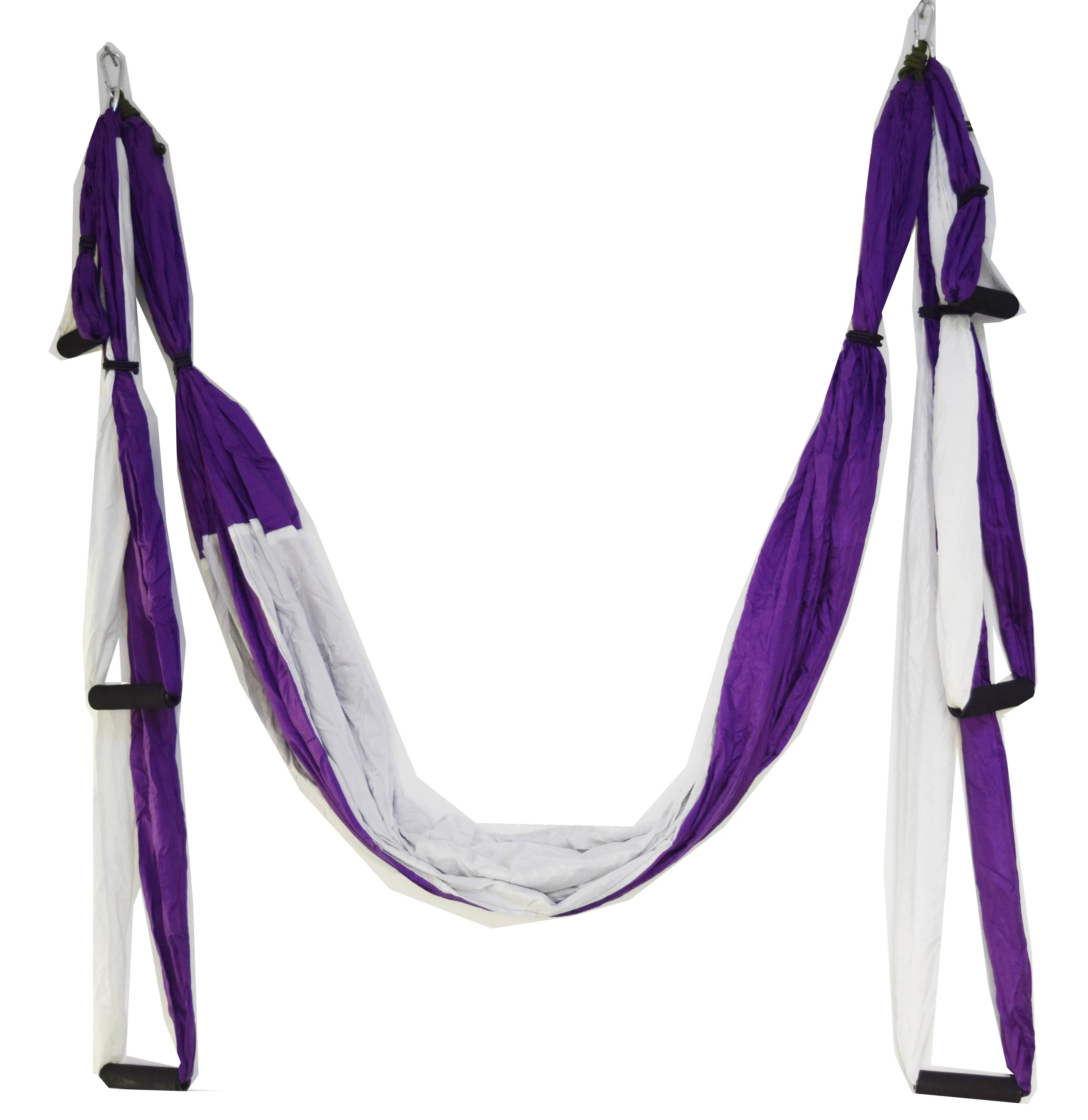
A static load is a relatively stationary load applied gradually or maintained without significant movement. An example is a person resting in a supported aerial hammock position without swinging or bouncing.
Although static loading is generally easier to evaluate than dynamic movement, the actual force distribution still depends on the hammock configuration, suspension geometry, attachment points, and user's position.
What Is a Dynamic Load?
A dynamic load occurs when movement or changing forces affect the equipment. In aerial yoga, this can happen during swinging, bouncing, lifting into a pose, lowering out of an inversion, or making a sudden transition.
Acceleration and deceleration can create forces that differ from the user's stationary body weight. The direction and distribution of these forces can also change as the person moves.
There is no universal dynamic-load multiplier that can safely be applied to every aerial hammock. Actual forces depend on the movement, equipment geometry, suspension arrangement, and other conditions. Buyers should therefore follow the manufacturer's approved movement restrictions rather than estimating a higher operating limit themselves.
Why Inversions and Transitions Require Additional Caution
Inversions introduce different loading directions and body positions. As the user changes orientation, the hammock may experience uneven loading across the fabric and suspension points.
Transitions can also involve shifting body weight, asymmetrical forces, and sudden movement. A product advertised for supported stretching is not automatically approved for drops, bouncing, advanced inversions, or dynamic aerial routines.
Before attempting these movements, verify that the manufacturer explicitly permits the intended activity and that the complete suspension arrangement is suitable for it. Beginners should learn appropriate techniques under qualified instruction rather than experimenting with unsupported movements at home.
The Weakest-Link Principle: Assess Every Component in the Setup
An aerial yoga hammock is a connected suspension system. Its overall suitability depends on every component working together under the manufacturer's approved configuration. One damaged, incompatible, improperly installed, or inadequately rated component can compromise the entire setup.
Importantly, buyers should not simply select the lowest numerical rating from unrelated components and assume that this establishes the complete-system capacity. Ratings must be interpreted according to their definitions, loading directions, and permitted configurations.
Aerial Hammock Fabric and Stitching
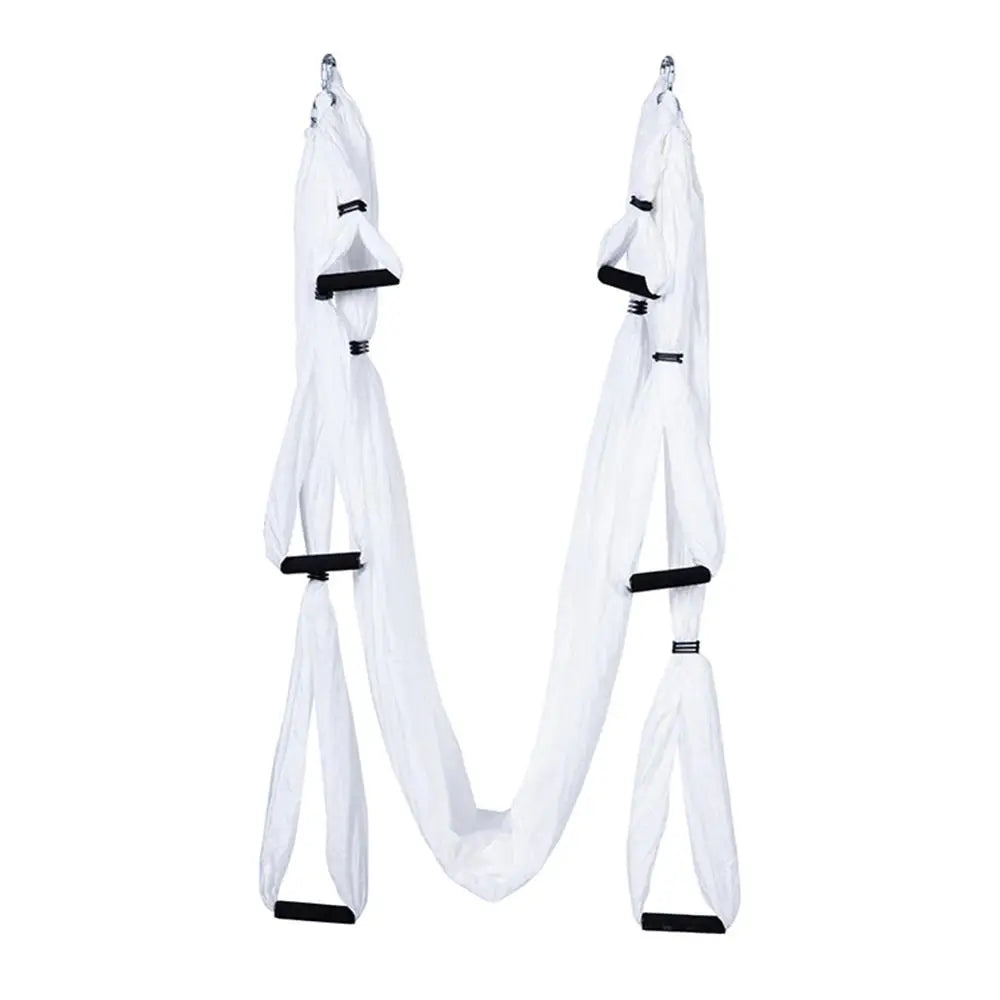
Fabric is the primary body-supporting material. Buyers should review its material specifications, construction, stitching quality, and manufacturer testing documentation.
For nylon aerial hammocks, inspect the following:
- Fabric composition and construction details.
- Stitching patterns and seam quality.
- Signs of fraying, cuts, abrasion, or thinning.
- Manufacturer instructions concerning washing, drying, and storage.
- Exposure restrictions involving sunlight, chemicals, moisture, and heat.
- Documented maximum user weight and approved activities.
Fabric material alone cannot establish a safe user-weight limit. A strong-looking parachute nylon fabric does not automatically guarantee that its seams, suspension attachments, or complete assembly have an equivalent capacity.
Aerial Suspension Straps and Extension Components
Suspension straps connect the hammock to the supporting hardware or structure. Their construction, stitching, abrasion resistance, and configuration affect the complete installation.
Check whether the straps are supplied with the hammock, whether their ratings are documented, and whether the manufacturer approves their use with the specific product. Extension straps should not be added simply because they appear physically compatible.
Some aerial hammock packages do not include ceiling mounting hardware or extension straps. Additional components must be selected according to the manufacturer's installation requirements.
Carabiners and Connector Load Ratings
Carabiners connect suspension components and must be suitable for their intended application. Buyers should check manufacturer markings, documented ratings, gate specifications, and permitted loading orientation.
Important inspection points include:
- Visible cracks, corrosion, or deformation.
- Abnormal wear around the body and connection points.
- Correct gate operation and locking mechanism function.
- Compatibility with the connected straps and rigging components.
- Manufacturer restrictions on cross-loading, side-loading, and gate loading.
A connector's published rating applies under specified conditions. Incorrect orientation or loading can affect its performance, so a carabiner should never be selected based only on its appearance or advertised strength.
Swivel Rigging Hardware and Attachment Points
Swivels and other rigging hardware can be used in aerial suspension configurations where rotation or particular connection arrangements are required. Their ratings, connection compatibility, orientation, and installation instructions must be verified individually.
Do not assume that a swivel included in an unrelated fitness kit is appropriate for an aerial yoga hammock. Follow the complete system manufacturer's approved equipment specifications.
Portable Aerial Yoga Stands
A portable aerial yoga stand provides an alternative to permanent ceiling installation, but it has its own capacity and configuration requirements.
Before choosing a stand, check:
- Manufacturer-stated maximum user weight.
- Approved hammock and suspension compatibility.
- Required assembly configuration.
- Stability and positioning instructions.
- Restrictions involving swinging, inversions, or dynamic movements.
- Inspection and maintenance requirements.
A stand's capacity should not be inferred from the rating of the hammock attached to it. Both products must be approved for the intended configuration.
Structural Ceiling Anchors and Building Support
Ceiling mounting involves more than choosing a hook or bolt with a high advertised strength rating. The supporting building structure must also be appropriate for the intended loading conditions.
Potential supporting structures include structural joists, beams, and suitable concrete elements. However, their suitability depends on the building design, material condition, installation method, and applicable engineering requirements.
Drywall or decorative ceiling finishes alone should never be treated as proof of adequate structural support.
A rated mounting plate does not establish that the ceiling behind it can support an aerial yoga system. For permanent installations, uncertain substrates, or dynamic aerial use, obtain assessment and installation guidance from a qualified professional familiar with the relevant structural and rigging requirements.
Does a 440 lbs Aerial Yoga Hammock Safely Support a 440 lbs User?
No, not automatically. A 440 lbs advertised capacity does not establish that every user weighing up to 440 lbs can safely perform every aerial yoga movement. The answer depends on what the manufacturer means by the rating, which components were tested, the complete installation, and the permitted usage conditions.
What Does a 440 lbs Capacity Claim Actually Mean?
The same 440 lbs figure can describe different measurements depending on the product listing. It might refer to a fabric strength claim, a component rating, a maximum user weight, or a complete-system specification.
These measurements have different meanings. If a listing does not explain the rating definition or provide supporting documentation, buyers should contact the manufacturer before treating the number as an approved user limit.
440 lbs in Kilograms: Understanding the Conversion
For international buyers, 440 lbs is approximately 199.6 kg, commonly rounded to 200 kg in product descriptions.
For example, an aerial yoga hammock advertised with a stated load capacity of up to 200 kg may also display a 440 lbs specification. Although these figures are approximately equivalent, the conversion does not clarify whether the rating represents maximum user weight, breaking strength, or another measurement.
Questions to Ask Before Trusting a 440 lbs Rating
Before purchasing a heavy-duty aerial yoga hammock, ask the manufacturer:
- Does 440 lbs refer to maximum user weight or breaking strength?
- Does the stated rating apply to the complete assembled system?
- Which fabric and stitching tests support the specification?
- Are suspension straps, carabiners, and other connectors included in the rating?
- Is the equipment approved for static stretching, inversions, and dynamic movements?
- What mounting system and structural requirements apply?
- Are installation instructions and inspection procedures available?
These questions provide a more meaningful basis for comparison than choosing the product with the largest number on its packaging.
Standard vs. Heavy-Duty Aerial Yoga Hammock Equipment
Standard and heavy-duty aerial yoga equipment can differ in construction, documented user-weight limits, suspension components, and intended applications. However, the terms standard and heavy-duty are not universal technical certifications. A heavy-duty label alone does not demonstrate a higher verified working load limit or greater overall safety.
Standard Aerial Hammock Equipment
Standard equipment may be suitable for users whose intended activities and body weight fall within the manufacturer's documented specifications.
When comparing a standard aerial hammock, evaluate its fabric construction, maximum user weight, included connectors, suspension arrangements, and mounting requirements. Do not assume that a lower advertised rating means the product is unsuitable for every beginner or supported stretching routine.
Heavy-Duty Aerial Hammock Equipment
Heavy-duty equipment is generally marketed toward buyers looking for more substantial support specifications or equipment intended for particular fitness applications. Nevertheless, marketing descriptions must be supported by actual manufacturer documentation.
Look for clearly stated maximum user weight, fabric specifications, reinforced stitching information, compatible suspension hardware, and approved mounting arrangements. A higher fabric strength claim does not automatically establish a higher permissible user weight.
Standard vs. Heavy-Duty Equipment Comparison
The following comparison focuses on what buyers should verify rather than assuming that every product in either category shares identical construction or performance characteristics.
| Evaluation criterion | Standard equipment | Heavy-duty equipment | What to verify |
| Maximum user weight | Varies by manufacturer and model. | May advertise a higher limit. | Confirm the documented maximum user weight for the complete approved configuration. |
| Fabric and stitching | Construction varies by product. | May specify particular fabric or reinforced construction. | Review material, seam, and testing documentation. |
| Suspension straps | May be included or sold separately. | May use different suspension configurations. | Verify component ratings and compatibility. |
| Carabiners and swivels | Specifications depend on the package. | Specifications also depend on the package. | Check markings, orientation, and manufacturer approval. |
| Stand or mounting compatibility | Depends on the installation design. | Requires the same structural evaluation. | Verify approved mounting arrangements and structural suitability. |
| Approved movement | May be limited to particular exercises. | Depends on documented intended use. | Confirm whether inversions and dynamic transitions are permitted. |
| Inspection and replacement | Follow manufacturer instructions. | Follow manufacturer instructions. | Check service-life limits, inspection schedules, and retirement criteria. |
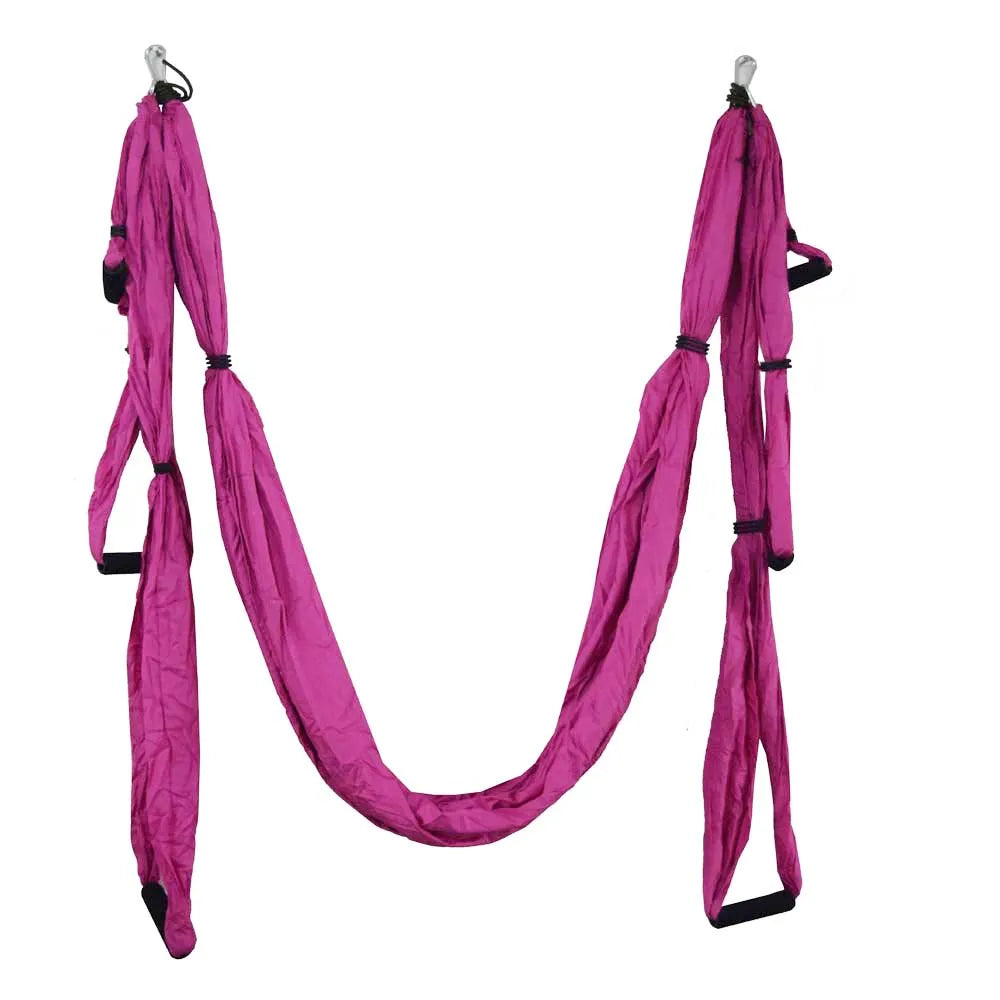
For buyers comparing equipment for home practice, the Aerial Yoga Hammock – 200KG Heavy-Duty Support Swing is one option to evaluate against these criteria.
Its published specifications include non-elastic 210T parachute nylon fabric, a main hammock measuring 250 × 150 cm, three handle lengths of 30 cm, 85 cm, and 135 cm, and a stated load capacity of up to 200 kg (440 lbs). The package includes the hammock, handles, four metal buckles, telescopic buckles, and a carry bag.
One important distinction: the stated 200 kg capacity is a product specification, but the available description does not establish whether it is a working load limit, minimum breaking strength, or independently verified maximum user weight for the complete installed system. Buyers should request clarification and supporting documentation before relying on it as a safe user limit, particularly for dynamic aerial movements.
Also note that extension straps and ceiling hanging trays are not included and must be purchased separately. Their compatibility and installation requirements should be verified before assembling the setup.
When comparing products, review the lifestyle equipment collection alongside individual product specifications, but prioritize documented capacity and installation requirements over marketing labels.
Which Equipment Should Heavier Users Consider?
Heavier users should compare the manufacturer's maximum user-weight specification with their actual body weight and intended practice style. The complete system must be approved for both the user's weight and the movements they plan to perform.
Consider these scenarios:
- Beginner practicing supported poses: Choose equipment with a clearly documented maximum user weight and follow the manufacturer's approved installation and movement restrictions.
- Regular inversion practice: Confirm that the complete suspension system is approved for inversions and the intended transitions. Do not rely on a static capacity claim alone.
- Comparing 300 lbs and 440 lbs ratings: A documented 300 lbs maximum user weight may provide more useful information than an unexplained 440 lbs strength claim. Compare rating definitions, not just headline figures.
- Choosing a portable stand or ceiling mount: Evaluate the manufacturer's complete configuration requirements, supporting structure, and permitted movements. Neither arrangement is automatically safer.
If you are considering a portable home setup, review the 200KG aerial yoga hammock specifications and confirm the appropriate suspension and mounting components before purchasing additional accessories. The stated fabric and load specifications should not be treated as independent confirmation of complete-system capacity.
How to Choose the Right Aerial Yoga Hammock Weight Capacity
Choosing an aerial yoga hammock requires matching product documentation with your intended activities and installation conditions. A simple decision framework can help avoid common purchasing mistakes.
Step 1: Define Your Intended Practice
Determine whether you plan to use the hammock for supported stretching, beginner aerial yoga, swing-chair movements, inversions, or more dynamic fitness exercises.
Different activities can create different loading conditions. Check that the manufacturer explicitly permits your intended practice rather than assuming that all aerial movements are supported.
Step 2: Verify the Maximum User Weight
Look for a clearly stated maximum user weight rather than relying exclusively on fabric strength or breaking-strength claims. Confirm the units and conversion between pounds and kilograms.
If the product only lists an unexplained maximum load, request clarification about the rating definition and applicable testing conditions.
Step 3: Check Every Suspension Component
Review the hammock, stitching, suspension straps, connectors, swivels, and mounting equipment. Make sure the manufacturer approves the complete combination.
Do not combine components from unrelated products simply because their connectors appear to fit together.
Step 4: Evaluate Installation Requirements
Determine whether the product is designed for a compatible portable stand or a permanent ceiling installation. Check the supporting structure and seek qualified installation guidance when needed.
Step 5: Review Maintenance and Inspection Instructions
Before buying, check whether the manufacturer provides care instructions, inspection intervals, service-life information, and clear replacement criteria. These details are particularly important for equipment used regularly at home.
Ceiling Installation: Why Anchor Ratings Are Not Enough
Installing an aerial yoga hammock requires an appropriate connection between the suspension hardware and a structurally suitable building element. A strong-looking ceiling hook does not guarantee that the complete installation can support the intended loads.
Identify the Supporting Ceiling Structure
Potential mounting substrates include structural joists, beams, and suitable concrete structures. Their suitability must be established according to the building design and equipment requirements.
Drywall, plaster, and decorative ceiling panels should not be treated as structural supports. The visible ceiling surface may conceal the actual supporting structure, so identifying the correct attachment location is essential.
Check Anchor Compatibility and Installation Requirements
Different anchors and fasteners are designed for different substrates. A mounting component rated for one installation type should not automatically be used in another.
Verify the manufacturer's approved mounting hardware, substrate requirements, installation instructions, and loading limitations. Avoid improvised attachment arrangements or modifications that have not been approved.
When to Consult a Qualified Installer or Structural Professional
Professional assessment is particularly important when:
- The ceiling construction or supporting material is uncertain.
- You are planning a permanent installation.
- The intended practice involves dynamic aerial movements.
- The mounting point has visible damage or signs of movement.
- You are considering additional anchors, extension components, or modified suspension arrangements.
Relevant engineering guidance and manufacturer documentation should inform the installation. ASTM standards, where applicable to specific equipment or materials, should be checked for their actual scope. General references to a standard or a component rating do not independently certify an entire aerial yoga setup.
Aerial Yoga Hammock Safety Checklist Before Every Use
Regular inspection helps identify visible problems before equipment is used. However, a visual inspection cannot replace manufacturer-directed inspections, required professional assessments, or applicable equipment retirement procedures.
Inspect Fabric, Seams, and Stitching
Spread the hammock fabric out and inspect the accessible surfaces and seams. Look for:
- Frayed or thinning fabric.
- Cuts, holes, or abrasion marks.
- Loose threads or damaged stitching.
- Compromised seams or attachment areas.
- Unusual discoloration associated with material damage.
- Signs of chemical, heat, or environmental exposure.
Do not continue using equipment with suspected structural fabric damage.
Inspect Straps, Carabiners, and Swivels
Check every connection before practice. Look for corrosion, deformation, cracks, damaged strap stitching, unusual wear, and connectors that do not operate correctly.
Confirm that carabiner gates function properly and that each component is installed in its manufacturer-approved orientation. Replace or professionally assess questionable hardware according to the applicable instructions.
Check Stands, Anchors, and Structural Connections
Inspect portable stands for instability, damaged parts, loose fasteners, and incorrect assembly. For ceiling installations, check for visible movement, loose connections, and signs of compromised mounting points.
Stop using the setup if any structural connection appears damaged or its integrity is uncertain. Do not attempt to solve a structural problem by simply tightening hardware without understanding the cause.
When Should Aerial Hammock Equipment Be Replaced?
Equipment should be retired according to manufacturer service-life limits, inspection findings, damage history, and exposure conditions.
Replace or remove from service equipment when the manufacturer requires retirement, when damage is identified, or when its service history cannot be established sufficiently to determine its condition.
A high advertised weight capacity does not make worn fabric, damaged stitching, corroded carabiners, or compromised mounting hardware acceptable for continued use.
Printable Pre-Use Inspection Checklist
Use this quick checklist before each practice session:
- Fabric is free from visible cuts, fraying, and abnormal wear.
- Stitching and seams show no visible damage.
- Suspension straps are compatible and undamaged.
- Carabiners and connectors show no cracks, corrosion, or deformation.
- Swivels and other rigging components function correctly.
- Portable stands are correctly assembled and stable.
- Ceiling anchors and structural connections show no visible movement or damage.
- All components match the manufacturer's approved configuration.
- Installation requirements and movement restrictions are understood.
- Equipment remains within its documented service life.
How to Calculate the Total Load Capacity of an Aerial Yoga Hammock Setup
You cannot reliably calculate the permissible capacity of an aerial yoga hammock by adding individual component ratings or selecting the highest advertised number. The complete-system limit must be established through the applicable manufacturer-approved configuration, compatible component specifications, and appropriate structural assessment.
Identify the Documented Rating for Every Component
Start by identifying all components involved in the suspension system:
- Hammock fabric and stitching.
- Suspension straps and extension components.
- Carabiners and connectors.
- Swivels and rigging hardware.
- Portable stands, if applicable.
- Ceiling anchors and mounting plates.
- Supporting beams, joists, or structural elements.
Record each manufacturer's name, product model, rating definition, and applicable operating conditions. If a component does not have adequate documentation, do not assume its capacity from its appearance or physical dimensions.
Check Compatibility and Approved Configuration
Equipment ratings cannot automatically be combined when components come from different manufacturers or are designed for different loading conditions.
Connection orientation, loading direction, attachment geometry, and installation method can influence performance. A component rated for a particular configuration may not retain the same rating when used differently.
Use the Manufacturer's Complete-System Limit
The permissible operating capacity should be established from the manufacturer-approved complete-system specifications and the suitability of the supporting structure.
If the manufacturer does not provide sufficient information to establish the complete-system limit, do not calculate one independently from individual component figures. Contact the manufacturer or a qualified professional before using the equipment.
Final Thoughts: Choose an Aerial Yoga Hammock by Verified Capacity, Not Marketing Numbers
Understanding hammock weight limits means looking beyond advertised pounds and kilograms. Minimum breaking strength, working load limit, and maximum user weight describe different measurements, while static and dynamic loading introduce additional considerations for aerial practice.
A 440 lbs or approximately 200 kg product claim is not automatically a guarantee that a person weighing 440 lbs can safely perform every exercise. Fabric, stitching, straps, carabiners, swivels, stands, mounting hardware, and the supporting building structure must all be appropriate for the intended use.
When comparing standard and heavy-duty aerial yoga equipment, prioritize transparent manufacturer documentation, clearly defined user-weight limits, compatible components, approved installation methods, and inspection guidance.
If you are exploring a home aerial yoga setup, you can review the 200KG Heavy-Duty Support Swing and compare its 210T non-elastic parachute nylon fabric, dimensions, included accessories, and stated load specification with your requirements. Confirm the precise meaning of its capacity rating and obtain any additional suspension or installation components separately.
The most practical purchasing decision is not necessarily the hammock with the largest advertised number. It is the complete, compatible, properly installed system whose documented operating limits match your body weight and intended practice.
Pillar Article: Aerial Fitness Equipment: Complete Comparison & Buying Guide for Home Training