
Multifunctional Pedal Resistance Rope: Compare 2, 4 & 6-Tube Systems
Choosing compact home workout equipment can be surprisingly difficult when different products look almost identical but offer different resistance configurations. A multifunctional pedal resistance rope provides a convenient way to perform pulling, stretching, and strength-training movements without investing in bulky gym equipment. However, should you choose a 2-tube, 4-tube, or 6-tube system?
The right option depends on more than the number of elastic tubes. Material quality, resistance characteristics, pedal stability, handle comfort, stretching capacity, and exercise versatility all influence the experience. This guide compares the three common configurations, explains what to inspect before purchasing, and demonstrates practical exercises for your arms, shoulders, core, waist, and legs.
For shoppers seeking a compact and versatile training accessory, a four-tube pedal resistance trainer can offer a practical balance of exercise variety, portability, and manageable equipment complexity.
What Is a Multifunctional Pedal Resistance Rope?
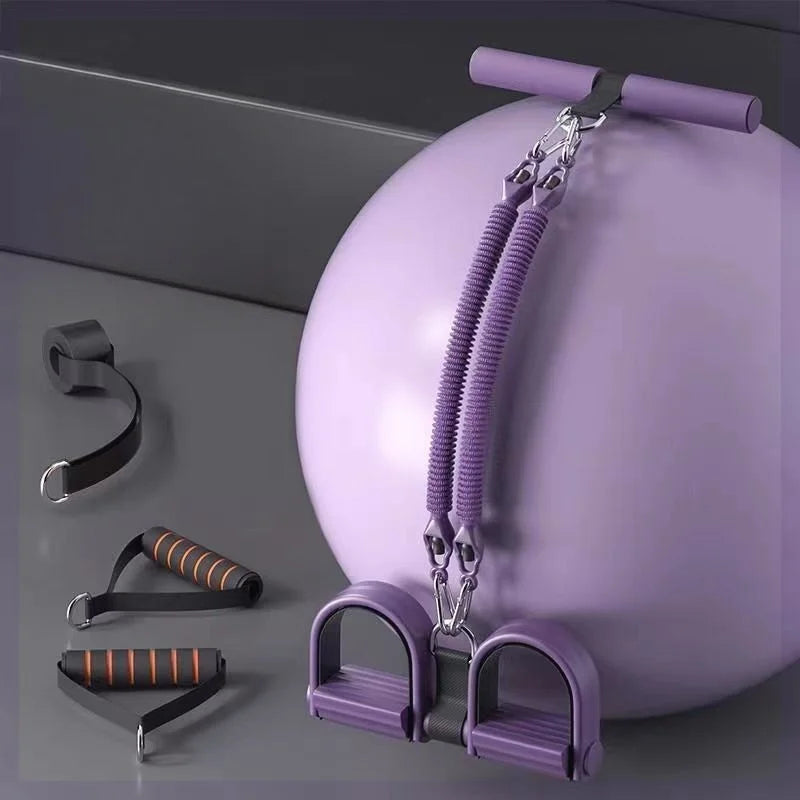
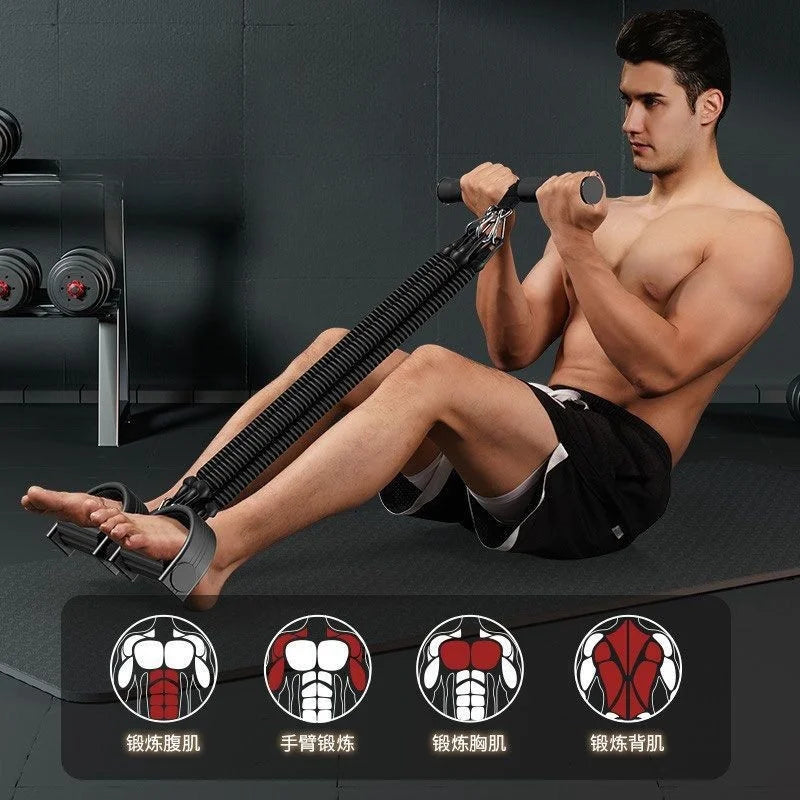
A multifunctional pedal resistance rope is a compact exercise device that combines elastic resistance tubes, foot pedals, and hand grips. Users place their feet against or inside the pedals and pull the handles to create tension through the elastic tubing. Depending on the design, the equipment can support upper-body, lower-body, abdominal, and stretching movements.
How a Pedal Resistance Rope Works
The equipment operates through elastic resistance. When you pull the handles away from the foot pedals, the tubes stretch and generate opposing tension. Your muscles work against this tension as you complete the movement.
Unlike conventional free weights, resistance generally increases as elastic tubing stretches. The amount of tension depends on the tube material, thickness, length, elasticity, and degree of extension. Consequently, two resistance trainers with the same number of tubes may feel noticeably different during exercise.
To use the equipment effectively:
- Place the pedals securely beneath your feet or in the manufacturer's recommended position.
- Hold both handles with a comfortable, controlled grip.
- Position your body so the tubes are aligned without twisting or rubbing against sharp surfaces.
- Pull the handles smoothly against the elastic tension.
- Return slowly to the starting position without allowing the tubes to snap back.
Main Components and Their Functions
- Resistance tubes: Elastic components that generate tension during pulling and stretching movements.
- Foot pedals: Provide a foot-contact point that helps anchor the equipment during supported exercises.
- Handles: Allow users to grip and control the tubing while exercising.
- Foam covering: Helps improve grip comfort during repeated movements.
- Connectors: Join the resistance components and influence the security of the assembled equipment.
- Door anchor: An additional attachment included with some models for compatible anchored exercises when used according to the manufacturer's instructions.
Who Should Consider This Type of Home Workout Equipment?
A pedal resistance rope can suit beginners, casual exercisers, travelers, and people who want a lightweight alternative to larger strength-training equipment. It is particularly useful when floor space is limited or a dedicated home gym is impractical.
It can also complement an existing routine involving bodyweight exercises, walking, stretching, and other resistance-training accessories. However, it does not replace every function of dumbbells, barbells, cable machines, or specialized strength equipment.
For additional compact fitness and wellness accessories, explore the Lifestyle collection.
2-Tube vs. 4-Tube vs. 6-Tube Pedal Resistance Rope: What's the Difference?
The number of tubes influences equipment configuration, but it does not establish a universal resistance rating. A six-tube system is not automatically stronger than a four-tube model. Actual resistance depends on individual tube specifications, material properties, length, diameter, and how the manufacturer designs the connections.
Understanding these differences helps shoppers select a trainer that matches their preferred exercises and experience level.
2-Tube Resistance Trainer: Simple and Beginner-Friendly
A two-tube resistance trainer typically has a straightforward construction with fewer elastic components. Its simpler design may make it easier to understand and manage when starting resistance training at home.
Potential advantages:
- Simple equipment configuration.
- Fewer tubes to organize and inspect.
- Convenient for straightforward pulling and stretching movements.
- Potentially suitable for users who prefer a basic training accessory.
Potential limitations:
- Fewer possible tube combinations if the design does not support additional adjustments.
- Potentially less flexibility for users seeking multiple resistance configurations.
- Actual resistance may be insufficient for some experienced exercisers.
A two-tube trainer is worth considering when simplicity matters more than configuration variety. Nevertheless, check its actual resistance specifications rather than assuming that fewer tubes always mean lighter tension.
4-Tube Resistance Trainer: A Balanced Choice for Versatility
A four-tube resistance trainer offers multiple elastic components in a relatively compact format. Depending on its construction, the additional tubes may support a broader range of pulling and stretching applications than simpler configurations.
Its main attraction is versatility. Users can incorporate the equipment into seated arm exercises, shoulder movements, supported leg exercises, and core-focused routines.
However, not every four-tube system allows individual tubes to be detached or independently adjusted. Buyers should verify whether the tubes are permanently connected, independently removable, or designed to work together.
Potential advantages:
- Multiple elastic tubes for varied resistance applications.
- Convenient for full-body home exercise routines.
- Compact storage and transportation.
- A practical middle-ground configuration for users seeking exercise versatility.
Potential limitations:
- Resistance adjustability depends on the actual connection design.
- More components require regular inspection.
- May not provide enough maximum resistance for every experienced strength trainee.
For people seeking a practical combination of portability and exercise variety, a four-tube full-body pedal resistance trainer is worth considering.
6-Tube Resistance Trainer: More Configuration Options
Six-tube systems contain additional elastic components that may offer more possible resistance combinations, depending on how the manufacturer connects the tubing.
This configuration can appeal to users who prioritize flexibility and want to explore different pulling and stretching movements. However, additional tubes can also introduce more complicated assembly, storage, and maintenance requirements.
Potential advantages:
- Additional tubing components may provide more configuration possibilities.
- Potential flexibility for varied exercise applications.
- May suit users who want to experiment with different resistance arrangements.
Potential limitations:
- More components may make setup and tube management complicated.
- Additional tubing does not guarantee greater resistance.
- Potentially higher purchase costs depending on construction and accessories.
- More connection points may require additional inspection.
Side-by-Side Comparison of 2, 4, and 6 Tubes
Use the following comparison matrix to identify which configuration best matches your priorities.
- 2-tube system: Best considered for straightforward routines, simple construction, and users who do not need numerous configuration options.
- 4-tube system: A practical choice for shoppers seeking a balance of exercise versatility, manageable equipment size, and multiple elastic components.
- 6-tube system: Worth evaluating when additional configuration possibilities are important and the manufacturer's specifications support the intended training requirements.
Configuration flexibility: Two tubes generally mean fewer components to manage, four tubes offer a middle-ground arrangement, and six tubes may provide additional combinations if the design permits independent adjustment.
Setup complexity: Two-tube models are often simpler, while systems with more components may require additional attention during setup.
Portability: All three configurations can be compact, although the actual dimensions and construction determine storage convenience.
Resistance: Model-dependent for all three configurations. Tube count alone cannot establish the amount of resistance.
Value: The best purchase is the model that offers the required resistance, comfortable contact points, reliable connections, and useful accessories without unnecessary complexity.
Rather than selecting a trainer based only on tube count, compare the actual specifications and available configurations before ordering.
How to Choose the Right Resistance Tube Material: Latex vs. TPE
Resistance tube material influences elasticity, handling, maintenance, and the overall training experience. Two common material categories are natural latex and thermoplastic elastomer (TPE).
Natural Latex Resistance Tubes
Natural latex is widely used in elastic fitness products because of its flexibility and ability to stretch under tension. Depending on its formulation and manufacturing quality, latex tubing can provide a responsive resistance feel during pulling and stretching exercises.
However, natural latex is not suitable for everyone. People with latex allergies should avoid direct exposure and choose an appropriate alternative. Latex can also deteriorate when exposed to unsuitable storage conditions, excessive heat, sunlight, or damaging chemicals.
TPE Resistance Tubing
TPE is a family of thermoplastic elastomer materials that combine flexible and elastic characteristics. Its properties vary according to the formulation and manufacturing process.
Some TPE products are selected as alternatives for people who prefer to avoid natural latex. Nevertheless, shoppers should confirm the actual material composition instead of assuming that every product labeled TPE is completely free of latex or other potential allergens.
Which Material Should You Choose?
The better material depends on individual preferences, allergies, product specifications, and intended frequency of use.
- Choose natural latex when its elasticity suits your preferences and you do not have a latex sensitivity.
- Consider TPE when you prefer a thermoplastic elastomer construction and have verified its material specifications.
- Inspect both materials for manufacturing defects, surface damage, and signs of deterioration.
- Follow the manufacturer's cleaning, storage, and stretching instructions.
Material alone does not determine durability. Tube thickness, construction quality, connector reinforcement, manufacturing consistency, and maintenance also matter.
What Features Matter Most When Buying a Pedal Resistance Rope?
A good purchasing decision requires examining the complete product rather than focusing on its advertised tube count. The following features can help distinguish a useful resistance trainer from an unsuitable alternative.
Resistance Adjustability and Tube Configuration
Start by checking whether the tubes can be detached, combined, or used independently. Some resistance trainers have fixed configurations, while others support multiple arrangements.
Ask the seller for documented resistance specifications where available. If individual resistance measurements or maximum extension limits are not provided, do not assume that adding tubes will create a particular resistance level.
Foot Pedal Grip and Stability
Foot pedals play an important role in maintaining a secure setup. Check their dimensions, surface texture, construction, and available foot clearance.
Pedals should feel comfortable and provide a suitable contact surface for your feet. During exercise, avoid unstable positioning or arrangements that cause the tubing to rub against your shoes or surrounding objects.
Ergonomic Foam Handles and Grip Comfort
Handles influence comfort during repeated pulling movements. Foam-covered grips can provide a softer contact surface than bare connectors or hard plastic handles.
Before purchasing, evaluate:
- Handle diameter and length.
- Foam thickness and surface texture.
- Grip comfort during repeated movements.
- Whether the handles feel secure rather than excessively loose.
Tube Connectors, Reinforcement, and Durability
Connection points deserve particular attention because they transfer tension between the handles, pedals, and elastic tubing.
Look for secure attachment points, consistent construction, and protective coverings where appropriate. Avoid products with loose connectors, exposed reinforcement, damaged stitching, or visible manufacturing defects.
Before every workout, inspect the tubing for cracks, cuts, discoloration, sticky surfaces, and unusual brittleness. Stop using equipment if any component appears damaged.
Stretching Range, Dimensions, and Storage
Tube length affects how comfortably different users can perform exercises. Taller users or people with longer limbs may need to pay particular attention to the available extension range and starting position.
Never stretch resistance tubing beyond the manufacturer's stated limits. An uncomfortable range of motion should not be forced simply to complete an exercise.
Portability and Overall Value for Money
Compact resistance trainers are attractive because they can be stored in small spaces and carried when traveling. However, portability should not be the only purchasing consideration.
Evaluate the complete package, including material quality, handles, pedal construction, accessories, resistance specifications, warranty coverage, and return conditions.
The Kentdo Pedal Resistance Band – 4-Tube Full Body Workout Trainer provides a useful example of a compact four-tube configuration.
Its listed specifications include:
- Design: Four-tube pedal resistance system.
- Materials: TPE, elastic material, and foam.
- Approximate dimensions: 52 × 26.5 cm.
- Available colors: Black and purple.
- Training areas: Arms, shoulders, waist, abdomen, and legs.
- Included package: One pedal tension rope, two handles, and one door anchor.
- Intended users: Men and women.
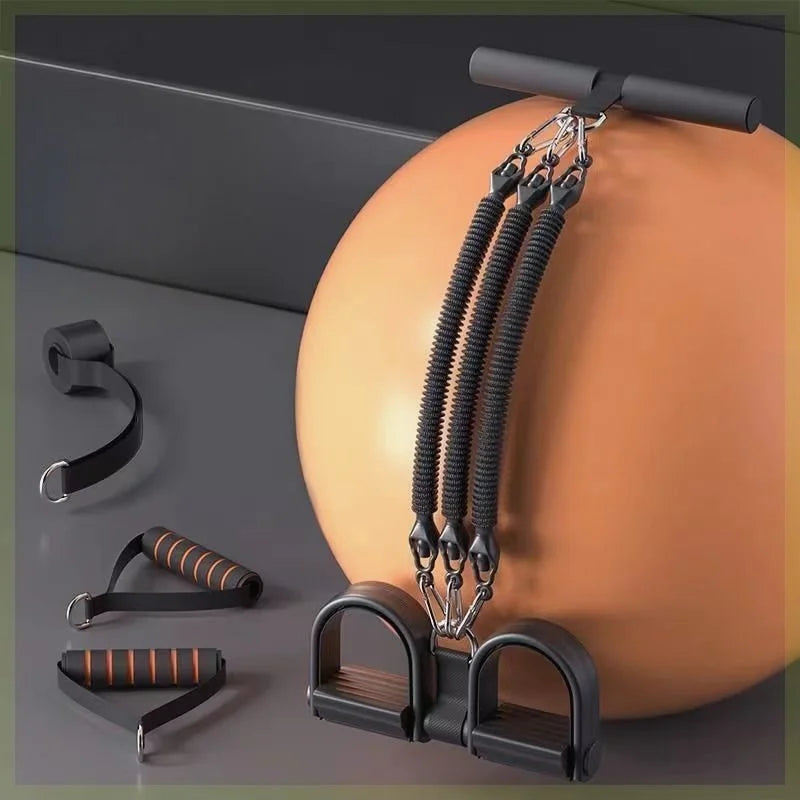
These specifications make it an option for people who want a lightweight training accessory with multiple exercise applications. The listed information does not establish independently adjustable tube resistance, measured tension levels, or a specific maximum stretching capacity, so those details should be confirmed before purchase.
For more compact personal-care and wellness equipment, you can also browse Body Care and Health Devices.
How to Use a Multifunctional Pedal Resistance Rope for Full-Body Training
A multifunctional pedal resistance rope can support several simple exercises when the equipment is positioned correctly. Start with light tension, maintain controlled movements, and choose repetitions that allow you to preserve good technique.
Upper-Body Exercises
Seated Biceps Curl
This exercise targets the biceps and can be included in a basic upper-body routine.
- Sit upright on a stable chair or exercise surface.
- Position both feet securely on the pedals according to the equipment instructions.
- Hold the handles with your palms facing upward.
- Keep your elbows close to your torso.
- Curl the handles toward your shoulders while maintaining control.
- Lower the handles slowly to the starting position.
Suggested volume: Two sets of 10–12 controlled repetitions.
Seated Shoulder Press
A seated shoulder press uses resistance to train the shoulders and supporting upper-body muscles.
- Begin in a stable seated position with your feet securely positioned.
- Hold the handles near shoulder height.
- Keep your wrists comfortable and your torso upright.
- Press the handles upward within a comfortable range of motion.
- Lower them slowly without allowing the tubing to snap back.
Suggested volume: Two sets of 8–10 repetitions.
Resistance Row
Resistance rows involve pulling the handles toward your torso and engaging the upper back, shoulders, and arms.
- Sit upright with your legs comfortably extended.
- Secure the pedals beneath your feet.
- Hold both handles with your arms extended.
- Pull the handles toward your torso while keeping your elbows close to your sides.
- Pause briefly before returning slowly to the starting position.
Suggested volume: Two sets of 10–12 repetitions.
Lower-Body Exercises
Seated Leg Extension
A seated leg extension can provide a controlled resistance movement for the quadriceps when the equipment supports the required setup.
- Sit on a stable chair with your back supported.
- Use a manufacturer-approved arrangement that provides secure resistance for the working leg.
- Begin with your knee comfortably bent.
- Extend the knee slowly against the elastic tension.
- Return to the starting position without allowing the tubing to recoil.
Suggested volume: Two sets of 8–10 repetitions per leg.
Only perform this movement if the equipment's design supports the setup safely. Do not improvise an attachment that could slip or release unexpectedly.
Standing Hip Abduction
Standing hip abduction involves moving one leg laterally to engage the muscles around the hip.
- Stand beside a stable support surface.
- Use an appropriate manufacturer-approved anchoring arrangement if the equipment supports this movement.
- Maintain an upright posture and keep your supporting foot stable.
- Move the working leg outward slowly against resistance.
- Return to the starting position with control.
Do not attempt this exercise using an unsecured pedal or an improvised anchor. Equipment stability must come first.
Core and Seated Resistance Exercises
Seated Core Pull
A seated pulling movement can involve the trunk muscles while helping users practice maintaining an upright posture.
- Sit upright with your feet securely positioned.
- Hold the handles with both hands.
- Begin with your arms extended comfortably.
- Pull the handles toward your torso while keeping your abdominal muscles engaged.
- Maintain a neutral spine and avoid excessive twisting.
- Return slowly to the starting position.
Suggested volume: Two sets of 8–10 controlled repetitions.
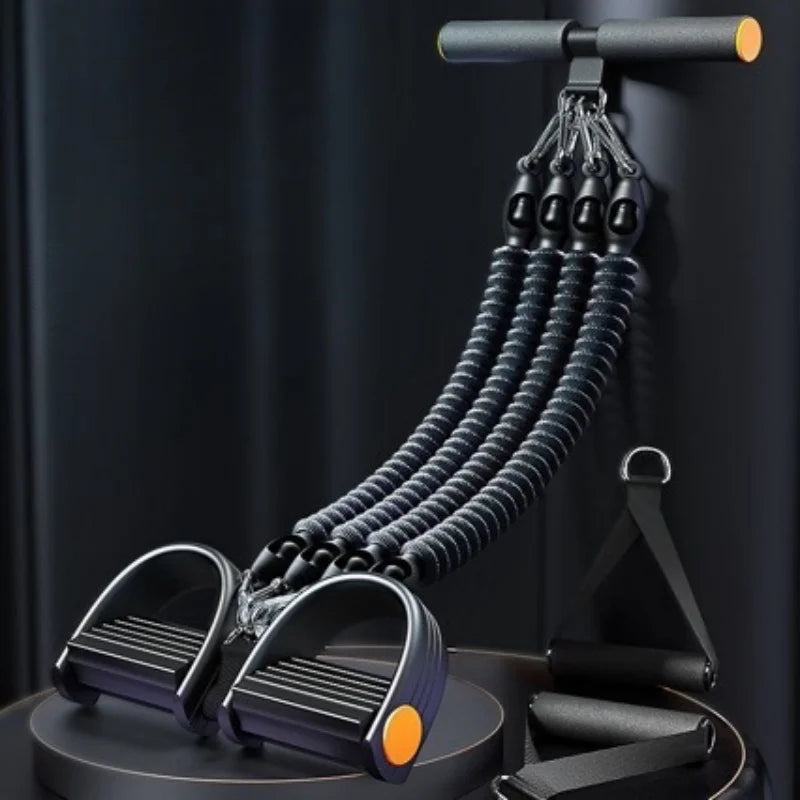
Suggested Beginner Full-Body Routine
Beginners can combine several movements into a manageable routine without needing a complicated exercise schedule.
- Seated biceps curls: One or two sets of 10 repetitions.
- Seated shoulder presses: One or two sets of 8 repetitions.
- Resistance rows: One or two sets of 10 repetitions.
- Seated leg extensions: One set of 8 repetitions per leg, if the equipment supports the setup.
- Seated core pulls: One set of 8 controlled repetitions.
Begin with a comfortable resistance level and rest between sets. You do not need to complete every movement during your first session. Prioritize technique, stable positioning, and gradual progression.
A compact four-tube pedal resistance band can be a convenient equipment option for these types of supported pulling and stretching exercises.
Which Pedal Resistance Rope Is Best for Your Fitness Level?
The best pedal resistance rope is the one that provides manageable tension, suits your intended exercises, and allows you to maintain proper movement technique.
Beginners: Prioritize Comfortable, Controllable Resistance
Beginners should focus on equipment that is easy to understand and comfortable to use. A two-tube trainer may be appropriate for simple routines, while a four-tube trainer can also work if its resistance characteristics suit the user.
Do not assume that a particular tube count automatically provides beginner-level resistance. Check the manufacturer's specifications and begin with movements that feel controlled.
Intermediate Users: Consider a Versatile 4-Tube System
Intermediate exercisers may appreciate the versatility of a four-tube system. It can support different upper-body, lower-body, and seated pulling movements without taking up much storage space.
The main advantage is having a compact training accessory that can be incorporated into different routines. However, check whether the tubes offer independent adjustment before expecting multiple resistance levels.
The Kentdo four-tube pedal resistance trainer is worth reviewing if you want a compact option with foam-covered handles, foot pedals, and a listed TPE and elastic construction.
Experienced Exercisers: Evaluate 6-Tube Configurations
Experienced users may want to investigate six-tube systems when additional resistance combinations or exercise configurations are important. However, advanced training requires more than additional elastic components.
Evaluate actual resistance measurements, tube dimensions, connector construction, maximum extension specifications, and available progression. If the trainer cannot provide sufficient resistance for your goals, conventional free weights or more substantial resistance equipment may be more appropriate.
How to Select an Appropriate Resistance Level
Use the following guidelines when selecting resistance:
- Choose tension that allows smooth repetitions without jerking.
- Maintain comfortable joint positions and consistent posture.
- Avoid breath-holding or using excessive momentum.
- Start with fewer repetitions if you are unfamiliar with elastic resistance.
- Increase resistance gradually when your current workload becomes manageable.
- Stop if you experience pain, unusual discomfort, or equipment instability.
For many shoppers seeking a balance between exercise variety and manageable equipment complexity, a properly specified four-tube system is a sensible middle-ground option.
Pros and Cons of Multifunctional Pedal Resistance Ropes
Although pedal resistance trainers are convenient, understanding their limitations is essential before making a purchase.
Main Advantages
- Compact storage: Their lightweight construction makes them easier to store than many conventional gym machines.
- Portability: Many models can be carried in a travel bag or stored in a small drawer.
- Exercise variety: They can support different pulling, pressing, and stretching movements.
- Convenient home training: Users can incorporate resistance exercises into a home routine without bulky equipment.
- Simple equipment setup: Basic pedal and handle arrangements can be relatively straightforward to use.
- Multiple training areas: Different movements can involve the arms, shoulders, core, waist, and legs.
Potential Limitations
- Variable resistance: Tube count does not provide a standardized measurement of tension.
- Material degradation: Elastic tubing can deteriorate with age, environmental exposure, or repeated use.
- Limited maximum resistance: Some models may not provide enough loading for experienced strength trainees.
- Positioning requirements: Exercises depend on secure pedal placement and appropriate anchoring.
- Regular inspection: Tubes and connectors need to be checked for damage.
- Limited exercise selection: The equipment cannot reproduce every movement available with a complete gym setup.
Is It a Replacement for Traditional Gym Equipment?
A multifunctional pedal resistance rope is best viewed as a supplementary home fitness tool rather than a complete gym replacement.
Dumbbells provide external loads that do not depend on elastic extension. Barbells allow progressive loading for many compound exercises, while cable machines offer different pulling angles and resistance arrangements.
Pedal resistance trainers offer a different advantage: compact construction and convenient elastic resistance for selected exercises.
If you want a simple way to add resistance to a home routine, they can be useful. If your goals require substantial progressive loading or specialized strength movements, consider combining resistance tubing with other equipment.
How to Maintain a Pedal Resistance Rope and Extend Its Lifespan
Regular maintenance helps you identify problems before they affect your training experience. Elastic tubing and connection points should be treated as components that require routine inspection.
Inspect Tubes and Connectors Before Each Workout
Before using the equipment, examine the entire length of every tube. Look for:
- Small cuts or visible cracks.
- Discoloration or unusual surface changes.
- Sticky, brittle, or hardened material.
- Loose or damaged connectors.
- Exposed reinforcement or damaged protective sleeves.
Stop using the equipment if any component shows signs of structural damage. Do not attempt to continue exercising with a compromised resistance tube.
Clean and Store the Equipment Correctly
Follow the manufacturer's cleaning instructions and use only suitable cleaning methods for the materials. Allow the equipment to dry completely before storing it.
Keep resistance tubes away from:
- Direct sunlight for extended periods.
- Excessive heat.
- Sharp objects and abrasive surfaces.
- Harsh chemicals and unsuitable cleaning products.
- Storage conditions that could deform or damage the elastic material.
Avoid Overstretching and Incorrect Anchoring
Never exceed the manufacturer's recommended extension limits. Overstretching may place excessive stress on the tubing and connectors.
Avoid tying improvised knots, attaching the equipment to unsuitable furniture, or using a door anchor without confirming that the attachment is compatible and secure. An unstable anchor can release unexpectedly during exercise.
When Should You Replace Resistance Tubes?
Replace damaged tubing when you notice cracks, cuts, significant discoloration, brittleness, or other signs of deterioration. Also inspect connectors and handles for loosening or structural damage.
Do not repair damaged resistance tubing with adhesive tape and continue using it for workouts. A compromised elastic component may fail under tension.
Multifunctional Pedal Resistance Rope Buying Checklist
Before ordering a pedal resistance trainer, compare its specifications with your actual training requirements. A detailed inspection can help prevent disappointment caused by misleading tube-count claims or incomplete product information.
Check These Specifications Before Ordering
- Tube count: Confirm whether the product contains two, four, or six resistance tubes.
- Material: Verify whether the tubing uses natural latex, TPE, or another elastic material.
- Resistance specifications: Look for documented tension measurements where available.
- Adjustability: Determine whether individual tubes can be removed, combined, or used separately.
- Tube dimensions: Check length, thickness, and recommended extension limits.
- Pedal construction: Review dimensions, foot clearance, grip, and overall stability.
- Handle comfort: Examine foam coverage, handle length, and grip construction.
- Connectors: Check the attachment design and reinforcement.
- Included accessories: Confirm whether handles, pedals, and door anchors are included.
- Warranty: Review available coverage and replacement policies.
- Return policy: Understand the conditions for returning unsuitable or defective equipment.
Choose the Configuration That Matches Your Workout Needs
Use your preferred training style to guide the decision:
- Choose two tubes when you prefer a straightforward setup and the available resistance matches your needs.
- Choose four tubes when you want a practical balance of compact construction and multiple exercise applications.
- Choose six tubes when additional configuration options are useful and the manufacturer's resistance specifications justify the extra components.
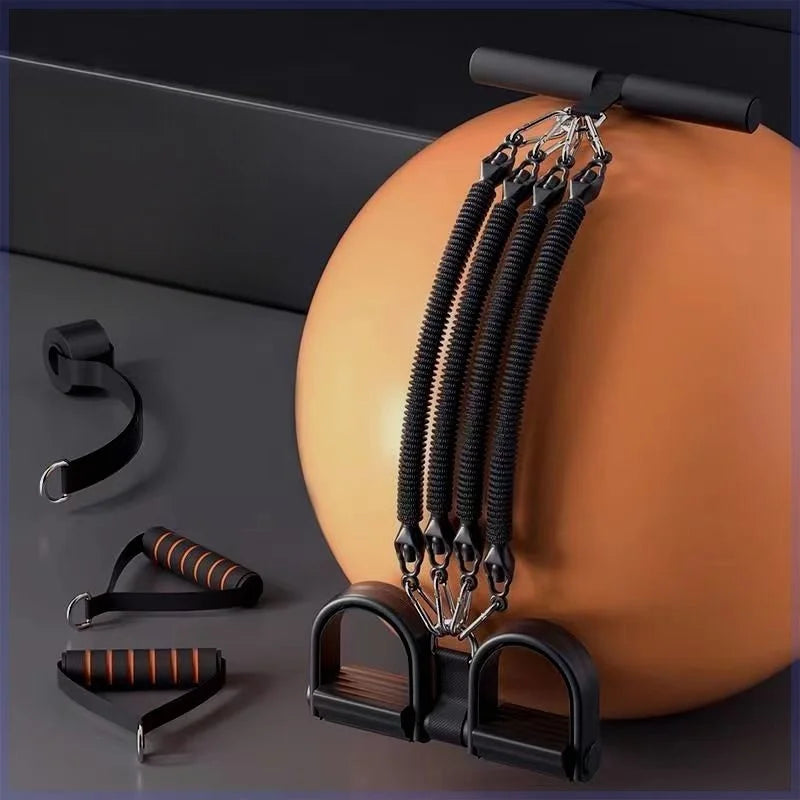
If a four-tube trainer matches your requirements, review the Pedal Resistance Band – 4-Tube Full Body Workout Trainer before purchasing.
Its listed package includes one pedal tension rope, two handles, and one door anchor. The approximate dimensions are 52 × 26.5 cm, and its construction combines TPE, elastic material, and foam. Available colors are black and purple.
Final Verdict: Is a 4-Tube Multifunctional Pedal Resistance Rope Worth Considering?
The best multifunctional pedal resistance rope is not necessarily the one with the most elastic tubes. It is the one that provides suitable resistance, comfortable contact points, secure connections, and useful exercise options for your training requirements.
A two-tube trainer can be a straightforward choice for basic routines. A six-tube model may offer additional configuration possibilities, provided its design supports them. Between these options, a well-specified four-tube resistance trainer offers a practical balance for people who want compact home workout equipment with multiple exercise applications.
The Kentdo Pedal Resistance Band – 4-Tube Full Body Workout Trainer combines four elastic tubes, foam-covered handles, foot pedals, and a compact design. Its listed construction and included accessories make it worth evaluating for home and travel workouts involving the arms, shoulders, waist, abdomen, and legs.
Before purchasing, compare the actual resistance characteristics, tube construction, pedal stability, dimensions, and connection design. Remember that proper technique and consistent training matter more than the number of tubes in your equipment.
If you are looking to make your home exercise routine more versatile without adding bulky gym equipment, explore the Kentdo multifunctional four-tube pedal resistance rope and check whether its specifications match your fitness goals.
For more practical beauty, wellness, and lifestyle ideas that complement everyday routines, visit the Beauty & Self-Care Blog.
Pillar Article: Adjustable Pedal Resistance Workout Equipment: Buying Guide & Exercises