

Nine Blade Fan: Does More Blades Mean Better Airflow?
A nine-blade fan can create smooth, consistent personal airflow, but more blades do not automatically mean stronger cooling. Blade count is only one part of fan performance. Blade pitch, motor design, speed, airflow output, noise, oscillation, and room size all influence how comfortable a fan feels in real use.
For a desk, bedroom, or small office, the better question is not simply “How many blades does the fan have?” It is whether the complete airflow system delivers the right balance of circulation, comfort, noise, portability, and cooling for your space.
Does a Nine Blade Fan Have Better Airflow?
A nine-blade fan does not inherently produce more airflow than a three-, five-, or seven-blade fan. Actual performance depends on how the blades are shaped and pitched, how quickly they rotate, the motor's characteristics, the fan housing, and the amount of air the system can move.

More blades do not automatically mean more airflow
Blade count describes how many blades share the work of moving air around the fan's rotor. Adding blades can change the way air is distributed and may contribute to a smoother-feeling stream, but it does not establish a universal airflow advantage.
A well-designed three-blade fan can move more air than a poorly designed nine-blade fan. Conversely, a nine-blade system can be useful when the goal is controlled personal airflow rather than maximum room-wide air movement.
How blade count interacts with blade pitch and motor power
Blade pitch is the angle at which each blade meets the air. A motor must provide enough rotational force to turn the blades while maintaining the desired speed. Increasing blade count without appropriately designing the motor, blade shape, spacing, and pitch can change the load on the system.
That is why comparing blade count in isolation can be misleading. A nine-blade fan should be evaluated as a complete airflow system rather than judged solely by its number of blades.
Why CFM is more useful than blade count alone
When manufacturers provide a reliable airflow rating such as cubic feet per minute (CFM), that measurement can be more informative for comparing air-moving performance than blade count alone. CFM indicates how much air the fan moves over a given period, while blade count describes one element of the mechanical design.
For personal cooling, however, maximum CFM is not always the only consideration. The distance between you and the fan, airflow direction, speed control, noise, and whether the air reaches the area where you actually sit can matter just as much.
What Does Fan Blade Count Actually Affect?
Airflow and air movement
Blade count can influence how air is accelerated and distributed through the fan. More blades may allow the airflow system to produce a different pressure and velocity profile, depending on the blade geometry and motor characteristics.
The practical takeaway is simple: blade count affects airflow behavior, but it should not be treated as a standalone measure of airflow strength.
Wind coverage and perceived cooling
Personal cooling depends on where the moving air reaches your body. A fan pointed directly toward a person can make a noticeable comfort difference even when it is not designed to circulate an entire room.
This distinction matters for hot desks, bedside tables, and compact offices. A personal air cooler fan can be useful when the objective is focused airflow around one person rather than replacing a larger room fan or air conditioner.
Noise level and smoothness of airflow
Blade count can influence the character of airflow and the sound produced as blades interact with surrounding air. More blades may contribute to a smoother airflow experience in some designs, but they do not guarantee quiet operation.
Motor quality, rotational speed, blade balance, housing design, and blade geometry can all affect perceived noise. For a bedroom or workspace, the actual noise rating and real-world operating behavior are more useful than blade count alone.
Energy efficiency and motor workload
Every fan design involves a balance between airflow, rotational speed, motor load, and electrical consumption. More blades can alter the aerodynamic load placed on a motor, so simply adding blades is not a shortcut to better efficiency.
For rechargeable fans, efficiency becomes especially relevant because lower power consumption can help extend usable operating time between charges.
Nine Blade Fan vs. Three, Five, and Seven Blade Fans
Three-blade fans
Three-blade designs are common because they can provide an effective balance of airflow, simplicity, and motor load. They are frequently used where moving a substantial volume of air is a priority.
Five-blade fans
Five-blade designs can provide a different balance between airflow distribution and smoothness. They are often found in household and personal fans where comfortable circulation is important.
Seven-blade fans
Seven-blade designs add additional blade surfaces and may be engineered for smoother or more distributed airflow. Their performance still depends heavily on blade geometry and motor characteristics.
Nine-blade fans
Nine-blade systems can be particularly relevant when manufacturers are designing for consistent personal airflow and a smoother-feeling breeze. A compact nine-blade fan may be well suited to a desk, bedside table, or other personal cooling position.
Quick comparison: blade count, airflow, noise, and comfort
| Blade count | What it may influence | What you should still check |
| Three blades | Efficient air movement and simple airflow design | CFM, blade pitch, motor, noise |
| Five blades | Balanced airflow distribution | Airflow rating, speed range, blade geometry |
| Seven blades | Potentially smoother or more distributed airflow | Motor performance, noise, wind coverage |
| Nine blades | Consistent personal airflow and potentially smoother air delivery | CFM, blade pitch, motor, speed, room suitability |
Are Nine Blade Fans Quieter?
Nine-blade fans are not automatically quieter than fans with fewer blades. A higher blade count can contribute to smoother airflow in a well-engineered design, but operating noise is affected by many other variables.
Why more blades can create smoother airflow
When blade geometry and spacing are carefully designed, additional blades can influence how air is continuously moved through the rotor. This may reduce the perception of abrupt airflow pulses and create a more consistent breeze.
That can be useful when a fan is positioned close to a person in a bedroom or workspace. Still, “nine blades” should not be interpreted as a guaranteed decibel rating.
Why motor, blade shape, balance, and speed also matter
A poorly balanced rotor can create vibration regardless of blade count. Higher rotational speeds can also increase aerodynamic and mechanical noise. Blade shape, housing clearance, motor construction, and the stability of the fan all contribute to the final sound profile.
How to evaluate published noise ratings
If a manufacturer publishes a noise figure, check whether it specifies the measurement conditions and operating speed. A fan measured at its lowest setting may sound very different from the same fan operating at maximum speed.
For sleep or focused work, look for a fan that offers controllable airflow rather than assuming that a particular blade count guarantees quiet operation.
Blade Count vs. Motor Power: Which Matters More?
How fan motor power affects performance
The motor supplies the rotational energy needed to move the blades. Motor characteristics influence how quickly the rotor can operate and how consistently it performs under load.
However, electrical power alone does not tell you how much useful airflow a fan will deliver. Two fans with similar power consumption can have different airflow results because their blades, housings, and aerodynamic designs differ.
Why stronger motors do not always mean better comfort
Maximum airflow can be useful when you need to move air across a large area, but extremely strong airflow may be unnecessary for someone sitting directly in front of a small personal fan.
For desk cooling, a moderate and controllable breeze may be more comfortable than maximum output. This is especially true when the fan operates close to your face or upper body.
How blade design and motor power work together
The motor and blades should be considered as one system. The motor needs to support the intended blade geometry and operating speed, while the blades need to convert rotational energy into useful airflow efficiently.
How Blade Pitch Changes Nine Blade Fan Performance
What is fan blade pitch?
Blade pitch refers to the angle of a fan blade relative to its plane of rotation. It influences how aggressively the blade interacts with air as it spins.

Higher vs. lower blade pitch
A higher-pitch blade can be designed to move air more aggressively, but it can also place greater aerodynamic demand on the motor. A lower-pitch design may prioritize smoother operation or lower resistance depending on the overall fan architecture.
There is no universally superior pitch. The appropriate design depends on the fan's intended speed, motor, blade size, housing, and cooling objective.
Why nine blades with different pitches can perform differently
Two nine-blade fans can feel completely different because blade count does not describe blade angle, surface area, curvature, or aerodynamic profile. This is one reason shoppers should resist judging fans by the number printed in the product title.
Fan Speed Settings and Oscillation: The Missing Pieces
Why multiple fan speed settings matter
Speed control lets you adjust airflow to match your environment. A low setting may be more appropriate for sleeping or concentrated desk work, while a stronger setting can help when the room feels particularly warm.
Adjustability can therefore have a bigger effect on everyday comfort than moving from one blade count to another.
How oscillation improves wind coverage
Oscillation changes the direction of airflow so that moving air reaches a broader area. This can be valuable for shared spaces or rooms where multiple people need air movement.
Static airflow vs. whole-room air circulation
A compact personal fan and a large room-circulation fan serve different purposes. Static airflow directed toward one person can provide focused comfort, while whole-room circulation requires sufficient airflow and coverage to move air throughout the space.
If your goal is to cool one workstation, a compact personal cooling device can be more practical than using a large fan simply to move air toward one chair.
Is a Nine Blade Fan Good for a Bedroom or Large Room?
A nine-blade fan can be a good fit for a bedroom, desk, office, or other personal space when its airflow, noise characteristics, and physical size match the intended use. Blade count alone does not determine whether it is appropriate for a room.
Best for bedrooms and personal spaces
Compact nine-blade designs can make sense when you want focused airflow near a bed or chair without occupying much floor or desk space. A quieter operating profile can also be useful during sleep or focused work, provided the specific model is genuinely quiet at the speed you intend to use.
Using a nine-blade fan in a living room or larger space
For a larger room, a small nine-blade personal fan may provide useful spot cooling but should not automatically be expected to cool the entire space. Room size, ceiling height, heat sources, insulation, humidity, and existing ventilation all influence how effective air movement will feel.
Match fan airflow and wind coverage to room size
For personal cooling, position the fan so its airflow reaches the person rather than simply circulating somewhere else in the room. For larger spaces, prioritize higher airflow capacity and broader coverage.
When a larger fan or higher-CFM model makes more sense
If the goal is substantial room-wide air circulation, a larger fan with a higher stated airflow capacity may be more appropriate. A compact personal air cooler is better viewed as a focused comfort device rather than a replacement for a whole-room HVAC system.
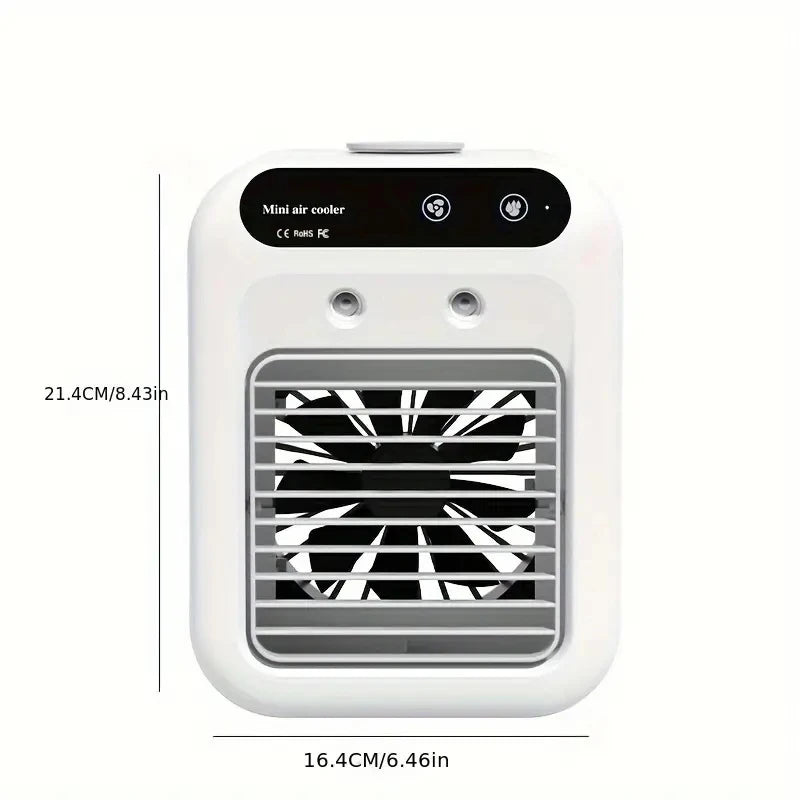
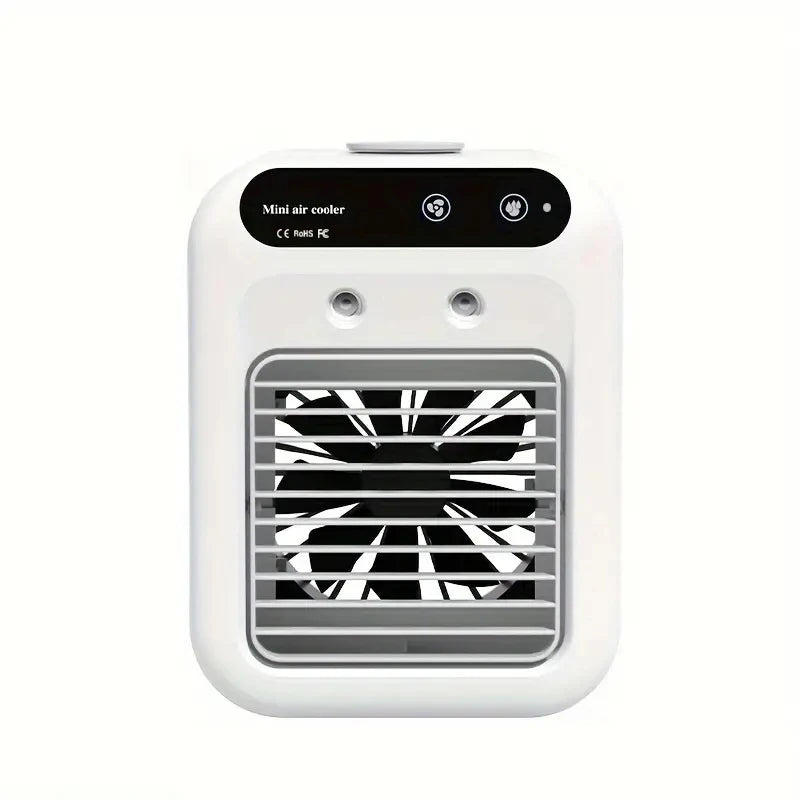
For smaller spaces, however, a rechargeable mini air cooler can offer a practical combination of compact size, focused airflow, and portability. The portable air cooler fan uses a nine-blade airflow system, a 500ml water reservoir, rechargeable power, and USB charging for desks, bedrooms, offices, and other personal spaces.

What to Look for When Choosing a Nine Blade Fan
Check CFM or stated airflow performance
Whenever available, use an airflow specification to compare actual air-moving capability rather than relying on blade count alone.
Compare blade pitch and blade design
Look for information about blade geometry, pitch, size, and construction. These details can help explain why two fans with the same number of blades perform differently.
Evaluate motor power and efficiency
Consider how the motor supports the blade system and whether the fan is intended for continuous operation, personal cooling, or larger-scale circulation.
Look for useful fan speed settings
Multiple settings make it easier to tailor airflow for work, relaxation, sleeping, or warmer conditions.
Consider oscillation and wind coverage
If more than one person needs airflow, or if you want to circulate air through a larger area, oscillation can be more useful than simply increasing blade count.
Check noise level for bedrooms and workspaces
Do not assume that nine blades automatically means quiet. Check the manufacturer's noise information when available and consider the speed at which you plan to operate the fan.
Match the fan to your room size and cooling goal
Choose a personal fan for focused comfort and a larger high-airflow model when your goal is broad room circulation. For other everyday devices, you can also explore the broader Lifestyle collection for compact products designed around practical daily use.
A portable water air cooler can add another dimension to personal comfort by combining airflow with a water reservoir. The featured model holds up to 500ml and is rechargeable through USB, making it suitable when you want portable cooling without remaining next to a wall outlet.
Nine Blade Fan: Pros and Cons at a Glance
Potential advantages
- Can provide consistent, comfortable personal airflow when properly engineered.
- May support a smoother-feeling breeze depending on blade geometry and motor design.
- Can work well in compact personal spaces when paired with an appropriately sized housing.
- May be useful for desks, bedrooms, offices, and other areas where focused cooling is the priority.
Potential limitations
- More blades do not guarantee higher CFM.
- Blade count alone cannot establish noise level.
- A compact nine-blade fan may not provide enough airflow for large-room circulation.
- Motor power, blade pitch, speed, and housing design can make a larger difference than blade count.
Who should consider one?
A nine-blade fan is worth considering if you want focused personal airflow and prefer to evaluate comfort as a complete system rather than chasing maximum blade count. It can be particularly practical for people cooling a desk, bedside area, small office, or other personal zone.
Frequently Asked Questions About Nine Blade Fans
Does a nine blade fan have better airflow than a three or five blade fan?
Not necessarily. A nine-blade fan can provide smooth and consistent airflow, but actual airflow depends on blade pitch, motor performance, blade geometry, housing design, and operating speed. CFM or another reliable airflow specification is more useful for direct performance comparisons.
Are nine blade fans quieter than fans with fewer blades?
Not automatically. More blades can contribute to smoother airflow in some designs, but motor noise, vibration, blade balance, speed, and housing construction also affect sound. Check the actual noise specification when one is provided.
What does the number of fan blades actually affect?
Blade count can influence airflow distribution, aerodynamic loading, perceived smoothness, and the way air moves through the fan. It does not independently determine cooling power, noise, or energy efficiency.
Is blade count or motor power more important for fan performance?
Neither should be evaluated in isolation. Motor performance and blade design must work together. A powerful motor cannot compensate for inefficient blade geometry, while a sophisticated blade system still needs an appropriately matched motor.
Is a nine blade fan good for cooling a bedroom or large room?
A nine-blade fan can be useful for focused bedroom or personal cooling, particularly when positioned near the person who needs airflow. For large-room circulation, choose a model with airflow capacity and coverage appropriate to the room rather than relying on blade count.
Conclusion: Look Beyond the Blade Count
A nine-blade fan can be an effective personal cooling solution, but the number nine is not a performance guarantee. The best fan depends on how blade count interacts with blade pitch, motor design, airflow output, speed settings, noise, oscillation, and room size.
If you need focused cooling for a hot desk, bedroom, office, or small space, a compact nine-blade system can be a sensible option—especially when portability and rechargeable operation matter. The portable air cooler fan combines nine-blade airflow with a 500ml water capacity, quiet operation, rechargeable battery power, USB charging, and a compact design intended for personal spaces.

Ultimately, choose the fan based on the cooling problem you are trying to solve. For personal comfort, the right combination of airflow, controllability, noise, size, and placement is usually more meaningful than blade count by itself. For more practical device-focused ideas, browse the Body Care and Health Devices collection or continue exploring the Beauty & Self-Care Blog.
Pillar Article: Best Bedroom Cooling Devices for 2026: Compare Your Options













