
Pedal Resistance Band Exercises for Abs: 8 Beginner-Friendly Moves to Strengthen Your Core at Home
Building stronger abdominal muscles at home does not require a bulky gym setup, expensive machines, or a collection of heavy weights. With the right equipment, you can perform effective core strengthening exercises in a small space. Pedal resistance band exercises for abs offer a convenient way to introduce resistance into familiar movements using foot pedals, elastic tubes, and comfortable handles.
Unlike conventional loop bands, a pedal resistance band lets you anchor resistance through your feet while controlling tension with your hands. This setup creates opportunities for seated crunches, controlled rotations, alternating leg movements, and core stabilization exercises.
Whether you are new to strength training or looking for portable workout equipment for small spaces, the following eight exercises can help you train your rectus abdominis, obliques, and deeper core stabilizers. You will also learn how to position the equipment, choose appropriate resistance, and build a practical 10–15-minute home ab workout.
What Are Pedal Resistance Bands and How Do They Work for Abs?
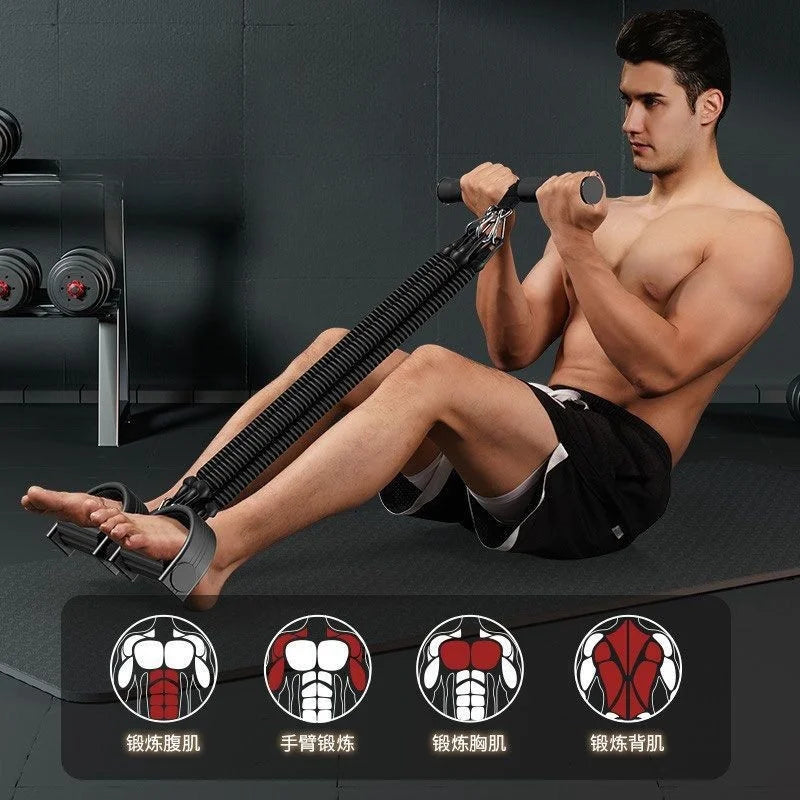
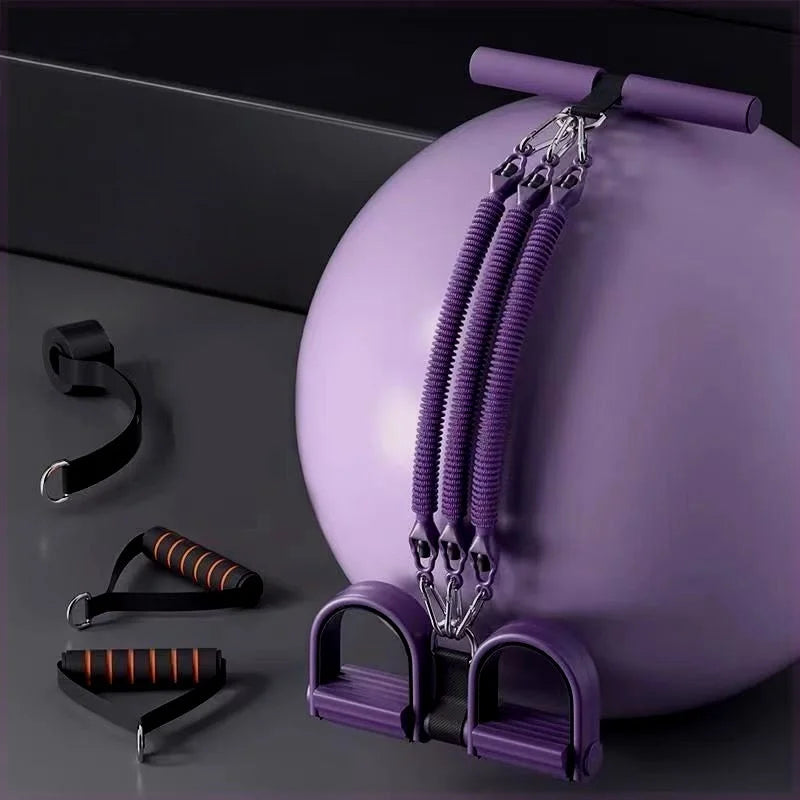
A pedal resistance band is a compact exercise tool that combines elastic resistance tubes, foot pedals, and handles. Your feet provide an anchor while your hands control the tension, allowing you to perform pulling, stretching, and abdominal movements. For core training, this arrangement supports controlled abdominal flexion, gentle rotation, alternating leg movements, and stabilization exercises without requiring traditional gym equipment.
Understanding Foot Pedals, Resistance Tubes, and Handles
Most pedal resistance trainers have three main components:
- Foot pedals: These provide a place to position your feet and create an anchor point during seated and lying exercises.
- Resistance tubes: Elastic tubes stretch when you move your arms or legs, creating resistance throughout the movement.
- Handles: These allow you to grip and control the resistance while performing pulling, curling, and rotational movements.
A four-tube system offers multiple elastic resistance elements for different pulling and stretching movements. The amount of resistance you experience depends on the equipment design, tube condition, and how far the elastic material is stretched.
Can You Use Pedal Resistance Bands for Abdominal Exercises?
Yes. Pedal resistance bands can support abdominal exercises by combining foot-anchored resistance with controlled upper-body and lower-body movements. You can use them for seated crunches, cross-body rotations, alternating knee lifts, and core stabilization holds. These movements train different parts of your abdominal musculature while allowing you to adjust your range of motion and resistance.
The key is to keep your torso controlled rather than relying on your arms to pull the handles. Your abdominal muscles should remain engaged throughout each repetition.
Which Abdominal Muscles Do Pedal Resistance Bands Target?
Understanding your core muscles helps you select exercises that serve different training purposes.
- Rectus abdominis: Often called the six-pack muscle, it runs vertically along the front of the abdomen. It contributes to spinal flexion, including the movement performed during crunches.
- External and internal obliques: Located along the sides of your abdomen, these muscles help rotate and stabilize your trunk. They are involved in Russian twists and cross-body crunches.
- Transverse abdominis: This deeper abdominal muscle wraps around the trunk and contributes to abdominal bracing and trunk stability.
- Other core stabilizers: Muscles around your hips, pelvis, and spine help maintain alignment while your arms and legs move against resistance.
Dynamic movements such as crunches emphasize abdominal flexion, while anti-rotation holds and dead bug variations challenge your ability to stabilize the trunk.
How to Set Up Your Pedal Resistance Band Before Training
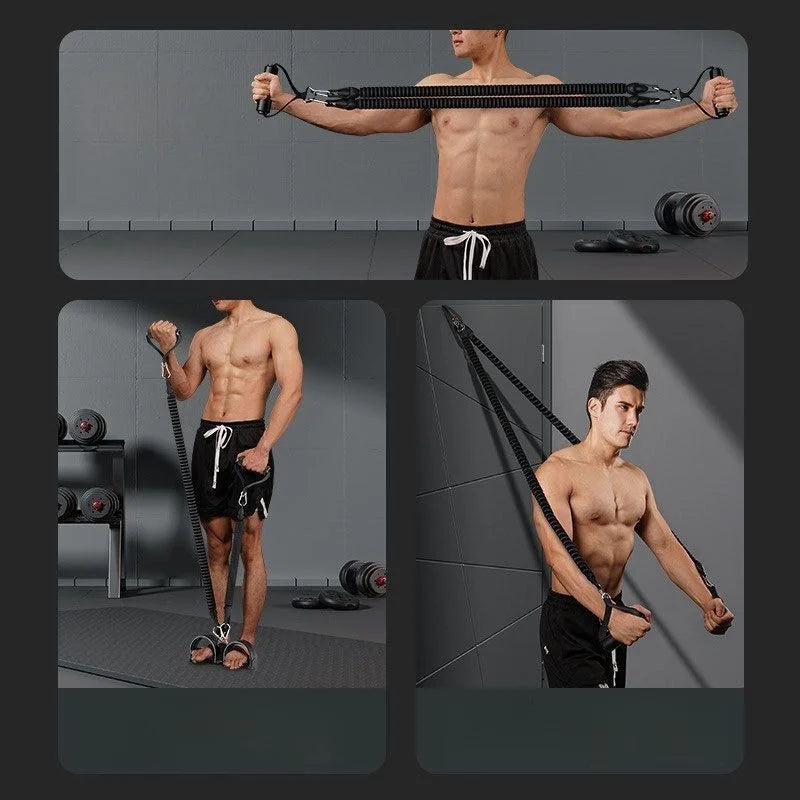
Before starting, take a moment to establish a comfortable and secure setup. Correct positioning makes each movement easier to control.
- Inspect the equipment: Check the resistance tubes, connections, handles, and pedals for cracks, tears, or damage.
- Position your feet: Place both feet securely in the pedals, ensuring they cannot easily slip out during movement.
- Grip the handles: Hold the handles firmly without squeezing excessively.
- Establish starting tension: Begin with light resistance that allows you to move smoothly without leaning or straining.
- Set your posture: Keep your spine in a comfortable neutral position and gently brace your abdominal muscles.
- Test the movement: Perform a few small repetitions to confirm that the pedals remain secure and the resistance is manageable.
If you do not already own a suitable trainer, a compact option such as the Pedal Resistance Band – 4-Tube Full Body Workout Trainer provides foot pedals, elastic resistance tubes, and handles for home exercise routines.
8 Best Pedal Resistance Band Exercises for Abs
The following exercises are organized by their primary muscle emphasis. Start with light resistance and prioritize controlled movement over stretching the tubes as far as possible.
Group 1: Pedal Resistance Band Exercises for the Rectus Abdominis
These first three movements emphasize the front abdominal muscles through controlled trunk flexion and alternating leg movements.
1. Seated Resistance Band Abdominal Crunch
Target muscles: Rectus abdominis.
Setup: Sit upright with both feet securely positioned in the pedals. Hold the handles near chest level and establish moderate, comfortable tension.
How to perform it:
- Sit with your knees slightly bent and your feet secured in the pedals.
- Hold both handles in front of your chest.
- Gently brace your abdominal muscles.
- Slowly curl your upper torso forward without rounding excessively through your lower back.
- Pause briefly when you feel your abdominal muscles contract.
- Return slowly to your starting position while maintaining control of the resistance.
Breathing: Exhale during the forward crunch and inhale while returning.
Sets and repetitions: 2–3 sets of 10–12 repetitions.
Rest: 30–45 seconds.
Beginner modification: Reduce resistance and use a smaller range of motion. Avoid pulling your body forward with your arms.
2. Supine Pedal Resistance Band Crunch
Target muscles: Rectus abdominis.
Setup: Lie on your back with your knees bent and both feet secured in the pedals. Hold the handles near your shoulders.
How to perform it:
- Lie comfortably on an exercise mat with your knees bent.
- Secure your feet in the pedals and hold both handles.
- Brace your abdominal muscles before moving.
- Gently lift your shoulder blades from the mat.
- Keep your neck relaxed and avoid pulling your head forward.
- Lower your shoulders slowly while maintaining controlled resistance.
Breathing: Exhale as your shoulders lift and inhale as you lower.
Sets and repetitions: 2 sets of 10–12 repetitions.
Rest: 30–45 seconds.
Beginner modification: Perform a partial crunch with minimal resistance. Stop before your lower back or neck becomes uncomfortable.
3. Seated Alternating Knee-to-Chest Resistance Pull
Target muscles: Rectus abdominis and hip flexors, with core stabilization.
Setup: Sit with both feet secured in the pedals and hold the handles firmly. Use light tension so you can move one leg at a time without losing your posture.
How to perform it:
- Sit upright with both feet positioned securely in the pedals.
- Hold the handles and gently brace your abdomen.
- Slowly draw one knee toward your chest.
- Return the foot under control to its starting position.
- Repeat the movement with the opposite leg.
- Continue alternating while keeping your torso stable.
Breathing: Exhale while raising each knee and inhale while lowering it.
Sets and repetitions: 2 sets of 8–10 repetitions per leg.
Rest: 30–45 seconds.
Beginner modification: Lift each knee only a short distance and reduce resistance if maintaining an upright posture feels difficult.
Group 2: Pedal Resistance Band Exercises for the Obliques
Your obliques help rotate your torso and resist unwanted movement. The next two exercises introduce rotational control without requiring excessive twisting.
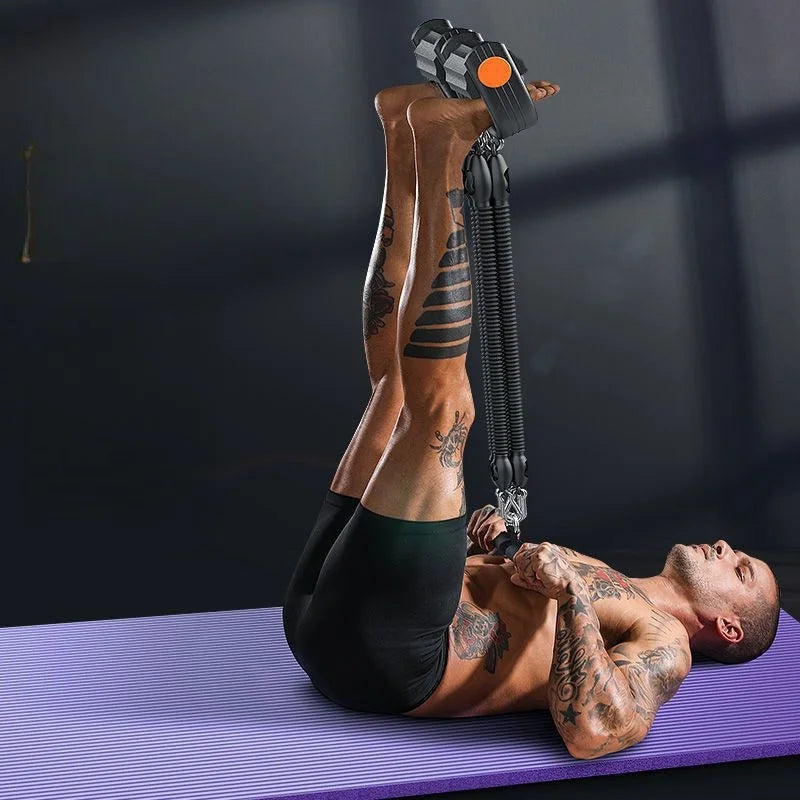
4. Seated Resistance Band Russian Twist
Target muscles: External and internal obliques.
Setup: Sit with your knees bent, feet secured in the pedals, and both handles held together in front of your torso.
How to perform it:
- Sit upright with your feet securely positioned.
- Hold both handles together near your chest.
- Brace your abdominal muscles.
- Gently rotate your upper torso toward one side.
- Return to the center and rotate toward the opposite side.
- Keep your hips stable and avoid forcing the rotation.
Breathing: Exhale during each rotation and inhale as you return to the center.
Sets and repetitions: 2 sets of 8–10 repetitions per side.
Rest: 30–45 seconds.
Beginner modification: Keep your feet grounded in the pedals, reduce tension, and use a small rotational range.
5. Alternating Seated Cross-Body Resistance Crunch
Target muscles: External and internal obliques, with assistance from the rectus abdominis.
Setup: Sit with both feet anchored in the pedals and hold the handles at chest height.
How to perform it:
- Sit upright and establish light resistance.
- Brace your abdomen before starting.
- Gently bring one shoulder toward the opposite knee.
- Return to the starting position without leaning backward.
- Repeat toward the other side.
- Alternate sides while keeping the movement controlled.
Breathing: Exhale during the cross-body contraction and inhale while returning.
Sets and repetitions: 2 sets of 8–10 repetitions per side.
Rest: 30–45 seconds.
Beginner modification: Reduce the range of motion. Your shoulder does not need to touch your knee.
Group 3: Pedal Resistance Band Exercises for Deep Core Stabilization
These exercises focus on keeping your torso stable while your arms or legs move. They are useful for developing controlled abdominal bracing and coordination.
6. Seated Resistance Band Anti-Rotation Hold
Target muscles: Transverse abdominis, obliques, and other core stabilizers.
Setup: Sit upright with your feet anchored in the pedals. Hold both handles in front of your chest with manageable, symmetrical resistance.
How to perform it:
- Sit tall and secure your feet in the pedals.
- Hold the handles in front of your chest.
- Brace your abdominal muscles as though preparing for a gentle push.
- Maintain a steady torso without twisting or leaning.
- Hold the contraction while breathing normally.
- Relax gradually before repeating.
Breathing: Breathe steadily throughout the hold without holding your breath.
Sets and duration: 2–3 sets of 15–20-second holds.
Rest: 30–45 seconds.
Beginner modification: Start with 10-second holds and lighter resistance.
7. Pedal Resistance Band Dead Bug Variation
Target muscles: Transverse abdominis, rectus abdominis, and deep core stabilizers.
Setup: Lie on your back with your knees raised in a comfortable tabletop position. Secure the pedals on your feet and hold the handles with your arms positioned comfortably.
How to perform it:
- Lie on your back and establish a stable tabletop position.
- Hold the handles with enough tension to maintain control.
- Brace your core before moving either leg.
- Slowly extend one leg while keeping the other leg stable.
- Return to the starting position under control.
- Repeat with the opposite leg while maintaining a comfortable lower-back position.
Breathing: Exhale during leg extension and inhale as the leg returns.
Sets and repetitions: 2 sets of 8 repetitions per leg.
Rest: 30–45 seconds.
Beginner modification: Perform alternating heel taps with minimal resistance and a smaller movement range.
8. Seated Alternating Leg Extension with Core Brace
Target muscles: Transverse abdominis, rectus abdominis, and hip stabilizers.
Setup: Sit upright with both feet securely positioned in the pedals. Hold the handles at a comfortable height.
How to perform it:
- Sit tall with both knees bent and your feet anchored.
- Brace your abdomen and hold the handles steadily.
- Slowly extend one leg forward against manageable resistance.
- Return the leg without allowing your torso to lean backward.
- Repeat with the opposite leg.
- Continue alternating while maintaining steady core engagement.
Breathing: Exhale while extending your leg and inhale as you return.
Sets and repetitions: 2 sets of 10 repetitions per leg.
Rest: 30–45 seconds.
Beginner modification: Use partial leg extensions and lighter tension to maintain stable posture.
Featured Equipment: Pedal Resistance Band for Home Core Training
If you want one compact piece of equipment for these movements, consider a trainer that combines foot pedals, elastic tubes, and handles. The Pedal Resistance Band – 4-Tube Full Body Workout Trainer is designed for pulling and stretching exercises that involve the arms, shoulders, waist, abdomen, and legs.
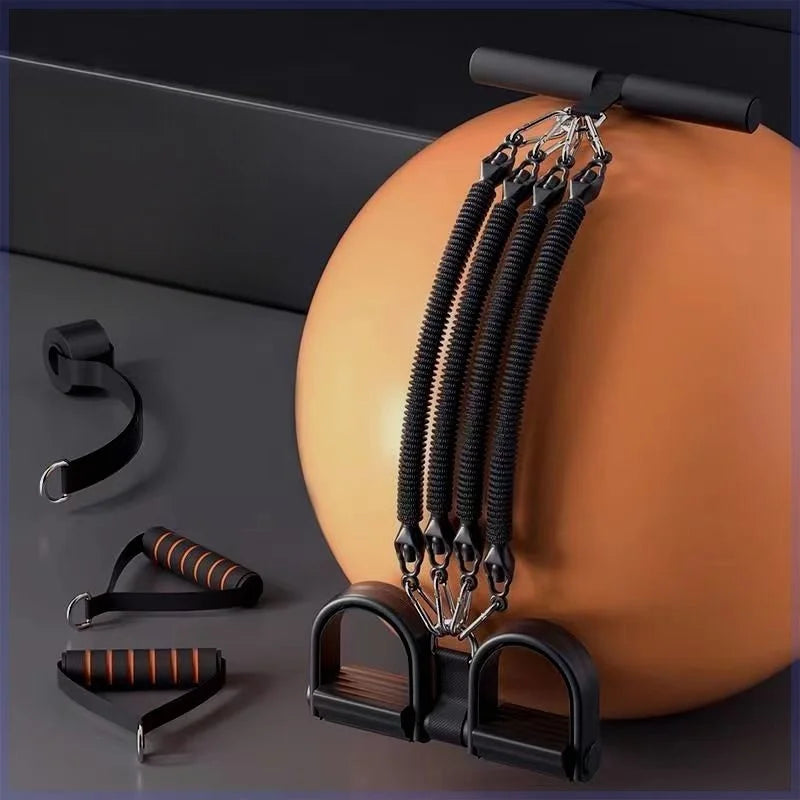
Its listed specifications include:
- Design: Four-tube pedal resistance system.
- Materials: TPE, elastic material, and foam.
- Approximate size: 52 × 26.5 cm.
- Available colors: Black and purple.
- Included accessories: One pedal tension rope, two handles, and one door anchor.
- Intended training areas: Arms, shoulders, waist, abdomen, and legs.
The compact design makes it suitable for people who want to keep their home workout equipment easy to store or carry. Its included door anchor may also support compatible pulling exercises when installed according to the manufacturer's instructions. Always verify that the anchor is secure before using it.
It is an optional equipment choice rather than a requirement for strengthening your abdominal muscles. Bodyweight movements can also provide effective core training.
How to Choose the Right Resistance Level for Each Exercise
For most beginners, approximately 8–12 controlled repetitions per set provide a practical starting point for dynamic movements. Stabilization exercises can begin with 10–20-second holds.
Choose resistance that allows you to complete every repetition with stable posture and controlled movement. If you cannot finish the movement without leaning backward, jerking the handles, or losing your foot position, reduce the tension.
- Beginner: Light resistance, smaller movement ranges, and 8–10 repetitions.
- Developing: Moderate resistance and 10–12 controlled repetitions.
- Intermediate: Gradually increase resistance, repetitions, or hold duration while maintaining proper technique.
Do not stretch elastic tubes beyond their manufacturer's recommended limits. More tension does not automatically produce better training results.
How to Build a 10–15-Minute Pedal Resistance Band Ab Workout
You do not need to perform all eight exercises in one session. A short, balanced routine can introduce abdominal flexion, rotational movement, and deep core stabilization without overwhelming beginners.
Step 1: Warm Up Your Core for 2 Minutes
Begin with gentle movements to prepare your body for resistance training.
- Perform gentle standing or seated torso rotations.
- Practice pelvic tilts to become familiar with controlling your lower back.
- March slowly in place to increase movement and circulation.
- Take several controlled breaths while gently engaging your abdomen.
Keep the warm-up comfortable and avoid forcing any movement.
Step 2: Follow This Beginner 10–15-Minute Ab Routine
After warming up, follow this five-exercise sequence. Complete the recommended sets and rest briefly between exercises.
| Exercise | Sets | Repetitions or Duration | Main Focus |
| Seated Resistance Band Abdominal Crunch | 2 | 10–12 | Rectus abdominis |
| Seated Alternating Knee-to-Chest Resistance Pull | 2 | 8 per leg | Front core |
| Seated Resistance Band Russian Twist | 2 | 8 per side | Obliques |
| Seated Resistance Band Anti-Rotation Hold | 2 | 15 seconds | Deep core stabilization |
| Pedal Resistance Band Dead Bug Variation | 2 | 8 per leg | Deep core control |
This routine should take approximately 10–15 minutes, including short rests and transitions. Adjust the number of repetitions and rest periods according to your fitness level.
Step 3: Progress from Beginner to Intermediate
As your technique improves, gradually increase the challenge rather than immediately choosing stronger resistance.
- Beginner: Start with one or two sets, light resistance, and controlled movements.
- Developing: Progress toward two or three sets while maintaining good posture and breathing.
- Intermediate: Gradually increase resistance, movement difficulty, or hold duration while preserving control.
Change one training variable at a time. For example, increase your repetitions before increasing resistance. This makes it easier to understand how your body responds to the added workload.
How Often Should You Train Your Abs with Pedal Resistance Bands?
For beginners, two or three nonconsecutive core-training sessions per week can be a reasonable starting point. Allow recovery between challenging sessions, particularly when your abdominal muscles feel tired or sore.
Your ideal frequency depends on your overall exercise routine, training experience, and recovery. You can also include lighter bodyweight core exercises on other days if they do not interfere with recovery.
For additional equipment-specific training ideas, explore this four-tube pedal resistance trainer as an example of compact equipment designed for more than abdominal movements.
Pedal Resistance Bands vs. Traditional Resistance Bands and Ab Wheels
Pedal resistance bands, loop bands, conventional resistance tubes, and ab wheels all provide different ways to challenge your muscles. The best option depends on the exercises you want to perform and how you prefer to train.
Key Differences in Setup, Movement, and Core Training
| Equipment | Setup and Anchoring | Movement Patterns | Seated Exercises | Best Application |
| Pedal resistance bands | Foot pedals with attached resistance tubes and handles | Seated abdominal flexion, leg extensions, rotation, and stabilization | Well suited to supported seated movements | Compact home workouts combining arm and leg resistance |
| Loop resistance bands | Continuous elastic loop placed around the limbs or body | Hip resistance, lateral movement, and stabilization | Possible depending on exercise and loop size | Lower-body activation and bodyweight resistance exercises |
| Tube resistance bands | Elastic tubing with handles, sometimes including a door anchor | Pulling, pressing, rotation, and upper-body resistance | Possible with a suitable secure anchor | Versatile full-body resistance training |
| Ab wheels | Rolling wheel with two handles | Forward rollouts and anti-extension stabilization | Not generally designed for seated exercises | More demanding bodyweight core stability exercises |
When Should You Choose Pedal Resistance Bands for Core Workouts?
Pedal resistance bands can be useful when you prefer foot-anchored resistance, supported seated movements, and a compact setup. They offer a practical way to coordinate upper-body and lower-body movements while keeping your workout equipment relatively simple.
They may be particularly convenient for people who:
- Want home workout equipment without weights.
- Have limited storage space for exercise equipment.
- Prefer seated resistance exercises.
- Want to combine arm and leg movements with core stabilization.
- Need lightweight equipment that is easier to carry when traveling.
If you are comparing different home fitness accessories, the Body Care and Health Devices collection provides another place to explore compact wellness and exercise-related equipment.
Can Pedal Resistance Bands Replace Traditional Core Exercises?
No single piece of equipment needs to replace every core exercise. Pedal resistance bands can complement bodyweight movements such as planks, dead bugs, bird dogs, and modified side planks.
Each exercise emphasizes different movement patterns. Crunches train trunk flexion, anti-rotation exercises challenge rotational control, and planks develop the ability to maintain a stable trunk against movement.
Combining these methods can create a more balanced core routine than relying on one piece of equipment alone.
Common Mistakes to Avoid When Using Pedal Resistance Bands for Abs
Good exercise technique matters more than the amount of resistance you use. Watch for these common problems when performing pedal resistance band exercises.
Allowing Your Lower Back to Arch Excessively
Excessive lower-back arching can occur when your abdominal muscles are not adequately engaged or when you extend your legs farther than you can comfortably control.
Maintain a comfortable neutral spinal position and shorten the movement if your lower back begins to arch excessively. During lying exercises, avoid forcing your back into an uncomfortable position.
Pulling the Handles Instead of Engaging Your Core
It is easy to rely on your arms when the resistance tubes become challenging. However, this can reduce the intended emphasis on your abdominal muscles.
Before every repetition, gently brace your abdomen. Keep your arms controlled and coordinate your torso movement with your breathing rather than pulling the handles abruptly.
Releasing Resistance Too Quickly
Elastic resistance creates tension throughout the movement, including when you return to your starting position. Allowing the tubes to snap back can cause sudden movements and make your exercise less controlled.
Slowly return your hands, legs, and torso to their starting positions. Maintain control of the resistance from beginning to end.
Positioning Your Feet Incorrectly in the Pedals
Loose or uneven foot placement can make it difficult to maintain stable resistance. Before beginning, check that both feet are positioned securely and that the pedals are not slipping.
Recheck your foot position whenever you change exercises, particularly when moving from seated to lying movements.
Starting with Too Much Resistance
Excessive resistance may cause you to shorten your range of motion, lean backward, or use momentum to complete repetitions.
Start with manageable tension. Increase resistance only when you can perform your current exercise with stable posture, controlled breathing, and consistent technique.
Holding Your Breath During Abdominal Contractions
Some beginners unintentionally hold their breath when an exercise becomes difficult. This can make it harder to maintain a comfortable training rhythm.
Exhale during the more demanding part of each movement and inhale as you return. During stabilization holds, breathe steadily rather than holding your breath.
Pedal Resistance Band Safety Tips for Home Ab Workouts
Resistance equipment is simple to use, but elastic tubes store tension. Proper inspection, positioning, and movement control are important for safer home training.
Inspect Resistance Tubes and Foot Pedals Before Every Workout
Before each session, check for:
- Cracks, cuts, or tears in the elastic tubes.
- Loose or damaged connections between tubes and handles.
- Worn or unstable foot pedals.
- Loose handles or damaged foam grips.
- Signs that the elastic material has become excessively stretched or weakened.
Do not use damaged equipment. Replace worn components according to the manufacturer's recommendations rather than attempting to continue training with compromised elastic tubes.
Keep Your Feet Secure and Maintain Controlled Tension
Position your feet properly before stretching the tubes. Avoid sudden movements, excessive stretching, or pulling at angles that could cause the pedals to slip.
Keep enough space around your workout area to move comfortably. When using a door anchor, follow the manufacturer's installation instructions and verify that the door and anchor are secure before applying tension.
Use Proper Breathing and Stop if Sharp Pain Occurs
Muscular effort during exercise is expected, but sharp, sudden, or unusual pain is not something to push through. Stop the movement if pain occurs.
If discomfort persists or you have concerns about an existing injury, seek guidance from a qualified healthcare professional before continuing resistance training.
Adapt Exercises to Your Fitness Level
Not every movement is suitable for every person. If you are new to strength training, begin with lighter resistance, smaller movement ranges, and fewer repetitions.
People with existing injuries, movement limitations, or difficulty maintaining balance may benefit from individualized guidance from a qualified exercise or healthcare professional.
How to Combine Pedal Resistance Band Training with Other Core Exercises
Pedal resistance bands can be one part of a broader home strength-training routine. Combining resistance exercises with bodyweight movements helps introduce different movement patterns and develop more balanced core control.
Combine Resistance Training with Bodyweight Core Exercises
Consider adding these movements to your weekly routine:
- Dead bugs: Train abdominal stabilization while alternating arm and leg movements.
- Modified planks: Challenge your ability to maintain a stable trunk.
- Bird dogs: Develop coordination and trunk stability while extending opposite arms and legs.
- Side planks: Challenge the obliques and lateral core stabilizers.
- Pelvic tilts: Help you practice controlled pelvic positioning.
Choose variations that match your current ability. You do not need to perform every movement in the same session.
Explore More Full-Body Resistance Band Exercises
Core training is only one part of a complete strength routine. You can also work your shoulders, arms, back, and legs with resistance-based movements.
Explore more home wellness and exercise-related guides to discover additional ways to organize your fitness routine. Combining abdominal exercises with upper-body and lower-body resistance training can help you build a more balanced home workout.
If you want to continue with equipment-specific movements, a four-tube pedal resistance trainer can support a variety of pulling and stretching exercises beyond the core-focused movements covered in this guide.
Why Progressive Resistance Training Matters
Progressive resistance training means gradually increasing the challenge placed on your muscles as your ability improves. This does not mean increasing tension every workout.
Instead, focus on:
- Improving movement control and consistency.
- Gradually increasing repetitions when your technique remains stable.
- Extending stabilization holds as your endurance improves.
- Increasing resistance in small, manageable steps.
- Allowing adequate recovery between challenging sessions.
Consistency and proper technique are more useful starting points than chasing maximum resistance or performing large numbers of repetitions.
Conclusion: Build a Stronger Core with Pedal Resistance Band Exercises
Pedal resistance band exercises for abs provide a convenient way to introduce resistance into home core training without relying on bulky gym equipment. By combining foot pedals, elastic tubes, and handles, this compact equipment supports seated crunches, controlled rotations, alternating leg movements, and stabilization exercises.
The eight exercises in this guide target the rectus abdominis, internal and external obliques, transverse abdominis, and supporting core muscles. Start with manageable resistance, secure your feet properly, maintain controlled movements, and coordinate your breathing throughout each repetition.
Remember that strengthening abdominal muscles does not selectively burn belly fat. Overall body composition is influenced by broader factors, including physical activity, nutrition, and lifestyle habits.
You can begin with the simple 10–15-minute routine and gradually progress as your technique and endurance improve. If you want a compact option for resistance training at home or while traveling, consider exploring the Pedal Resistance Band – 4-Tube Full Body Workout Trainer as one possible addition to your exercise equipment.
Pillar Article: Adjustable Pedal Resistance Workout Equipment: Buying Guide & Exercises