

Portable Water Air Cooler: 2026 Buying Guide & Best Uses
A portable water air cooler can be a practical way to improve personal comfort when a desk gets too hot, a bedroom feels stuffy, or a small workspace needs more airflow without a bulky appliance. But these devices are not miniature versions of portable air conditioners. Their performance depends heavily on humidity, airflow, room size, ventilation, water capacity, and how close you are to the cooling output.
This guide explains how portable water air coolers work, where they perform best, where they struggle, and what to compare before buying. It also shows when a rechargeable mini air cooler makes more sense than a conventional fan—and when a portable AC is the better choice.
Portable Water Air Cooler at a Glance
A portable water air cooler uses airflow and water-based evaporative cooling to create a more refreshing stream of air. Compact models are generally best viewed as personal cooling devices, rather than replacements for whole-room air conditioning.
Quick Comparison: Water Air Cooler vs Portable AC
- Cooling method: A water air cooler uses evaporation and airflow; a portable AC uses a refrigeration cycle to remove heat from the air.
- Best for: Water coolers suit personal cooling, desks, bedrooms, offices, and small areas where focused airflow is useful. Portable AC units are better when substantial room-temperature reduction is the priority.
- Humidity: Evaporative cooling generally performs better in drier conditions. Portable AC units can be used across a much broader range of humidity conditions.
- Ventilation: Evaporative coolers benefit from appropriate air exchange. Portable AC units require heat exhaust through their vent system.
- Portability: Mini water coolers are usually easier to move and position close to one person.
- Power: Rechargeable and USB-powered models can provide flexibility away from a fixed outlet.
- Maintenance: Water reservoirs and cooling media need regular cleaning and care.
Best Use Cases by Cooler Type
- Personal air cooler: Desk, bedside table, home office, reading area, or other one-person spaces.
- Larger evaporative cooler: Larger open areas where stronger airflow and greater water capacity are available.
- Portable AC: Enclosed rooms where meaningful room-temperature reduction is required.
- Traditional rechargeable fan: Situations where you want airflow without adding moisture.
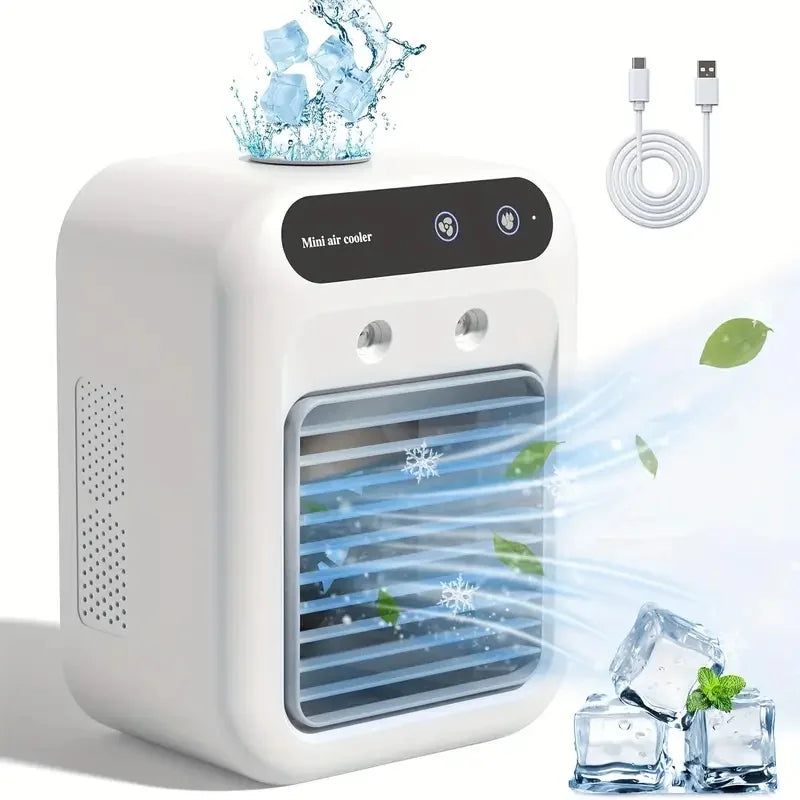
For focused cooling in a compact space, the KentDO portable air cooler fan combines a rechargeable battery, USB charging, a 500ml water reservoir, and a nine-blade airflow design. Its specifications make it more naturally suited to personal cooling than to conditioning an entire large room.
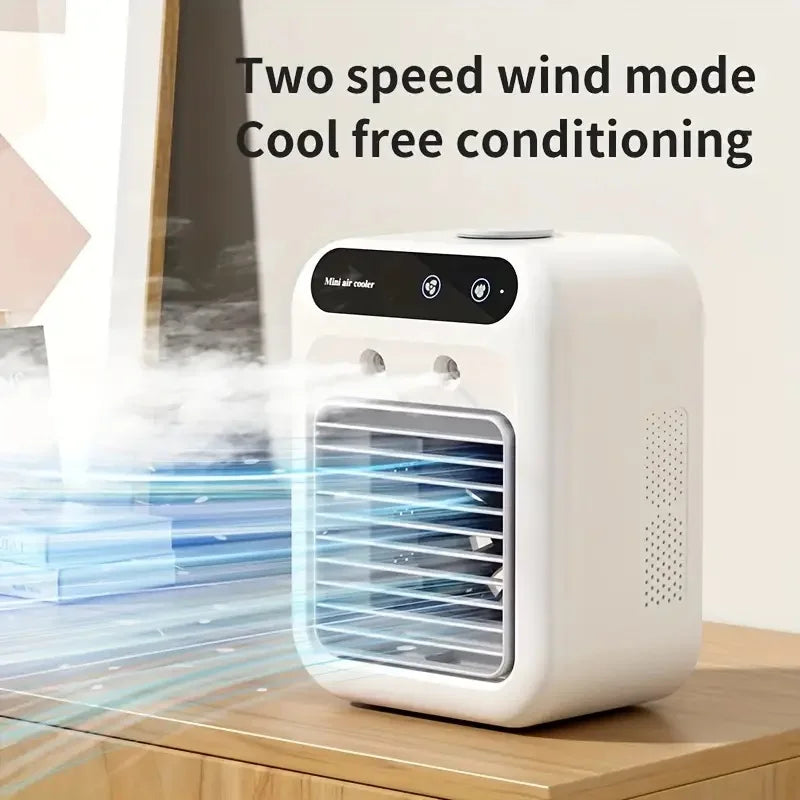
What Is a Portable Water Air Cooler?
A portable water air cooler is a compact cooling appliance that combines a fan with a water-based cooling system. You fill its reservoir with water, and the device moves air through or across a water-moistened cooling medium. As water evaporates, it can absorb heat from the surrounding air, producing an airflow that feels cooler under suitable environmental conditions.
You may also see these products described as portable evaporative coolers, mini air coolers, personal air coolers, water-cooled fans, or swamp coolers. These terms overlap, although product construction and cooling capacity can vary considerably.
How Evaporative Cooling Works
Evaporative cooling depends on water changing from liquid to vapor. The evaporation process consumes heat energy, while the fan moves air across the cooling area and toward the user.
The important limitation is that evaporation works differently depending on the air's moisture content. When the surrounding air is relatively dry, it has greater capacity to accept additional moisture. When humidity is already high, evaporation becomes less effective.
That is why a portable water air cooler should not be evaluated only by the words “cold air.” Look at the environment where you plan to use it, the airflow it produces, its water capacity, and whether you need personal or room-wide cooling.
Portable Water Air Cooler vs Water-Cooled Fan
The terminology can be confusing. Some products marketed as water-cooled fans provide primarily directed airflow with a modest evaporative effect. Others are designed more explicitly around an evaporative cooling pad or larger water reservoir.
For a small personal device, the practical question is not simply what category name appears on the box. Ask how much airflow reaches you, how much water the reservoir holds, how portable the unit is, how noisy it is, and how well its cooling method matches your climate.
Portable Evaporative Cooler vs Swamp Cooler
“Swamp cooler” is a common informal term for an evaporative cooler. Larger systems can be designed to move substantial volumes of air through larger cooling media, while mini air coolers are generally intended for much more localized use.
For that reason, avoid assuming that a compact desktop air cooler will deliver the same effect as a large evaporative cooling system. Product size, airflow, water capacity, ventilation, and application are fundamentally different.
Do Portable Water Air Coolers Actually Cool a Room?
Sometimes, but expectations matter. A portable water air cooler can make the air immediately around you feel more refreshing, but a compact personal unit should not automatically be expected to lower the temperature of an entire enclosed room like an air conditioner.
Personal Cooling vs Room Cooling
The closer you are to the airflow, the more directly you can benefit from it. This makes personal air coolers particularly useful for a desk, bedside table, reading chair, workstation, or other defined area.
If your primary problem is “my desk gets too hot while I work,” focused airflow can be more relevant than attempting to cool every cubic foot of the room. Likewise, someone sitting beside a small cooler may experience noticeably greater comfort than someone several feet away.
When Evaporative Cooling Works Best
Evaporative cooling is generally more favorable when the air is relatively dry. Good airflow and suitable ventilation can also help because the cooling process adds moisture to the air.
A portable water air cooler can therefore be particularly attractive for personal comfort in environments where conventional fan airflow feels insufficient but installing or operating an air conditioner is unnecessary.
When a Water Air Cooler Works Poorly
High humidity is one of the most important limitations. If indoor air is already very humid, evaporation becomes less effective. Adding additional moisture can also make an enclosed space feel less comfortable.
A compact cooler may also disappoint if you expect it to rapidly cool a large room. If the goal is substantial and consistent room-temperature reduction, particularly in a hot and humid environment, a properly sized air conditioner is usually the more appropriate technology.
Portable Water Air Cooler vs Portable Air Conditioner
The most important buying distinction is between evaporative cooling and refrigerant-based air conditioning. They are not interchangeable technologies.
Cooling Method and Temperature Reduction
A water air cooler relies on evaporation and airflow. Its strongest practical benefit is often a more refreshing stream of air near the user.
A portable air conditioner uses refrigeration to transfer heat out of the conditioned space. It is therefore designed for a fundamentally different objective: actively reducing room temperature rather than simply improving the sensation of airflow around one person.
Humidity and Ventilation Requirements
Evaporative cooling depends on environmental conditions and adds moisture to the air. In humid conditions, this can reduce effectiveness.
A portable AC does not depend on evaporation to create its primary cooling effect, but it does require appropriate exhaust arrangements to remove heat generated by its refrigeration system.
Energy Use, Noise, Portability, and Cost
A small rechargeable water air cooler can be convenient when you need targeted cooling, minimal footprint, and flexible placement. A portable AC is a larger appliance with more substantial cooling hardware and installation considerations.
There is no universal “best” choice. A desk worker who needs airflow for a few hours has a different requirement from someone trying to lower the temperature of an enclosed bedroom during a heat wave.
Which One Should You Buy?
- Choose a water air cooler when you want personal cooling, portability, water-assisted airflow, and a compact appliance.
- Choose a rechargeable fan when you mainly want airflow and do not want to add moisture.
- Choose a portable AC when substantial room-temperature reduction is the primary objective.
How to Choose the Right Portable Water Air Cooler
1. Match Cooling Capacity to Room Size
Start with the space you actually need to cool. A mini air cooler for a desk is not equivalent to a larger evaporative cooler designed for broader airflow.
If only one person needs relief, prioritize compact personal cooling. If several people need cooling across a larger room, look for a device specifically designed for greater airflow and coverage—or consider an air conditioner if true room cooling is required.
2. Check Local Humidity Before Buying
Humidity should be near the top of your buying checklist. Evaporative cooling has a fundamental environmental dependency: the drier the air, the more favorable the conditions for evaporation.
For consistently humid environments, a fan or air conditioner may be a better fit depending on your objective. Do not choose a water air cooler solely because its product description uses stronger cooling language.
3. Look at Airflow, Not Just Temperature Claims
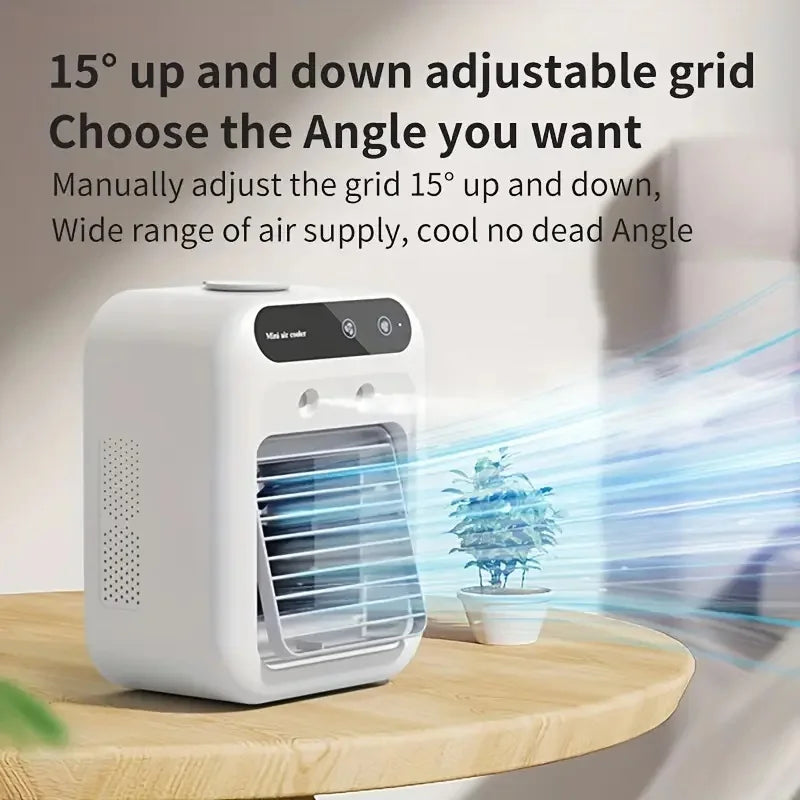
Airflow direction, fan speed, blade configuration, intake design, and oscillation can all affect how useful a personal cooler feels. For desk cooling, directional output may matter more than theoretical room coverage.
The KentDO model uses a nine-blade fan design intended to provide consistent personal airflow. That specification is useful when evaluating its role as a desktop or personal cooling device, but it should not be interpreted as a guarantee of whole-room cooling.
4. Compare Water Tank Capacity and Runtime
A larger reservoir generally means fewer refills, but tank size alone does not determine runtime. Water consumption varies with cooling conditions, fan speed, operating mode, and the design of the cooling system.
The KentDO portable air cooler fan has a 500ml water capacity. For personal use, this gives you a clearly defined reservoir size to compare against other mini air coolers.
5. Evaluate Noise Level
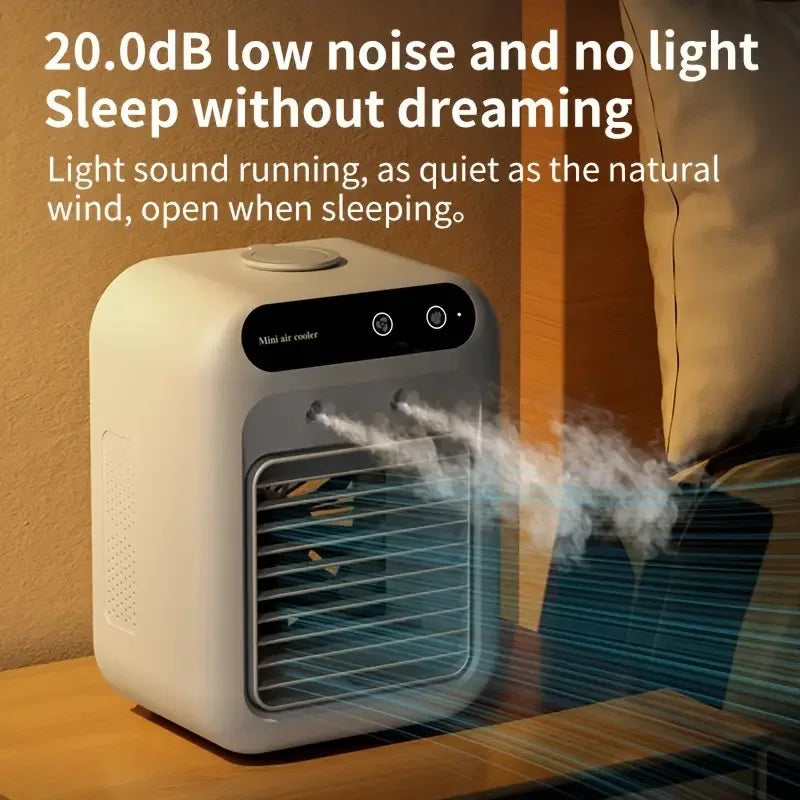
Noise becomes especially important in bedrooms, offices, study areas, and shared spaces. A cooling device that produces strong airflow but constantly distracts you may be less useful than a quieter model with moderate personal airflow.
Look for published noise information when available, and consider the operating speed you are most likely to use rather than judging a device only by its maximum setting.
6. Choose the Right Power Source
USB-powered and rechargeable air coolers provide more placement flexibility than appliances that must remain beside a wall outlet. Battery operation can be particularly useful when moving between rooms or working in locations where outlet access is inconvenient.
The KentDO model uses a rechargeable battery and USB charging, allowing it to function as a portable personal cooling device rather than requiring continuous connection to a fixed outlet.
7. Check Portability and Physical Size
For a desk, bedside table, office cubicle, or small room, footprint matters. Measure your available surface before buying and consider whether the reservoir is easy to fill without moving other objects.
8. Look for Useful Features Without Paying for Gimmicks
Useful features can include multiple fan speeds, directional airflow, oscillation, water-level visibility, timers, USB charging, and easy controls. Ice compatibility can also be convenient if explicitly supported by the manufacturer.
Do not assume that more features automatically mean stronger cooling. A simple appliance with good airflow, appropriate water capacity, quiet operation, and convenient power may be more useful than a feature-heavy device poorly suited to your environment.
9. Understand BTU Claims
BTU ratings are commonly associated with air-conditioning capacity. They should not be used casually to compare a mini evaporative cooler with a compressor-based portable AC.
For water-based personal cooling, pay closer attention to airflow, water capacity, operating controls, power source, physical size, humidity suitability, and intended coverage.
Best Portable Water Air Cooler Types for Different Uses
Best for a Desk or Personal Workspace
For a hot desk area, look for a compact footprint, directional airflow, low-distraction operation, USB charging, and straightforward water refilling. Personal cooling is often the most logical application for a mini air cooler.
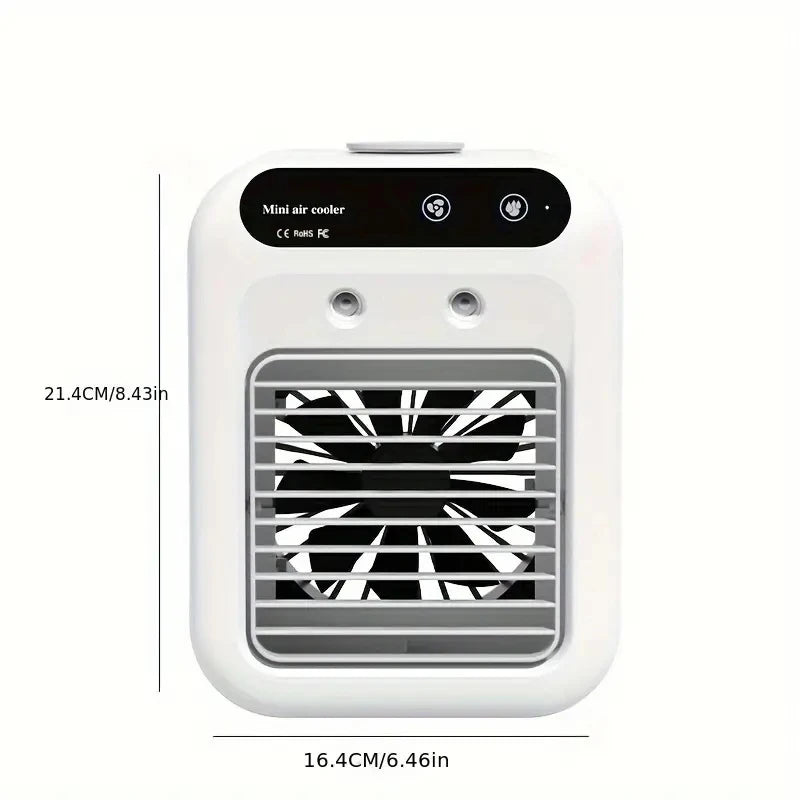
A small rechargeable unit can also complement broader lifestyle cooling essentials when your goal is to make one work area more comfortable rather than cool the entire building.
Best for a Bedroom
Bedroom use places extra emphasis on noise, placement, water capacity, and humidity. A quiet portable air cooler can be useful near the bedside when personal airflow is the goal, especially in conditions where evaporative cooling is appropriate.
If the bedroom is already very humid, however, adding moisture may not be desirable. In that situation, a conventional fan or air conditioner may provide a better experience.
Best for Small Rooms
A small room can benefit from a larger evaporative cooler if its airflow and water capacity are designed for the space. A mini desktop unit should generally be treated as a personal cooler unless its manufacturer specifies broader coverage.
Best for an Office
Office cooling requires a balance between comfort and disruption. Compact size, quiet airflow, simple controls, and flexible power can matter more than maximum output.
A rechargeable mini cooler is especially practical when you want to adjust cooling around your own workstation without changing the temperature for everyone else.
Best for RVs and Camping
Portable water air coolers can be attractive in mobile environments because of their compact footprint and, for some models, battery or USB operation. However, outdoor and RV performance still depends on humidity, airflow, available power, water access, and the size of the space.
Portable Water Air Cooler Pros & Cons
Pros
- Compact compared with many room-cooling appliances.
- Can provide refreshing personal airflow close to the user.
- Water-assisted cooling can feel more refreshing than ordinary airflow in suitable dry conditions.
- Rechargeable models provide flexible placement.
- Small reservoirs can be convenient for personal use.
- Generally easier to move between a desk, bedroom, or office than a larger appliance.
Cons
- Evaporative cooling becomes less effective as humidity rises.
- Compact models should not automatically be treated as whole-room air conditioners.
- Water reservoirs require regular cleaning.
- Cooling media or filters may require maintenance depending on the design.
- Adding moisture can be undesirable in already humid rooms.
- Performance depends heavily on placement, airflow, climate, and the specific product design.
Water Tank Capacity, Runtime, and Operating Cost
How Long Does One Tank Last?
There is no universal runtime for a water tank. Fan speed, ambient conditions, cooling mode, reservoir design, and evaporation rate all affect how quickly water is consumed.
A useful way to evaluate a model is to compare its tank capacity with your intended operating pattern. If you plan to use it beside your desk for several hours, a 500ml reservoir may offer a practical balance between compact size and refill frequency.
Does Using Ice Improve Cooling?
If a product specifically supports ice, it may temporarily make the airflow feel cooler. However, ice does not change the underlying technology into refrigeration-based air conditioning.
Never add ice or other materials unless the manufacturer's instructions permit them. The water reservoir should be used according to the product's operating guidance.
Electricity and Water Costs
Operating cost depends on the device's actual electrical consumption, usage time, charging method, and local electricity rates. Water consumption is also model-specific.
Rather than assuming every mini air cooler is inexpensive to operate, check the manufacturer's power specifications and calculate cost based on how many hours you expect to use the device each day.
How to Use and Maintain a Portable Water Air Cooler
How to Set Up a Water Air Cooler
- Place the cooler on a stable, level surface with unobstructed air intake and output.
- Fill the water reservoir only to the indicated maximum level.
- Connect or charge the device according to the manufacturer's instructions.
- Position the airflow toward the area where cooling is needed.
- Choose a comfortable fan speed rather than automatically using maximum output.
- Maintain suitable ventilation, particularly when operating an evaporative cooler for extended periods.
How to Clean the Water Tank and Cooling Pad
Water-based cooling equipment requires routine hygiene and maintenance. Empty unused water when appropriate, clean the reservoir according to the manufacturer's instructions, and prevent stagnant water from remaining in the appliance unnecessarily.
Cooling pads, filters, and other internal components should be cleaned or replaced according to the specific product instructions. Mineral buildup can become more noticeable when hard water is used frequently.
How Often Should Filters or Cooling Pads Be Maintained?
There is no single maintenance interval that applies to every portable evaporative cooler. Usage frequency, water quality, dust, humidity, and the manufacturer's design all influence maintenance needs.
If airflow decreases, odors develop, visible mineral deposits appear, or the cooling performance changes, inspect the reservoir and cooling components according to the manufacturer's cleaning guidance.
For additional personal-care and everyday-device options, you can also explore KentDO's Body Care and Health Devices collection.
Portable Water Air Cooler Troubleshooting
Why Is My Air Cooler Not Blowing Cold Air?
- Check whether the water reservoir has enough water.
- Confirm that the cooling function is operating as intended.
- Inspect the cooling media or filter for dust or mineral buildup.
- Check that the air intake and outlet are not blocked.
- Consider whether the room's humidity is too high for effective evaporation.
- Move the unit closer if it is intended for personal rather than whole-room cooling.
Remember that an evaporative cooler is not expected to produce the same type of cooling as a compressor-based air conditioner.
Why Does the Room Feel More Humid?
Evaporative cooling adds moisture to the airflow. In a poorly ventilated or already humid room, that moisture can accumulate and make the environment feel more humid.
If this occurs, improve appropriate ventilation or discontinue water-based cooling and consider another cooling method better suited to the conditions.
Why Is the Airflow Weak?
Weak airflow can result from a low fan setting, blocked intake, dirty filters or cooling media, a depleted battery, or normal limitations of a compact mini air cooler. Check the device's power and airflow settings before assuming the appliance has failed.
Portable Water Air Cooler Decision Tree
Start With Your Climate
Is your environment relatively dry? If yes, evaporative cooling may be worth considering. If your environment is consistently humid, carefully evaluate whether adding moisture will actually improve comfort.
Then Choose Personal or Room Cooling
Do you mainly need cooling around one person? A compact personal air cooler or rechargeable fan may fit the requirement.
Do you need substantial cooling across an enclosed room? Compare a larger cooling system or portable AC rather than assuming a mini water cooler can perform the same task.
Finally Check Power, Runtime, and Portability
Need flexible placement? Look for rechargeable or USB-powered cooling.
Need long unattended operation? Compare battery runtime, water capacity, charging requirements, and refill frequency.
Need the smallest footprint? Prioritize compact personal cooling rather than oversized room-cooling claims.
For a desk, bedroom, or compact office where focused airflow is the priority, the KentDO portable air cooler fan is designed around a 500ml reservoir, rechargeable operation, USB charging, quiet operation, and a nine-blade airflow system.
What to Look for Before You Buy
Portable Water Air Cooler Buying Checklist
- Confirm that evaporative cooling matches your local humidity.
- Decide whether you need personal cooling or whole-room cooling.
- Compare airflow and fan-speed options rather than relying only on temperature claims.
- Check water tank capacity and expected refill frequency.
- Consider noise if the device will be used in a bedroom or office.
- Check whether the device is rechargeable, USB-powered, or designed for continuous wall power.
- Measure the available desk or bedside footprint.
- Review maintenance requirements for the reservoir, filter, and cooling media.
- Verify whether ice is permitted before adding it.
- Do not compare evaporative coolers and portable AC units solely by BTU terminology.
- Check the manufacturer's warranty, return policy, and operating instructions.
Portable Water Air Cooler Comparison Matrix
Use this quick decision matrix when comparing a portable water air cooler with the most common alternatives:
- Need direct airflow at your desk: Personal air cooler or rechargeable fan.
- Want water-assisted cooling in dry conditions: Portable evaporative cooler.
- Want airflow without additional moisture: Conventional fan.
- Need meaningful room-temperature reduction: Portable air conditioner.
- Need rechargeable portability: Battery-powered personal cooler or fan.
- Need cooling for several people across a larger room: Evaluate a larger evaporative cooler or AC based on climate and room requirements.
Frequently Asked Questions
Do portable water air coolers actually cool a room?
They can improve comfort within a room, but compact models are generally most effective as personal cooling devices. Their ability to affect the entire room depends on airflow, room size, ventilation, humidity, and the specific cooler's capacity. They should not automatically be expected to deliver the same room-temperature reduction as an air conditioner.
What is the difference between a portable water air cooler and a portable AC?
A portable water air cooler uses water-based evaporative cooling and airflow, while a portable AC uses refrigeration to remove heat from the room. Water air coolers can be compact and convenient for personal cooling, whereas portable AC units are designed for stronger room-temperature control but require more substantial equipment and heat-exhaust arrangements.
How big of a room can a portable water air cooler cool?
There is no universal room-size rating for every portable water air cooler. Compact personal models are better suited to localized cooling, while larger evaporative coolers may cover broader areas. Always compare the manufacturer's stated coverage, airflow, and intended use with your actual room size.
Do portable water air coolers work in humid climates?
They can operate in humid climates, but evaporative cooling generally becomes less effective as humidity increases. If your indoor environment is already humid, a conventional fan or air conditioner may provide more suitable cooling depending on your objective.
How long does a portable water air cooler run on one tank?
Runtime varies with tank size, fan speed, cooling mode, ambient conditions, and the device's water consumption. A 500ml reservoir, for example, gives you a useful capacity reference, but it does not establish one universal number of operating hours.
Final Buying Advice
The best portable water air cooler is not necessarily the one with the most features. It is the one whose cooling method, airflow, water capacity, noise level, runtime, power source, portability, and intended coverage match your environment.
If your main problem is a hot desk, uncomfortable personal workspace, stuffy bedside area, or small office zone, a compact rechargeable mini air cooler can provide a convenient way to focus airflow where you need it. If you live in a humid environment or need substantial temperature reduction across an enclosed room, be realistic about the limitations of evaporative cooling and consider whether a conventional fan or portable AC is more appropriate.
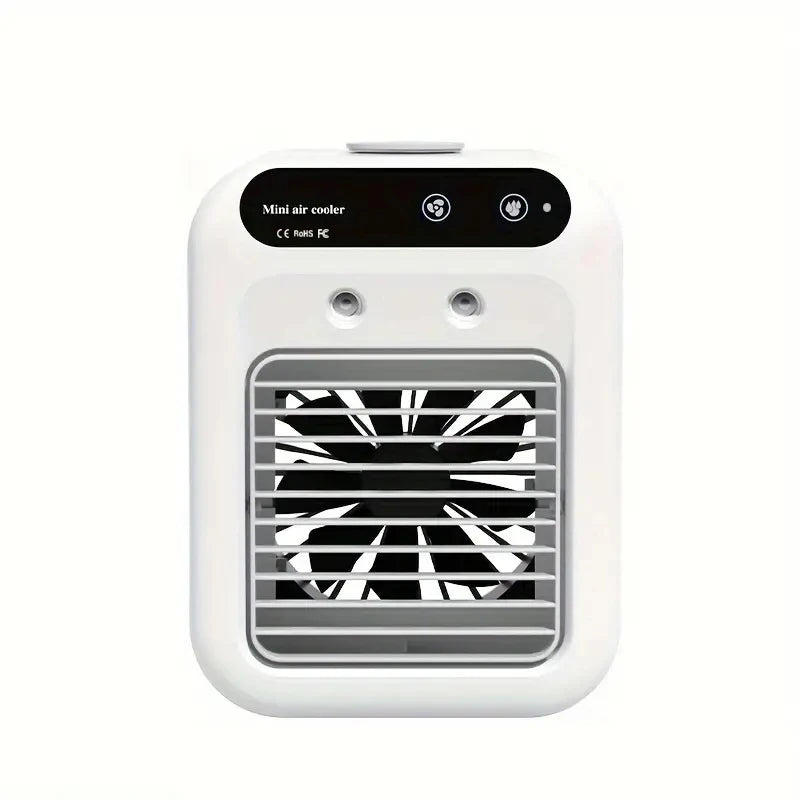
For personal cooling, the KentDO portable air cooler fan offers a defined 500ml water capacity, rechargeable battery operation, USB charging, quiet operation, compact construction, and a nine-blade airflow design. Those specifications make it a practical candidate for targeted cooling around desks, bedrooms, offices, and other personal spaces.
When comparing your options, start with the climate and the size of the area you actually need to cool. Then evaluate airflow, water capacity, runtime, noise, portability, maintenance, and power requirements. That approach will help you choose a cooling device based on real-world fit rather than marketing claims alone.
Pillar Article: Best Bedroom Cooling Devices for 2026: Compare Your Options













