

Quiet Mini Air Cooler for Bedroom: Best Options Compared
A quiet mini air cooler for bedroom use can be a practical way to improve personal comfort at night—especially when a full-size fan feels too loud or air conditioning is unnecessary. The important distinction is that mini evaporative air coolers are primarily designed for personal or localized cooling, not for replacing whole-room air conditioning. For bedroom use, the best choice depends on nighttime noise, airflow, humidity, water capacity, runtime, controls, and how much space you actually need to cool.
Quick Comparison: Best Quiet Mini Air Coolers for Bedrooms
| Option | Best Use Case | Cooling Method | Water Capacity | Noise Focus | Main Limitation |
| Portable Air Cooler Fan | Bedside and personal cooling | Fan + water cooling | 500ml | Quiet 9-blade airflow | Best for localized rather than whole-room cooling |
| Mini Personal Air Cooler | Small personal zone | Evaporative cooling | Varies by model | Low-speed operation | Performance depends strongly on humidity |
| Portable Air Conditioner | Whole-room temperature reduction | Compressor-based cooling | Not required for cooling | Typically louder | Higher energy use and larger footprint |
Best Options by Bedroom Use Case
- For light sleepers: prioritize genuinely low operating noise, multiple fan speeds, and controls that do not create distracting lights or sounds.
- For bedside personal cooling: choose a compact unit with directional airflow, simple controls, and an easy-to-refill water reservoir.
- For a small bedroom: look for adequate airflow, useful tank capacity, and realistic expectations about localized versus whole-room cooling.
- For longer overnight operation: prioritize water capacity, low-speed efficiency, automatic shutoff, and a timer if the model provides one.
What We Looked For
The most useful comparison criteria for a bedroom air cooler are noise, airflow, cooling effect, water-tank capacity, runtime, fan-speed options, controls, power requirements, maintenance, humidity tolerance, and intended cooling area. Manufacturer noise claims should also be treated carefully because perceived sound depends on fan speed, pump or water sounds, room acoustics, and distance from the sleeper.
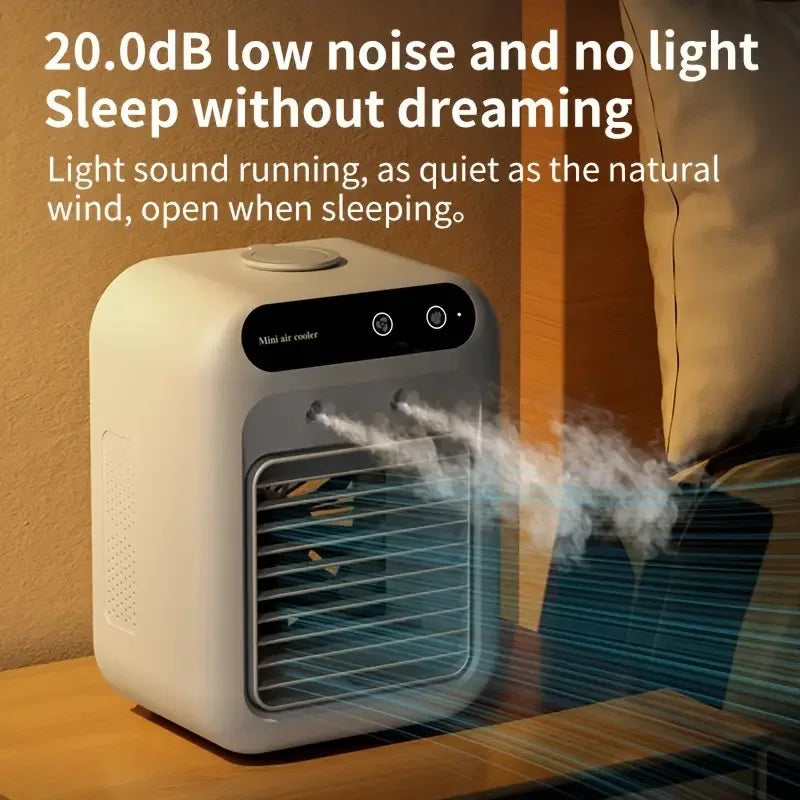
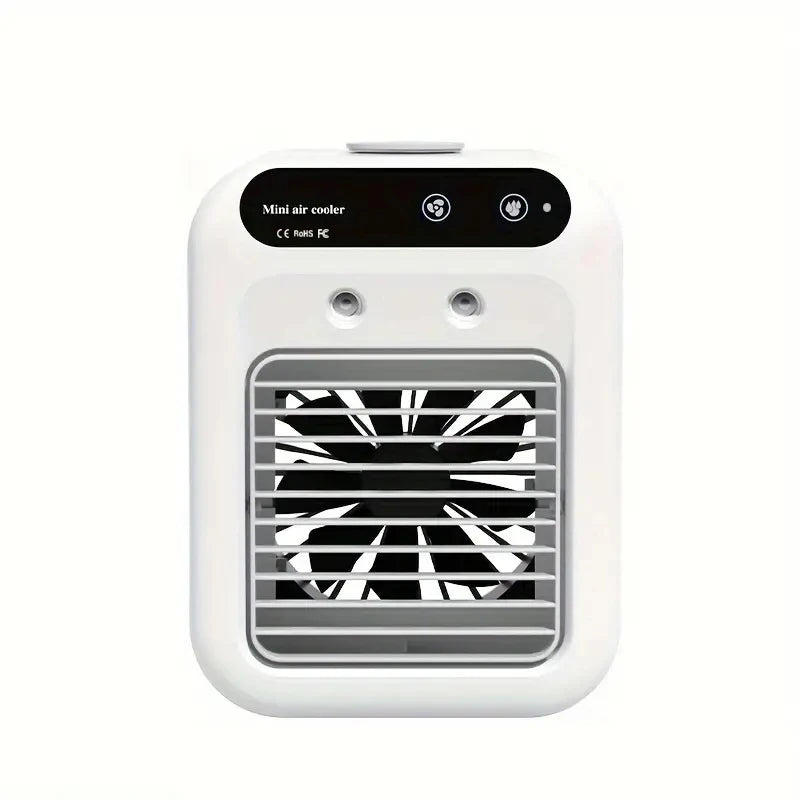
For shoppers who want a compact personal option, the Portable Air Cooler Fan combines a 500ml water capacity, rechargeable battery, USB charging, and a 9-blade airflow design for desks, bedrooms, offices, and other small personal spaces.
What Is the Quietest Mini Air Cooler for a Bedroom?
The quietest mini air cooler is not necessarily the model with the lowest advertised decibel number. Bedroom noise is affected by fan speed, airflow turbulence, water movement, pump operation, surface vibration, and the acoustics of the room. A useful bedroom model should provide enough airflow to create noticeable personal comfort while avoiding distracting mechanical or water sounds.
Bedroom-Friendly Noise Levels: Understanding Decibels
Decibels are useful for comparing noise, but the number alone does not tell you how a cooler will feel beside a bed. A low fan setting may be comfortable for sleep but provide less airflow. A higher setting can create more noticeable airflow noise while delivering stronger personal cooling.
When comparing models, look beyond a single noise figure. Check whether the measurement was taken at a particular fan speed, whether the unit has a sleep mode, and whether water or pump sounds are mentioned separately from fan noise.
Why the Quietest Setting Is Not Always the Best Setting
There is usually a tradeoff between noise and airflow. The lowest setting may be the most sleep-friendly, but it may not provide enough air movement for someone who feels hot. A slightly higher setting can sometimes produce a better balance of cooling and acceptable noise.
Features That Matter for Sleep
- Multiple fan speeds
- Sleep or low-noise operation
- Dim or minimal indicator lighting
- Timer functionality where available
- Automatic shutoff where available
- Stable airflow without excessive vibration
Can a Mini Air Cooler Actually Cool a Bedroom?
A mini air cooler can make the area immediately around a sleeper feel cooler, but it generally should not be treated as a replacement for whole-room air conditioning. Its strongest advantage is personal cooling: directing air toward the bed, chair, desk, or another nearby location where you actually need relief.
Personal Cooling vs. Whole-Room Cooling
A compact water air cooler moves air across or around a water-cooled medium and directs that airflow toward the user. This can improve perceived comfort in a localized area without attempting to lower the temperature of an entire bedroom.
That distinction matters when shopping. If your goal is to make the air immediately around your pillow or bedside position feel more comfortable, a portable air cooler can make sense. If you need the temperature of an entire bedroom substantially reduced, a larger cooling appliance is usually more appropriate.
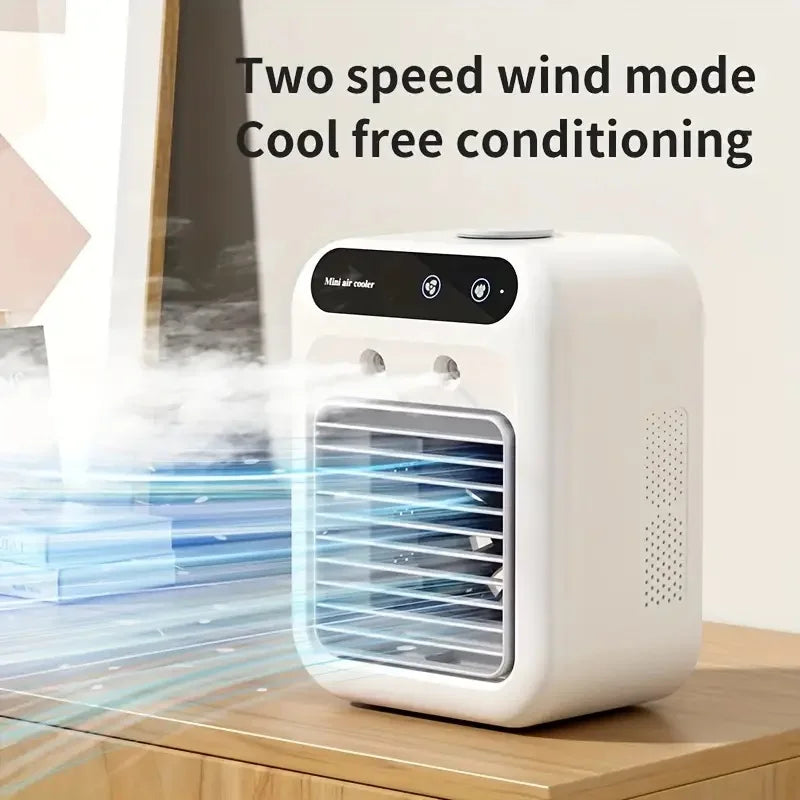
Evaporative Cooler vs. Portable Air Conditioner
An evaporative air cooler and a portable air conditioner solve different problems. An evaporative cooler uses airflow and water to provide localized cooling, while a portable air conditioner uses a refrigeration cycle to remove heat from the air.
| Factor | Mini Evaporative Air Cooler | Portable Air Conditioner |
| Cooling area | Personal or localized | Whole-room focused |
| Water | Typically required | Not required for the primary cooling process |
| Energy demand | Generally low | Generally higher |
| Portability | Very high | Lower due to larger size |
| Humidity impact | Can increase local humidity | Can provide dehumidification |
| Noise | Often lower, depending on design | Typically more noticeable |
When a Mini Air Cooler Makes Sense
- You mainly need personal cooling beside the bed.
- Your bedroom is only mildly to moderately hot.
- You want a compact cooling device.
- You prefer lower energy requirements than conventional air conditioning.
- You need a portable device that can move between a bedroom, office, and desk.
- You want airflow without operating a large appliance.
When You Need Air Conditioning Instead
Choose air conditioning when the main objective is dependable whole-room temperature reduction, especially during severe heat. Air conditioning is also the more appropriate option when humidity control is important. A mini evaporative cooler cannot provide the same whole-room cooling capacity as a compressor-based air conditioner.
Best Quiet Mini Air Cooler Picks for Different Bedroom Needs
The right bedroom cooling device depends more on the use case than on a generic ranking. A light sleeper may prioritize noise above all else, while another shopper may care more about portability, water capacity, or longer operation.
Best for Light Sleepers
Light sleepers should prioritize a unit that can operate comfortably at a low fan setting. Adjustable airflow is especially useful because you can start with a quieter setting and increase airflow only when necessary.
Avoid assuming that a larger airflow rating automatically means a better bedroom cooler. Stronger airflow can produce more fan noise and may be unnecessary if the unit is positioned close to the bed.
Best for Bedside Personal Cooling
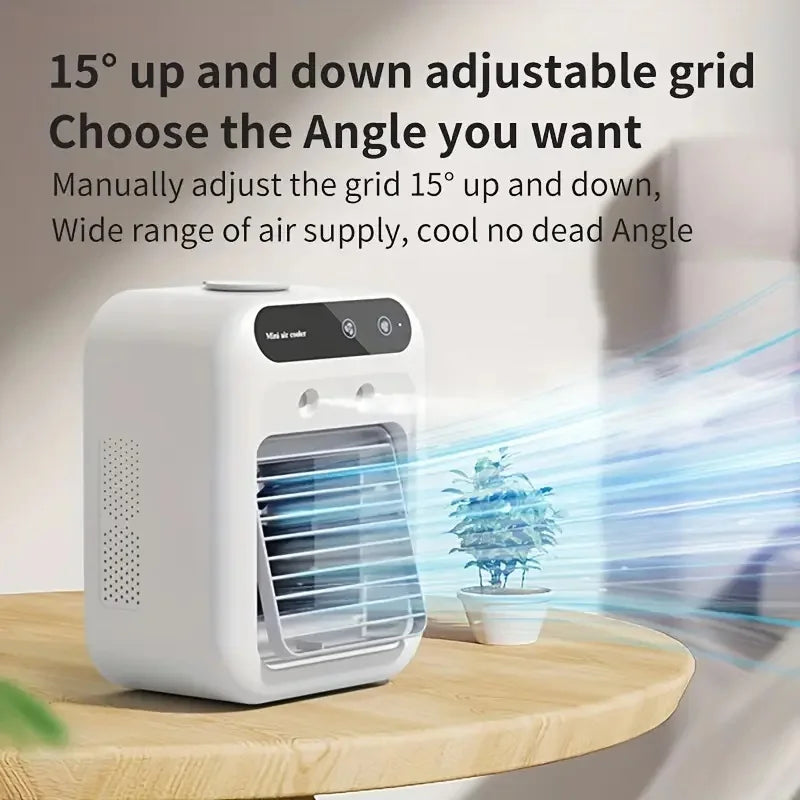
A compact rechargeable air cooler is particularly convenient beside a bed because it does not require the footprint of a conventional floor fan. Directional airflow also allows you to aim cooling toward the sleeper rather than attempting to circulate the entire bedroom.
The Portable Air Cooler Fan is designed around this personal-cooling use case, with a compact form, 500ml water reservoir, rechargeable battery, USB charging, and 9-blade airflow system.
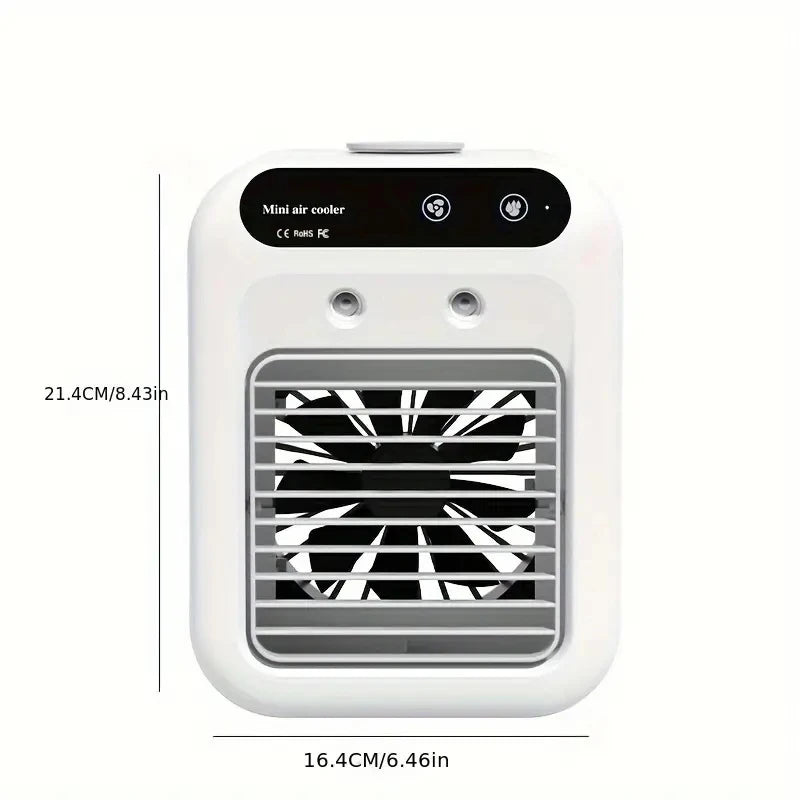
Best for a Small Bedroom
For a small bedroom, focus on where the cooling is needed rather than assuming that a mini unit will reduce the temperature everywhere. A compact cooler can be useful when placed near the sleeper, but room-wide performance depends on bedroom size, heat load, airflow, ventilation, and humidity.
Best for Longer Overnight Operation
For overnight use, tank capacity and fan setting become particularly important. A larger reservoir generally gives you more water available for longer operation, but actual runtime depends on how quickly water evaporates and how strongly the fan operates.
How Long Can a Mini Air Cooler Run Overnight?
There is no single runtime that applies to every mini air cooler. Overnight operation depends on tank size, fan speed, evaporative rate, ambient temperature, humidity, and the specific design of the unit.
Water-Tank Size and Expected Runtime
A larger tank generally supports longer operation because it provides more water before a refill is required. However, tank capacity should not be interpreted as a guaranteed number of operating hours. Two units with similar reservoirs can consume water at different rates.
The Portable Air Cooler Fan has a 500ml water capacity. That makes the reservoir a useful specification to consider when comparing compact personal cooling devices, but users should still follow the manufacturer's operating instructions rather than assuming a fixed overnight runtime.
Low vs. High Fan Speed Runtime
Higher airflow can increase water consumption in an evaporative system, potentially shortening the period before the reservoir needs attention. A lower setting can provide a quieter experience and may extend water availability.
What Happens When the Water Runs Out?
Behavior after the reservoir empties depends on the specific model. Some devices can continue operating as fans, while others may stop the cooling function or shut down. Always check the product instructions for the exact behavior and avoid assuming that every water-cooled fan operates in the same way.
Does an Evaporative Air Cooler Work Well in a Humid Bedroom?
Evaporative cooling generally works better when the surrounding air is relatively dry. As relative humidity rises, the air has less capacity to accept additional water vapor, which can reduce evaporative cooling effectiveness.
How Humidity Affects Evaporative Cooling
Water evaporation is central to evaporative cooling. In dry conditions, evaporation can occur more readily. In humid conditions, evaporation becomes less efficient, so the cooling effect can feel weaker and additional moisture may make the room feel more humid rather than more comfortable.
Signs Your Bedroom Is Too Humid for an Air Cooler
- The room already feels damp or muggy.
- Cooling feels limited despite strong airflow.
- Adding more water does not noticeably improve comfort.
- Moisture accumulation becomes noticeable around the device.
- You prefer dry, conditioned air rather than humidified airflow.
How to Improve Results in a Humid Room
Use the cooler where its airflow can reach you directly, maintain reasonable ventilation where appropriate, and avoid adding unnecessary water simply because the reservoir has capacity. If humidity control is a major priority, air conditioning is usually a better solution because evaporative cooling and dehumidification work in opposite directions.
Energy Use: Mini Air Cooler vs. Air Conditioning
One of the main reasons shoppers consider a mini air cooler is its small size and comparatively simple fan-and-water system. A compact personal cooling device generally requires much less power than a compressor-based air conditioner, but lower energy use also comes with lower cooling capacity.
Why Mini Air Coolers Usually Use Less Electricity
A mini air cooler primarily powers a small fan and, depending on the design, a water-cooling or circulation system. A portable air conditioner must operate a refrigeration compressor and other components required to remove heat from the room.
Low Energy Use Does Not Mean Stronger Cooling
This is one of the most important buying distinctions. Lower electricity consumption does not mean that a mini cooler can outperform an air conditioner. The smaller energy requirement reflects the fact that the device is designed for personal comfort rather than full-room heat removal.
What to Check on the Power Label
Compare voltage, wattage, operating time, fan settings, and charging requirements. For rechargeable models, also consider battery capacity and how often you expect to recharge the unit. These specifications provide a more useful basis for comparison than simply assuming that every mini cooler has the same energy consumption.
What to Check Before Buying a Quiet Bedroom Air Cooler
Noise Level and Fan Speeds
Look for multiple airflow settings and reliable noise information. If you are a light sleeper, the lowest operating mode may matter more than maximum airflow.
Water Tank Capacity and Runtime
Consider how frequently you want to refill the device. A 500ml reservoir, for example, provides a clear reference point for compact personal cooling, but actual operating duration varies with conditions and settings.
Sleep Mode, Timer, and Display Controls
Nighttime controls can make a significant difference. A timer, automatic shutoff, dim indicators, and quiet operation can help prevent the cooling device from becoming a new source of sleep disruption.
Size, Airflow Direction, and Bedside Placement
A small cooler should be positioned so its airflow reaches the person who needs cooling. Personal airflow is often more useful than placing a compact device across the room and expecting it to cool the entire space.
Cleaning and Maintenance
Water-based cooling devices require regular attention. Follow the manufacturer's instructions for changing water, cleaning the reservoir, maintaining any cooling medium or filter, and allowing components to dry when appropriate. Regular maintenance helps reduce odor and buildup and keeps the device more pleasant to use.
Pros and Cons of Mini Air Coolers for Bedrooms
Main Advantages
- Compact enough for bedside or desktop use.
- Designed for personal rather than bulky room cooling.
- Generally lower energy requirements than air conditioning.
- Portable and easy to reposition.
- Water-assisted airflow can feel more refreshing than ordinary fan airflow in suitable conditions.
- Rechargeable models can operate without remaining beside a wall outlet.
- Lower fan settings can provide a quieter nighttime experience.
Main Limitations
- Not a replacement for whole-room air conditioning.
- Evaporative performance decreases as humidity rises.
- Water reservoirs require regular refilling and cleaning.
- Noise varies by fan speed and device design.
- Actual runtime depends on operating conditions.
- Cooling performance is highly dependent on placement and proximity to the user.
Which Quiet Mini Air Cooler Should You Choose?
The best quiet mini air cooler for a bedroom is the one that matches the actual cooling problem. Before buying, decide whether you need personal airflow beside the bed, localized cooling in a small room, or reliable whole-room temperature reduction.
Choose a Mini Air Cooler If...
- You want personal cooling near the bed.
- You need a compact device for a small space.
- You value portability and rechargeable operation.
- You prefer lower power requirements.
- Your environment is suitable for evaporative cooling.
- You do not need to significantly lower the temperature of an entire bedroom.
For a compact personal setup, the Portable Air Cooler Fan offers a 500ml water reservoir, rechargeable battery, USB charging, quiet operation, and a 9-blade airflow system. It is best understood as a personal cooling appliance for bedrooms, desks, offices, and other small spaces rather than as a whole-room air conditioner.
Choose a Portable Air Conditioner If...
- You need dependable whole-room temperature reduction.
- Your bedroom becomes extremely hot.
- Humidity reduction is important.
- Localized personal airflow is not enough.
- You accept higher energy use, greater size, and potentially more operating noise.
Frequently Asked Questions
What is the quietest mini air cooler for a bedroom?
The quietest practical choice depends on the model's fan speed, airflow design, pump or water noise, and bedroom acoustics. For sleep, prioritize low-speed operation, adjustable airflow, and sleep-friendly controls rather than relying on a single advertised noise number.
Are mini air coolers quiet enough to sleep with?
Many compact air coolers can be suitable for nighttime use when operated at a low setting, but perceived noise varies between devices and users. Light sleepers should pay particular attention to motor, fan, pump, vibration, and indicator-light behavior.
Can a mini air cooler actually cool a bedroom?
A mini air cooler can improve personal comfort and cool the air around the user, but it generally has limited ability to lower the temperature of an entire bedroom. For whole-room cooling, a portable or conventional air conditioner is more appropriate.
How long can a mini air cooler run overnight?
Runtime depends on water capacity, fan speed, evaporation rate, humidity, temperature, and the individual model. A 500ml tank provides useful capacity for a compact unit, but it should not be treated as a guaranteed number of overnight hours.
Does an evaporative air cooler work well in a humid bedroom?
Evaporative cooling is generally less effective as relative humidity increases. If your bedroom is already humid or muggy, air conditioning may provide better overall comfort because it can both cool and dehumidify the air.
Final Recommendation
A quiet mini air cooler for bedroom use makes the most sense when your priority is personal or localized cooling with a compact footprint. Look for low-noise operation, adjustable fan speeds, practical water capacity, suitable runtime, easy maintenance, and controls that will not disturb sleep.
If you need to cool only the area around your bed, a rechargeable water air cooler can be a convenient alternative to running a larger appliance. The Portable Air Cooler Fan is particularly suited to personal use because it combines a 500ml water capacity, 9-blade airflow, rechargeable battery, USB charging, and compact design.
If your real objective is to reduce the temperature and humidity of an entire bedroom, however, do not expect a mini evaporative cooler to perform like an air conditioner. Match the device to the room, climate, and cooling goal first, then prioritize noise and runtime for nighttime comfort.
For more personal-care and lifestyle devices, explore the Body Care and Health Devices collection and choose cooling equipment based on the space, comfort level, and use case that matter most to you.
Pillar Article: Best Bedroom Cooling Devices for 2026: Compare Your Options













