

Skin Analysis Machine for Clinics: 2026 Buying Guide
Choosing a skin analysis machine for clinics is not simply a matter of buying the camera with the highest megapixel count or the device with the longest list of “advanced” features. A useful professional system should produce consistent facial images, reveal relevant skin characteristics, organize findings into understandable reports, and help practitioners make better-informed consultation and treatment-planning decisions.
That distinction matters because facial imaging, quantitative skin analysis, and medical diagnosis are not interchangeable. A professional analyzer can document visible and less obvious skin patterns, support standardized comparisons, and improve client education, but its outputs should be interpreted according to the manufacturer's validated capabilities and intended use.
This guide explains what to evaluate when comparing professional AI skin analyzers, multispectral imaging systems, digital skin scanners, and facial analysis equipment for salons, clinics, medspas, and skin management businesses.
What Is a Professional Skin Analysis Machine?
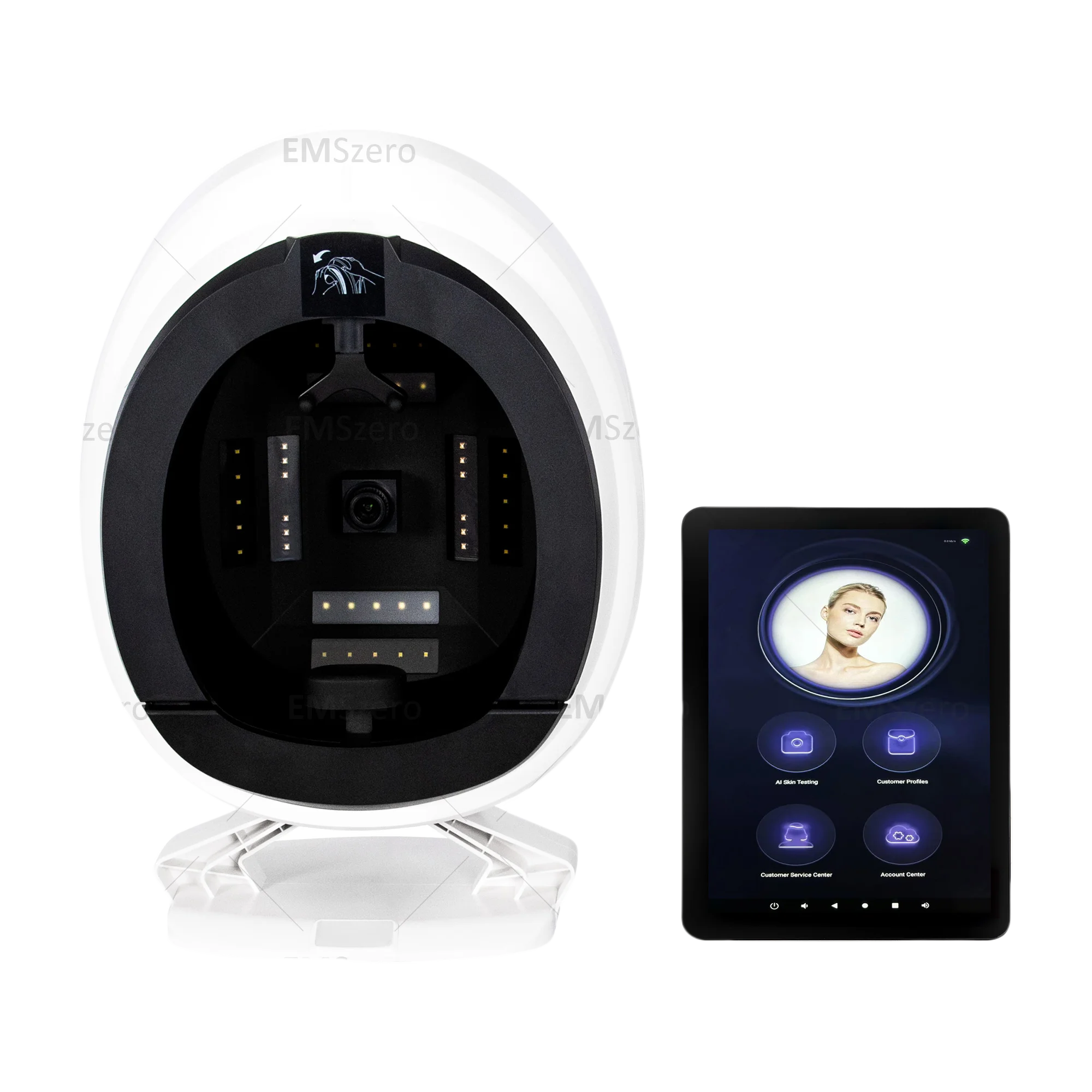
A professional skin analysis machine combines controlled facial imaging, software analysis, and reporting tools to create a structured view of skin condition. Depending on the system, it may visualize or evaluate characteristics such as pigmentation, uneven tone, pores, wrinkles, texture, acne-related patterns, redness, moisture, sebum, and elasticity.
The important question for a buyer is not simply “What does this machine detect?” but “How does the system capture, analyze, document, and reproduce that information?”
What a Clinic-Grade System Can Measure
Professional facial analysis equipment can combine visible-light imaging with additional spectral or analytical modes. Common evaluation categories include pigmentation and skin tone, pores, wrinkles, texture, acne, redness, moisture, sebum, and elasticity.
However, measurement terminology needs careful interpretation. An imaging system may visualize a characteristic, estimate a characteristic through software, or measure it with a dedicated sensor. Those are technically different approaches. When comparing devices, ask which measurements are directly sensed, which are calculated from images, and which are visual indicators.
Imaging Data vs. Medical Diagnosis
A digital skin analysis report should not automatically be treated as a medical diagnosis. Facial imaging can support cosmetic consultations, documentation, client education, and treatment tracking. Diagnosis of a medical skin condition requires appropriate clinical evaluation by a qualified healthcare professional.
This distinction is especially important when reviewing phrases such as “skin diagnostic,” “clinical analysis,” or “medical-grade.” Buyers should verify the manufacturer's intended use, regulatory status, labeling, and evidence before relying on any medical claim.
Why Repeatability Matters
Repeatability can be more valuable than headline resolution. If facial images are captured under different lighting, distances, angles, or exposure conditions, apparent changes may reflect the imaging environment rather than actual changes in skin.
A strong workflow therefore standardizes facial positioning, lighting, camera distance, capture angles, and operating procedures. This becomes particularly important when the machine is used for before-and-after comparisons or longitudinal skin tracking.
What Should a Skin Analysis Machine Measure?
The right measurement set depends on the services your clinic provides. A consultation-focused salon may prioritize clear visual reporting and client education, while a treatment-tracking practice may place greater emphasis on standardized capture, repeatability, quantitative scoring, and historical records.
Pigmentation and Skin Tone
Facial imaging can document visible pigmentation, uneven tone, and changes in the appearance or distribution of pigmented areas. Consistent imaging allows practitioners to compare images over time and explain visual findings more clearly during consultations.
Pores, Wrinkles, and Texture
High-resolution facial imaging can provide detailed visualization of surface characteristics such as pores, fine lines, wrinkles, and texture. Resolution is useful here, but image detail alone does not guarantee accurate measurement. Lens quality, lighting, focus, facial positioning, and software methodology also affect results.
Erythema and Redness
Specialized imaging may help visualize redness-related patterns that are difficult to assess consistently under ordinary room lighting. Buyers should verify exactly how a particular system handles redness and whether its output is a visual map, calculated score, or validated measurement.
Hydration, Moisture, and Sebum
“Moisture measurement” deserves particular scrutiny when comparing skin analyzers. A dedicated sensor-based measurement and an image-derived estimate are not equivalent. The same principle applies to sebum analysis. Ask the manufacturer how the value is generated, what reference method was used, and what limitations apply.
UV Spots and Sub-Surface Visualization
UV-based imaging can reveal patterns that are not readily visible in ordinary RGB photographs. These images can be useful for cosmetic consultation and client education, but visible patterns should not automatically be interpreted as diagnosed disease or guaranteed future skin problems.
RGB, UV, Cross-Polarized, and Multispectral Imaging Explained
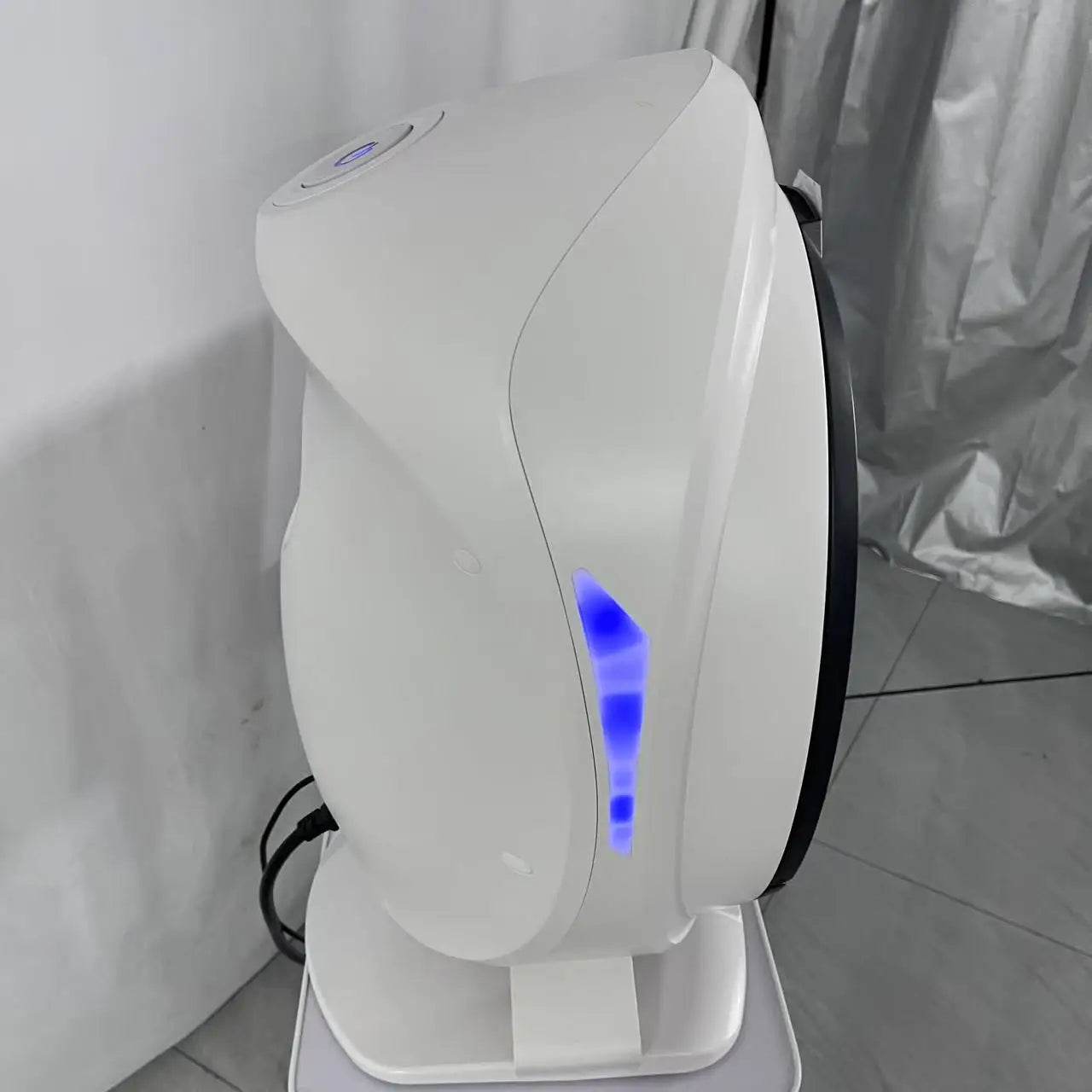
Imaging technology is one of the most important differences between professional facial analyzers. Instead of asking which technology is universally “best,” evaluate which modalities actually support your clinic's services and documentation workflow.
RGB Imaging
RGB imaging uses visible light to capture a conventional representation of the face. It is useful for documenting skin tone, surface appearance, pores, wrinkles, texture, and visible pigmentation.
For many consultation workflows, high-quality RGB imaging is the foundation of the system. It provides a recognizable reference image that practitioners and clients can easily understand.
UV Imaging
UV imaging uses ultraviolet illumination to produce visual patterns that differ from ordinary visible-light photographs. It can help visualize certain pigmentation-related patterns and other UV-responsive characteristics.
Because UV imaging depends on specialized illumination and interpretation, buyers should evaluate the manufacturer's documentation rather than assuming every UV image has the same analytical value.
Cross-Polarized Imaging
Cross-polarized imaging uses polarization to reduce certain surface reflections. This can make some color and redness-related patterns easier to visualize than under standard illumination.
For clinics concerned with consistent facial documentation, polarization can be useful because reducing glare may improve the visibility of underlying color variations in captured images.
Multispectral Imaging
Multispectral imaging captures information across multiple wavelength ranges rather than relying solely on standard visible-light photography. More spectral information can support broader skin analysis, provided the associated software has a meaningful method for interpreting the captured data.
The number of spectral channels should therefore be considered alongside image quality, analysis methodology, reporting, repeatability, and actual clinical workflow value.
Which Imaging Technology Does a Clinic Actually Need?
Use your service mix as the starting point. If your primary goal is consultation visualization, excellent RGB imaging and intuitive reporting may provide more practical value than a complicated system that staff rarely use. If your practice emphasizes detailed skin tracking, pigmentation analysis, or advanced consultation, additional spectral modes may justify a more sophisticated platform.
The goal is not maximum technology. The goal is technology that produces information your team can consistently use.
AI Skin Assessment: How Much Automation Is Actually Useful?
AI can make professional skin analysis faster by automating parts of the process that would otherwise require manual visual review. Depending on the system, AI-powered analysis may identify areas of interest, generate scores, create skin maps, organize findings, and produce structured reports.
What AI Skin Analysis Can Automate
An AI facial analyzer can help organize large amounts of facial imaging information into categories that are easier to discuss with clients. Automated detection and reporting can also reduce repetitive administrative work and provide a consistent starting point for practitioner review.
For a busy salon or clinic, this workflow can be especially useful when consultations need to move from image capture to understandable recommendations without excessive manual processing.
How to Evaluate AI Accuracy
Do not evaluate AI accuracy from marketing language alone. Ask whether the manufacturer provides information about the reference standards, validation population, testing methodology, repeatability, sensitivity, specificity, or other relevant performance measures.
Also ask whether the AI is identifying visual features, estimating numerical values, or classifying skin characteristics according to a proprietary scoring system. These distinctions affect how results should be interpreted.
AI Scores vs. Practitioner Interpretation
The strongest professional workflow treats AI output as decision support rather than an unquestionable answer. Practitioners can use structured analysis to guide discussion, then apply professional judgment, client history, visual assessment, and treatment objectives when making recommendations.
How a Skin Analysis Machine Fits Into a Clinic Consultation
A professional skin analysis machine creates the most value when it becomes part of a repeatable consultation workflow rather than a standalone gadget.
Step 1: Standardized Image Capture
The process begins with consistent positioning, lighting, facial angles, and capture distance. Staff should follow the same protocol for every client and every follow-up session whenever possible.
Step 2: Automated Analysis and Skin Mapping
The system processes captured facial images and organizes relevant findings into visual maps, categories, or scores. This can make subtle differences easier to explain than relying solely on a mirror or ordinary photograph.
Step 3: Practitioner Review and Treatment Planning
The practitioner reviews the output, identifies the concerns most relevant to the client's goals, and determines which recommendations are appropriate. Analysis software should support professional judgment rather than replace it.
Step 4: Digital Reporting and Client Education
A structured digital report can turn technical imaging into a consultation tool. Visual comparisons and clearly labeled categories can help clients understand why a particular skincare strategy or professional service has been recommended.
Step 5: Treatment Tracking and Before-and-After Comparison
Longitudinal tracking is one of the strongest reasons to use professional facial imaging. Consistent images can provide a visual record of changing skin characteristics and support follow-up consultations.
For practices expanding their technology offering, a professional system such as the AI Skin Analyzer for Professional 3D Facial Skin Analysis combines a 36MP industrial HD camera, 8-spectrum imaging, AI-powered analysis, digital reporting, and image tracking. Its stated analysis categories include acne, pigmentation, pores, wrinkles, moisture, sebum, tone, and elasticity.
If you are building a broader professional skincare equipment setup, you can also review skin and beauty care devices to evaluate complementary equipment for your workflow.
A practical next step is to map your current consultation process from image capture through reporting, then determine which steps a professional analyzer could simplify or standardize.
Technical Specifications to Compare Before Buying
When comparing a professional skin analysis machine, avoid judging the system by one specification. A 36MP camera may produce highly detailed images, but resolution is only one part of useful facial analysis.
Camera and Image Resolution
Review camera resolution, sensor quality, lens characteristics, focus, exposure consistency, and the quality of the final report. Higher resolution can provide more image detail, but usable analytical information depends on the entire capture system.
Lighting and Spectral Modes
Check whether the device provides RGB, UV, polarized, cross-polarized, or multispectral modes. Also verify how each mode is used by the software and which skin characteristics it is intended to analyze.
Measurement Repeatability
Ask for information about standardized acquisition conditions and repeatability. A machine that produces similar results under controlled conditions can be more valuable for treatment tracking than a system that produces impressive but inconsistent images.
Physical Footprint and Ergonomics
Consider the physical size of the equipment, patient positioning, operator access, room requirements, and how easily staff can capture images. A technically sophisticated machine can become an operational liability if it slows consultations or requires excessive setup.
Connectivity and Device Integration
Review compatible computers, USB or network connectivity, data export options, software requirements, and integration capabilities. If your clinic already uses electronic client records or practice-management software, determine whether the analyzer fits that environment before purchasing.
Software, Reporting, and Data Management

The software layer often determines whether a technically impressive analyzer becomes a practical everyday tool. Hardware captures the information; software turns it into something staff can interpret, save, compare, and communicate.
Digital Skin Reporting
Look for reports that organize findings clearly and allow practitioners to explain results without overwhelming clients. Useful features can include visual summaries, scores, skin maps, practitioner notes, and client-facing outputs.
Client Records and Treatment Tracking
If your business performs recurring skincare services, historical records and before-and-after comparisons can be highly valuable. Ask how images are stored, how previous sessions are retrieved, and whether the system supports longitudinal comparisons.
Cloud Software vs. Local Storage
Cloud-based systems can make information accessible across authorized workstations, while local storage may provide greater control over where files reside. Both approaches introduce operational considerations involving backups, access controls, privacy, software subscriptions, and administrative management.
User Experience and Workflow Speed
Test the complete capture-to-report process. Count the number of operator steps, evaluate the learning curve, and determine how quickly a trained employee can complete an analysis. A system that saves several minutes per consultation can have meaningful operational value over hundreds of appointments.
For additional education around facial and body-care technology, the Body & Face Blog can complement a professional skincare equipment research process.
Certification, Compliance, and Manufacturer Documentation
What Certifications Should You Verify?
Buyers should verify the certifications supplied for the exact model being purchased, along with applicable electrical safety documentation and market-specific requirements. The product information for the MYOSLIM system described in this guide lists CE and RoHS certification.
Certification should always be checked against current manufacturer documentation. A certification mark does not by itself establish that an analyzer is approved for medical diagnosis or that every software measurement has clinical validation.
Medical Device Claims vs. Cosmetic Analysis Claims
Intended use matters. A device marketed for cosmetic skin assessment is different from a regulated medical diagnostic device. Before using analysis results to support medical decisions, verify the manufacturer's regulatory claims and the requirements applicable to your market and practice.
Evidence and Validation Methodology
Ask vendors for validation information before accepting numerical scores or accuracy claims. Useful questions include: What population was tested? What reference method was used? How were measurements repeated? What conditions can affect results? What are the known limitations?
Training, Warranty, and Support: The Hidden Buying Criteria
Staff Training and Onboarding
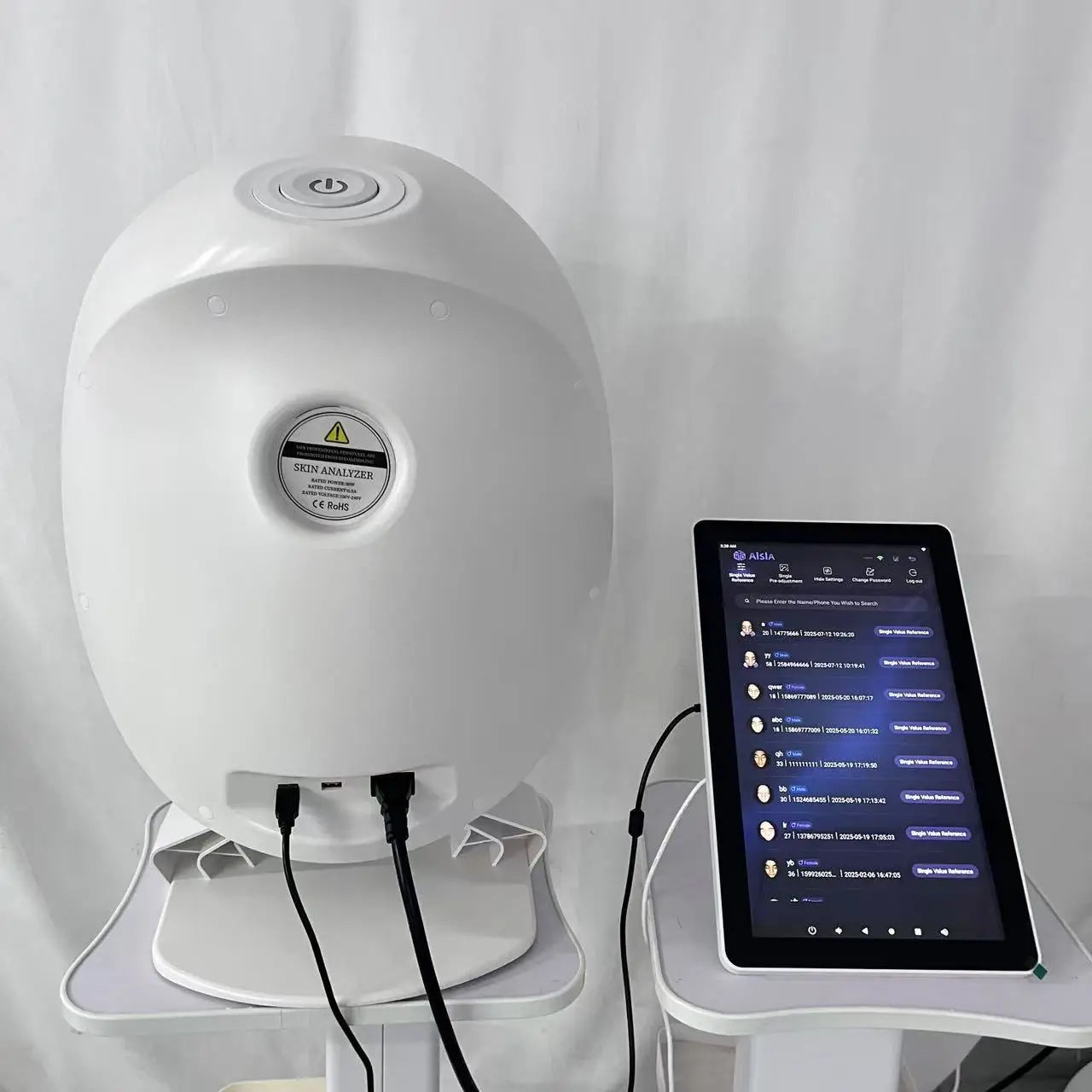
Standardized operator training is essential because image quality and interpretation can vary with user behavior. Staff should understand positioning, capture protocols, software operation, report interpretation, and the limitations of the system.
Warranty and Service Coverage
Warranty terms should be evaluated alongside the purchase price. The MYOSLIM AI skin analyzer described here lists a one-year warranty. Buyers should confirm what the warranty covers, how repairs are handled, whether replacement parts are available, and what support is provided after installation.
Updates, Calibration, and Long-Term Maintenance
Ask whether software updates, calibration, hardware maintenance, accessories, or compatibility upgrades create recurring costs. These expenses should be included in the ownership calculation rather than discovered after purchase.
How Much Does a Professional Skin Analysis Machine Cost?
The purchase price of a professional skin analysis machine can vary substantially because systems differ in camera hardware, spectral imaging, AI software, reporting, data management, support, and integration capabilities. Rather than selecting the lowest sticker price, compare the complete cost of ownership.
What Determines the Purchase Price?
Major cost drivers include imaging resolution, number and type of spectral modes, sensors, software capabilities, automated analysis, reporting functionality, physical hardware, manufacturer support, and included training.
Recurring Costs to Include
Ask vendors about software subscriptions, cloud storage, support plans, calibration, accessories, upgrades, replacement components, and staff training. A less expensive machine can become more expensive over several years if recurring software or support fees are substantial.
Total Cost of Ownership Checklist
- Initial hardware purchase price
- Software or cloud subscription costs
- Installation and staff training
- Warranty and extended support
- Calibration and maintenance
- Accessories and replacement components
- Software updates and upgrades
- Data storage and administration
For example, the MYOSLIM professional AI skin analyzer is specified with 36MP industrial HD imaging, 8-spectrum technology, AI analysis, 220V operation, CE and RoHS certification, and a one-year warranty. Those specifications give buyers a concrete starting point for comparison, but they should still be evaluated against the total software, support, installation, and operating requirements of competing systems.
Before purchasing, request the complete ownership cost in writing rather than comparing hardware prices alone.
Professional Skin Analysis Machine Comparison Matrix
Use the following matrix to compare competing systems on the factors that matter most to a professional practice.
| Evaluation Area | Basic Facial Imaging | Professional AI Analyzer | |
| Visible RGB imaging | Usually available | Core capability | Core capability |
| High-resolution facial capture | Varies | Important criterion | Important criterion |
| AI-assisted analysis | Limited or absent | Typically central | Often available |
| Multiple spectral modes | Limited | May include multiple wavelengths | Usually broader |
| Skin mapping | Basic | Commonly useful | Often advanced |
| Digital reporting | May be basic | Important buying criterion | Important buying criterion |
| Longitudinal tracking | Depends on software | Strong workflow advantage | Strong workflow advantage |
| Best fit | Simple documentation | Consultation and structured analysis | Advanced multi-modal workflows |
Professional Skin Analysis Machine Comparison Checklist
Imaging and Measurement Criteria
- What imaging modalities are included?
- What skin characteristics can the system visualize or evaluate?
- Which measurements are sensor-based versus image-derived?
- What is the camera resolution and optical configuration?
- How standardized is facial image capture?
- Is repeatability documented?
- Can results be compared across multiple appointments?
Workflow and Software Criteria
- How much of the analysis is automated?
- Can practitioners review AI findings before recommendations are made?
- Does the system generate digital reports?
- Can staff store client images and historical results?
- Does it support before-and-after comparison?
- How quickly can staff move from capture to report?
- Does it integrate with existing clinic systems?
Business and Ownership Criteria
- What is the complete purchase price?
- Are there recurring software or cloud fees?
- What training is included?
- What does the warranty cover?
- How is technical support provided?
- Are calibration or maintenance services required?
- What certification and manufacturer documentation are supplied?
- What evidence supports the system's measurement and AI claims?
Once you have narrowed your requirements, compare the finalists using the same capture conditions and, where possible, request a live demonstration. A software demonstration can reveal workflow limitations that are difficult to identify from a product specification sheet.
If your business also evaluates adjacent beauty technology, professional body care and health devices can provide additional context for building a broader equipment setup.
For buyers whose requirements include high-resolution facial imaging, multi-spectrum analysis, AI-supported reporting, and professional image tracking, the AI Skin Analyzer for Professional 3D Facial Skin Analysis is one option to evaluate against the checklist above.
Pros and Cons of Professional AI Skin Analysis Machines
Pros
- Creates standardized digital facial documentation.
- Can reveal visual patterns that are difficult to assess with ordinary observation.
- Supports structured consultation and client education.
- AI can automate parts of detection, scoring, mapping, and reporting.
- High-resolution imaging can improve visual detail.
- Multiple imaging modes can broaden the information available during consultation.
- Historical images can support treatment tracking when capture conditions are consistent.
Cons
- Imaging results depend on standardized capture conditions.
- Not every software score represents a direct physical measurement.
- AI outputs should not replace professional judgment.
- More imaging modes can increase complexity and training requirements.
- Software subscriptions or support costs can increase total ownership cost.
- Certification does not automatically mean the system is a medical diagnostic device.
- Marketing claims about “accuracy” should be checked against actual validation evidence.
Which Skin Analysis Machine Is Right for Your Clinic?
Best for Consultation-Focused Salons
Prioritize intuitive image capture, easy-to-understand reports, fast workflows, and strong client education. The system should help staff explain visible and less obvious skin characteristics without adding unnecessary operational complexity.
Best for Treatment-Tracking Clinics
Prioritize repeatability, standardized acquisition, historical records, quantitative analysis where validated, and before-and-after comparison. For these practices, consistent methodology can be more important than having the largest number of imaging modes.
Best for Advanced Multi-Modal Analysis
Clinics that genuinely use advanced pigmentation, redness, UV, or multi-spectral analysis may benefit from broader imaging capabilities. The additional technology should be justified by actual services and consultation needs rather than purchased simply because the feature list is longer.
Questions to Ask a Manufacturer Before You Buy
Ask About Measurement Accuracy and Validation
Request documentation explaining how measurements and AI scores were developed and validated. Ask what population was studied, what reference methods were used, how repeatability was tested, and what limitations should be disclosed to practitioners.
Ask for a Live Software Demonstration
Do not evaluate only the physical device. Ask the vendor to demonstrate the complete process: image capture, automated analysis, skin mapping, report creation, client record management, and before-and-after comparison.
Ask for the Complete Ownership Cost
Request hardware, software, training, warranty, support, maintenance, calibration, storage, and upgrade costs. This makes it easier to compare a professional AI skin analyzer with alternative facial imaging systems on a five-year basis.
Frequently Asked Questions
What does a professional skin analysis machine measure?
A professional skin analysis machine may visualize or evaluate characteristics such as pigmentation, skin tone, pores, wrinkles, texture, acne, redness, moisture, sebum, and elasticity, depending on its imaging technology and software. Buyers should verify which outputs are direct measurements, image-derived estimates, or visual indicators.
How do I choose a skin analysis machine for a clinic or salon?
Start with your consultation goals and then compare imaging modalities, camera quality, measurement repeatability, AI methodology, reporting, client records, treatment tracking, integrations, certification documentation, training, warranty, support, and total cost of ownership. Choose the system that fits your workflow rather than simply selecting the machine with the longest feature list.
What is the difference between RGB, UV, cross-polarized, and multispectral skin imaging?
RGB imaging captures visible-light facial appearance. UV imaging uses ultraviolet illumination to reveal different visual patterns. Cross-polarized imaging uses polarization to reduce certain surface reflections and can improve visualization of some color and redness-related patterns. Multispectral imaging captures information across multiple wavelength ranges for broader spectral analysis.
Are AI skin analysis machines accurate enough for professional consultations?
They can be useful decision-support tools, but accuracy depends on the hardware, capture protocol, software methodology, validation, and type of output. Professional buyers should request validation evidence and understand whether a result is a direct measurement, an image-derived estimate, or an AI classification. AI analysis should complement professional interpretation rather than automatically replace it.
How much does a professional skin analysis machine cost?
Pricing varies according to camera hardware, spectral imaging capabilities, AI software, reporting, data management, support, and integrations. The best comparison is total cost of ownership, including software, cloud services, training, maintenance, calibration, support, and upgrades rather than hardware price alone.
Final Buying Recommendation
The best skin analysis machine for clinics is not necessarily the system with the most spectral modes, the highest advertised resolution, or the most aggressive AI claims. The stronger choice is the system that produces useful and repeatable information under real-world operating conditions.
For professional buyers, the evaluation should come down to several connected questions: Can the system capture consistent facial images? Can it provide meaningful analysis of the skin characteristics relevant to your services? Can practitioners understand and review the results? Can reports support client consultations? Can images be tracked over time? Are the manufacturer's accuracy, certification, and intended-use claims documented? And does the total cost make sense for the volume and type of consultations your business performs?
A system such as the AI Skin Analyzer for Professional 3D Facial Skin Analysis offers a specification profile centered on 36MP HD facial imaging, 8-spectrum technology, AI-powered analysis, multiple skin indicators, digital reporting, and image tracking. Those capabilities make it worth evaluating when your goal is to move from subjective visual assessment toward a more structured digital consultation workflow.
Before committing to any professional facial analyzer, request documentation, test the software workflow, compare total ownership costs, and confirm that the system's intended use matches your business. The right purchase is the one that improves the consistency and usefulness of your consultations without asking the technology to do more than its evidence and intended purpose support.
Pillar Article: AI Facial Analyzer for Estheticians: Best Options Compared













