

Abdominal Muscle Stimulation: How It Works & Who It’s For
Abdominal muscle stimulation can be appealing when you want more targeted muscle activation but struggle to fit consistent core workouts into a busy schedule. Electrical muscle stimulation (EMS) uses controlled electrical signals to produce muscle contractions, while some professional body-contouring systems combine muscle stimulation technologies with radiofrequency (RF).
The important distinction is that muscle stimulation, muscle strengthening, fat reduction, and visible abdominal definition are not the same outcome. Abdominal stimulation may provide a useful training or body-contouring modality, but it does not automatically replace resistance exercise, nutrition, recovery, or an overall fitness program.
This guide explains how abdominal muscle stimulation works, what it may realistically help with, how it compares with traditional abdominal training, how frequently it can be used, and what to consider when evaluating a professional stimulation device.
What Is Abdominal Muscle Stimulation?
Abdominal muscle stimulation is the use of controlled electrical stimulation to activate abdominal muscles and produce involuntary muscle contractions. Depending on the device and intended application, the technology may be described as EMS, NMES, or, in professional body-contouring systems, HIEMT or related high-intensity electromagnetic stimulation terminology.
The central concept is straightforward: instead of relying entirely on your brain to voluntarily contract a muscle, an external stimulation system delivers a signal designed to activate motor nerves and cause the targeted muscle to contract.
Abdominal muscle stimulation in simple terms
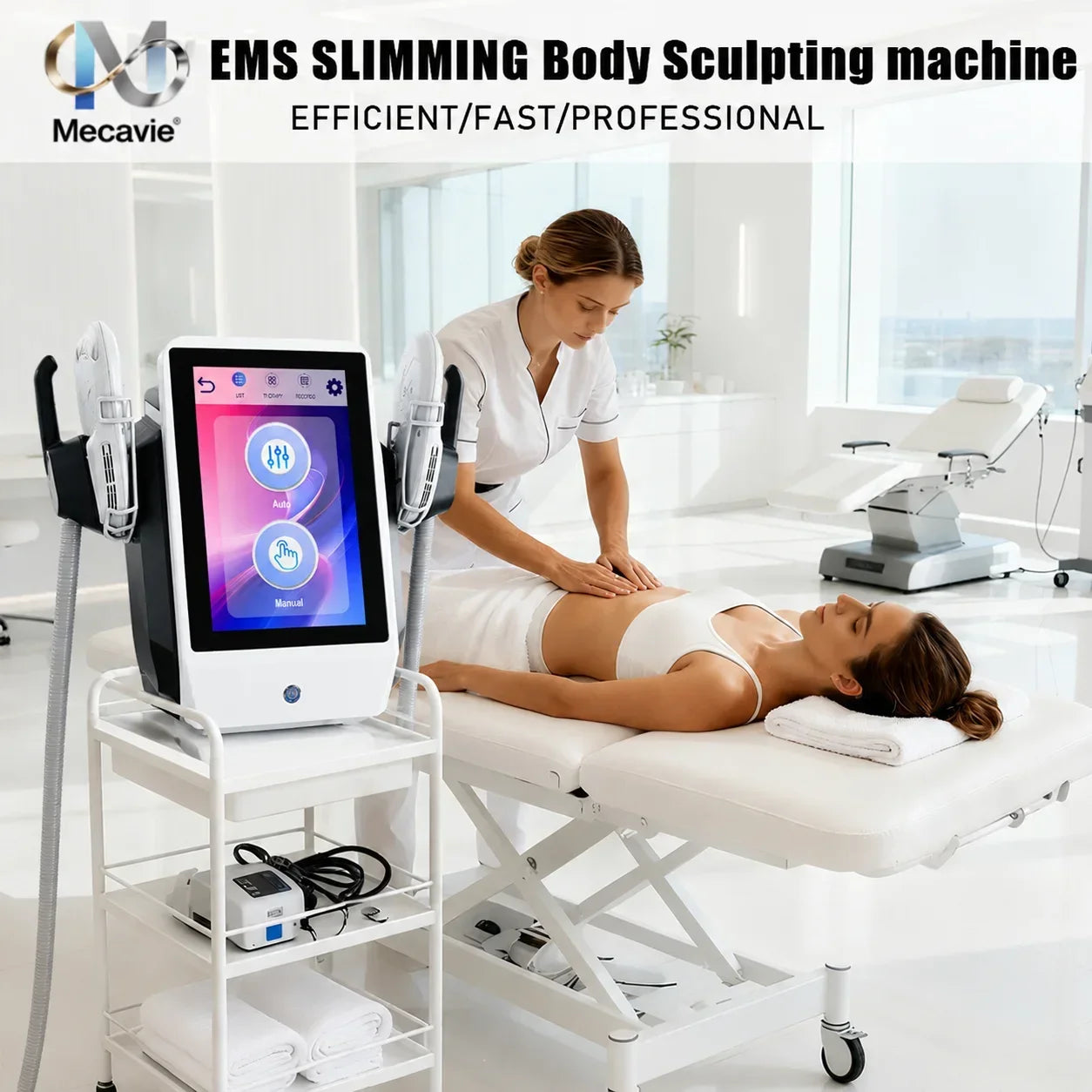
During a stimulation session, an applicator or electrode system is positioned over the intended treatment area. The device delivers electrical or electromagnetic energy according to its programmed settings. When the stimulation reaches an appropriate motor nerve pathway, the muscle responds with a contraction.
Users may feel repeated tightening, pulsing, contracting, or relaxing sensations as the stimulation cycles through its programmed pattern. Intensity and sensation vary substantially according to the technology, device, settings, applicator placement, and individual tolerance.
EMS vs. NMES: What’s the Difference?
EMS is a broad term for electrical muscle stimulation. NMES, or neuromuscular electrical stimulation, more specifically describes electrical stimulation intended to activate nerves that control skeletal muscle contraction.
Professional body-contouring equipment may use additional terminology, including HIEMT, to describe high-intensity stimulation designed to generate strong muscle contractions. These terms should not automatically be treated as interchangeable because devices differ in how energy is generated, delivered, controlled, and intended to be used.
Which muscles can stimulation target?
Abdominal stimulation can be designed around major muscles of the core, including portions of the rectus abdominis and other abdominal and trunk musculature depending on applicator positioning and device design. Professional body-contouring systems may also be configured for areas such as the buttocks, arms, and legs.
How Abdominal Muscle Stimulation Works
The mechanism can be understood as a sequence: stimulation signal → nerve or muscle activation → muscle contraction → repeated training stimulus.
How electrical stimulation triggers a muscle contraction
Voluntary movement normally begins when the nervous system sends electrical signals through motor nerves to skeletal muscle. Electrical stimulation devices attempt to reproduce part of this signaling process externally.
When the stimulation parameters are sufficient to activate the relevant motor nerves, muscle fibers contract. Repeated stimulation can therefore create a series of contractions during a session rather than a single sustained contraction.
This is different from simply placing a passive device over the abdomen. The relevant physiological action is the controlled activation of muscle tissue through the stimulation system.
What happens during a stimulation session?
A typical professional session involves positioning the applicator over the selected treatment area, selecting an automatic program or manual settings, gradually establishing a tolerable intensity, and allowing the device to complete its programmed cycle.
Depending on the equipment, the sensation may range from mild rhythmic contractions to much stronger muscle activity. A professional system may provide adjustable programs and intensity controls so the operator can adapt treatment parameters to the intended application and the manufacturer's instructions.
Why repeated contractions may support muscle adaptation
Muscle adapts to repeated physical demands. Traditional resistance training creates this demand through voluntary movement against resistance. Electrical or electromagnetic stimulation creates a different type of contraction stimulus.
However, a contraction alone does not guarantee a particular visual result. Training response depends on variables such as stimulation intensity, duration, frequency of sessions, baseline fitness, nutrition, recovery, and individual physiology. This is why abdominal muscle stimulation is better viewed as a modality that may complement a broader training strategy rather than a shortcut to guaranteed muscle definition.
Can Abdominal Muscle Stimulation Improve Muscle Definition?
Abdominal muscle stimulation may support muscle activation and, depending on the technology and use protocol, may contribute to changes in muscle performance or development. It cannot guarantee visible abdominal definition because muscle visibility also depends heavily on body composition and the amount of tissue covering the abdominal muscles.
Muscle definition vs. abdominal fat
One of the most important distinctions in body contouring is the difference between building or maintaining muscle and reducing the amount of body fat covering that muscle.
You can have well-developed abdominal muscles without seeing strong visual definition if sufficient subcutaneous fat remains over them. Conversely, reducing body fat does not automatically create highly developed abdominal musculature.
Abdominal stimulation should therefore not be presented as a substitute for nutrition or as a guaranteed fat-loss method. Its primary relevance in this context is targeted muscle activation.
What results are realistic?
Realistic expectations depend on the specific technology and starting point. Potential outcomes may include stronger perceived muscle activation during sessions, support for muscle conditioning, and changes in muscle appearance when stimulation is incorporated into an appropriate overall routine.
Visible results generally require consistency rather than a single treatment. They also vary from person to person, so marketing claims promising identical results for every user should be approached cautiously.
Factors that affect visible abdominal definition
- Existing abdominal muscle development
- Overall body composition
- Resistance-training history
- Nutrition and energy balance
- Stimulation intensity and protocol
- Session consistency
- Recovery and sleep
- Individual genetics and physiology
For readers interested in broader wellness technology, the Body Care and Health Devices collection provides a wider context for how body-focused devices fit into a personal care routine.
Can It Help With Hard-to-Tone Muscles?
Abdominal muscles can feel difficult to target effectively for several reasons. Some people have limited training time, others have difficulty maintaining consistent exercise technique, and some simply find repetitive abdominal exercises uncomfortable or ineffective for their goals.
Why some abdominal muscles are difficult to train effectively
Core training involves more than performing large numbers of crunches. Different abdominal and trunk muscles contribute to flexion, stabilization, rotation, and resistance to movement. Exercise selection and technique influence which muscles receive the greatest voluntary training stimulus.
Fatigue can also change technique. As a workout progresses, a person may unintentionally shift work toward other muscles rather than maintaining the intended movement pattern.
How targeted stimulation differs from voluntary contractions
With voluntary exercise, you consciously initiate the movement and coordinate multiple muscles to perform it. With stimulation, the external system provides the activation signal according to its programmed parameters.
That distinction makes stimulation interesting for targeted applications, but it also means that stimulation does not reproduce every benefit of active exercise. Traditional training develops movement coordination, strength through different ranges of motion, work capacity, and functional movement skills that a passive or externally driven contraction does not fully replicate.
When stimulation may be useful as an added training modality
People with limited time may find targeted stimulation attractive because it focuses on a specific muscle group without requiring a conventional workout session. It may also be considered by professionals looking to incorporate controlled muscle stimulation into a broader aesthetic or wellness service.
The strongest positioning is complementary: use stimulation as one component of a structured approach rather than treating it as an all-purpose replacement for physical activity.
Abdominal Muscle Stimulation vs. Traditional Abdominal Training
The comparison between stimulation and exercise is not necessarily about choosing one winner. The two approaches create muscle activity through different pathways and can serve different purposes.
| Factor | Abdominal muscle stimulation | Traditional abdominal training |
| How contraction begins | External electrical or electromagnetic stimulation | Voluntary nervous-system activation |
| Muscle activation | Targeted according to applicator/electrode placement and settings | Determined by exercise technique and movement pattern |
| Movement practice | May involve little or no voluntary movement | Develops movement and stabilization skills |
| Resistance loading | Not inherently equivalent to progressive resistance exercise | Can be progressively overloaded |
| Time requirement | Designed around programmed sessions | Requires active participation and exercise time |
| Body-composition impact | Should not be assumed to provide overall fat-loss results | Contributes to overall physical activity and energy expenditure |
| Best role | Potential complementary stimulation modality | Core component of comprehensive physical training |
Muscle contraction and training stimulus
Both approaches can produce muscle contractions, but the way those contractions are generated is different. Traditional training also allows the user to progressively change resistance, repetitions, tempo, range of motion, and exercise complexity.
EMS/NMES vs. resistance exercise
Electrical stimulation can create substantial localized contractions, but that does not make it physiologically identical to lifting resistance or performing loaded movements. Resistance training provides mechanical loading and requires the body to coordinate movement against an external challenge.
Can stimulation replace exercise?
No. Abdominal muscle stimulation should not generally be treated as a complete replacement for exercise. A comprehensive fitness program can provide benefits involving cardiovascular fitness, mobility, balance, coordination, functional strength, and overall physical activity that a localized stimulation session cannot reproduce.
Best approach: stimulation plus a broader core-training routine
For people whose goals include better muscle definition, a balanced strategy can combine appropriate resistance exercise, regular physical activity, adequate recovery, and nutrition with stimulation when it fits their objectives and the device's intended use.
For additional body and face care education, readers can explore the Body & Face Blog as part of a broader approach to personal-care routines.
Who Is Abdominal Muscle Stimulation For?
People looking for targeted abdominal training support
Abdominal stimulation may be relevant to adults who want a targeted muscle-activation modality and understand that it complements rather than replaces conventional exercise.
It can be particularly interesting for professionals operating aesthetic or wellness settings where controlled muscle stimulation is one part of a broader body-contouring service.
People struggling with lack of muscle definition
If the primary concern is that the abdominal area looks insufficiently defined, first determine whether the issue is primarily muscle development, body composition, or both. Stimulation addresses the muscle-activation side of the equation; it should not be presented as a universal solution for every cause of limited definition.
Who may need a different approach
Someone whose primary goal is significant weight loss, cardiovascular conditioning, mobility improvement, or functional strength development needs a broader strategy than localized muscle stimulation.
People with medical conditions, implanted electronic devices, pregnancy, recent surgery, unexplained pain, significant skin problems in the treatment area, or other relevant contraindications should seek appropriate professional guidance before using electrical or electromagnetic stimulation equipment.
If targeted devices are part of a larger personal-care routine, the Skin and Beauty Care Devices collection can also help place body-focused technology within a broader device category.
For professional users who want to investigate whether targeted stimulation fits their setup, the Emsnova EMS Body Sculpting Machine combines HIEMT, EMS, and RF technologies in one professional-oriented system.
How Often Can You Use an Abdominal Muscle Stimulation Device?
There is no universal stimulation schedule that applies to every device. Session frequency should follow the manufacturer's instructions, the specific technology, programmed treatment parameters, the intensity used, and the user's overall training load.
Factors that determine session frequency
- The type of stimulation technology
- Stimulation intensity
- Session duration
- Target muscle group
- Number of weekly sessions
- Whether the user is also performing resistance training
- Individual tolerance and recovery
- The manufacturer's recommended protocol
Why recovery matters between stimulation sessions
A strong muscle contraction is still a physical stimulus. Increasing intensity or frequency without allowing adequate recovery does not automatically accelerate results and may contribute to excessive soreness or fatigue.
When stimulation is combined with conventional abdominal training, remember that the muscles are receiving training stress from both sources. Total workload matters more than looking at either activity in isolation.
How to build stimulation into a weekly routine
A practical approach is to begin conservatively according to the device instructions, monitor how the muscles respond, and avoid assuming that maximum intensity or maximum frequency is automatically better.
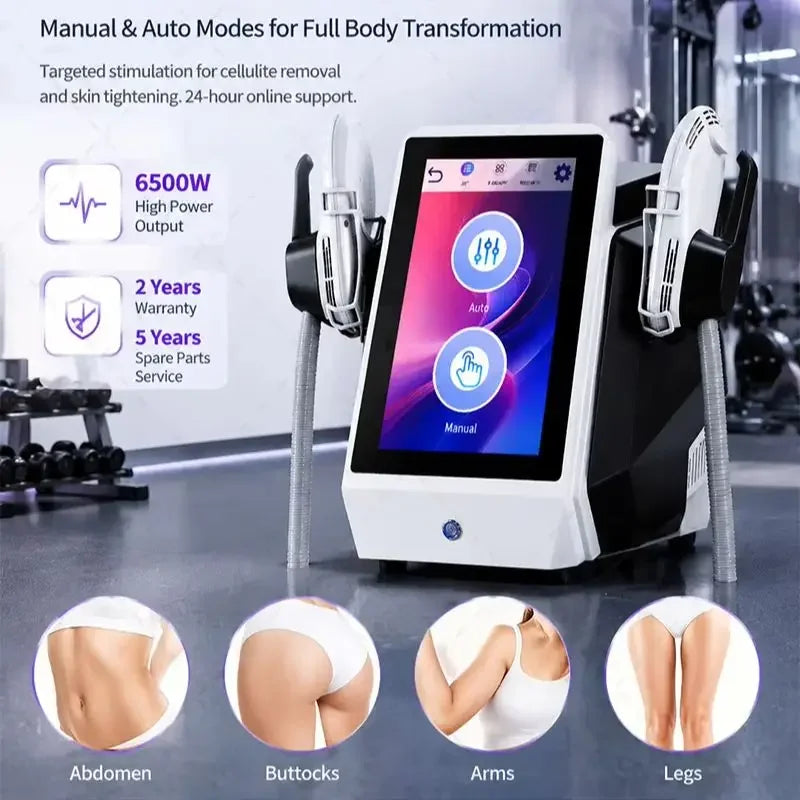
Professional equipment with automatic and manual operating modes can offer flexibility. For example, the Emsnova system is specified with both automatic and manual operation, allowing different approaches to device operation while keeping treatment parameters within the manufacturer's intended use.
What to Look for in an Abdominal Electrical Stimulation Device
Choosing a stimulation device should start with technology, intended use, operating controls, safety information, and support—not simply the highest advertised power number.
Adjustable intensity and stimulation modes
Look for clearly documented intensity controls and operating modes. Automatic programs can simplify operation, while manual controls may be useful for trained professional operators who need greater control within the manufacturer's specified parameters.
Electrode or applicator coverage
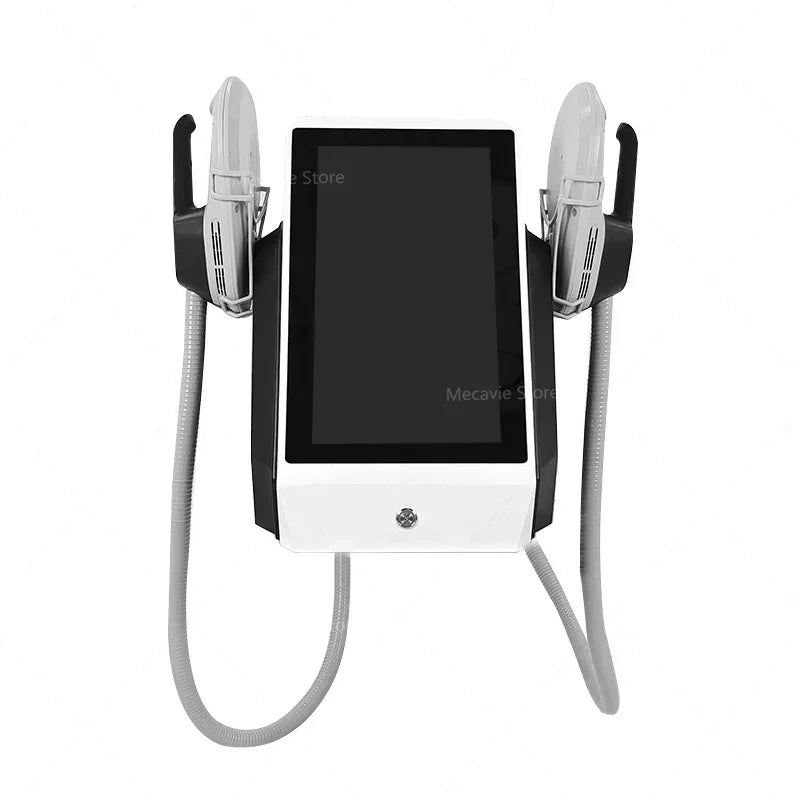
Applicator design affects where stimulation is delivered. For professional body-contouring equipment, consider whether the available handles or applicators are appropriate for the treatment areas you intend to address.
Comfort, fit, and ease of use
A technically sophisticated device still needs to be practical. Consider how applicators are positioned, how easily settings can be adjusted, whether treatment areas are straightforward to access, and whether the system can be integrated efficiently into the intended environment.
Controls, session presets, and usability
Clear controls matter when a device is used repeatedly. Automatic programs can help simplify standard operation, while manual operation can provide more flexibility for experienced users.
Safety features and manufacturer guidance
Review the supplied instructions, contraindications, warnings, intended treatment areas, operating limits, cleaning requirements, and maintenance information before purchasing. For professional equipment, warranty and spare-parts support are also meaningful selection criteria.
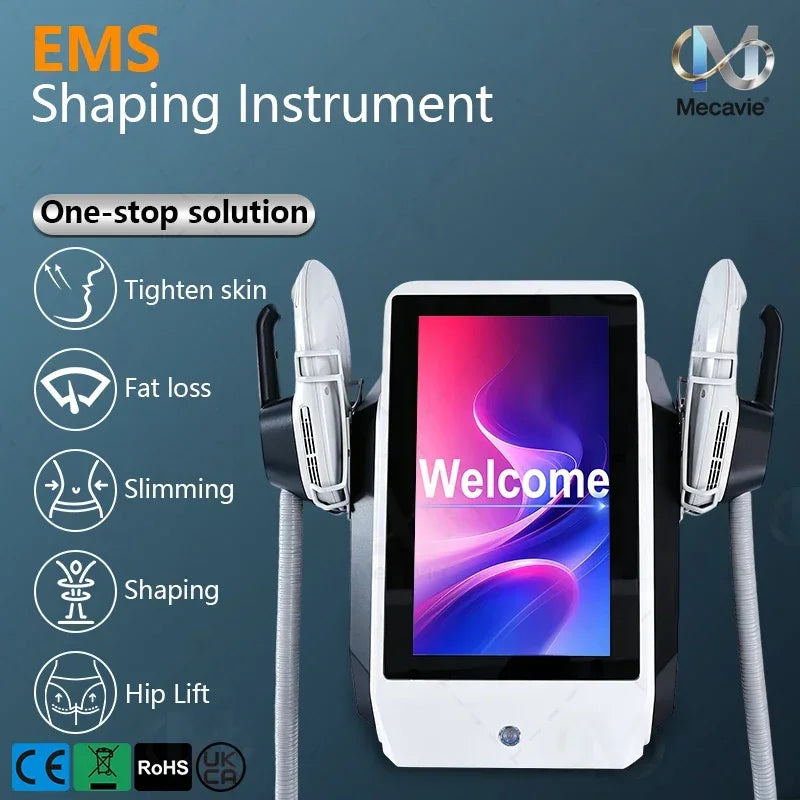
For example, the EMS Body Sculpting Machine for Muscle Toning & Body Contouring is specified as a professional Emsnova system using HIEMT + RF + EMS technology, with automatic and manual operation, AC power, CE and RoHS certification, a stated 2-year warranty, and 5-year spare-parts service.
Abdominal Muscle Stimulation Safety and Best Practices
Electrical and electromagnetic stimulation should be treated as professional technologies rather than ordinary passive wellness accessories. Correct operation matters because stimulation intensity and energy delivery can vary considerably between systems.
Follow the device's instructions
Always use the equipment according to its manufacturer documentation. Do not improvise treatment locations, exceed recommended settings, modify applicators, or assume that protocols for one device apply to another.
Common usage considerations
- Use the device only on approved treatment areas.
- Inspect equipment and applicators before use.
- Follow the recommended intensity progression.
- Do not use damaged equipment or cables.
- Keep treatment areas clean and follow applicable cleaning instructions.
- Stop if unexpected pain, significant discomfort, skin irritation, dizziness, or another concerning response occurs.
- Keep complete manufacturer documentation available for professional operators.
When to ask a healthcare professional before use
Medical screening may be appropriate before using muscle stimulation technology if you have an implanted electronic medical device, are pregnant, have recently undergone surgery, have an acute injury, unexplained abdominal symptoms, significant skin abnormalities in the treatment area, or another condition that could affect the safety of stimulation.
Professional operators should also follow applicable local requirements and the device manufacturer's labeling and training guidance. Certification markings such as CE or RoHS can provide useful information about a product's stated compliance framework, but they should not be interpreted as proof that every treatment is appropriate for every person.
How to Combine Abdominal Stimulation With a Complete Fitness Routine
The most sustainable way to approach abdominal muscle stimulation is to treat it as one tool within a broader routine.
Pair stimulation with resistance exercise
Resistance exercise remains valuable because it allows progressive loading and active movement. Exercises such as loaded carries, planks, controlled flexion movements, anti-rotation exercises, and appropriately selected resistance exercises can train the core through different functions.
Prioritize progressive abdominal training
Rather than simply increasing the number of repetitions indefinitely, consider how your training stimulus changes over time. Increasing resistance, improving technique, changing leverage, or progressing exercise difficulty can provide a structured challenge.
Allow adequate muscle recovery
Recovery is part of training. If your abdominal muscles are already receiving substantial exercise stress, adding high-intensity stimulation sessions should be considered as additional workload rather than completely separate activity.
Set realistic expectations for muscle definition
Visible definition is influenced by muscle size, body composition, genetics, nutrition, and consistency. Stimulation can address one component of the equation, but no single device can control every factor.
Abdominal Muscle Stimulation: What Results Should You Expect?
What stimulation may help with
- Creating controlled contractions in targeted muscles
- Adding a muscle-stimulation modality to an existing routine
- Supporting targeted muscle-conditioning goals
- Providing an option for professional body-contouring environments
- Addressing targeted muscle activation when conventional training time is limited
What stimulation cannot guarantee
- A specific amount of abdominal fat reduction
- Visible six-pack definition for every user
- Results identical to resistance training
- Permanent body-composition changes from stimulation alone
- Results without consistent use and appropriate overall lifestyle habits
How long results may take to become noticeable
There is no reliable universal timeline because outcomes depend on the technology, protocol, starting condition, training habits, body composition, and individual response. Early sessions may primarily be noticeable through the sensation of muscle contractions rather than dramatic visual changes.
When appearance is the goal, evaluate progress over an appropriate period rather than judging the effectiveness of a stimulation device after one session. Consistency, recovery, nutrition, and the rest of the training program all influence the final result.
Abdominal Muscle Stimulation: A Practical Decision Framework
Before choosing a device, ask five questions:
- What is the actual goal? Decide whether you want muscle activation, conditioning support, body contouring, or a broader fitness outcome.
- What technology does the device use? Distinguish EMS/NMES from electromagnetic stimulation and understand whether additional technologies such as RF are included.
- Who will operate it? Professional equipment may require appropriate training, setup, and adherence to manufacturer guidance.
- What areas can it treat? Confirm that the applicators and intended treatment areas match your use case.
- What support comes with the system? Consider warranty coverage, spare parts, documentation, and manufacturer support alongside technical specifications.
For a professional system combining multiple technologies, the Emsnova EMS body sculpting machine is specified for the abdomen, buttocks, arms, and legs and combines HIEMT + RF + EMS with automatic and manual operation. Its listed specifications include 6500W power, ABS + TPR construction, AC power, and CE and RoHS certification.
Frequently Asked Questions About Abdominal Muscle Stimulation
What is abdominal muscle stimulation?
Abdominal muscle stimulation uses controlled electrical or electromagnetic stimulation to produce contractions in targeted abdominal muscles. Depending on the equipment, it may be described using terms such as EMS, NMES, or HIEMT.
Can abdominal muscle stimulation help with hard-to-tone muscles?
It may provide targeted muscle activation for people who have difficulty achieving their desired training stimulus through conventional exercise alone. However, it should be considered a complementary modality rather than a guaranteed solution for hard-to-tone areas.
Does abdominal muscle stimulation improve muscle definition?
It may support muscle conditioning and, depending on the technology and protocol, contribute to changes in muscle development or appearance. Visible definition also depends on body composition, existing muscle development, nutrition, genetics, and training consistency.
How often can you use an abdominal muscle stimulation device?
Frequency depends on the specific device, treatment parameters, intensity, session duration, and overall training load. Follow the manufacturer's recommended protocol rather than assuming that more frequent or more intense sessions produce better results.
Is abdominal muscle stimulation a replacement for exercise?
No. Stimulation can create targeted muscle contractions, but it does not reproduce all the benefits of active exercise, including progressive resistance training, cardiovascular conditioning, movement practice, coordination, and overall physical activity.
The Bottom Line on Abdominal Muscle Stimulation
Abdominal muscle stimulation offers a way to create targeted muscle contractions without relying entirely on voluntary movement. That makes EMS, NMES, and professional high-intensity stimulation technologies relevant to people interested in targeted muscle activation, body contouring, and additional training modalities.
The key is to keep expectations precise. Muscle stimulation is not synonymous with fat loss, and stronger contractions do not automatically mean visible abdominal definition. The most sensible approach is to consider stimulation alongside resistance exercise, nutrition, recovery, and realistic body-composition goals.
For professional users evaluating a system that combines targeted muscle stimulation with RF technology, the Emsnova EMS Body Sculpting Machine can be considered as one option when its specifications, treatment areas, operating modes, support, and intended use align with the needs of the setup.
Pillar Article: Abdominal Muscle Stimulation Device: Benefits, Safety & Buying Guide













