

Lash Extension Tray Quality: How to Spot Professional-Grade Lashes
Two lash extension trays can carry the same labeled curl, diameter, and length yet perform very differently during pickup, placement, styling, and wear. The difference is often manufacturing consistency rather than the specification printed on the tray. Lash extension tray quality is best evaluated through observable factors such as fiber uniformity, diameter accuracy, curl memory, strip release, base stability, stiffness, weight, finish, tray consistency, and batch-to-batch reliability.
For lash artists and wholesale buyers, these details matter because inconsistent fibers can increase sorting time, slow pickup, complicate placement, create uneven styling, and make repeat orders less predictable. A professional-grade tray should perform consistently—not simply look good in its packaging.
What Makes a Lash Extension Tray High Quality?
A high-quality lash extension tray combines accurate specifications with predictable physical performance. Professional lashes should have consistent fibers, stable curls, controlled stiffness, secure but workable strip adhesion, clean bases, and repeatable dimensions across the tray.
The 10-point lash tray quality checklist
- Fiber uniformity: neighboring lashes should have a consistent appearance, shape, and thickness.
- Diameter accuracy: the stated diameter should correspond closely to the physical fibers throughout the tray.
- Curl memory: fibers should maintain a predictable curl instead of flattening or changing shape easily.
- Strip adhesion and release: lashes should stay organized on the strip but release cleanly with controlled pickup.
- Base stability: lash bases should remain aligned and structurally consistent during removal.
- Stiffness: fibers need enough structure for control without feeling excessively rigid or brittle.
- Weight consistency: comparable fibers should provide predictable weight for the selected diameter and styling.
- Finish: the surface should have a controlled, consistent matte or gloss appearance without obvious defects.
- Tray consistency: the same specifications should produce similar physical performance from tray to tray.
- Batch reliability: repeat orders should maintain comparable fiber, curl, strip, and finish characteristics.
Why specifications alone do not prove quality
A tray labeled 0.15 mm, C curl, and 12 mm does not automatically guarantee that every fiber behaves like a true 0.15 mm C-curl 12 mm lash. Manufacturing tolerances, fiber processing, curling, finishing, and strip bonding can introduce variation.
Specifications are therefore the starting point, not the complete quality assessment. A professional buyer should compare the stated specifications with physical performance across multiple fibers and, ideally, multiple trays.
How to Evaluate Lash Extension Fibers Before Buying
Begin with the fibers themselves. Look across several neighboring lashes rather than judging one strand. Professional lash extension fibers should appear clean, uniform, and structurally consistent.
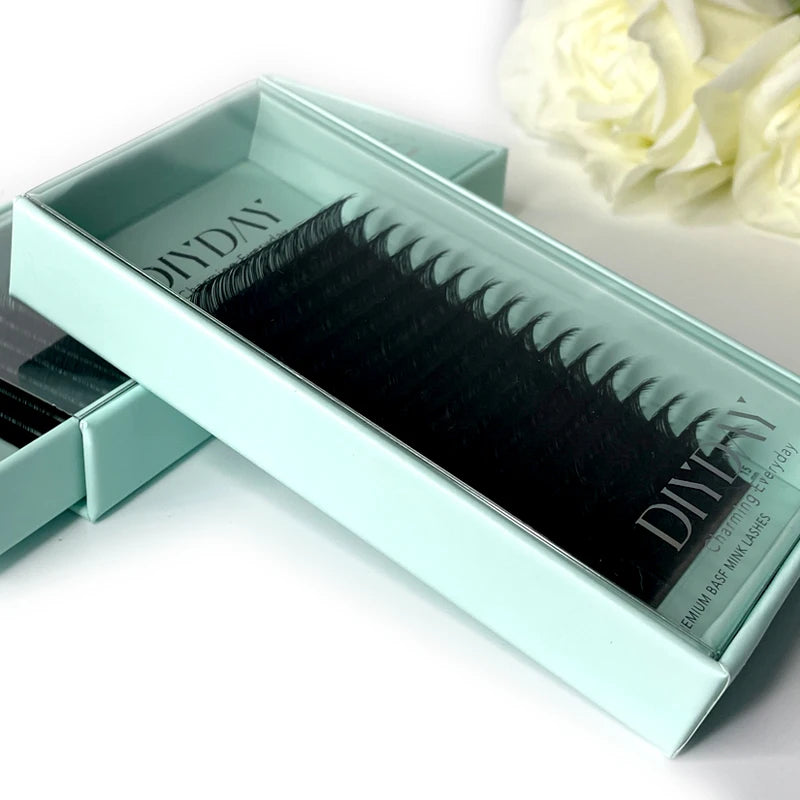
Fiber uniformity and surface finish
Look for consistent thickness, smooth surfaces, predictable tips, and clean silhouettes. Uneven fibers can make tweezer pickup less predictable and may require the artist to spend additional time sorting or rejecting individual lashes.
Rough surfaces, visibly irregular tapering, damaged tips, or inconsistent shapes are warning signs. The goal is not merely a soft fiber; it is a fiber that behaves consistently from one pickup to the next.
Softness versus excessive stiffness
Softness is useful when it supports natural movement and comfortable manipulation, but softness alone is not a quality metric. A fiber that is excessively flexible may be difficult to control, while an overly rigid fiber can feel harsh and may resist precise placement.
The practical target is controlled flexibility: enough structure for accurate pickup and placement while remaining lightweight and workable.
Matte versus overly glossy finish
A consistent matte black finish is often desirable when the goal is a seamless, natural-looking classic lash set. However, the important quality signal is consistency. Uneven shine, surface defects, or visibly different finishes between fibers can indicate inconsistent processing.
Check Lash Extension Diameter Accuracy and Weight
Diameter affects more than appearance. It contributes to the physical weight and behavior of an individual lash extension. For classic lash applications, predictable diameter helps artists select extensions appropriate to the natural lash and intended styling.
Why diameter consistency matters for application
When fibers within the same tray vary noticeably in thickness, pickup and placement can become less predictable. A visibly heavier or thinner neighboring lash may also change the appearance of a finished set.
Consistent diameter supports repeatable styling because the artist can expect comparable fibers to behave similarly during application.
How to spot diameter variation in a tray
- Choose several neighboring fibers from different areas of the strip.
- Compare their apparent thickness under good lighting.
- Look for sudden changes in shaft thickness or visibly uneven bases.
- Repeat the comparison in another section of the tray.
- Compare a second tray with the same labeled specification when possible.
Weight consistency and natural-lash compatibility
Extension selection should always consider the natural lash, the chosen diameter, the styling objective, and the professional's application method. A consistent tray makes that decision more predictable because the stated diameter is less likely to conceal large physical variations.
Evaluate Lash Extension Curl and Curl Memory
Curl quality is not simply about how dramatic an extension looks in the tray. Curl memory describes how consistently a fiber maintains its intended shape when handled and used during application.
What good curl memory looks like
Strong curl consistency means multiple fibers with the same labeled curl show a similar profile and maintain that profile during normal handling. Predictable curl makes placement and styling more repeatable.
Signs of weak or inconsistent curl
- Some fibers appear noticeably flatter than neighboring lashes.
- Curves vary even though the labeled curl is identical.
- Fibers distort easily during ordinary handling.
- The base or upper curve appears visibly twisted.
- Different sections of the tray show different curl profiles.
Simple curl stability test
Compare at least five to ten fibers from different areas rather than testing a single lash. Examine their side profiles and compare the curve. Then repeat the check with another tray of the same specification. A professional supplier should be able to provide repeatable results rather than relying on one visually perfect sample.
Inspect Lash Extension Strips and the Lash Extension Base
The strip is one of the most overlooked parts of lash tray quality. Even excellent fibers can become inefficient to use if the strip holds too aggressively, releases prematurely, creates residue, or allows bases to shift.

Strip adhesion: secure enough to organize, not difficult to release
Good strip construction balances organization with release. Lashes should remain orderly during storage and handling, but the artist should be able to remove individual fibers without excessive pulling, twisting, or damage.
Base stability and alignment
Stable bases help support controlled tweezer pickup. When fibers shift, twist, or detach unpredictably, the artist may spend additional time correcting the lash before placement.
Signs of poor strip construction
- Fibers detach before intended pickup.
- Lashes resist removal and deform at the base.
- Adhesive residue transfers to the fiber or tools.
- Individual bases twist as they are removed.
- Rows become difficult to organize after repeated pickups.
How Lash Tray Quality Affects Application Efficiency
The value of a professional lash tray is ultimately measured in workflow. Fiber quality becomes commercially important when it changes how quickly and accurately an artist can work.
Pickup speed and tweezer control
Uniform fibers and predictable strip release reduce unnecessary manipulation. When the lash lifts cleanly and behaves consistently, the artist can spend less time correcting individual fibers.
Fan formation and base control
For techniques where controlled manipulation or fan formation is required, consistent fiber structure and predictable bases can make repeated movements easier to manage. Classic lash artists also benefit from predictable bases because individual extensions need to be isolated and positioned accurately.
Placement precision and styling consistency
Consistent diameter, curl, stiffness, and alignment help reduce variation between neighboring applications. That matters when an artist is trying to reproduce a specific mapping or maintain a uniform appearance across both eyes.
Professional Lash Extension Tray Quality Checklist
10-factor quality scorecard
Use a simple 1–5 score for each factor when evaluating samples. A score of 5 means highly consistent, 3 means acceptable but worth monitoring, and 1 means a significant quality concern.
| Quality factor | What to inspect | Professional target |
| Fiber uniformity | Shape, thickness, tips | Consistent across the tray |
| Diameter accuracy | Visible thickness variation | Minimal variation |
| Curl memory | Curve consistency and stability | Predictable curl |
| Strip release | Pickup resistance and residue | Secure yet clean release |
| Base stability | Alignment and twisting | Stable, clean bases |
| Stiffness | Flexibility versus rigidity | Controlled flexibility |
| Weight | Consistency within specification | Predictable physical behavior |
| Finish | Matte/gloss uniformity | Consistent surface appearance |
| Tray consistency | Performance between trays | Repeatable results |
| Batch reliability | Repeat-order performance | Stable specifications and behavior |
Pass, caution, and reject signals
- Pass: fibers, curls, bases, finish, and strip release remain consistent across multiple samples.
- Caution: minor variation exists but does not materially affect pickup, placement, or styling.
- Reject: major diameter variation, unstable curls, damaged fibers, excessive residue, premature detachment, or significant tray-to-tray differences are present.
A useful buying rule is to investigate the lowest scores rather than relying only on the average. One serious defect—such as unstable curl or excessive strip residue—can create more workflow problems than several minor cosmetic imperfections.
Why Lash Extension Quality Can Vary Between Trays or Batches
Batch consistency depends on manufacturing controls. Fiber production, diameter control, curling, finishing, bonding, and strip processing all have tolerances. If those processes are not controlled consistently, two trays with identical labels may not behave identically.
Manufacturing tolerances and process consistency
Professional buyers should ask suppliers how specifications are controlled and how finished trays are inspected. Consistency is especially important for salons because changing physical characteristics can force artists to adjust their technique when a reorder arrives.
Material and finishing differences
Processing and finishing can influence surface appearance, stiffness, flexibility, and curl behavior. This is why broad claims such as “premium,” “soft,” or “professional” are less useful than documented specifications combined with physical sample testing.
Why sample approval matters for wholesale orders
Wholesale buyers should test samples before committing to a large order. Ideally, compare several trays and, when practical, samples from more than one production batch. This provides a better indication of supplier reliability than evaluating one sample alone.
How to Inspect Lash Extension Trays Before Professional Use
A repeatable inspection process can turn quality evaluation into a routine purchasing control.
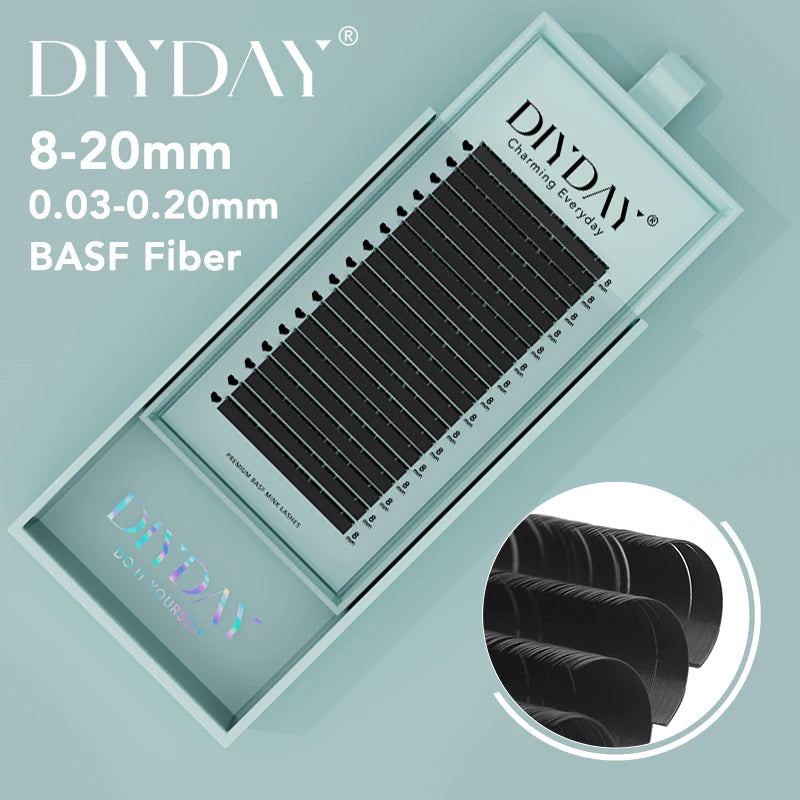
Step 1: Check labeling and specifications
Confirm length, diameter, curl, material, quantity, and any other documented specifications before opening the tray.
Step 2: Inspect fiber uniformity and finish
Compare multiple fibers for thickness, surface consistency, taper, tips, and overall appearance. Do not judge the tray from a single strand.
Step 3: Test curl memory and stiffness
Compare the curl profiles of several fibers and assess whether they maintain predictable shape during ordinary handling. The fibers should provide enough structure for control without appearing excessively rigid.
Step 4: Test strip release and base stability
Remove several fibers from different parts of the strip. Observe whether they release cleanly, remain aligned, and avoid excessive residue or base deformation.
Step 5: Compare multiple trays
This is the most important step for wholesale buyers. A tray can perform well in isolation but still fail a consistency test if the next tray behaves differently.
What to Check When Buying Lash Extension Trays Wholesale
Wholesale buyer decision framework
For larger purchases, prioritize five areas: documented specifications, physical sample consistency, manufacturing quality control, packaging and handling, and reorder reliability. A low unit price is less attractive if inconsistent lashes increase sorting, waste, application time, or client-service variability.
Questions to ask a lash extension supplier
- What fiber material is used?
- What tolerances are maintained for diameter and length?
- How is curl consistency checked?
- How are strip adhesion and release controlled?
- Are finished trays inspected before shipment?
- Can samples from multiple trays or batches be evaluated?
- How is consistency maintained for repeat orders?
- What happens if a delivered batch does not match the approved sample?
For buyers comparing professional lash supplies, it is useful to evaluate the supplier's documented specifications and quality-control information alongside the physical sample rather than treating price as the primary purchasing criterion.
When a lower price signals higher workflow cost
Inconsistent lashes can create hidden costs through slower pickup, more rejected fibers, additional sorting, greater application time, and inconsistent results. For a working lash artist, the effective cost of a tray includes both its purchase price and the labor required to use it efficiently.
Pros of investing in consistent trays:
- More predictable pickup and placement.
- Less sorting and fiber rejection.
- More consistent curl and styling results.
- Better repeatability when reordering.
- More efficient professional workflow.
Potential drawbacks to evaluate:
- Higher-quality trays may have a higher initial unit cost.
- Sample testing requires time before a wholesale commitment.
- Different curl, diameter, and length specifications still require appropriate natural-lash assessment and technique.
For broader beauty and professional-care product research, KentDo's Beauty & Self-Care Blog and related beauty collections can provide additional category context when planning a professional purchasing workflow.
Choosing Professional-Grade Lash Extension Trays: A Practical Decision Guide
For individual tray purchases
Prioritize physical consistency over marketing language. Check fiber uniformity, predictable pickup, curl stability, strip construction, finish, and documented diameter and length. If the tray performs consistently across multiple fibers, it is a stronger candidate for professional use.
For wholesale purchasing
Raise the standard from “Does this tray look good?” to “Will the next shipment behave the same way?” Sample approval, quality-control procedures, manufacturing consistency, documented specifications, and supplier communication become critical.
What professional-grade consistency should look like
Classic Eyelash Extension 10 Trays Soft Natural Volume Pro+ provides a useful example of how documented specifications can be evaluated against this framework. The product is described as using premium synthetic fiber with a matte black finish, handmade manufacturing, a 7–25 mm length range, and multiple curl options including B, C, CC, D, DD, L, L+, LU, LC, and LD. The supplied product information also identifies soft fibers, lightweight construction, and curl-lock technology intended to maintain shape.
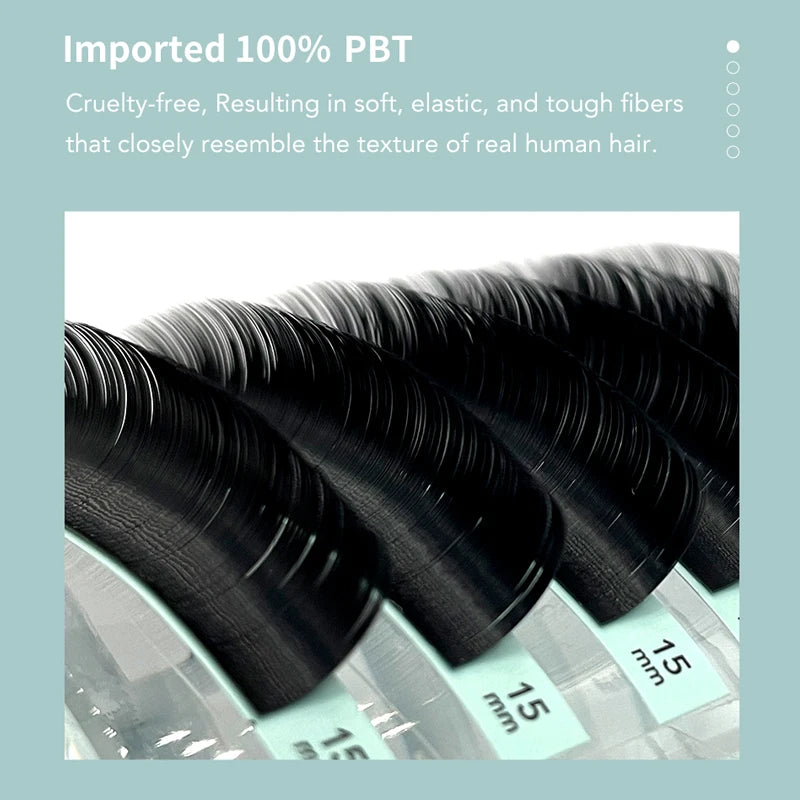
Those specifications address several of the quality criteria in this guide, including material, finish, curl selection, length range, and manufacturing method. The strongest purchasing approach is still to compare the physical tray against the checklist above and assess consistency across multiple trays when buying in larger quantities.
Review the documented specifications: Classic Eyelash Extension 10 Trays Soft Natural Volume Pro+.
Lash Extension Tray Quality Comparison Matrix
Use this quick matrix before approving a new tray or supplier sample:
| Evaluation area | Professional-grade signal | Warning signal |
| Fibers | Uniform, smooth, consistent | Rough, irregular, visibly different |
| Diameter | Predictable thickness | Noticeable variation |
| Curl | Stable and repeatable | Flattened or mismatched |
| Strip | Secure and clean release | Premature detachment or resistance |
| Base | Aligned and stable | Twisting or deformation |
| Stiffness | Controlled flexibility | Excessively rigid or difficult to manipulate |
| Finish | Consistent matte or gloss appearance | Uneven shine or surface defects |
| Batch consistency | Similar performance across orders | Significant tray-to-tray variation |
Final Lash Extension Tray Quality Checklist
Professional lash extension tray quality should be measurable rather than based on vague claims such as “soft,” “premium,” or “long-lasting.” Before purchasing, evaluate fiber uniformity, diameter accuracy, curl memory, strip release, base stability, stiffness, weight, finish, tray consistency, and batch reliability.
For individual trays, focus on predictable application and physical consistency. For wholesale orders, place even greater emphasis on repeatability, sample approval, documented specifications, manufacturing quality control, and supplier communication.
The best professional tray is not necessarily the one with the longest feature list. It is the one that consistently delivers the physical characteristics your lash artists expect, from the first pickup to the final tray in the order.
Ready to compare a professional tray against the quality framework? Review the documented specifications and evaluate the Classic Eyelash Extension 10 Trays Soft Natural Volume Pro+ using the same 10-point inspection process before making your purchasing decision.
Pillar Article: Lash Extension Curl Retention: What Pros Should Look For













