
How to Target Upper Body Muscles: Exercises, Form & Techniques
Performing upper-body exercises without understanding which muscles are doing the work can make training feel repetitive and less effective. Knowing how to target upper body muscles involves more than choosing an exercise—it requires understanding movement direction, grip position, elbow angle, range of motion, and the role of supporting muscles. Small technique adjustments can change how an exercise feels and which muscle groups contribute most to the movement.
Whether you're training at home or in a gym, you can develop your chest, shoulders, back, biceps, triceps, and forearms through a combination of compound exercises and targeted movements. This guide explains the anatomy behind upper-body training, practical exercise choices, technique adjustments, and a beginner-friendly routine for building balanced strength.
How Upper Body Muscles Work Together
Upper-body exercises rarely work just one muscle. Most movements involve several muscles working together to move a joint, stabilize your body, and control resistance. Understanding these relationships helps you select exercises more effectively and avoid relying on the same movement patterns for every workout.
The Six Main Upper-Body Muscle Groups
The upper body contains several major muscle groups that contribute to pushing, pulling, lifting, gripping, and stabilizing movements.
- Chest: The pectoralis major helps move the arm across the body and supports pressing movements. The pectoralis minor contributes to scapular positioning.
- Shoulders: The anterior, lateral, and posterior deltoid heads help raise, rotate, and move the upper arm in different directions.
- Back: The latissimus dorsi helps pull the arm down and backward. The trapezius and rhomboids help control shoulder-blade movement.
- Biceps and elbow flexors: The biceps brachii assists with elbow flexion and forearm supination, while the brachialis contributes to elbow bending.
- Triceps: The triceps brachii extends the elbow. Its long head also contributes to shoulder movement.
- Forearms: The forearm flexors, extensors, and other muscles support gripping, wrist movement, and forearm rotation.
Primary Movers, Secondary Muscles, and Stabilizers
The primary mover is the muscle contributing most directly to a movement. Secondary muscles assist, while stabilizers help maintain control and joint positioning.
During a push-up, the pectoralis major contributes to pressing the body away from the floor. The triceps extend the elbows, the anterior deltoids assist shoulder movement, and the core muscles help maintain a stable body position.
During a row, the back muscles contribute to pulling the arms toward the torso, while the biceps help bend the elbows and the core stabilizes the body.
Understanding Push vs. Pull Movements
Push and pull exercises train complementary movement patterns:
- Horizontal pushing: Push-ups and bench presses emphasize chest, triceps, and anterior shoulders.
- Vertical pushing: Overhead presses emphasize the deltoids and triceps.
- Horizontal pulling: Rows recruit the back, biceps, rear shoulders, and scapular stabilizers.
- Vertical pulling: Pull-ups and lat pulldowns emphasize the latissimus dorsi, biceps, and other back muscles.
Combining pushing and pulling exercises creates a more balanced upper-body training plan than repeatedly performing pressing exercises alone.
How to Target Chest Muscles Effectively
Chest training primarily focuses on the pectoralis major, a large muscle that contributes to horizontal adduction of the upper arm—the action of bringing your arms toward the midline of your body. Pressing and pushing exercises train the chest while also recruiting shoulders and triceps.
Chest Muscle Anatomy: Pectoralis Major vs. Pectoralis Minor
The pectoralis major is the primary chest muscle involved in most pressing movements. Its different fiber regions contribute to arm movement depending on shoulder position and exercise direction. The pectoralis minor lies beneath it and helps control scapular movement rather than directly producing most pressing force.
Best Exercises to Target the Chest
- Standard push-ups: Train the chest, triceps, and anterior deltoids through horizontal pushing.
- Incline push-ups: Reduce the amount of body weight being pushed, making them useful for beginners.
- Decline push-ups: Elevate the feet to change torso angle and increase exercise difficulty.
- Dumbbell presses: Allow adjustable resistance and a controlled pressing range.
- Chest fly variations: Focus on bringing the arms toward the midline with relatively less elbow extension.
How Hand Position and Elbow Angle Change Chest Emphasis
Hand spacing, elbow angle, and torso position influence the mechanics of a push-up or press. A moderate hand width with elbows angled roughly 30–60 degrees from the torso is a practical starting point for many people.
Extremely wide hand positions or excessive elbow flare may increase shoulder discomfort for some exercisers. Choose a position that allows a comfortable range of motion, stable wrists, and controlled repetitions.
Step-by-Step: Proper Push-Up Form for Chest Activation
- Place your hands slightly wider than shoulder width or at a comfortable pressing width.
- Align your shoulders, hips, and ankles in a straight line, or use an elevated surface for an easier variation.
- Brace your abdomen and maintain a controlled body position.
- Lower your chest toward the floor by bending your elbows without allowing your hips to sag.
- Press through your hands to return to the starting position.
- Keep your movements smooth and use a range of motion that you can control comfortably.
Beginners can start with wall push-ups, countertop push-ups, or knee-supported push-ups before progressing to floor variations.
How to Target Shoulder Muscles
Shoulder training is most effective when it includes movement in several directions rather than focusing only on overhead pressing. The deltoids have three main regions, each contributing to different shoulder actions.
Understanding the Three Deltoid Heads
- Anterior deltoid: Helps raise the arm forward and assists pressing movements.
- Lateral deltoid: Contributes to raising the arm out to the side.
- Posterior deltoid: Helps move the arm backward and contributes to horizontal abduction.
Best Exercises for Front, Side, and Rear Delts
- Overhead press: Emphasizes the anterior and lateral deltoids, with triceps assistance.
- Front raises: Focus on shoulder flexion and the anterior deltoid.
- Lateral raises: Emphasize shoulder abduction and lateral deltoid involvement.
- Reverse flyes: Recruit the posterior deltoids and upper-back muscles.
- Face pulls: Combine pulling and external-rotation-related movement to train rear shoulders and supporting upper-back muscles.
How Elbow Position and Movement Direction Affect Shoulder Targeting
During lateral raises, move your arms outward with a slight bend in the elbows. Avoid shrugging excessively or swinging the weights. During overhead presses, keep your ribs controlled and avoid arching your lower back to compensate for limited shoulder movement.
Resistance should be light enough to maintain consistent movement and appropriate shoulder positioning. Increasing weight at the expense of control can make the exercise less effective and increase discomfort.
Common Shoulder Training Mistakes
- Shrugging excessively during lateral raises.
- Using momentum instead of controlled shoulder movement.
- Arching the lower back excessively during overhead presses.
- Using resistance that prevents a comfortable range of motion.
- Neglecting rear-deltoid exercises in favor of front-shoulder movements.
How to Target Back Muscles
Back training involves horizontal and vertical pulling movements that recruit different combinations of the latissimus dorsi, trapezius, rhomboids, posterior deltoids, and supporting muscles. The direction in which you pull and the movement of your shoulder blades influence the muscles involved.
Understanding the Latissimus Dorsi, Trapezius, and Rhomboids
The latissimus dorsi contributes to shoulder extension and adduction, helping bring the arm downward or backward. The trapezius supports scapular elevation, depression, rotation, and retraction depending on the region involved. The rhomboids help retract and stabilize the shoulder blades.
Best Exercises for Different Back Muscles
- Pull-ups: Train the lats, biceps, and supporting upper-back muscles.
- Lat pulldowns: Provide a scalable vertical-pulling exercise for the lats and elbow flexors.
- Bent-over rows: Recruit the lats, rhomboids, trapezius, posterior deltoids, and elbow flexors.
- Seated rows: Train the back through horizontal pulling with adjustable resistance.
- Reverse flyes: Emphasize posterior deltoids and upper-back muscles.
- Resistance-band rows: Offer a practical home alternative for horizontal pulling.
How Grip Width and Elbow Direction Change Back Emphasis
Pulling your elbows closer to your torso and directing them toward your hips can emphasize lat involvement during rows. Moving the elbows farther outward during a row generally increases the contribution of posterior deltoids and upper-back muscles.
Grip variations change the mechanics of the movement, but they do not isolate a single muscle completely. Choose a grip that provides a comfortable range of motion and consistent control.
Understanding Scapular Movement During Back Exercises
Shoulder blades naturally move during pulling exercises. In a row, they can move forward slightly as the arms extend and retract as you pull. During pulldowns, scapular movement also helps coordinate the shoulder and arm.
Keeping the shoulder blades rigid throughout every repetition is not necessary. Allow controlled movement while avoiding excessive shrugging or uncontrolled shoulder positioning.
How to Target Biceps and Other Elbow Flexors
Biceps training focuses on elbow flexion and, when the forearm rotates, supination. Exercises that bend the elbow with different grip orientations can help develop the biceps brachii, brachialis, and brachioradialis.
Biceps Brachii vs. Brachialis: What Is the Difference?
The biceps brachii crosses the elbow and shoulder and contributes to elbow flexion and forearm supination. The brachialis lies beneath the biceps and contributes strongly to elbow flexion regardless of forearm rotation.
Best Exercises to Target the Biceps
- Standard dumbbell curls: Train elbow flexion with a supinated grip.
- Incline curls: Place the upper arm behind the torso to change the starting position of the biceps.
- Hammer curls: Use a neutral grip and recruit the brachialis and brachioradialis prominently.
- Resistance-band curls: Provide adjustable resistance for home training.
How Grip Orientation Changes Biceps Activation
A supinated grip, with palms facing upward, directly involves the biceps in elbow flexion and forearm supination. A neutral grip, used during hammer curls, increases the emphasis on the brachialis and brachioradialis. A pronated grip can shift the contribution toward other elbow flexors.
Grip changes influence recruitment rather than completely isolating a muscle.
Proper Curl Form and Common Mistakes
- Stand or sit with your upper arms relatively stable.
- Begin with your elbows comfortably extended.
- Flex your elbows to lift the resistance.
- Keep your wrists neutral and avoid excessive swinging.
- Lower the weight slowly to a comfortable starting position.
Avoid leaning backward, swinging the weights, or bending your wrists excessively to complete repetitions.
How to Target Triceps Muscles
The triceps brachii extends the elbow and contributes to pressing movements. Training the triceps through different shoulder positions can help develop all three heads of the muscle.
Understanding the Three Triceps Heads
- Long head: Crosses the shoulder joint and contributes to elbow extension and shoulder movement.
- Lateral head: Contributes to elbow extension and is prominent during many pressing movements.
- Medial head: Assists elbow extension across a range of loads and movement conditions.
Best Exercises for Triceps Development
- Close-grip push-ups: Emphasize elbow extension while also recruiting chest and shoulders.
- Triceps dips: Train elbow extension using body weight, although they may be uncomfortable for some shoulders.
- Overhead extensions: Train elbow extension with the arms overhead, placing the long head at a different muscle length.
- Cable or resistance-band pushdowns: Provide controlled elbow-extension resistance.
How Arm Position Influences Triceps Emphasis
Overhead triceps exercises position the long head at a relatively longer muscle length because it crosses the shoulder joint. Pushdowns and other elbow-extension exercises performed with the upper arm closer to the torso train the triceps in a different shoulder position.
Use controlled repetitions and avoid forcing your elbows into uncomfortable positions.
Beginner-Friendly Triceps Form Corrections
- Keep the upper arms reasonably stable during extensions.
- Avoid forcing deep dips if your shoulders feel uncomfortable.
- Use a manageable resistance level.
- Complete controlled repetitions instead of rushing.
- Adjust your range of motion if you experience joint discomfort.
How to Target Forearm Muscles
Forearms contribute to wrist movement, grip strength, and forearm rotation. Training them can support exercises such as rows, curls, pull-ups, and carrying movements.
Forearm Flexors and Extensors: Main Functions
The forearm flexors help flex the wrist and fingers, while the extensors help extend the wrist and fingers. Other forearm muscles contribute to forearm rotation and grip control.
Best Exercises for Forearm Strength
- Wrist curls: Emphasize wrist flexion.
- Reverse wrist curls: Emphasize wrist extension.
- Farmer's carries: Train grip endurance while carrying weights.
- Dead hangs: Challenge grip endurance using a secure overhead bar.
- Hammer curls: Recruit the brachioradialis and other elbow flexors.
How Grip Strength Supports Overall Upper-Body Training
Grip endurance helps you hold dumbbells, resistance bands, and bars during pulling and carrying exercises. A comfortable wrist position and controlled loading are important when training grip.
Avoid excessive wrist flexion or extension under heavy resistance. Begin with short sets and gradually increase duration or load as your grip strength improves.
How to Choose Exercises That Target Specific Upper-Body Muscles
Select exercises according to the muscle group you want to emphasize, the equipment available, your current strength level, and your ability to perform the movement comfortably. The following comparison helps connect muscle function to practical exercise choices.
Upper-Body Muscle-to-Exercise Comparison
| Muscle Group | Primary Exercise | Primary Movement | Secondary Muscles | Beginner Modification |
| Chest | Push-up | Horizontal pushing | Triceps, anterior deltoids | Wall or incline push-up |
| Shoulders | Lateral raise | Shoulder abduction | Supporting shoulder muscles | Light dumbbells or bands |
| Back | Resistance-band row | Horizontal pulling | Biceps, rear deltoids | Light band resistance |
| Biceps | Dumbbell curl | Elbow flexion | Brachialis, brachioradialis | Light dumbbells |
| Triceps | Band pushdown | Elbow extension | Supporting shoulder muscles | Light band resistance |
| Forearms | Farmer's carry | Grip and carrying | Core, shoulder stabilizers | Light weights and short walks |
For readers building a home exercise routine, exploring home fitness and body-care equipment can help identify practical tools for supporting strength training. Exercise selection and consistent technique matter more than simply collecting equipment.
How Grip Width, Elbow Position, and Range of Motion Affect Muscle Emphasis
- Hand spacing: Changes pressing or pulling mechanics and the movement demands placed on the shoulder and elbow joints.
- Grip orientation: Influences forearm rotation and the involvement of elbow flexors during curls and pulling movements.
- Elbow trajectory: Changes the direction of force and the relative contribution of back, shoulder, and chest muscles.
- Range of motion: Determines how far a joint moves and the positions in which muscles produce force.
- Torso angle: Influences the direction of resistance relative to the shoulder and chest during pressing exercises.
These adjustments can change muscle recruitment, but no hand position or exercise variation completely isolates a single muscle in most compound movements.
Compound vs. Isolation Exercises: Which Should You Choose?
Compound exercises involve multiple joints and muscle groups. Push-ups, rows, and overhead presses are examples. They are useful for building coordinated strength and training several muscles in one movement.
Isolation exercises focus more narrowly on a movement at one joint, such as curls, lateral raises, and wrist curls. They can help add targeted training volume to specific muscle groups.
A balanced routine generally combines both types of exercises. Compound movements provide the foundation, while isolation exercises help address specific training goals.
Beginner-Friendly Upper-Body Workout for All Major Muscle Groups
Beginners can start with a manageable full upper-body workout using body weight, resistance bands, or dumbbells. The following routine covers pushing, pulling, shoulder movement, arm training, and grip strength without requiring a large collection of equipment.
Complete Upper-Body Workout Routine
| Exercise | Target Muscles | Sets | Repetitions or Duration | Rest |
| Incline or standard push-ups | Chest, triceps, anterior deltoids | 2–3 | 8–12 | 60–90 sec |
| Resistance-band or dumbbell rows | Back, biceps, rear deltoids | 2–3 | 8–12 | 60–90 sec |
| Overhead press | Shoulders, triceps | 2–3 | 8–10 | 60–90 sec |
| Lateral raises | Lateral deltoids | 2 | 10–15 | 45–60 sec |
| Biceps curls | Biceps, elbow flexors | 2–3 | 10–12 | 45–60 sec |
| Triceps extensions | Triceps | 2 | 10–12 | 45–60 sec |
| Farmer's carries | Forearms, grip, core | 2 | 20–30 sec | 60 sec |
Choose resistance that allows you to complete each set with controlled technique while leaving some capacity for additional repetitions. Rest longer when needed to maintain movement quality.
How to Modify the Routine for Beginners
- Start with one or two sets of each exercise if the full routine feels too demanding.
- Use wall or incline push-ups instead of standard push-ups.
- Choose light dumbbells or resistance bands for shoulder and arm movements.
- Use supported rowing positions to reduce unnecessary lower-back strain.
- Prioritize movement control before increasing resistance or exercise difficulty.
How to Apply Progressive Overload Safely
Progressive overload means gradually increasing the training challenge as your strength and exercise capacity improve. You can progress by:
- Adding a few repetitions while maintaining good form.
- Increasing resistance gradually.
- Adding a set when your current workload is manageable.
- Progressing to a more challenging exercise variation.
- Improving control or using a greater comfortable range of motion.
Track your workouts so you can identify gradual progress. Avoid sudden increases in training volume or resistance.
How Often Should You Train Your Upper Body?
Beginners can often start with two nonconsecutive upper-body training days per week. This allows time between demanding sessions for recovery while helping establish a consistent routine.
Training frequency depends on exercise intensity, overall activity, recovery, and experience. If you experience persistent soreness or fatigue, reduce your workload or allow more recovery time.
Training at Home: Using a Push-Up Board and Minimal Equipment
Home upper-body training can be built around bodyweight exercises, resistance bands, and dumbbells. A push-up board is another optional tool that provides multiple hand-position options for practicing different push-up variations.
A portable push-up board can be useful when standard push-ups feel repetitive or when you want a structured way to experiment with hand placement. The color-coded positions help identify different placement options, but they do not guarantee isolated muscle activation. Proper movement, comfortable positioning, and gradual progression remain the foundation of effective training.
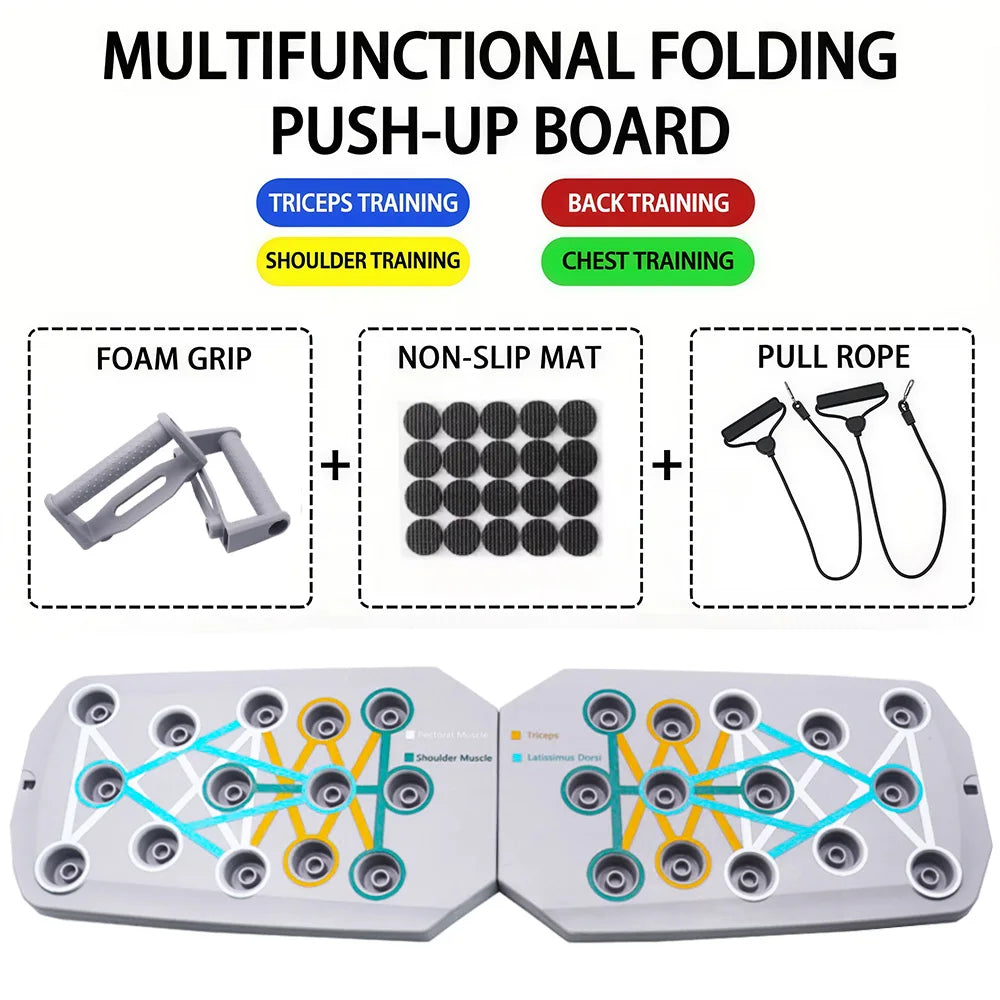
The Push-Up Board Set for Full Upper Body Strength Training is one example of portable home exercise equipment designed to support different push-up hand positions and variations. Its padded non-slip handles and portable design make it an option for home workouts or travel where space is limited.
For beginners, the board can complement a routine that also includes pulling exercises, shoulder movements, arm exercises, and grip training. It should not replace a balanced upper-body program.
Explore other practical options through the lifestyle equipment collection if you are building a compact exercise setup for home use.
Common Upper-Body Training Mistakes and Safety Tips
Targeting muscles effectively requires consistent training and sound technique. Avoiding common errors helps you maintain control, balance your routine, and manage exercise demands.
Using Momentum Instead of Controlled Muscle Contractions
Swinging weights, bouncing during repetitions, or rushing movements can make it difficult to control resistance and maintain the intended movement pattern. Use a steady pace, particularly during curls, lateral raises, and pressing exercises.
Neglecting Pulling Exercises and Rear Shoulders
Routines that emphasize push-ups, presses, and front-shoulder movements without enough pulling work can become unbalanced. Include rows, pulldowns, reverse flyes, and other pulling exercises to train the back and posterior shoulders.
Training Through Pain or Using Excessive Resistance
Muscular effort and fatigue are normal during training, but sharp or persistent joint pain is not something to ignore. Reduce resistance, adjust your range of motion, or stop the exercise if pain occurs. Seek guidance from a qualified healthcare professional when symptoms persist or when an injury or medical condition affects your training.
Use stable equipment, check exercise surfaces, and make sure handles, bands, weights, or other accessories are secure before starting.
Setting Realistic Upper-Body Development Expectations
Strength improvements, movement coordination, and visible muscle development do not occur at the same rate. Results depend on training consistency, exercise progression, nutrition, sleep, genetics, and recovery.
Rather than expecting a specific transformation timeline, focus on gradual improvement in exercise technique, repetitions, resistance, and overall training consistency.
Conclusion
Learning how to target upper body muscles effectively starts with understanding their functions and selecting movements that match those functions. Chest pressing, shoulder raises, back rows, biceps curls, triceps extensions, and forearm exercises each contribute to a more complete upper-body routine.
Grip orientation, elbow positioning, torso angle, range of motion, and controlled movement can influence muscle recruitment. Combine these technique principles with balanced push-and-pull training and gradual progressive overload to build a sustainable routine.
Whether you train in a gym or at home, begin with manageable resistance, prioritize comfortable technique, and build consistency. A compact setup with bodyweight exercises and optional equipment such as a multifunctional push-up board can help you practice different pressing variations while complementing a balanced upper-body workout.
Pillar Article: Multifunctional Push Up Board Set: Features, Exercises & Buying Guide