
Multifunctional Push Up Board Set: Features, Exercises & Buying Guide
Building upper-body strength at home does not require a full gym, but repeating the same floor push-ups can make workouts feel limited. A multifunctional push up board set offers a more organized way to vary hand placement, adjust exercise angles, and focus on different upper-body muscle groups. Before choosing one, it helps to understand how color-coded positions work, which exercises you can perform, how stable the handles should feel, and what components are actually included. This guide compares push-up boards with traditional push-up bars and floor push-ups to help you make a confident buying decision.
What Is a Multifunctional Push Up Board Set?
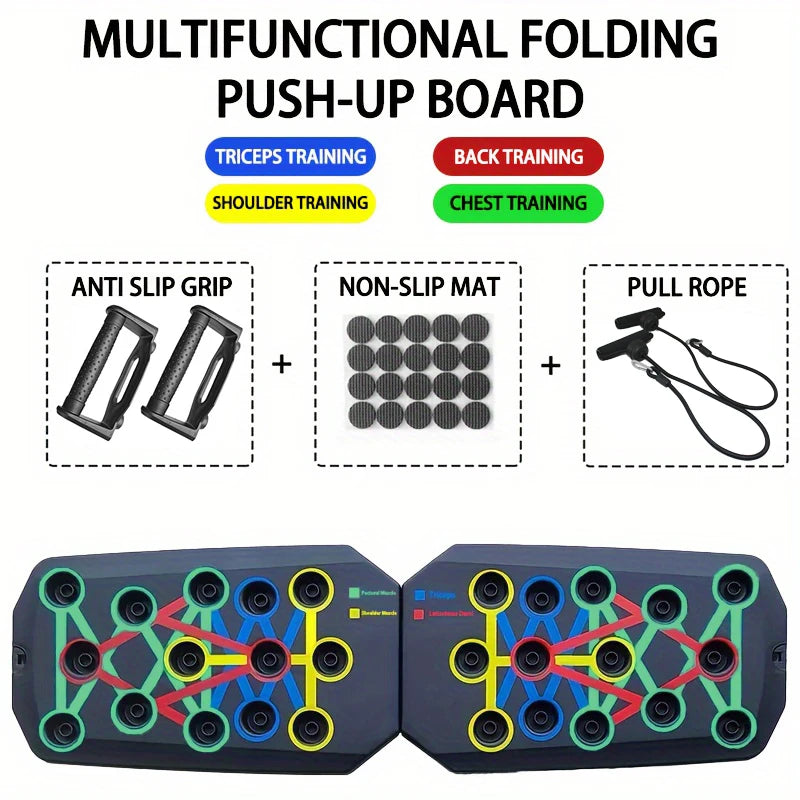
A multifunctional push up board set is a portable bodyweight training system that uses designated hand-placement positions and detachable handles to create different push-up configurations. Instead of placing your hands directly on the floor or relying on one fixed grip position, you move the handles into selected slots to change your hand spacing, exercise mechanics, and upper-body training emphasis.
For people with limited workout space, this equipment can provide a convenient alternative to purchasing several separate push-up accessories. It supports chest, shoulder, and triceps-focused movements while allowing the upper back and core to contribute to stabilization.
How the Multifunctional Push-Up Board Works
The board contains designated slots where detachable handles can be positioned. Each configuration changes the distance and angle between your hands, influencing how your shoulders, elbows, and upper-body muscles work during a push-up.
The basic process is straightforward:
- Place the board on a stable, level workout surface.
- Identify the appropriate hand-placement positions for your intended exercise.
- Insert the handles into their designated slots and make sure they are securely connected.
- Position your hands comfortably on the padded grips.
- Assume a controlled push-up position and perform repetitions with consistent technique.
What Makes It Different From a Standard Push-Up Board?
Not every push-up board offers the same functionality. Some provide simple raised handles, while multifunctional models use multiple positioning slots, color-coded guidance, and interchangeable configurations.
The main advantage is exercise organization. Rather than guessing where to place your hands, you can use the board's marked positions as a visual reference for repeating different upper-body variations.
The LINGPENG Push-Up Board Set for Full Upper Body Strength Training follows this approach with multiple exercise positions, padded non-slip handles, and a portable design intended for home and travel workouts.
If you want to evaluate the actual configuration before choosing your equipment, explore the multifunctional push-up board set and review its available product photographs and specifications.
Key Features of a Multifunctional Push Up Board Set
When comparing push-up training systems, focus on features that directly affect comfort, exercise variety, stability, and convenience. Attractive colors alone do not make a board effective; its construction and usability matter just as much.
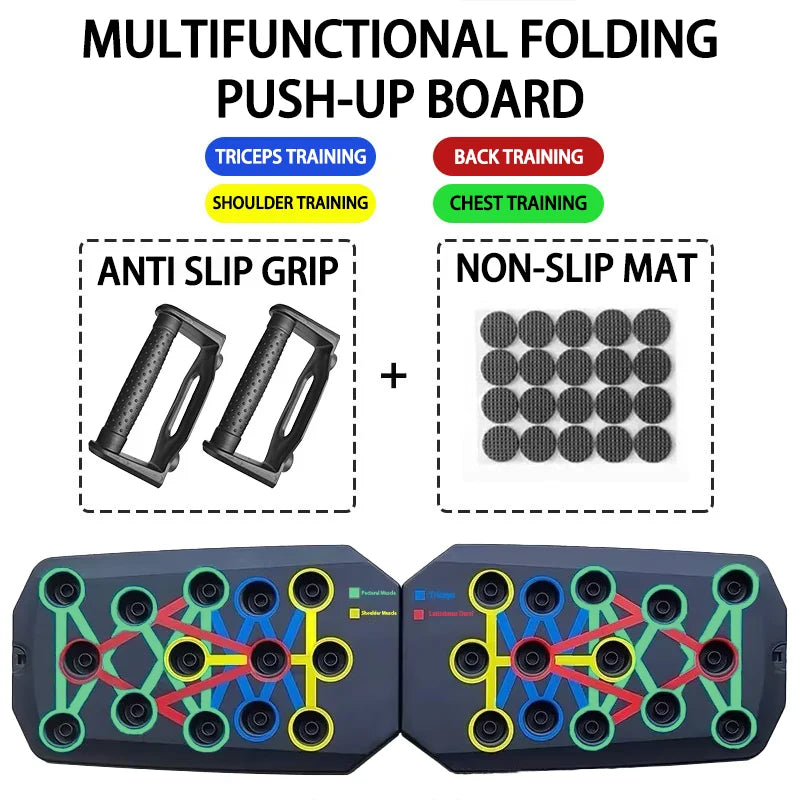
Color-Coded Hand Positioning System
Color-coded slots help users identify different hand-placement configurations. Depending on the manufacturer's design, specific positions may be associated with chest, shoulders, triceps, or other upper-body training emphasis.
Common push-up positioning principles include:
- Chest emphasis: A moderately wide hand position can increase the contribution of the pectoralis major.
- Triceps emphasis: A narrower hand position generally increases the demand on the triceps brachii.
- Shoulder emphasis: Appropriate hand positioning and body angles can increase anterior deltoid involvement.
- Stabilization: Different configurations challenge the muscles responsible for controlling the shoulders, trunk, and shoulder blades.
Color conventions are manufacturer-specific. Do not assume that a particular color always represents the same muscle group across different brands. Check the actual board's markings and instructions before exercising.
Detachable Push-Up Handles and Grip Design
Handles are one of the most important components to evaluate because they support your body weight during exercise. A comfortable grip can make repeated movements easier to manage, particularly during longer training sessions.
Look for:
- Padded grips that feel comfortable against your palms.
- Non-slip surfaces that help maintain hand contact.
- Secure attachment points that do not loosen during movement.
- Handle spacing that allows comfortable shoulder and wrist positioning.
- Connections that can be inspected easily before each workout.
Elevated handles may also provide an alternative to placing your palms flat on the floor. However, they do not automatically eliminate wrist discomfort or make every push-up variation suitable for everyone.
Multiple Exercise Configurations
One of the strongest reasons to choose a multifunctional board is the ability to change exercise configurations without purchasing several separate accessories.
Depending on the available positions, users can experiment with standard, narrow-grip, wider-grip, and shoulder-emphasis push-up variations. These changes help create a more structured workout and reduce dependence on a single repetitive movement.
Durable Construction and Board Stability
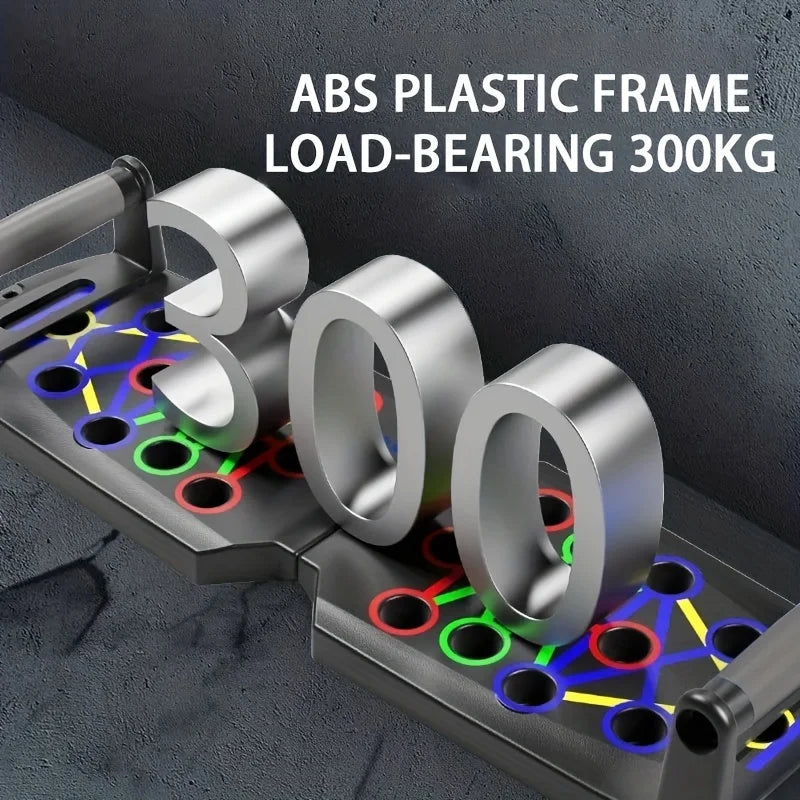
Board stability is essential because the equipment must remain secure while supporting dynamic bodyweight movements. A board that shifts, flexes excessively, or has poorly connected handles can interfere with exercise technique and increase the risk of losing balance.
Before buying, inspect the following:
- The structural design of the main board.
- The fit between the handles and positioning slots.
- The quality of connection points and locking mechanisms.
- The presence of anti-slip contact surfaces.
- The manufacturer's stated maximum load capacity, if provided.
The LINGPENG product description identifies padded, non-slip handles but does not specify the board's material, dimensions, structural reinforcement, or maximum weight capacity. These details should be confirmed with the seller rather than assumed.
Compact Storage and Portable Design
Storage convenience is particularly important for people exercising in apartments, bedrooms, or shared living spaces. A portable push-up board can be easier to organize than several individual training accessories.
Detachable handles also make it possible to separate components when storing or transporting the equipment. Before purchasing, consider the assembled footprint, disassembled dimensions, and whether all components can be kept together.
Pros: Multiple hand positions, convenient exercise variation, padded grips, portable construction, and straightforward assembly.
Cons: The board still requires adequate floor space, color conventions vary, and important specifications such as material and weight capacity may need confirmation. It also focuses primarily on pushing movements rather than providing a complete strength-training solution.
To compare the actual handle design and positioning options, take a closer look at the portable multifunctional push-up training system.
What Muscles Can You Target With a Multifunctional Push-Up Board?
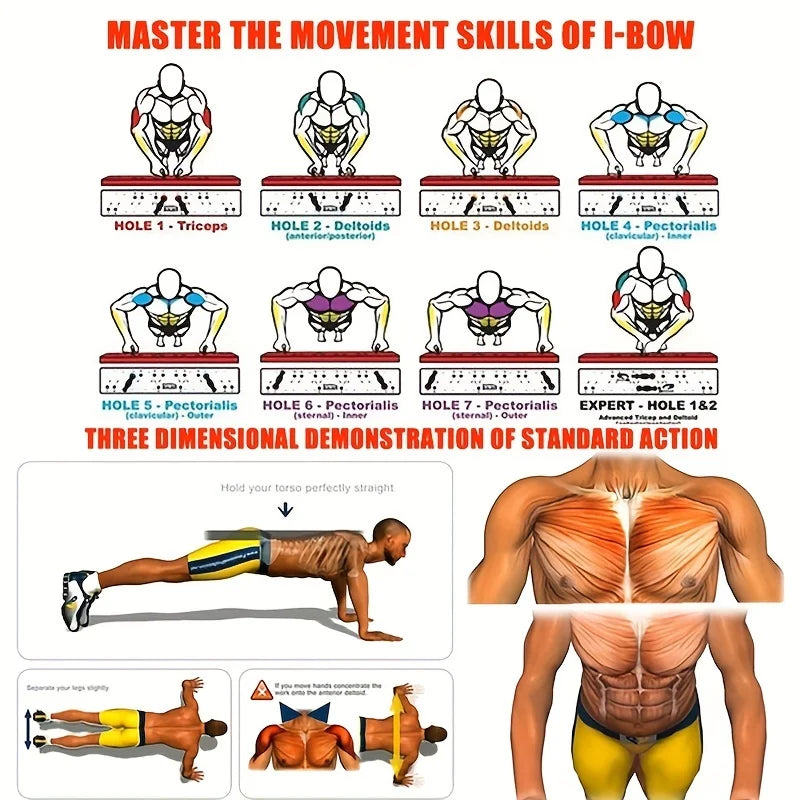
A multifunctional push-up board primarily supports upper-body pushing exercises. The main muscles involved include the pectoralis major, triceps brachii, and anterior deltoids. The abdominal muscles and shoulder stabilizers also help maintain proper body alignment throughout each repetition.
Chest-Focused Positions: Pectoralis Major
The pectoralis major is the large chest muscle responsible for movements that bring the upper arm across the front of the body. During push-ups, it contributes to horizontal shoulder adduction and helps move the body away from the floor.
A moderately wide hand position can increase the emphasis on the chest compared with narrower variations. However, the triceps and shoulders remain involved because push-ups are compound exercises rather than isolated chest movements.
Triceps-Focused Positions: Triceps Brachii
The triceps brachii is located along the back of the upper arm and plays a major role in extending the elbow. Narrower hand placements can increase triceps involvement during push-ups.
When performing a close-grip variation, keep your elbows controlled rather than allowing them to flare excessively. If the movement feels too difficult, reduce your repetitions or use an easier push-up modification.
Shoulder-Focused Positions: Deltoid Muscles
The anterior deltoids, located at the front of the shoulders, contribute to pushing movements. Certain hand positions and body angles can increase their involvement.
Choose a configuration that allows your shoulders to move comfortably. Avoid forcing your hands into an uncomfortable position simply because it is marked as a shoulder-focused option.
Upper-Back and Stabilizing Muscles
Although push-ups are primarily pushing exercises, the upper back contributes to shoulder-blade control and stability. Muscles such as the serratus anterior, trapezius, and other scapular stabilizers help coordinate shoulder movement.
The latissimus dorsi may contribute to upper-body stabilization, but conventional push-ups do not substantially isolate it as a pulling exercise would. For balanced upper-body development, combine push-up variations with pulling movements such as rows or resistance-band exercises.
Push-Up Board Exercises: Practical Configurations to Try
The value of a multifunctional board becomes clearer when you understand how to use its different configurations. Start with comfortable hand positions, maintain a stable trunk, and prioritize controlled repetitions instead of rushing through a high number of movements.
Standard Chest-Focused Push-Up
This variation is a practical starting point for developing upper-body pushing strength.
- Position the handles in a comfortable, moderately wide configuration.
- Place your hands on the grips and extend your legs behind you.
- Keep your head, hips, and heels aligned.
- Lower your chest toward the board while bending your elbows under control.
- Push through your hands to return to the starting position.
Keep your abdomen engaged and avoid allowing your lower back to sag. Beginners can perform the same movement with their knees on the floor.
Close-Grip Triceps Push-Up
A close-grip push-up increases the emphasis on elbow extension and triceps involvement.
- Move the handles into a narrower position if the board allows it.
- Keep your hands approximately beneath your shoulders or slightly closer, depending on comfort.
- Maintain a controlled elbow path as you lower your body.
- Push back up without locking your elbows aggressively.
Do not force an extremely narrow hand position. A comfortable variation with good alignment is more useful than an unnecessarily difficult setup.
Shoulder-Emphasis Push-Up
Selected configurations can increase shoulder involvement during pushing movements.
- Choose a hand position that allows your shoulders to move comfortably.
- Maintain a stable trunk and controlled body alignment.
- Lower your body gradually while avoiding excessive shoulder strain.
- Push back to the starting position with smooth movement.
If a full-bodyweight variation feels too demanding, use knee-supported push-ups or another easier modification.
Wide-Grip Push-Up Variation
Wide-grip push-ups change the relationship between your hands, elbows, and shoulders. They can increase chest involvement, although the actual training effect depends on individual anatomy and technique.
- Place the handles in a wider configuration.
- Position your hands symmetrically.
- Keep your body straight and lower your chest slowly.
- Push upward without allowing your shoulders to become uncomfortable.
A wider grip is not automatically better. Avoid excessive hand spacing that limits your comfortable range of motion.
Beginner-to-Intermediate Workout Example
Use the following routine as a starting framework. Adjust repetitions according to your current ability, and leave enough recovery time between sessions.
- Standard push-ups: 2 sets of 6–10 repetitions.
- Close-grip push-ups: 2 sets of 5–8 repetitions.
- Wide-grip push-ups: 2 sets of 6–8 repetitions.
- Shoulder-emphasis push-ups: 1–2 sets of 5–8 repetitions.
Rest approximately 60–120 seconds between sets, extending recovery when necessary. Start with fewer exercises if you are new to strength training.
Once you can complete the routine with controlled technique, gradually increase repetitions or sets. Allow adequate recovery between demanding upper-body sessions, and stop if you experience sharp pain, dizziness, or unusual discomfort.
What Is Included in a Multifunctional Push Up Board Set?
Package contents are an important purchasing consideration because multifunctional push-up products can vary considerably. Some include only a board and detachable handles, while other models may bundle resistance bands, additional grips, or workout accessories.
Standard Board and Detachable Handle Components
The confirmed product description for the LINGPENG multifunctional push-up board identifies the following characteristics:
- A multifunctional push-up board.
- Multiple color-coded exercise positions.
- Padded, non-slip handles.
- A portable design intended for convenient assembly and storage.
Optional Accessories and Their Functions
Some multifunctional push-up systems offer additional equipment such as resistance bands, training attachments, or exercise guides. These accessories can expand workout options, but they should never be assumed to come with every board.
For example, resistance bands can support pulling and accessory movements that complement push-up training. However, the supplied product information does not confirm that resistance bands or other additional accessories are included with this particular LINGPENG set.
Pre-Purchase Package Checklist
Before placing an order, use this checklist to distinguish confirmed features from details requiring verification:
- Confirmed: Multifunctional push-up board design.
- Confirmed: Color-coded exercise positions.
- Confirmed: Padded, non-slip handles.
- Confirmed: Portable and easy-to-assemble design.
- Not specified: Resistance bands or additional accessories.
- Not specified: Maximum supported user weight.
- Not specified: Board dimensions and material composition.
- Not specified: Warranty and return conditions.
Check the current product listing for the exact package configuration before purchasing. You can review the LINGPENG push-up board product details to examine the available images and confirm the components offered.
Multifunctional Push-Up Board vs. Push-Up Bars vs. Floor Push-Ups
Choosing between a multifunctional board, traditional push-up bars, and standard floor push-ups depends on how much exercise variety and equipment organization you want.
Feature-by-Feature Equipment Comparison
| Feature | Multifunctional Push-Up Board | Traditional Push-Up Bars | Floor Push-Ups |
| Exercise variety | Multiple marked hand positions | Varies with bar placement | Varies with hand placement |
| Hand-position guidance | Color-coded slots | Manual positioning | Manual positioning |
| Portability | Portable board and detachable handles | Usually compact and portable | No equipment needed |
| Storage | Requires space for the board and components | Generally easy to store | No storage required |
| Setup | Handles must be placed in the correct slots | Bars must be positioned securely | None |
| Grip elevation | Yes, through raised handles | Yes | No |
| Accessory compatibility | Depends on the specific model | Depends on the product | Not applicable |
Which Push-Up Equipment Is Best for Your Workout?
Choose a multifunctional push-up board if:
- You want visual guidance for different hand-placement configurations.
- You prefer having multiple positions organized on one board.
- You want portable equipment for home strength training.
- You enjoy experimenting with different upper-body push-up variations.
Choose traditional push-up bars if:
- You prefer simple, independent handles.
- You want flexibility in positioning the bars manually.
- You prefer equipment that is generally smaller and easier to store.
Choose standard floor push-ups if:
- You want a completely equipment-free workout.
- You are comfortable determining your own hand placement.
- You prefer a minimal home exercise routine.
None of these options is universally superior. A board provides more organized positioning guidance, bars offer flexibility, and floor push-ups provide the simplest approach.
How to Choose the Best Multifunctional Push Up Board Set
Before purchasing, evaluate the specifications that affect your training experience rather than relying exclusively on product photographs or broad marketing claims.
Board Dimensions, Materials, and Weight Capacity
Check the board's length, width, assembled footprint, and overall construction. These measurements determine whether it fits your available workout area and accommodates your preferred hand positions.
Material information is equally important. Look for clear manufacturer descriptions of the board material and structural design. Always check the stated maximum weight capacity before using the equipment.
Handle Stability, Grip Comfort, and Safety
Handle stability should be a priority. Before purchasing, look for close-up images of the attachment points and information about how the handles connect to the board.
When the equipment arrives, inspect every connection before exercising. The handles should fit securely without unexpected movement or looseness.
The LINGPENG set is described as having padded, non-slip handles. These are useful comfort-oriented features, but they do not replace checking the actual handle connections and overall structural integrity.
Floor Compatibility and Anti-Slip Performance
The surface beneath your board can affect stability. Smooth flooring, uneven surfaces, and loose rugs may create unwanted movement during exercise.
For safer use:
- Place the board on a clean, level surface.
- Avoid loose rugs and unstable flooring.
- Check the contact points before starting.
- Test the handles with light pressure before supporting your full body weight.
- Stop exercising if the board shifts or a handle becomes loose.
Beginner Suitability and Exercise Limitations
A multifunctional push-up board can be suitable for beginners because it offers different hand-placement options and a structured way to practice upper-body movements.
However, the board does not automatically reduce exercise difficulty. Beginners should consider:
- Starting with knee-supported push-ups.
- Using comfortable, moderate hand positions.
- Performing fewer repetitions with controlled movement.
- Increasing training volume gradually.
- Allowing adequate recovery between workouts.
It is also important to recognize the board's limitations. Push-ups primarily develop pushing strength and do not replace pulling exercises, lower-body training, cardiovascular activity, or a balanced fitness program.
Customer Reviews, Warranty, Shipping, and Returns
Product reviews can provide additional insight into everyday usability. Look for genuine customer feedback that discusses handle stability, ease of assembly, grip comfort, storage, and performance during repeated workouts.
Also verify the seller's current shipping terms, return conditions, and warranty coverage before purchasing. These details are not specified in the supplied product information and should be checked on the current store listing.
If the features and portable design match your requirements, you can view the multifunctional push-up board set and check its current availability before making your decision.
How to Store and Maintain Your Push-Up Board Set
Proper maintenance helps keep exercise equipment in usable condition and makes it easier to incorporate regular training into your routine.
Cleaning the Board and Handles After Workouts
Wipe down the board and handle grips after exercising to remove sweat and surface dirt. Use a soft cloth and a cleaning method compatible with the manufacturer's material recommendations.
Avoid harsh chemicals or excessive moisture unless the manufacturer specifically approves them. Allow all components to dry before storing the equipment.
Compact Storage and Component Organization
Remove detachable handles when appropriate and keep them together with the board. Store the equipment in a dry location away from excessive heat, moisture, or heavy objects that could damage its components.
Organizing the components after each workout also makes the next session easier to prepare.
Routine Inspection Before Use
Make a quick equipment check part of your workout preparation:
- Look for cracks, deformation, or visible damage.
- Check that handles fit securely into their slots.
- Inspect the grip padding for wear or separation.
- Check the board's contact points for damaged or missing anti-slip components.
- Confirm that the board remains stable on the selected floor surface.
Do not use the equipment if structural damage or unstable connections are present.
Frequently Asked Questions
Is a Multifunctional Push Up Board Set Suitable for Beginners?
Yes. Beginners can use a multifunctional push-up board to practice different hand positions and gradually develop upper-body strength. Start with knee-supported push-ups, manageable repetitions, and comfortable configurations before progressing to more demanding variations.
What Muscles Does a Multifunctional Push Up Board Target?
It primarily supports exercises involving the pectoralis major, triceps brachii, and deltoid muscles. The core and shoulder stabilizers also contribute to maintaining proper body alignment during push-ups.
How Do You Use the Different Color-Coded Hand Positions?
Insert the detachable handles into the designated slots corresponding to your chosen exercise configuration. Different positions change hand spacing and upper-body movement emphasis. Color meanings vary by manufacturer, so follow the markings and instructions supplied with your particular board.
What Accessories Are Typically Included?
A multifunctional push-up board generally includes the main board and compatible handles. Some models may offer resistance bands or additional attachments, but these are model-dependent. Check the actual product package description to confirm what is included.
How Do You Store and Maintain a Multifunctional Push-Up Board?
Detach and organize the handles when appropriate, wipe down the board and grips after workouts, and store everything in a dry location. Inspect the board, handle connections, and anti-slip components regularly before exercising.
Final Verdict: Is a Multifunctional Push-Up Board Set Worth Buying?
A multifunctional push-up board set is worth considering if you want a more organized approach to upper-body bodyweight training without purchasing several separate push-up accessories. Its biggest advantage is the combination of multiple hand-placement configurations, color-coded guidance, and portable exercise equipment in one system.
Compared with traditional push-up bars, a board provides more structured positioning. Compared with floor push-ups, it offers additional equipment-assisted exercise variety and elevated grips. However, these benefits are most valuable when you actually use the different configurations and maintain consistent exercise technique.
The LINGPENG multifunctional push-up board set offers several practical features, including multiple color-coded positions, padded non-slip handles, and a portable design. Its material, dimensions, maximum load capacity, and complete accessory package should be verified before purchasing.
For shoppers looking to make home upper-body training more varied and convenient, this product is a practical option to investigate.
Explore the Push-Up Board Set for Full Upper Body Strength Training to review the product configuration and decide whether it fits your home workout needs.
For more equipment ideas and personal-care products, explore KentDO's Lifestyle collection.
Related Articles:
- How to Target Upper Body Muscles: Exercises, Form & Techniques
- Push Up Hand Placement Guide: Find the Right Position for Better Form
- How to Use a Push Up Board: 8 Exercises for Beginners
- 10 Best Push Up Board Exercises for Beginners to Build Upper Body Strength
- Push Up Board with Handles: 7 Best Options Compared for Grip Comfort and Stability (2026)
- Best Portable Push Up Board Set: 7 Travel-Friendly Picks for 2026
- Upper Body Strength Training at Home: Complete 20–30 Minute Workout Plan
- Chest Workout Without Gym Equipment: 10 Effective Bodyweight Exercises
- Affordable Home Push-Up Training Equipment: 5 Types Compared